
Cognitive & Aging · Self-reflection
Dementia Test: a checklist of changes in memory and thinking
Fourteen questions about memory, language, judgement and everyday tasks — answerable about yourself or about someone you care for. The result is a written description of what has changed, to take to a doctor. It cannot diagnose dementia or rule it out.
This checklist records how much has changed. It cannot diagnose dementia, rule it out, or convert a total into a likelihood, and a low total is not reassurance.
-
THE FORMAT14 questionsRate how much each change has been present, from “Not at all” to “A lot”.
-
WHO IT IS FORYou or a relativeThe items describe symptoms, so a family member can answer them about someone else.
-
WHAT YOU GETNotes for a doctorA structured summary of change over time. No score here is a diagnosis.
The self-check
Take the memory and thinking checklist
Answer about change from how things used to be, thinking of roughly the last six to twelve months. If you are answering about someone else, rate what you have actually observed. There are no right answers, and this checklist has not been established as a diagnostic measure.
Your result
What the answer ranges mean
- 0–5 Few changes reported
- 6–14 Some changes reported
- 15–27 Many changes reported
- 28–42 Major changes reported
This checklist records how much has changed. It cannot diagnose dementia, rule it out, or convert a total into a likelihood, and a low total is not reassurance.
A checklist length, not a diagnostic threshold.
The short answer
What is dementia, and how is it different from Alzheimer’s?
Dementia is not a single disease but a syndrome — a group of related symptoms involving decline in memory, thinking, language, judgement and everyday functioning, caused by one of several underlying diseases that damage the brain. Alzheimer’s disease is the most common of those causes, which is why the two words get confused, but they are not interchangeable: dementia is the pattern of symptoms, and Alzheimer’s is one disease that produces it.
What separates dementia from ordinary forgetfulness in later life is not whether memory slips happen, but whether thinking has changed enough to interfere with daily life. The National Institute on Aging defines dementia as loss of cognitive functioning “to such an extent that it interferes with a person’s daily life and activities”, and draws the contrast concretely: normal ageing looks like “losing things from time to time”, while dementia looks like “misplacing things often and being unable to find them”. Dementia is also not only about memory — the NHS notes it can affect the way a person speaks, thinks, feels and behaves, and the World Health Organization points out that changes in mood and behaviour sometimes appear before memory problems do. Neither ageing nor dementia is the only explanation, which is why a clinician’s first job is to “assess whether a person has an underlying, potentially treatable, condition”. A checklist can describe a pattern of change; it cannot tell you what is causing it.
Every person with Alzheimer’s disease has dementia symptoms, but not everyone with dementia has Alzheimer’s. Vascular dementia, dementia with Lewy bodies and frontotemporal dementia are separate causes, and mixed forms are common.
57 million people were living with dementia worldwide in 2021, with nearly 10 million new cases each year — and although it becomes more common with age, the World Health Organization is explicit that dementia “is not an inevitable part of ageing”. A population figure is not a way to judge one person’s symptoms.
View sourceUnderstand the themes
The fourteen changes this checklist asks about
The items group into six themes. Each one asks about a change from how things used to be, not about a single bad day.
Remembering recent things
Forgetting recent conversations or events, and asking the same questions repeatedly. Recent memory tends to be affected earlier than memory for the distant past.
Losing track of time and place
Losing track of the date, month or season, or becoming lost somewhere that used to be familiar. The NHS lists disorientation among the common symptoms across types of dementia.
Following steps and handling money
Difficulty following a recipe or a set of directions, or trouble managing bills and money. These are practical tasks that draw on planning and sequencing.
Language and words
Trouble understanding what people say, or using unusual words for familiar objects. Changes in finding words can appear well before a person struggles with memory.
Judgement and decisions
Making poor decisions more often than before, or acting on impulse. The contrast that matters is frequency: the National Institute on Aging distinguishes “making a bad decision once in a while” from doing so “a lot of the time”.
Interest, personality and self-care
Losing interest in daily activities, changes in personality, or not keeping up with washing and self-care. The World Health Organization notes mood and behaviour changes can come before memory problems.
Distinctions that change what a result means
Read these differences before treating any total as an explanation. Each row is a question a clinician would separate out.
| The question | What points one way | What this checklist cannot settle |
|---|---|---|
| Is this normal ageing? | The National Institute on Aging calls occasional forgetfulness “often a normal part of aging”, while stating that “dementia is not a normal part of aging”. Frequency and consequence are what separate them. | Where your own experience sits on that line. The checklist records how much has changed, not whether it has crossed a clinical threshold. |
| Dementia, or Alzheimer’s disease? | Dementia is the syndrome; Alzheimer’s is the commonest disease causing it. The WHO attributes 60–70% of cases to Alzheimer’s; the Alzheimer’s Association puts it at 60–80%. | Which underlying cause is involved. Distinguishing causes needs examination, blood tests and often imaging. |
| Could this be mild cognitive impairment? | In MCI, thinking problems are measurable but, as the NIA puts it, people “are still able to take care of themselves and do their normal daily activities”. It is not early dementia by definition and can stay stable or improve. | Any of these categories. MCI is defined partly by formal testing, which this checklist is not. |
| Did this come on suddenly? | Confusion developing over hours or days can be delirium — the NHS describes “sudden confusion (delirium) caused by a medical condition, such as an infection”. That is urgent and treatable. | Nothing, in that situation. Sudden confusion needs same-day medical care rather than a questionnaire. |
Interpretation and context
How should you read your result?
Read the total as a description of how much has changed, then read your individual answers for the detail that actually helps a clinician.
- 01 01
Change matters more than the level
A doctor is interested in the direction of travel. Two people can score the same while one has always been forgetful and the other has changed sharply in six months — and those are different situations.
- 02 02
The threshold is effect on daily life
Dementia is defined by cognitive decline severe enough to interfere with daily activities. That is why the items about bills, recipes, directions and self-care carry as much weight as the memory items.
- 03 03
Other explanations come first
The NIA describes clinicians first assessing “whether a person has an underlying, potentially treatable, condition that may relate to cognitive difficulties”. A high total is a reason to start that process, not a conclusion about its outcome.
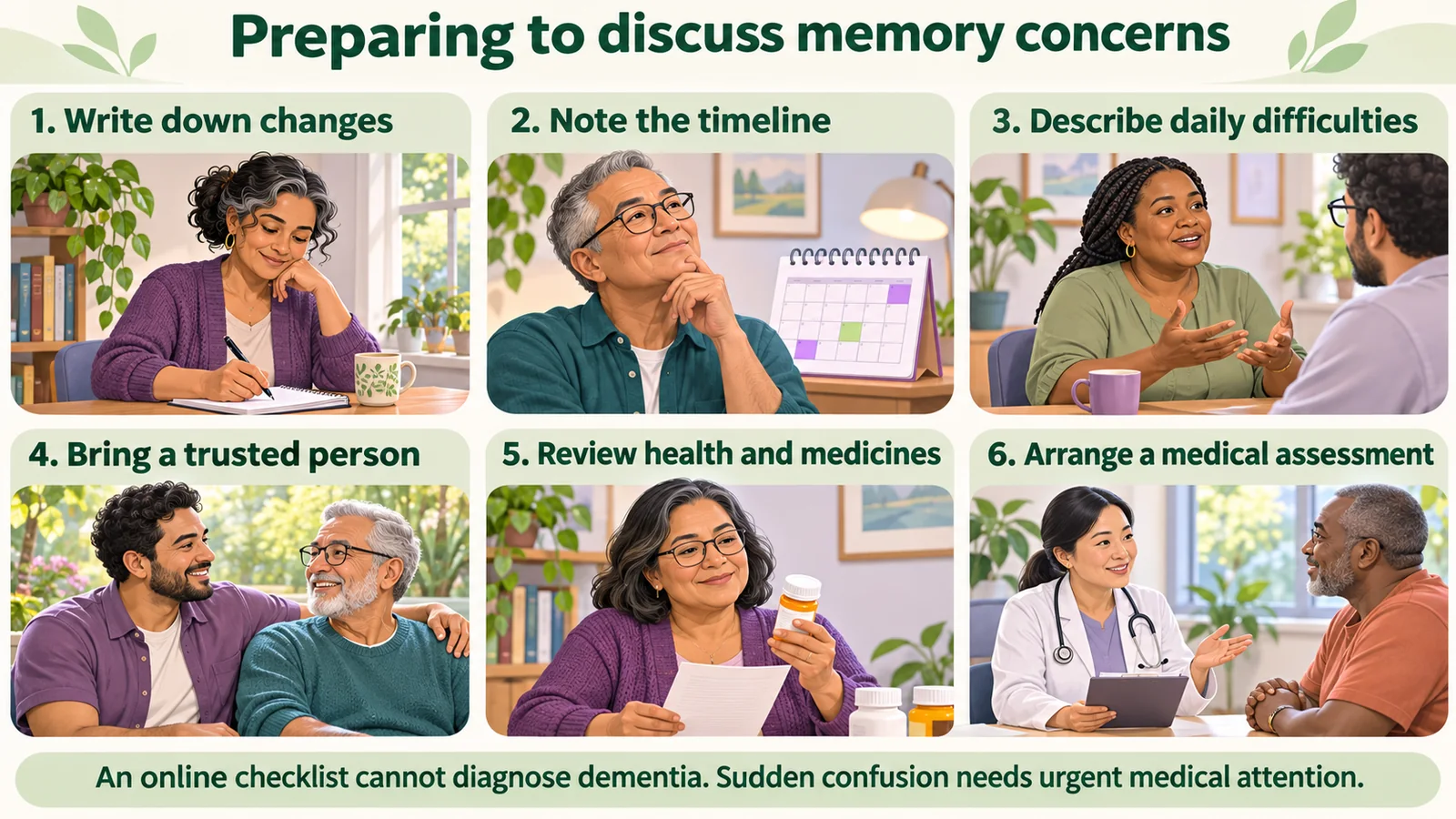
The Alzheimer’s Association is blunt about tests like this one: of home screening tests for dementia it says “none of these tests have been scientifically proven to be accurate” and they “cannot and should not be used as a substitute for a thorough examination by a skilled doctor”, warning that they can produce false positives. We agree, which is why this page gives you a written description to take to an appointment and no verdict of its own. The NHS adds that test scores can be influenced by a person’s level of education — in both directions.
Context matters
What else could explain these changes?
Many conditions produce changes that look like dementia, and several of them are treatable. This is the single most important reason not to read a high total as an answer.
Treatable medical causes
The National Institute on Aging lists “tumors, vitamin deficiencies, medication side effects, or problems with the thyroid, kidney, or liver” among conditions that can cause serious memory problems resembling dementia, and states that some causes “can be halted or even reversed with treatment”. The NHS routinely checks thyroid function, vitamin B12 and folate for exactly this reason.
Mood, sleep and stress
The NHS lists depression and anxiety among the conditions that can explain memory problems. Poor sleep and major stressful events also affect concentration and recall. If low mood or sleep is part of the picture, the Clinical Depression Test and the Insomnia Test may be more relevant starting points than this one.
A lifelong pattern, or a new one
Difficulty with attention and organisation that has been present since childhood is a different question from a recent change, and the ADHD Test covers it. Separately, the WHO lists hearing and vision loss among the risk factors for developing dementia, so uncorrected sensory problems are worth raising with a doctor in their own right.
Useful support
Where to get real answers and support
A checklist cannot answer this question. These are the routes that can, and the people who will talk to you while you wait.
- 01 / FIRST STEP
A GP or primary care appointment
The NHS is clear that “there’s no single test for dementia” and a diagnosis rests on a combination of assessments: how symptoms developed, a medication review, a physical examination, a cognitive assessment and blood tests covering liver, kidney and thyroid function, HbA1c, vitamin B12 and folate. A referral to a memory clinic may follow.
- 02 / TALK TO SOMEONE
Helplines that take carers seriously
In the United States the Alzheimer’s Association runs a free Helpline on 800.272.3900, “available around the clock, 365 days a year”, with interpretation in more than 200 languages; its staff “do not provide professional medical advice, diagnosis or treatment”. In the UK, Dementia UK’s Admiral Nurse Dementia Helpline is 0800 888 6678, Monday to Friday 9am–9pm and weekends 9am–5pm.
- 03 / OUTSIDE THE US AND UK
A national dementia association
Alzheimer’s Disease International works with “Alzheimer and dementia associations in over 100 countries” and can point you to the one where you live. The WHO also publishes iSupport, a self-help programme for carers.
Clinical guidance: NHS, tests for diagnosing dementia. These options are educational suggestions, not a treatment plan, and no result here should change anyone’s medication.
Practical next steps
Turn your answers into a useful appointment
The useful output of this checklist is not the number. It is the notes you make while answering it.
- 01
Add an example to every high answer
For each item you rated “Quite a bit” or “A lot”, write one concrete instance and roughly when it started. A specific example is something a clinician can work with; a total is not.
- 02
Book the appointment, and go together
If you are worried about someone else, the NHS advises you “encourage them to make an appointment with a GP and perhaps suggest that you go with them” — partly so you can describe what you have seen, partly to help them recall what was discussed afterwards.
- 03
Ask what else is being ruled out
It is reasonable to ask directly whether thyroid function, vitamin B12, medication effects, mood and sleep have been considered. The NHS notes that 1 in 4 people wait two years before seeking help, and that where dementia is found early its progress can sometimes be slowed.
If you or the person you are concerned about is in immediate danger, call your local emergency number now — 911 in the US, 999 in the UK. Dementia UK’s guidance is explicit: if someone living with dementia is in immediate danger, “please call 999 straight away”. Confusion that comes on suddenly over hours or days can be a medical emergency such as delirium and needs same-day care, not a checklist. If caring for someone has left you unable to cope, findahelpline.com lists free, confidential helplines in over 175 countries.
Good questions to ask
Dementia checklist FAQs
Direct answers on the format, the limits and what to do with your result.
Dementia is not a disease in itself. The NHS describes it as “a syndrome (a group of related symptoms) associated with an ongoing decline of brain functioning”, and the Alzheimer’s Association calls it an umbrella term. Alzheimer’s disease is the most common of the underlying diseases that cause those symptoms — the World Health Organization says it “may contribute to 60–70% of cases” — alongside vascular dementia, dementia with Lewy bodies and frontotemporal dementia. Everyone with Alzheimer’s has dementia symptoms; not everyone with dementia has Alzheimer’s.
There are 14 items, each scored from 0 for “Not at all” to 3 for “A lot”, giving a total between 0 and 42. If you came looking for a 15-question, 10-question or 30-question dementia test, those numbers refer to other checklists circulating online and we cannot vouch for any of them. What matters more than the length is that no questionnaire diagnoses dementia: the NHS states plainly that “there’s no single test for dementia”.
Not in the sense of a quiz with right and wrong answers. This checklist has no answer key, because it does not test knowledge — it records how much particular symptoms have changed, and only the person answering knows that. The cognitive tests clinicians use, such as the General Practitioner Assessment of Cognition mentioned by the NHS, are administered and interpreted by a professional, and even then “cannot diagnose dementia”. The genuinely portable thing is your own written list of examples and dates.
Some forgetfulness is expected with age. The National Institute on Aging describes such changes as “often a normal part of aging” while stating that “dementia is not a normal part of aging”. Its contrast is about frequency and consequence rather than the slip itself: normal ageing is “losing things from time to time”, dementia is “misplacing things often and being unable to find them”. The practical dividing line is whether thinking has changed enough to interfere with everyday life.
Yes. The items describe symptoms, so they can be answered about someone else, and what you have noticed genuinely matters. Clinicians actively seek it out: the National Institute on Aging describes doctors asking “the person experiencing symptoms, as well as a family member or friend” about daily activities and changes in behaviour and personality, and the NHS advises that “if possible, someone who knows you well should be with you at your GP appointment, so they can describe any changes”. Answer about how the person has changed, and note one concrete example per high answer.
No. A high total means you have described a noticeable pattern of change worth discussing with a doctor, and nothing more. The NHS states that “memory problems do not necessarily mean you have dementia”, and the Alzheimer’s Association warns that home screening tests “can have false-positive results, meaning that individuals can have results saying they have dementia when in fact they do not”. Several causes of these symptoms are treatable.
A great deal. The National Institute on Aging lists “tumors, vitamin deficiencies, medication side effects, or problems with the thyroid, kidney, or liver” among conditions causing memory problems that resemble dementia, and the NHS adds depression and anxiety, an underactive thyroid, side effects of some medicines, and sudden confusion from an infection. That is why a doctor’s first step is to rule those out. Confusion appearing suddenly over hours or days needs same-day medical attention.
Several things together, not one test. The NHS says a diagnosis “is based on a combination of assessments and tests”: a history of how symptoms developed and whether they affect daily life, a review of current medicines, a physical examination, a cognitive assessment, and blood tests covering liver, kidney and thyroid function, HbA1c, and vitamin B12 and folate. A brain scan may follow, and a GP may refer on to a memory clinic. The NHS also cautions that test scores can be influenced by level of education.
Save or print your answers, add one specific example and an approximate start date for each symptom you rated “Quite a bit” or “A lot”, and book a GP or primary care appointment. If you are completing this about someone else, the NHS suggests you “encourage them to make an appointment with a GP and perhaps suggest that you go with them”. An early answer is worth having either way: the NHS notes that where dementia is found early its progress can sometimes be slowed, and where the cause is something else, it may be treatable.
Editorial transparency
Sources and review information
Prepared by the PsyMed Editorial Team. This is an educational page, not a clinical assessment, and no licensed clinical reviewer is claimed. Sources checked: November 16, 2026. The stored questions, answer labels, weights and score ranges are preserved from the existing test; this redesign does not establish validation. Read how we build our tests and who we are.
References
- World Health Organization. Dementia fact sheet (updated 26 October 2026)
- National Institute on Aging. What Is Dementia? Symptoms, Types, and Diagnosis
- National Institute on Aging. Memory Problems, Forgetfulness, and Aging
- National Institute on Aging. What Is Mild Cognitive Impairment?
- NHS. Tests for diagnosing dementia
- NHS. Worried someone has dementia?
- Alzheimer’s Association. Medical Tests for Diagnosing Alzheimer’s and Dementia
- Alzheimer’s Association. Dementia vs. Alzheimer’s Disease: What Is the Difference?
One useful observation
Write down what changed. Let a doctor work out why.
The most useful thing on this page is not the total. It is the list of specific changes, with dates, that you can hand to a clinician who is able to find out why.
Take the self-check