
IQ Test: Free Practice Quiz & IQ Scores Explained
A 30-item practice quiz of reasoning, pattern and sequence puzzles, with a plain explanation of what IQ scores actually mean. Not a real IQ measurement: only a professionally administered test can give that.
Published Updated
If you’re looking for your IQ, start with a truth most “free IQ test” sites won’t tell you: a real IQ score can’t come from a quick online quiz. Genuine IQ testing means working through standardized tasks scored against a large, age-matched reference population — something only a professionally administered test can do. Any site that hands you an “IQ of 128” after a few questions is, at best, entertainment, and often a setup to sell you a “certificate.”
So this page is honest on both counts. Below you’ll find a free 30-question IQ practice quiz — real reasoning questions, actually scored, so you can test yourself and see how you do. But to be completely clear: it reports how many questions you got right, not an IQ number, because no online quiz has the norming data to produce a valid IQ. Alongside it, this page explains what IQ scores actually mean, how the real tests work, and how to get a legitimate assessment if you want one.
What Is IQ?
IQ, or “intelligence quotient,” is a score from a standardized test designed to measure a set of reasoning and problem-solving abilities that psychologists group under general cognitive ability (often called “g”). Modern IQ tests sample abilities like verbal comprehension, logical and abstract reasoning, working memory, visual-spatial processing, and processing speed, and combine them into a single overall score.
The crucial thing is how that score is built. Modern IQ tests are standardized so the population average is exactly 100, with a standard deviation of 15 points. This isn’t a natural fact about intelligence — it’s a design choice. Test-makers give the test to a large representative sample, then scale everyone’s raw performance so the mean lands at 100. Your IQ score is really a statement about where you fall relative to other people your age, not a count of correct answers. Because of that design, roughly 68% of people score between 85 and 115, about 95% between 70 and 130, and only about 2% above 130 or below 70.
IQ Score Ranges and What They Mean
Here’s how scores are typically classified on the Wechsler scale (the WAIS, the most widely used adult IQ test), with a mean of 100 and an SD of 15. The percentile shows the share of people scoring at or below each range.
| IQ Score | Classification | Percentile (approx.) |
|---|---|---|
| 130 and above | Very Superior / Gifted | Top ~2% (98th+) |
| 120 – 129 | Superior | ~91st – 97th |
| 110 – 119 | High Average | ~75th – 90th |
| 90 – 109 | Average | ~25th – 73rd |
| 80 – 89 | Low Average | ~9th – 24th |
| 70 – 79 | Borderline | ~2nd – 8th |
| Below 70 | Extremely Low | Bottom ~2% |
A few things worth knowing. The boundaries are conventions, not hard cutoffs — there’s no meaningful difference between a 109 and a 111. “Average” isn’t an insult: about half the population scores 90–109, and the vast majority of people in every profession fall within the broad average band. And a score only means something once you know which test produced it, because different tests use different standard deviations.
What Counts as a “Good” or “High” IQ?
The honest answer is that it depends what you mean. Any score in the broad average range (85–115) is completely normal and shared by about two-thirds of people. Scores of 110–119 are above average; 120–129 (Superior) reflect clearly strong reasoning; and 130 and above (the top ~2%) is the threshold most high-IQ societies use.
Mensa, the best-known high-IQ society, requires a score in the top 2% — the 98th percentile. Because different tests use different scales, that same threshold is 130 on the Wechsler (WAIS), 132 on the Stanford-Binet, and 148 on the Cattell — all the identical percentile, expressed on scales with different standard deviations. This is exactly why comparing raw IQ numbers between tests misleads: 148 sounds far higher than 130, but on their respective scales they mean the same thing. The percentile is what matters, not the number.
Signs of High Cognitive Ability
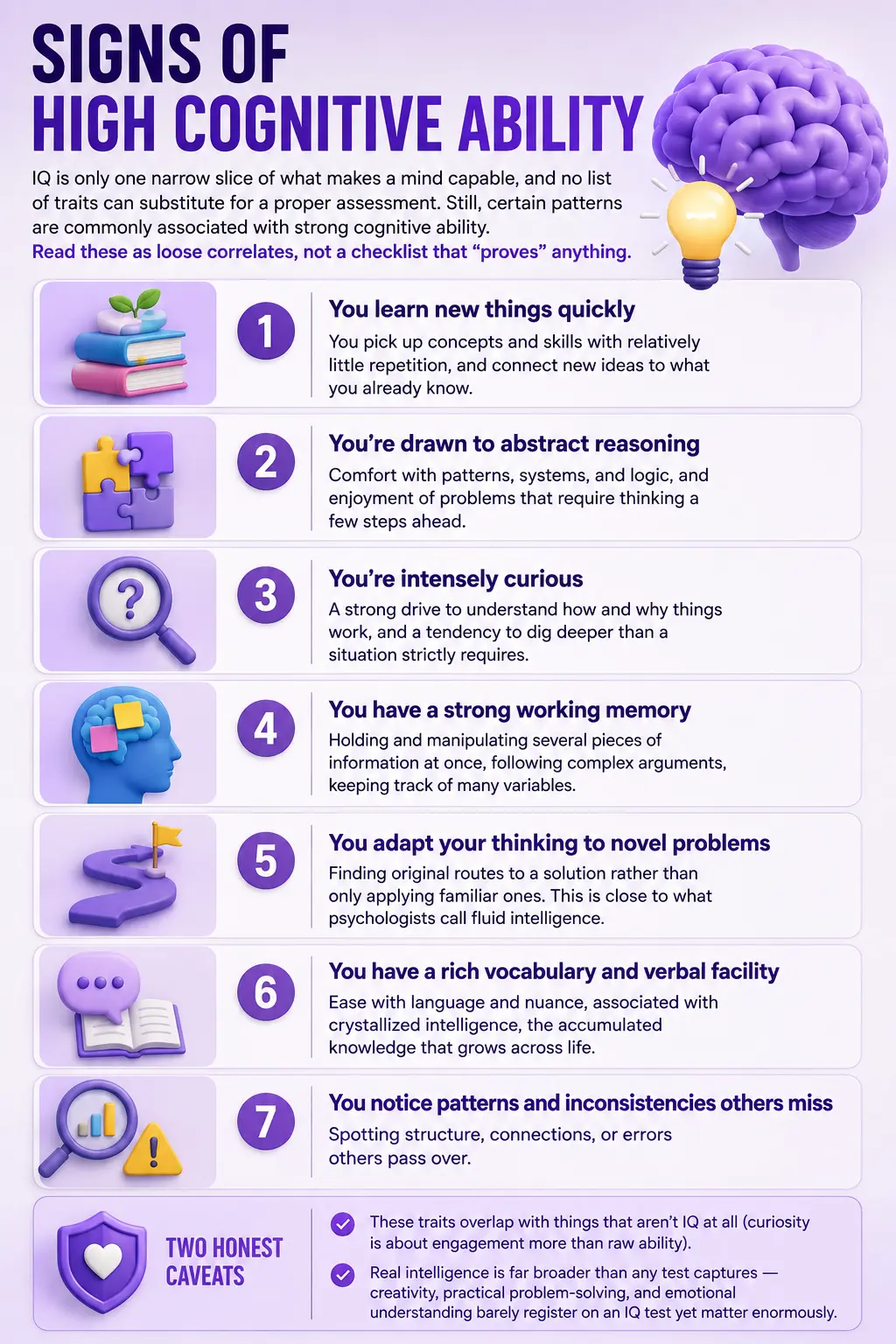
IQ is only one narrow slice of what makes a mind capable, and no list of traits can substitute for a proper assessment. Still, certain patterns are commonly associated with strong cognitive ability. Read these as loose correlates, not a checklist that “proves” anything.
-
You learn new things quickly
You pick up concepts and skills with relatively little repetition, and connect new ideas to what you already know.
-
You’re drawn to abstract reasoning
Comfort with patterns, systems, and logic, and enjoyment of problems that require thinking a few steps ahead.
-
You’re intensely curious
A strong drive to understand how and why things work, and a tendency to dig deeper than a situation strictly requires.
-
You have a strong working memory
Holding and manipulating several pieces of information at once, following complex arguments, keeping track of many variables.
-
You adapt your thinking to novel problems
Finding original routes to a solution rather than only applying familiar ones. This is close to what psychologists call fluid intelligence.
-
You have a rich vocabulary and verbal facility
Ease with language and nuance, associated with crystallized intelligence, the accumulated knowledge that grows across life.
-
You notice patterns and inconsistencies others miss
Spotting structure, connections, or errors others pass over.
Two honest caveats: these traits overlap with things that aren’t IQ at all (curiosity is about engagement more than raw ability), and real intelligence is far broader than any test captures — creativity, practical problem-solving, and emotional understanding barely register on an IQ test yet matter enormously.
How Real IQ Tests Work
Legitimate IQ testing looks nothing like a web quiz. The recognized tests are administered one-on-one by a trained, licensed psychologist over one to two hours, sampling multiple cognitive domains through a battery of subtests.
The most respected adult test is the Wechsler Adult Intelligence Scale (WAIS), now in its fifth edition, measuring verbal comprehension, visual-spatial ability, fluid reasoning, working memory, and processing speed. The Stanford-Binet Intelligence Scales (SB5) is another gold standard, and the Wechsler Intelligence Scale for Children (WISC-V) is used for children. Raven’s Progressive Matrices is a widely used nonverbal test focused on abstract reasoning, designed to reduce cultural and language bias.
These tests share features no online quiz has: they’re standardized against large representative samples, age-normed, rigorously tested for reliability and validity, and periodically renormed. That last point connects to the Flynn effect: raw cognitive performance has risen by roughly three points per decade over the last century, so tests must be re-standardized every 15–20 years to keep the average anchored at 100. A score of 100 today would have been about 115–120 on 1950s norms.
IQ also isn’t perfectly fixed. Scores can fluctuate by a few points between sessions depending on sleep, anxiety, motivation, and test familiarity. And different abilities age differently — fluid intelligence (solving novel problems) tends to peak in the mid-20s and slowly decline, while crystallized intelligence (knowledge and vocabulary) keeps rising well into later life.
Are Online IQ Tests Accurate?
Generally, no — and it’s worth being clear-eyed about this. Free online IQ tests are not equivalent to professionally administered assessments, and they range from “rough approximation” down to “outright scam.” Many are designed to give almost everyone a flatteringly high score (people rarely complain about being told they’re brilliant), and many use that inflated result as bait: take the test free, then pay to “unlock” your score or receive a “certificate.”
The reasons are structural. Online tests lack proper standardization and current norms; they can’t verify your age group or control conditions; they’re often too short to measure anything reliably; and they can’t stop you looking up answers or retaking until you like the number. This is exactly why the practice quiz below doesn’t pretend to give you an IQ number — it simply tells you how many reasoning questions you answered correctly, which is an honest thing a quiz can actually do.
Free IQ Practice Quiz (30 Questions)
Here’s a set of 30 reasoning questions in the style of real IQ-test items — number sequences, patterns, verbal analogies, odd-one-out, spatial reasoning, and logical deduction. They’re scored: you’ll get a count of how many you answered correctly, and a note on which types you did best at.
One more time, because it matters: this is a practice quiz, and your result is a number of correct answers out of 30 — not an IQ score. It’s a genuine test of some reasoning skills and a fun challenge, but turning “X out of 30” into an IQ number would require norming data no online quiz has. Take it as practice and enjoy the puzzles.
Choose the single best answer for each. No looking things up — that only cheats you out of a real read on how you did.
Understanding Your Practice Quiz Score
Your score is the number of questions you answered correctly, out of 30. Remember: this is a practice result, not an IQ score.
| Score | Level | What It Means |
|---|---|---|
| 26 – 30 | Excellent | You handled these reasoning puzzles very well, including the harder ones. |
| 20 – 25 | Strong | A strong result — you solved most of the questions across the different types. |
| 12 – 19 | Mixed / Solid | A solid, mixed result — some types clicked more than others. |
| 0 – 11 | These Were Tricky | These particular puzzles were tricky — which says nothing about your intelligence. |
Beyond IQ: What Intelligence Tests Miss
It’s worth ending here, because IQ occupies a strange place in the popular imagination — treated as a single number that sums up a mind, when it’s really a narrow (if useful) measure of specific reasoning abilities. A great deal of what makes people effective, creative, and wise sits entirely outside it.
Emotional intelligence — understanding and managing emotions, your own and others’ — shapes relationships and leadership in ways IQ doesn’t touch. Creativity overlaps only loosely with IQ. Practical intelligence, the “street smarts” of navigating real situations, and wisdom, the judgment to use knowledge well, barely register on a cognitive test yet matter enormously. Some psychologists (notably Howard Gardner, with his theory of multiple intelligences) argue for treating musical, interpersonal, bodily-kinesthetic, and other capacities as distinct intelligences — a popular idea, though a contested one among researchers, most of whom still find strong evidence for a general factor underlying cognitive abilities.
The practical takeaway: a number from a reasoning test, however valid, is a small window onto a mind. If you’re drawn to understanding yourself, the other tools on this site — looking at how you connect, cope, and engage — may tell you more about how you actually move through the world than any IQ score could.
Frequently Asked Questions
What is a good IQ score?
It depends what you mean by “good.” Any score from 85 to 115 is within the normal range and shared by about two-thirds of people, so the vast majority of us are around average — and that’s genuinely fine. Scores of 110–119 are above average (High Average), 120–129 are Superior, and 130 and above (the top ~2%) is classified as Very Superior or Gifted and is the threshold for high-IQ societies like Mensa. But “good” is contextual: most careers are fully accessible to people in the average range, and IQ is only one narrow slice of what makes someone capable. A number in any of these bands tells you very little about how someone’s life will actually go.
What is the average IQ?
The average IQ is 100, by design. Modern IQ tests are standardized so the population average is set to exactly 100, with a standard deviation of 15. This is a norming convention rather than a natural fact — scores are scaled so the mean lands at 100 and can be compared across tests and time. Because of this, about 68% of people score between 85 and 115, and about 95% between 70 and 130. The average is periodically re-anchored to 100 through renorming, which is necessary because raw cognitive performance has drifted upward over the decades (the Flynn effect).
Does this practice quiz give me my IQ?
No — and that’s deliberate. This quiz gives you a count of how many reasoning questions you answered correctly out of 30, which is an honest thing a quiz can measure. It does not convert that into an IQ number, because a valid IQ score requires comparing your performance against a large, age-matched standardization sample — data that no free online quiz has. Any site that turns a short quiz into a specific “IQ of 127” is inventing that number, usually to flatter you (and sometimes to sell you a certificate). Our quiz is a genuine reasoning challenge and a way to practice these question types, but treat your result as a practice score, not a measure of your intelligence.
Can an online IQ test give me my real IQ?
Not reliably. A valid IQ score requires a standardized test administered and scored against age-matched norms, usually by a trained psychologist — conditions no free web quiz can meet. Online tests are typically too short, aren’t properly normed, can’t verify your age group or control conditions, and often inflate scores to flatter users (sometimes as bait to sell a “certificate”). At best, a well-designed online test with a stated confidence range might give a very rough ballpark; at worst, the number is meaningless or a sales tactic. If you want a real result, see a licensed psychologist or take Mensa’s supervised test.
How can I get an official IQ test?
There are two main routes. For a full, professionally interpreted assessment, see a licensed psychologist or neuropsychologist, who can administer a recognized test like the WAIS-5 or Stanford-Binet 5. This is the gold standard and is often done for a specific purpose — assessing a learning difference, giftedness, or a cognitive concern — rather than simple curiosity, and it usually involves a fee and a couple of hours. Alternatively, if you mainly want to know whether you’re in the high range, Mensa offers supervised admission testing and accepts qualifying scores from many recognized tests; passing confirms you’re in the top 2% without giving a precise number.
Can you increase your IQ?
This is debated, and the honest answer is “somewhat, at the margins, but less than the self-improvement industry suggests.” IQ scores are relatively stable across adulthood, and claims that brain-training games meaningfully raise general intelligence have largely not held up — such training tends to make you better at the specific task, not smarter overall.
That said, education, a stimulating environment, good health, sleep, and reduced stress all support cognitive performance and can help you perform closer to your potential. Practising puzzles like the ones above will make you better at those puzzles (familiarity matters a lot), and learning genuinely enriches crystallized intelligence throughout life — so while you’re unlikely to dramatically move a well-measured IQ score, you can absolutely keep developing your mind and knowledge.
Related Tools & Tests
- Emotional Availability Test — emotional intelligence and connection, which IQ doesn’t measure
- Alexithymia Test — how you identify and process emotions, a different facet of the mind
- ADHD / ADD Test — attention and focus differences that affect how cognitive ability shows up
- Autism Test — a different neurotype with its own cognitive strengths and differences
- Personality Complex Test — how you see yourself relative to others, including around intelligence and achievement
References
- Wechsler, D. Wechsler Adult Intelligence Scale (WAIS). Pearson Assessments. [WAIS scoring: mean 100, SD 15; most widely used adult IQ test] pearsonassessments.com
- American Psychological Association. Intelligence and its measurement. [Definitions of intelligence, g, and cognitive abilities] apa.org
- Roid, G.H. (2003). Stanford-Binet Intelligence Scales, Fifth Edition (SB5). [Composite scores: mean 100, SD 15] hmhco.com
- Flynn, J.R. (1987). Massive IQ gains in 14 nations: What IQ tests really measure. Psychological Bulletin, 101(2), 171–191. [The Flynn effect and test renorming] pubmed.ncbi.nlm.nih.gov
- Mensa International. Qualifying test scores and the top-2% threshold. [130 Wechsler / 132 Stanford-Binet / 148 Cattell = 98th percentile] mensa.org
Further reading
Intelligence and personality are separate things: this measures what you can do, not what you are like. The free personality test covers the other half, profiling the five broad traits in about 50 questions. IQ and EQ are largely independent: one predicts certain kinds of reasoning, the other predicts how well you navigate emotions and relationships. If you have wondered how emotionally intelligent am I, that test covers the other half of the picture.
Related Tests
See All Quiz →
You may also like
See All Quiz →