

Addiction and Impulse Control
Is Gambling Becoming a Problem? Take This Free Gambling Addiction Test (PGSI)
→
Struggling to resist urges or impulses? This free impulse control disorder quiz screens across IED, kleptomania and more, then points you to the right test
Published Updated
We all act on impulse sometimes — an unplanned purchase, a sharp word, a spur-of-the-moment decision. That’s normal, and often harmless. An impulse control disorder is something more: a persistent difficulty resisting urges or impulses to act in ways that harm you or others, even when you genuinely want to stop and know the consequences. The defining experience isn’t wanting to do something — it’s being unable to not do it.
Importantly, “impulse control disorder” isn’t a single condition. It’s a family of related disorders — including intermittent explosive disorder, kleptomania, and pyromania — that share this common thread of impulse dyscontrol but show up in very different behaviors. This impulse control disorder quiz is designed as a starting point: it screens broadly for the signs of an impulse control problem, and then points you toward the specific condition your answers most resemble, so you can take a more focused test or bring something concrete to a professional. 15 questions, private results. It’s a screening tool, not a diagnosis.
Impulse control disorders are a group of conditions defined by a recurring failure to resist an impulse, urge, or temptation to perform an act that is harmful to oneself or others. In the DSM-5-TR, they sit within a chapter called “Disruptive, Impulse-Control, and Conduct Disorders.” What links these otherwise different conditions is a breakdown in self-regulation — the behaviors are difficult to control even when the person recognizes they’re damaging.
Many of these disorders share a characteristic emotional cycle: a build-up of tension or arousal beforehand, a sense of relief, gratification, or release during or after the act, and sometimes regret or guilt that follows. People with these conditions are also generally sensation-seeking — which distinguishes them from obsessive-compulsive conditions, where the driving force is anxiety-avoidance rather than sensation. This tension-and-release pattern is one of the clearest fingerprints of an impulse control problem.
The main conditions in this category are:
| Condition | Core Feature | Focused Test |
|---|---|---|
| Intermittent Explosive Disorder (IED) | Recurrent, impulsive outbursts of anger or aggression out of proportion to the trigger | IED Test |
| Kleptomania | Recurrent, irresistible urges to steal items not needed for use or value | Kleptomania Test |
| Pyromania | Deliberate, repeated fire-setting driven by fascination and tension release (rare) | Discuss with a professional |
| Oppositional Defiant Disorder (ODD) | A persistent pattern of angry, defiant, argumentative behavior (usually in youth) | Discuss with a professional |
| Conduct Disorder | Repeated violation of others’ rights and major social norms (usually in youth) | Related: ASPD Test |
An important clarification, because it’s widely misunderstood: several behaviors people associate with “impulse control” are no longer in this category under the current DSM. ADHD was moved to the neurodevelopmental disorders; gambling disorder and compulsive sexual behavior were moved to the addictions; and hair-pulling (trichotillomania) was moved to the obsessive-compulsive related disorders. They all involve impulsivity, but they’re classified elsewhere — which matters, because it changes what test and what treatment fit. This impulse control disorder quiz points you toward those too, where relevant.
These are the features most consistently linked to impulse control disorders. As you read, remember the question isn’t whether you’ve ever acted impulsively — everyone has — but whether these are a persistent pattern that’s causing harm or distress.
The central sign: repeatedly acting on an impulse despite genuinely wanting to stop and understanding the consequences. The failure is in the resisting, not the wanting.
A rising sense of tension, pressure, or arousal before you act on the urge — an internal push that grows until you give in to it.
Acting on the impulse brings a sense of relief, gratification, or release — often followed by guilt, regret, or shame once the moment passes. This tension-then-relief cycle is a hallmark.
The impulsive acts cause real consequences — damaged relationships, financial problems, legal trouble, injury, or harm to others — and yet they continue.
A pattern of speaking or acting before considering the effect, reacting instantly in emotional moments, and being unable to pause between urge and action.
The pattern isn’t a one-off tied to a single stressful period — it recurs, and it may be getting more frequent or more intense over time.
The behaviors interfere with your work, relationships, finances, or wellbeing, or leave you feeling out of control and ashamed. This distress and impairment is what turns impulsive tendencies into a disorder.
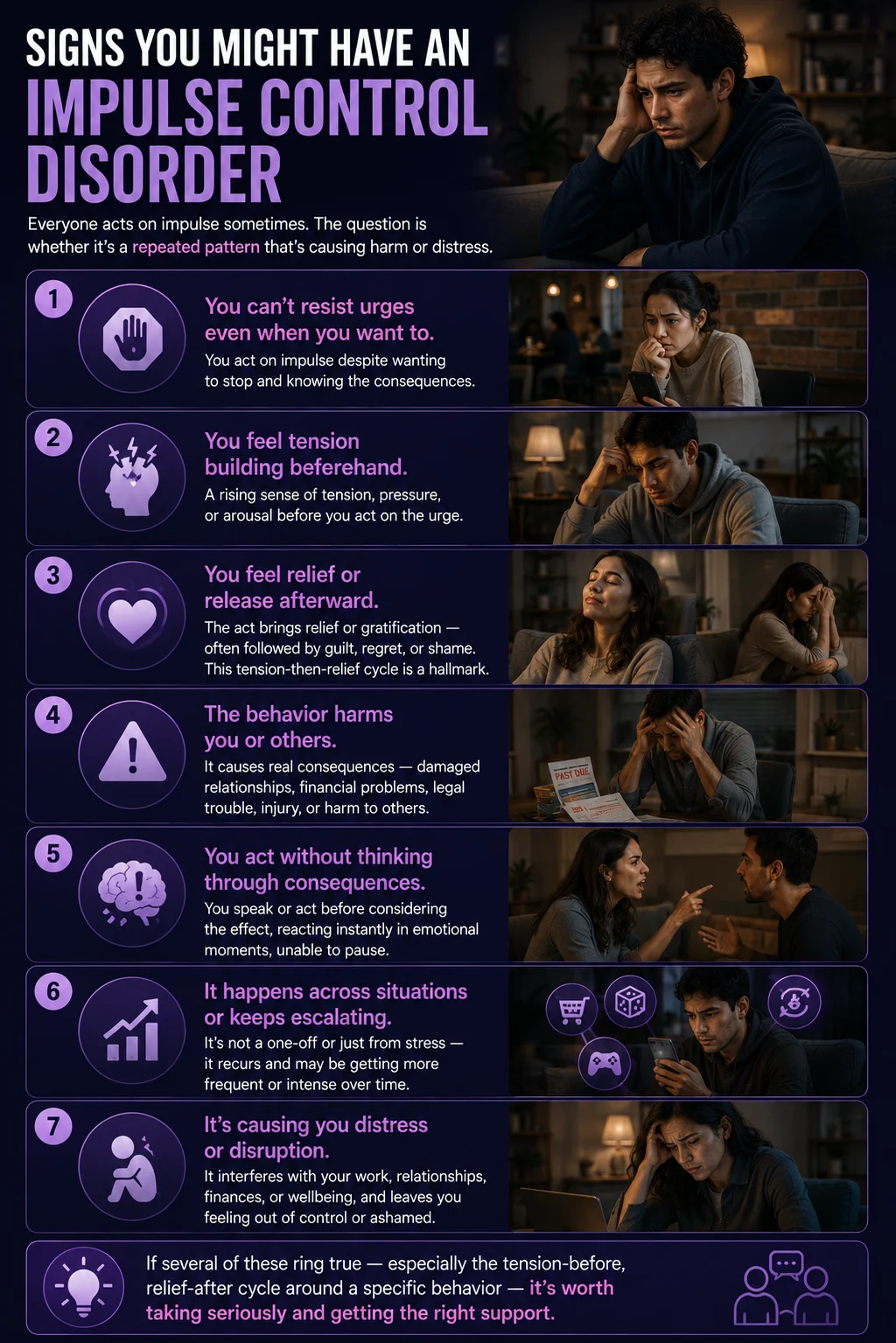
If several of these ring true — especially the tension-before, relief-after cycle around a specific behavior — it’s worth taking seriously, and worth identifying which behavior is involved, because that determines what helps.
This quiz has 15 questions covering the shared features of impulse control problems, plus markers that point toward specific conditions. For each, choose how often it applies to you:
Never = 0 | Rarely = 1 | Sometimes = 2 | Often = 3 | Always = 4
Your answers add up to a score from 0 to 60. Your result will also point you toward the specific type of impulse control disorder your answers most resemble — which is often more useful than the number itself, because the different conditions need different approaches. This is a screening tool, not a diagnosis; only a qualified professional can diagnose an impulse control disorder.
| Score Range | Level | What It Suggests |
|---|---|---|
| 0 – 15 | Minimal | Good impulse control overall. Occasional impulsive acts without a harmful pattern. |
| 16 – 30 | Mild | Some impulsive tendencies worth watching, especially if concentrated in one area. |
| 31 – 45 | Moderate | A pattern consistent with an impulse control problem. Worth a focused look and possibly a professional. |
| 46 – 60 | Significant | Strong indicators of impulse dyscontrol causing real impact. A professional assessment is recommended. |
Your total score shows how much impulse control is a challenge; which questions you scored highest on shows which kind — and that’s what determines the right test and treatment. The questions map like this:
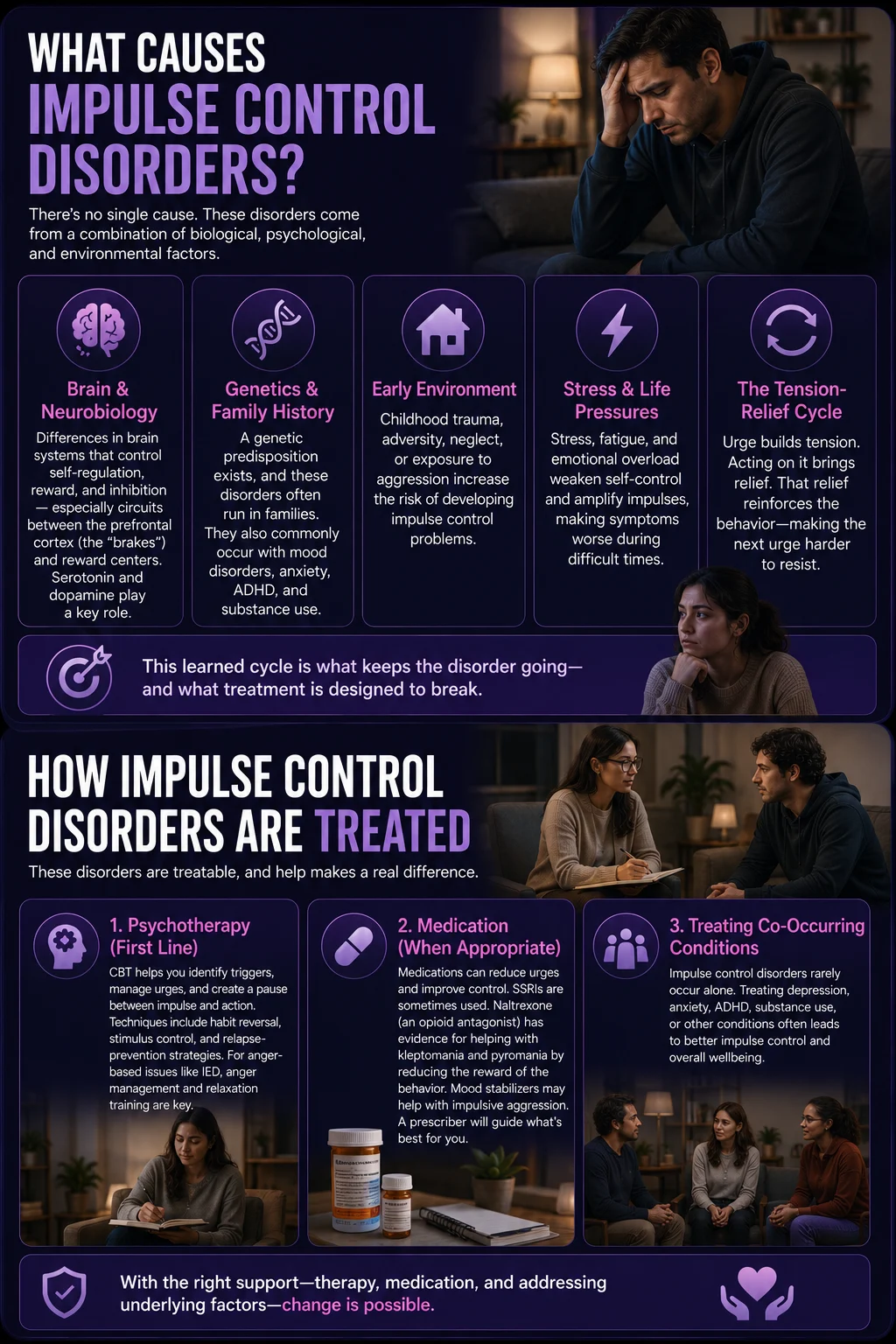
Impulse control disorders arise from a mix of factors rather than a single cause. Neurobiology plays a real role: these conditions involve the brain systems that govern self-regulation, reward, and inhibition — particularly circuits linking the prefrontal cortex (which applies the brakes) with deeper reward and emotion centers. Differences in serotonin and dopamine signaling are implicated, which is part of why certain medications can help.
Genetics and family history contribute, and impulse control disorders frequently run alongside other conditions — mood disorders, anxiety, ADHD, and substance use especially. Early environment matters too: childhood trauma, adversity, and exposure to aggression or neglect all raise risk. And stress is a powerful amplifier — impulse control tends to erode under pressure, fatigue, and emotional overload, which is why symptoms often worsen during difficult periods.
What tends to maintain these disorders is the tension-and-relief cycle itself. The urge builds discomfort; acting on it brings relief; the relief reinforces the behavior, making the next urge harder to resist. This learned loop is exactly what treatment targets — which is why these conditions, though genuinely hard to manage alone, respond well to the right structured help.
Impulse control disorders are treatable, and this is worth emphasizing because the shame that surrounds them often stops people from seeking the help that works.
Psychotherapy is the foundation. Cognitive Behavioral Therapy (CBT) helps people recognize the urges and triggers, tolerate the tension without acting on it, and build a deliberate pause between impulse and action. Specific techniques — habit reversal, stimulus control, and relapse-prevention strategies borrowed from addiction treatment — are tailored to the particular behavior. For anger-based conditions like IED, structured anger management and relaxation training add real value.
Medication helps in some cases, usually guided by the specific disorder and any co-occurring conditions. SSRIs are sometimes used, and the opioid antagonist naltrexone has evidence for reducing urges in kleptomania and pyromania by dampening the reward of the behavior. Mood stabilizers are sometimes used for impulsive aggression. A prescriber can advise on what fits.
Treating what co-occurs matters, because impulse control disorders rarely travel alone — addressing accompanying depression, anxiety, ADHD, or substance use often improves impulse control as well. Much of the research advancing these treatments comes from specialists like Dr. Jon Grant at the University of Chicago, whose work has shaped the combined therapy-and-medication approaches used today.
Under the DSM-5-TR, the impulse control disorders sit within the chapter “Disruptive, Impulse-Control, and Conduct Disorders.” The main conditions are intermittent explosive disorder (recurrent impulsive aggression), kleptomania (irresistible urges to steal), pyromania (repeated deliberate fire-setting), oppositional defiant disorder (a persistent pattern of defiant, hostile behavior, usually in youth), and conduct disorder (repeated violation of others’ rights and social norms, usually in youth), plus catch-all categories for presentations that don’t fit neatly. What they share is impulse dyscontrol — a failure to resist urges to act harmfully. Notably, some conditions people associate with impulsivity — ADHD, gambling disorder, and hair-pulling — were reclassified out of this category in the DSM-5 and are handled elsewhere.
No. Impulsivity is a normal personality trait that everyone has to some degree — acting quickly, seeking novelty, sometimes without full deliberation. It can even be an asset in the right context. An impulse control disorder is different: it’s a persistent, distressing failure to resist specific harmful urges, with a characteristic build-up of tension beforehand and relief afterward, causing real consequences the person can’t stop despite wanting to. The line is crossed when impulsivity becomes uncontrollable, harmful, and distressing rather than just a tendency toward spontaneity. If your impulsivity is more of a general trait — and especially if it comes with inattention and restlessness — it may relate more to ADHD, which our ADHD/ADD Test screens for.
Not anymore, under the current classification. In the DSM-IV, pathological gambling was listed among the impulse control disorders. The DSM-5 moved it into the “Substance-Related and Addictive Disorders” chapter, reclassifying it as gambling disorder — a behavioral addiction — because research showed it more closely resembles substance addictions in its brain mechanisms, course, and treatment response. It still involves impulse control difficulties, but it’s now understood and treated as an addiction. If gambling is your concern, our Gambling Addiction Test (based on the validated PGSI) is the right screen. Compulsive sexual behavior and compulsive shopping are similarly often understood through an addiction lens rather than as classic impulse control disorders.
Yes — impulse control disorders respond well to treatment, though they’re difficult to overcome through willpower alone, which is exactly why professional help matters. The mainstay is psychotherapy, especially CBT, which builds the ability to notice urges, tolerate the tension without acting, and insert a deliberate pause between impulse and action. Techniques from addiction treatment, like relapse prevention and stimulus control, are often used. Medication can help in some cases — SSRIs, mood stabilizers for impulsive aggression, and naltrexone (which reduces the reward-driven urges in conditions like kleptomania). Because these disorders often co-occur with depression, anxiety, ADHD, or substance use, treating those alongside usually improves impulse control too. Most people who get structured help see meaningful improvement.
That relief is actually one of the defining features of an impulse control disorder, and understanding it can be genuinely helpful. Many of these conditions follow a cycle: tension or arousal builds beforehand, becoming increasingly uncomfortable; acting on the urge releases that tension, producing a moment of relief or gratification; and then guilt or regret often follows.
This tension-and-relief pattern is part of what distinguishes impulse control disorders from, say, obsessive-compulsive behaviors (which are driven by anxiety-avoidance rather than sensation-seeking). The catch is that the relief reinforces the behavior — your brain learns that giving in “works” to relieve the discomfort, which makes the next urge harder to resist. Breaking that learned cycle, by learning to tolerate the tension without acting, is precisely what effective treatment teaches.
It’s worth seeking help if your impulsive behaviors are causing real consequences — damaged relationships, financial or legal problems, harm to yourself or others — or significant distress and a sense of being out of control, and especially if you’ve tried to stop and haven’t been able to. You don’t need to wait until things reach a crisis; these conditions tend to entrench over time, so earlier help is easier.
Seek help urgently if your impulses involve harming yourself or other people: in that case, contact a professional right away, or call or text 988 (Suicide & Crisis Lifeline) any time. A good first step for less urgent concerns is identifying which specific pattern fits using the map in your results, then bringing that to a doctor or mental health professional.
Addiction and Impulse Control
Is Gambling Becoming a Problem? Take This Free Gambling Addiction Test (PGSI)
Anxiety and Fear Disorders · Mental Health
Do I have Obsessive-Compulsive Disorder Test (Free OCD Quiz Online)
Personality Disorders
Could You Have OCPD? Take This Obsessive Compulsive Personality Disorder Test

Here you'll find all collections you've created before.