
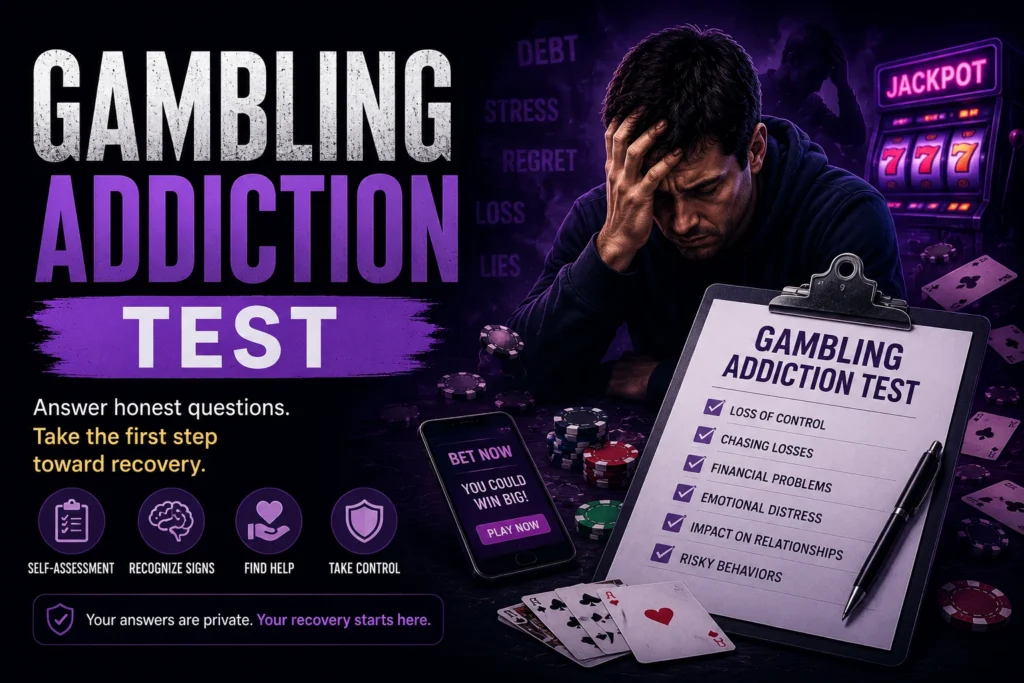
Is Gambling Becoming a Problem? Take This Free Gambling Addiction Test (PGSI)
Is gambling becoming a problem? This free gambling addiction test uses the validated Problem Gambling Severity Index (PGSI). 9 questions, confidential results.
Published Updated
Struggling with gambling? Confidential help is available 24/7.
📞 National Problem Gambling Helpline — Call or text 1-800-MY-RESET (1-800-697-3738), or 1-800-522-4700 — 24/7, free, confidential
💬 Chat and support at ncpgambling.org
Gambling problems carry a real and elevated risk of suicide. If you’re in crisis or having thoughts of harming yourself, call or text 988 (Suicide & Crisis Lifeline) right now. You are not alone, and this is treatable.
For most people, gambling is occasional entertainment. For some, it becomes something they can’t control — a compulsion that continues despite mounting losses, damaged relationships, and a genuine desire to stop. Gambling disorder is a real, recognized addiction: in fact, it was the first behavioral addiction formally classified alongside substance addictions in the DSM-5. It’s not a moral failing or a simple lack of willpower — it’s a condition that changes how the brain’s reward system works, and it’s treatable.
This free, confidential gambling addiction test uses the Problem Gambling Severity Index (PGSI) — the most widely used validated screening tool for problem gambling, used in national health surveys and clinical practice worldwide. It’s 9 questions about the past 12 months, and your results are private and instant. It’s a screening tool, not a diagnosis — but it’s a well-validated way to understand where your gambling falls on the spectrum from no problem to serious problem.
What Is Gambling Addiction?
Gambling addiction — clinically called gambling disorder, and sometimes problem or compulsive gambling — is a behavioral addiction characterized by persistent, recurrent gambling that continues despite significant harm and a desire to stop. It’s marked by loss of control: gambling more than intended, chasing losses, and being unable to cut back even as the consequences pile up in the form of debt, damaged relationships, and emotional distress.
Gambling disorder holds a landmark place in psychiatry: in the DSM-5 (2013), it became the first behavioral addiction ever classified alongside substance use disorders, moving out of the “impulse control disorders” category. This reflected mounting evidence that problem gambling activates the same brain reward and craving systems as drugs and alcohol, follows similar patterns of tolerance (needing to bet more for the same thrill) and withdrawal (restlessness or irritability when trying to stop), and responds to similar treatments. Recognizing it as an addiction rather than a failure of self-control was an important shift — both scientifically and for reducing the shame that keeps people from seeking help.
The DSM-5 defines gambling disorder by nine criteria, with at least four needed within a 12-month period for a diagnosis. These include preoccupation with gambling; needing to gamble with increasing amounts (tolerance); repeated unsuccessful efforts to cut back; restlessness or irritability when trying to stop (withdrawal); gambling to escape problems or distress; “chasing” losses; lying to conceal gambling; jeopardizing relationships, jobs, or opportunities; and relying on others for money to relieve gambling debts. Severity is graded by how many criteria are met (four to five mild, six to seven moderate, eight to nine severe). Notably, the DSM-5 removed the old “illegal acts” criterion from the previous edition.
Gambling disorder is serious. Beyond the financial devastation, it carries a genuinely elevated risk of suicide — driven by overwhelming debt, shame, and hopelessness — which is one of the most important reasons to take it seriously and seek help early. The encouraging side of that seriousness is that gambling disorder responds well to treatment, and recovery is entirely possible.
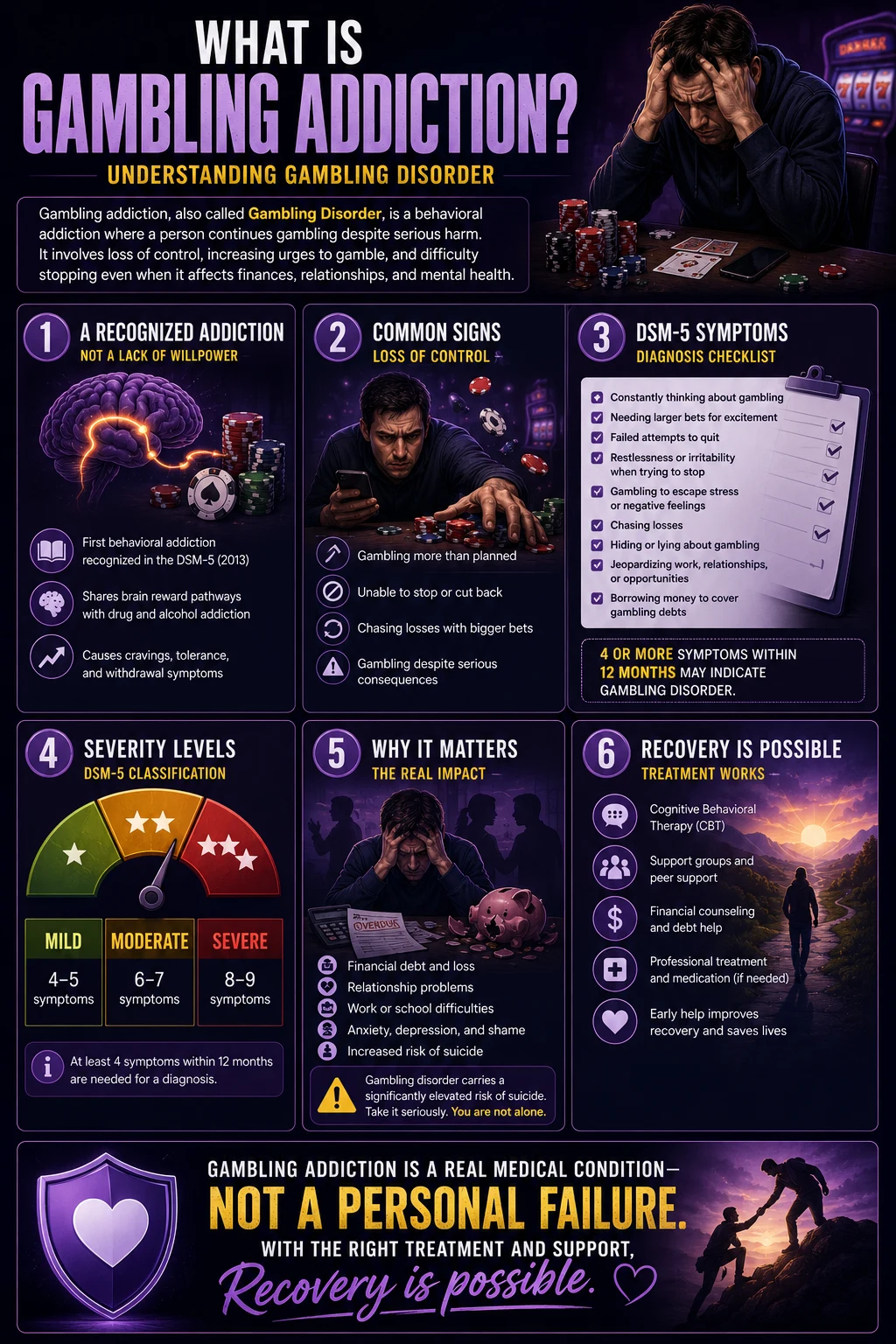
Signs You Might Have a Gambling Problem
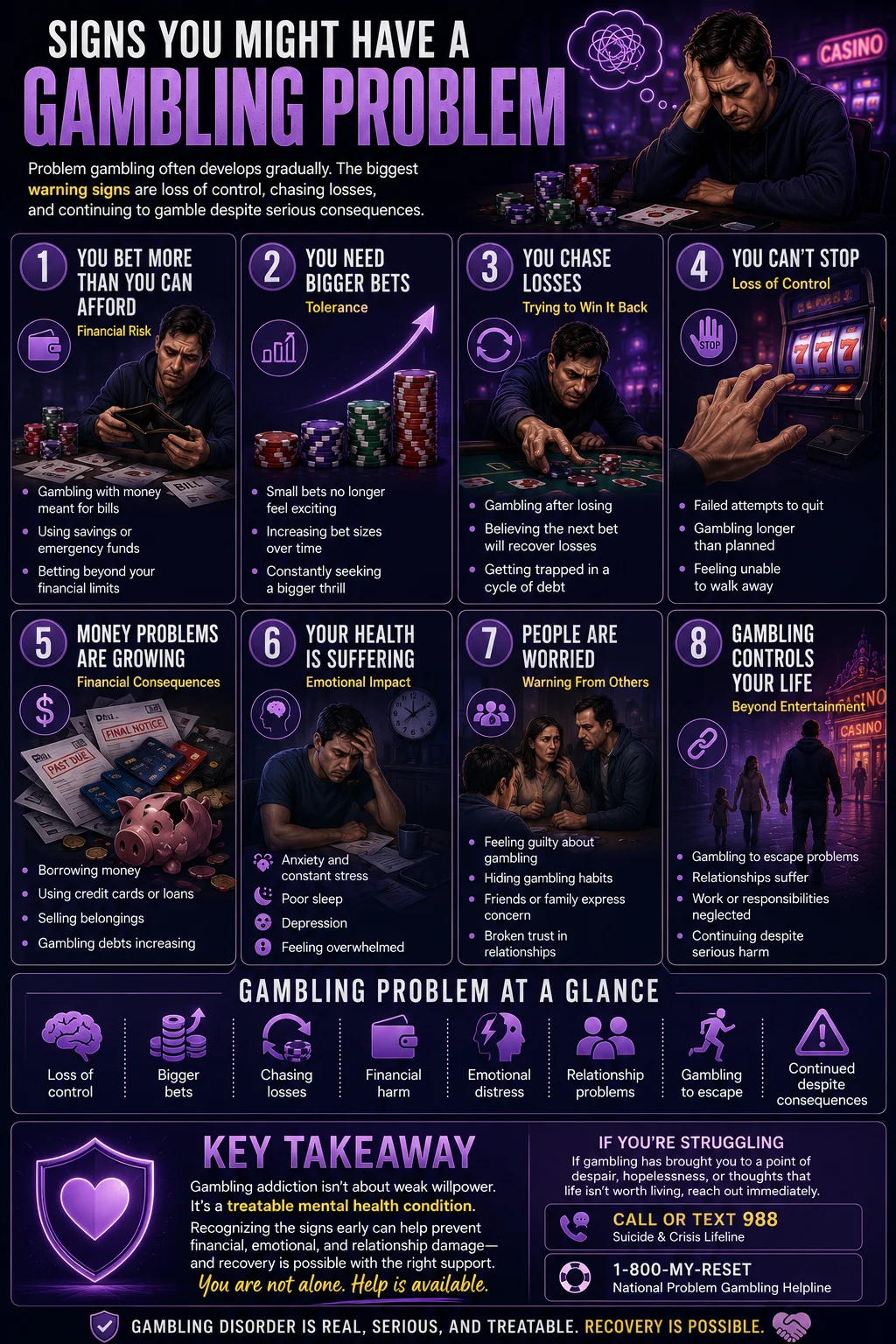
Gambling problems often stay hidden behind secrecy and shame, and they tend to escalate gradually, which makes them easy to rationalize. These are the signs most consistent with gambling disorder, drawn from the DSM-5 criteria and the PGSI. A pattern of several — especially with loss of control and continued gambling despite harm — is what’s worth taking seriously.
You gamble with more money than you can afford to lose. Betting amounts that genuinely hurt your finances — money meant for bills, savings, or essentials — rather than only what you can comfortably spare. When gambling stakes reach into money you can’t afford, the line into problem territory has been crossed.
You need to bet more to feel the same excitement. Just as with substance tolerance, the same bet no longer delivers the thrill it once did, so the amounts creep up. This escalation is a hallmark of addiction, not just enthusiasm.
You chase losses. After losing, you go back to try to win it back — the belief that the next bet will recover what’s gone. Chasing losses is one of the most characteristic and dangerous features of problem gambling, because it drives a spiral of deeper losses and bigger bets.
You can’t stop or cut back, even when you try. Repeated efforts to reduce or quit that don’t stick. The loss of control — gambling more or longer than intended, being unable to walk away — is central to the disorder and distinguishes it from a chosen hobby.
You borrow money or sell things to gamble. Turning to loans, credit, or selling possessions to fund gambling or to cover gambling debts. This is a serious sign that gambling has outrun your means and taken priority over financial well-being.
Gambling is causing stress, anxiety, or health problems. The toll shows up in your mental and physical health — sleeplessness, anxiety, depression, stress-related symptoms tied to gambling or its consequences.
You feel guilty, or others have expressed concern. Guilt about the way you gamble or what happens when you do, and people close to you criticizing your gambling or telling you they think you have a problem. Both your own guilt and others’ concern are meaningful signals worth heeding rather than dismissing.
Gambling is harming your finances, relationships, or responsibilities. Financial problems for you or your household, strained or damaged relationships, or gambling taking priority over work, family, and the things that matter. When gambling starts costing you the things you care about, and you continue anyway, that continuation despite harm is the core of addiction.
You gamble to escape. Using gambling to get away from stress, low mood, anxiety, or problems — as an emotional escape rather than entertainment. Gambling as a coping mechanism for difficult feelings is a common and telling feature.
A critical note: if gambling has brought you to a point of despair, hopelessness, or thoughts that life isn’t worth living, please reach out immediately — call or text 988, or the National Problem Gambling Helpline at 1-800-MY-RESET. The financial and emotional weight of gambling problems can feel crushing, but it is survivable and treatable, and help is available right now.
How This Gambling Addiction Test Works
This test uses the Problem Gambling Severity Index (PGSI), a validated 9-item screening tool. Thinking about the past 12 months, you’ll answer how often each statement has applied to you: Never, Sometimes, Most of the time, or Almost always.
Never = 0 | Sometimes = 1 | Most of the time = 2 | Almost always = 3
Your answers produce a score from 0 to 27, which places you in one of four validated risk categories. Because the PGSI is a genuinely validated instrument, this gives a more meaningful picture than a made-up quiz — but it’s still a screen, not a diagnosis. Answer honestly; the test is private, and honesty is what makes it useful.
Understanding Your Gambling Addiction Test Score
| Score | Category | What It Suggests |
|---|---|---|
| 0 | Non-Problem Gambling | No indication of problem gambling. Gambling, if any, does not appear to be causing problems. |
| 1 – 2 | Low Risk | A low level of risk with few or no identified consequences — but worth staying aware of. |
| 3 – 7 | Moderate Risk | A moderate level of problems leading to some negative consequences. Worth taking seriously and seeking support. |
| 8 – 27 | Gambling Problem | Problem gambling with negative consequences and possible loss of control. Reaching out for help is strongly encouraged. |
What Causes Gambling Addiction?
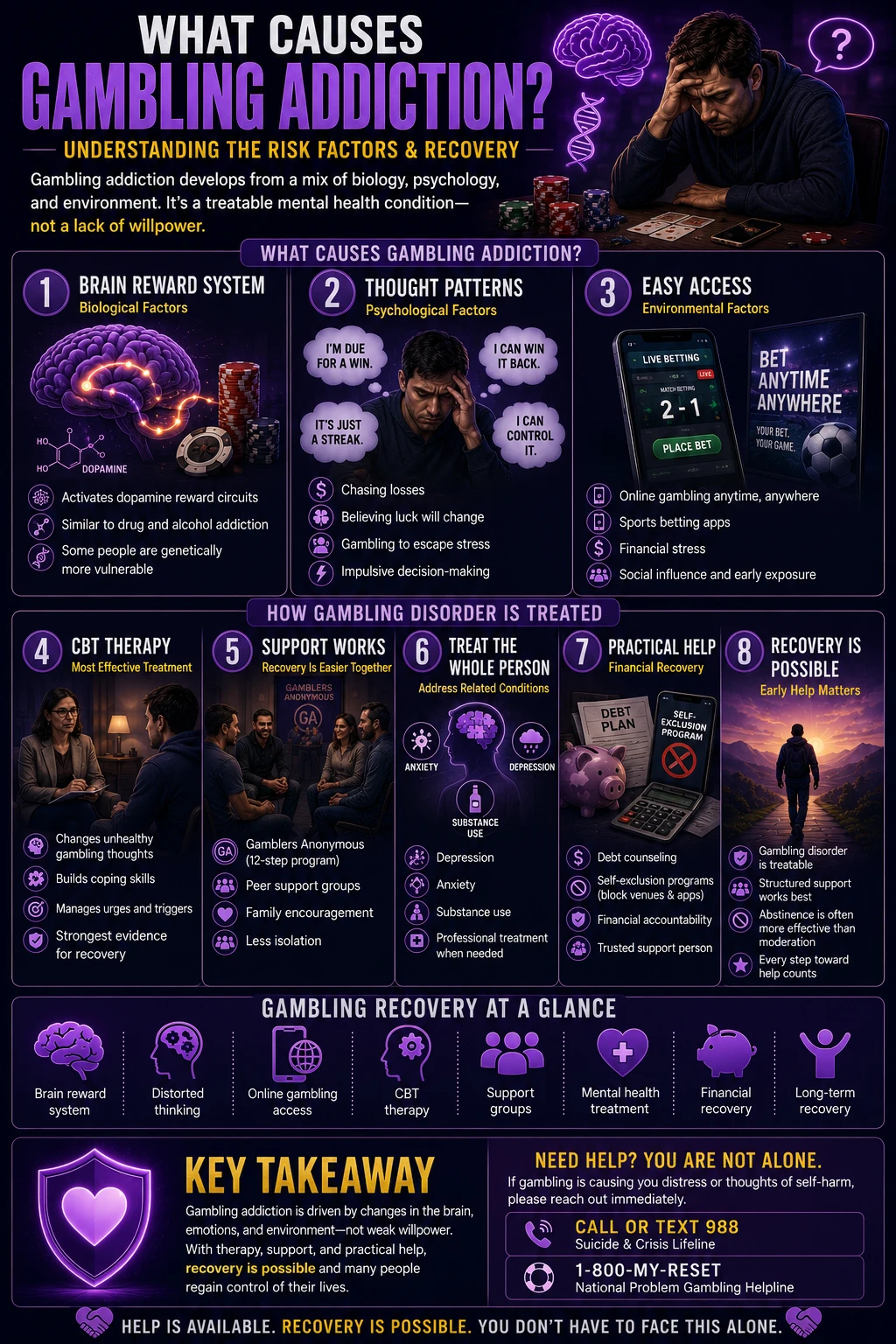
Gambling disorder develops from a combination of biological, psychological, and environmental factors, not from weakness of character. Biologically, it involves the brain’s reward system — the same dopamine-driven circuitry involved in substance addictions — and there’s a genetic component, with gambling problems (and addictions generally) running in families. Some people appear more neurologically vulnerable to the intermittent, unpredictable rewards that gambling is engineered to deliver, which are especially powerful at driving compulsive behavior.
Psychological factors play a major role. Gambling disorder frequently co-occurs with depression, anxiety, substance use, and impulsivity, and gambling is often used as a way to escape difficult emotions or circumstances. Certain cognitive distortions — like the belief that a win is “due” after losses, or that skill can control chance outcomes — help sustain the behavior. Environmental factors matter too: early exposure, the increasing accessibility of gambling (especially mobile and online betting, which lets people wager anytime, anywhere), financial stress, and social influences all contribute. The recent explosion of legal sports betting and gambling apps has made gambling more available than ever, raising risk for vulnerable people.
How Gambling Disorder Is Treated
Gambling disorder is treatable, and a range of approaches genuinely help. This is worth emphasizing, because the shame and financial despair around problem gambling can make recovery feel impossible — it isn’t.
Psychotherapy is central. Cognitive Behavioral Therapy is the best-established treatment; it helps identify and change the distorted thinking and behaviors that drive gambling, build coping strategies for urges and triggers, and address the underlying emotional patterns. Motivational approaches also help people build commitment to change.
Peer support helps many people. Gamblers Anonymous, a 12-step program modeled on Alcoholics Anonymous, provides community and structure, and connecting with others in recovery reduces the isolation that gambling problems create.
Treating co-occurring conditions matters. Because depression, anxiety, and substance use so often accompany gambling disorder, addressing them is frequently an essential part of recovery. Medication isn’t a standard treatment for gambling disorder itself, but may help with co-occurring conditions.
Practical and financial support is part of the picture too — help with debt, self-exclusion programs that block access to gambling venues and apps, and involving trusted people in managing finances during recovery. The National Problem Gambling Helpline (1-800-MY-RESET) can connect you with these resources. Importantly, for a genuine gambling disorder, “just setting limits” usually isn’t enough — the loss of control that defines the condition means structured support and, often, abstinence-focused treatment works better than trying to gamble “in moderation.”
Frequently Asked Questions
What is the Problem Gambling Severity Index (PGSI)?
The PGSI is a validated 9-item questionnaire that measures the severity of problem gambling over the past 12 months. Developed by Ferris and Wynne in 2001 as part of the Canadian Problem Gambling Index, it’s now the most widely used problem-gambling screen in the world — used in national health surveys (including the UK’s) and in clinical practice. Each item is scored 0 to 3, for a total from 0 to 27, which sorts people into four risk categories: non-problem (0), low risk (1–2), moderate risk (3–7), and problem gambling (8+). It’s valued for being brief, clear, and reliable, and it’s what this test is based on.
Is gambling addiction a real mental disorder?
Yes. Gambling disorder is a formally recognized mental health condition in the DSM-5, and it holds a notable distinction: it was the first behavioral (non-substance) addiction to be classified alongside substance use disorders, in 2013. This reflected strong evidence that problem gambling engages the same brain reward and craving systems as drug and alcohol addiction, shows similar features like tolerance and withdrawal, and responds to similar treatments. So gambling addiction isn’t a metaphor or a character flaw — it’s a genuine, diagnosable addiction, which is precisely why it responds to proper treatment rather than to willpower alone.
How do I know if I’m a problem gambler or just enjoy gambling?
The key distinction is control and consequences. Recreational gambling stays within limits you set, uses money you can afford to lose, and doesn’t harm your finances, relationships, or wellbeing — you can stop when you decide to. Problem gambling involves loss of control (gambling more or longer than intended, unable to cut back), chasing losses, betting money you can’t afford, and continuing despite mounting harm. Warning signs include borrowing to gamble, lying about it, guilt, others expressing concern, and gambling to escape stress. This test, based on the validated PGSI, is designed precisely to help you tell the difference — a score of 3 or more suggests it’s moved beyond purely recreational.
Can gambling addiction be cured?
Gambling disorder is very treatable, and many people achieve lasting recovery — rebuilding their finances, relationships, and lives. Cognitive Behavioral Therapy is well-established and effective, peer support like Gamblers Anonymous helps many people, and treating co-occurring conditions such as depression and anxiety is often an important part of the process. As with other addictions, “cured” is less the right frame than “in recovery” — many people find that a genuine gambling disorder is best managed through abstinence and ongoing support rather than a return to “controlled” gambling. But the core message is hopeful: with proper help, people do recover from even severe gambling problems.
Why is gambling addiction linked to suicide?
Gambling disorder carries a genuinely elevated risk of suicide, higher than many other addictions, and it’s important to be aware of this. The risk is driven by the specific consequences of problem gambling: overwhelming debt and financial ruin, profound shame and secrecy, damaged or destroyed relationships, and the hopelessness that can come from feeling trapped with no way out.
This is one of the most important reasons to seek help early and to take a gambling problem seriously. If gambling has brought you to a point of despair or thoughts of not wanting to be here, please reach out right now — call or text 988 (Suicide & Crisis Lifeline) or the National Problem Gambling Helpline at 1-800-MY-RESET. These feelings are a symptom of an overwhelming situation that can be helped, not a permanent reality.
Where can I get help for a gambling problem?
The best starting point in the US is the National Problem Gambling Helpline: call or text 1-800-MY-RESET (also reachable at 1-800-522-4700), available 24/7, free and confidential, and staffed by people who specialize in gambling problems. They can provide support and connect you with treatment, counseling, and financial resources in your area, with no judgment and no need to have everything figured out first. Other paths include talking with a doctor or therapist (ideally one experienced with addictions), joining Gamblers Anonymous, and using practical tools like self-exclusion programs that block access to gambling venues and apps. Reaching out early genuinely improves outcomes — you don’t have to wait until things are catastrophic to deserve help.
How accurate is this gambling test?
This test uses the actual Problem Gambling Severity Index, a genuinely validated instrument with strong research support and worldwide use, which makes it considerably more meaningful than an informal quiz. Its risk categories (non-problem, low, moderate, problem) are based on established research thresholds. That said, “validated” doesn’t mean “diagnostic” — the PGSI is a screening tool, not a clinical diagnosis, which requires a professional assessment against the full DSM-5 criteria. Your result is a reliable, research-based indication of where your gambling falls and whether it’s worth seeking help — treat it as a meaningful signal and a starting point, not a final verdict.
Related Tests
- Alcohol Addiction Test — alcohol and gambling problems frequently co-occur; substance and behavioral addictions often travel together
- Drug Addiction Test — gambling disorder shares brain-reward mechanisms with substance addictions and commonly overlaps with them
- Internet Addiction Test — another behavioral addiction with similar compulsive patterns; online gambling blurs the line between them
- Impulse Control Disorder Quiz — gambling disorder was formerly classified with impulse control disorders and shares features of impulsivity
- Clinical Depression Test — depression commonly co-occurs with gambling problems and both raise suicide risk; important to screen together
- Anxiety Test — anxiety frequently accompanies problem gambling, both as a cause and a consequence
- Kleptomania Test — another impulse-related condition in the addiction and impulse control category
References
- Ferris, J., & Wynne, H. (2001). The Canadian Problem Gambling Index: Final Report. Canadian Centre on Substance Abuse. [Original PGSI development and scoring bands]
- American Psychiatric Association. (2022). Diagnostic and Statistical Manual of Mental Disorders, Fifth Edition, Text Revision (DSM-5-TR). Gambling Disorder. [9 criteria; first behavioral addiction; severity levels] psychiatry.org
- Sharman, S., et al. / ALSPAC cohort. (2024). The relationship between Problem Gambling Severity Index scores and suicidality: a 9-year cohort study. [Elevated suicide attempt risk with problem gambling] pmc.ncbi.nlm.nih.gov
- National Council on Problem Gambling. (2026). National Problem Gambling Helpline (1-800-MY-RESET / 1-800-522-4700). [Current national helpline] ncpgambling.org
- UK Gambling Commission. Problem gambling screens: the PGSI. [PGSI 9-item wording and use in national surveys] gamblingcommission.gov.uk
Related Tests
See All Quiz →
Addiction and Impulse Control
Are You Addicted to the Internet? Take the Ultimate Digital Dependency Test
→
You may also like
See All Quiz →
Anxiety and Fear Disorders
15-Item Scopophobia Test – Fear of being stared at, watched, or observed
→