
Self-reflection · Relationships
Am I a Good Friend? An honest look at how you show up.
Fifteen statements on dependability, honesty, listening and mutual effort — free, private and nothing saved. A kind mirror rather than a grade, and there is no bad-person score here.
A self-reflection tool, not an assessment. It measures habits rather than character, and it cannot see the circumstances you have been in.
-
A KIND MIRROR15 statementsOn how you actually show up for people.
-
NO BAD SCOREHabits, not characterThese are learnable behaviours. A low score points at circumstances and skills, not at your worth.
-
PRIVATENothing is saved or sentFree, no account, no sign-up. Your result stays in your browser.
An honest look
Take the am I a good friend quiz
Answer for how you generally are rather than how you would like to see yourself. Fifteen statements, about two minutes, and the result appears only in your browser.
Your result
What the ranges mean
- 0–15 Room to grow — meaningful space to change how you show up
- 16–30 Growing — you care and do a lot right, with reachable room
- 31–45 Great — the big things are right, a few areas still developing
- 46–60 Exceptional — consistently generous, dependable and present
Each statement scores 0 (Strongly disagree) to 4 (Strongly agree), for a total of 0–60. These ranges are deliberately uncoloured rather than graded from red to green, because there is no failing score here. A low total describes habits and often a difficult season, not the kind of person you are.
Across 148 studies and 308,849 people, those with stronger social relationships had a 50% greater likelihood of survival. That is about having relationships, not about being skilled at them.
The short answer
What actually makes someone a good friend?
Dependability, honesty, empathy, support and genuine mutuality — someone who both gives and receives rather than only doing one. There is research on this rather than only opinion. Hall (2012) analysed what people expect from an ideal friend across three studies and found six factors: symmetrical reciprocity, agency, enjoyment, instrumental aid, similarity, and communion. In ordinary words: give and take that runs both ways, getting things done together, actually enjoying each other, practical help when it is needed, enough in common, and closeness. The structure held across samples, across sexes and across age groups.
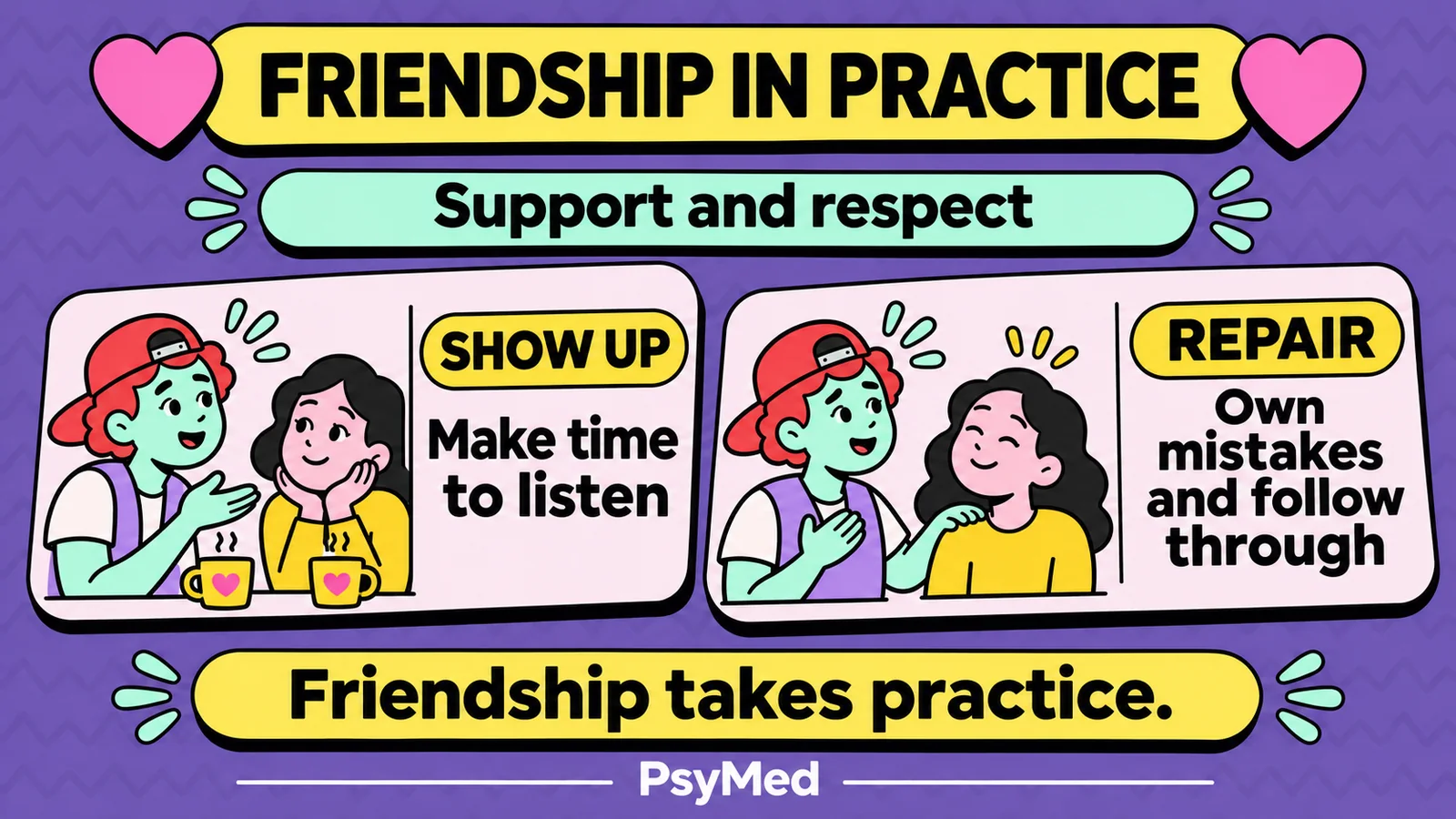
Two things are easy to get wrong. The first is honesty: a good friend is honest rather than merely agreeable, and sometimes the kindest available thing is a gentle truth told with care rather than the comfortable version. The second is balance. Friendship that only flows one way is not generosity in the long run, whichever direction it flows, and the willingness to own a mistake and repair it matters more than never making one.
Honest is not the same as blunt, and supportive is not the same as endlessly available. Both of those confusions damage friendships.
Holt-Lunstad and colleagues (2010) pooled 148 studies covering 308,849 people and found that those with stronger social relationships had a 50% greater likelihood of survival across the study periods, with the strongest effects for complex measures of social integration. Worth reading precisely: that is evidence about having relationships, not about being good at them, and nothing in it speaks to your score here.
View sourceSigns
What it looks like in practice
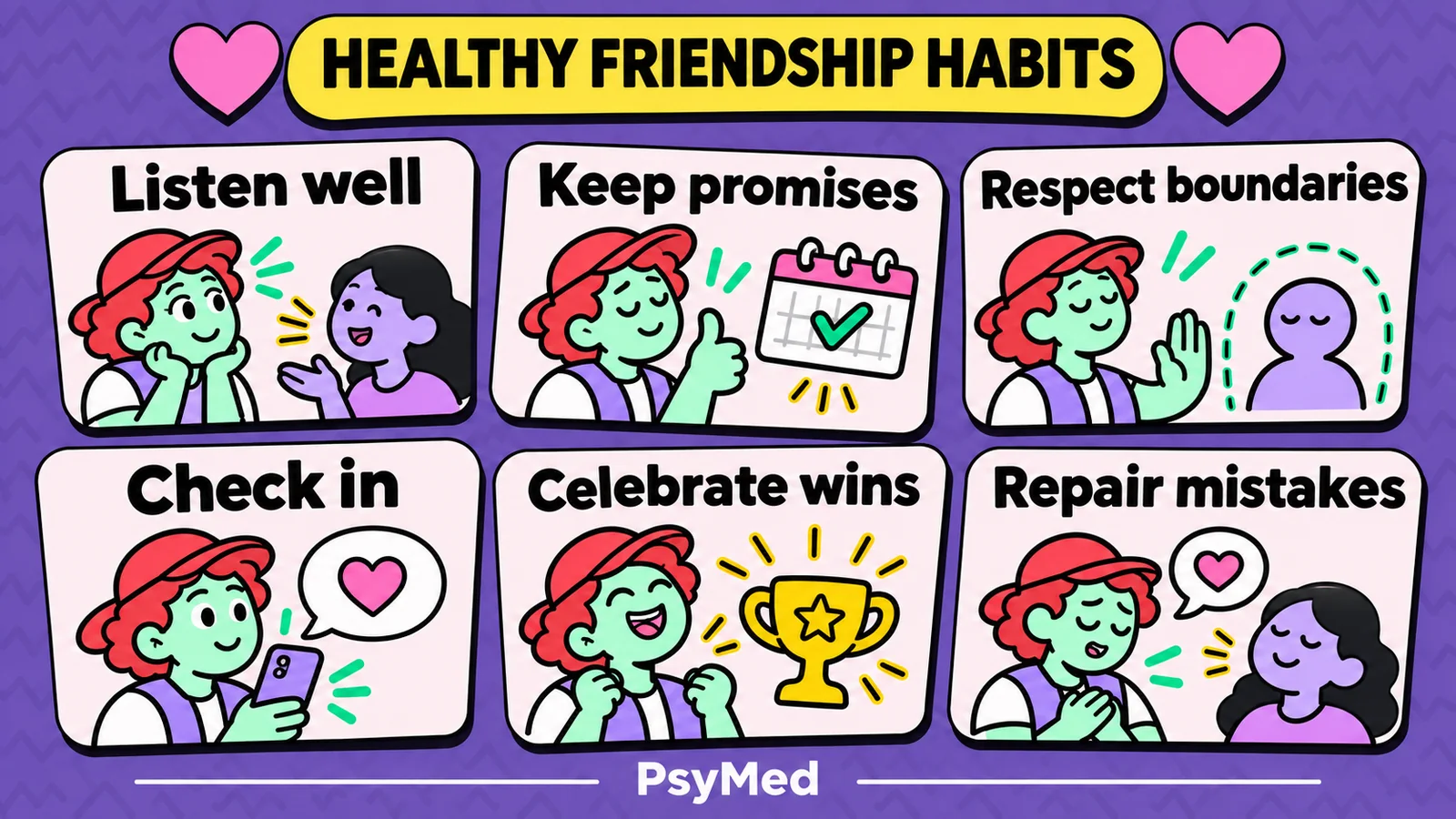
Good friendship shows up in ordinary, repeated behaviour rather than grand gestures. Notice which feel like your usual pattern — and treat the others as skills rather than verdicts.
You show up and follow through
When you say you will be there, you are. You remember what matters to them and you are reliably present. Dependability is unglamorous and it is the thing trust is actually built from.
You are honest, even when it is awkward
You tell them the truth kindly rather than only what they want to hear. Being a kind mirror is honesty in the service of the person, which is different from bluntness in the service of being right.
What they tell you stays with you
You do not pass on their private things or talk about them to other people. This is the foundation that makes being vulnerable with you possible at all.
You listen without redirecting
When they need to talk you actually listen, rather than steering it back to your own situation. You are curious about their life and ask, instead of waiting for your turn.
You are there when it is inconvenient
Showing up in a crisis, offering practical help without needing to be asked twice. Being dependable when it costs you something is the part that distinguishes friendship from friendliness.
You are genuinely glad when they win
Their good news lands as good news rather than as comparison. Celebrating someone’s success without a complicated feeling underneath is a real and not universal capacity.
Three things that look like good friendship
and are not, which is why they are worth separating.
| Looks like | What it actually is | Why it is different |
|---|---|---|
| Always available | Over-giving, often from fear of being dropped. | It runs down, turns to resentment, and ends friendships. |
| Never disagreeing | Agreeableness, not honesty. | It deprives them of the one person who would tell them. |
| Always fixing | Discomfort with their distress. | Most people want to be heard before they want solutions. |
| Is it bad to need things from friends? | No — it is half of what friendship is. Hall’s most heavily weighted factor is symmetrical reciprocity: give and take running both ways. A friend who never lets you do anything for them is withholding something, not being considerate. | |
What this quiz looks at
The three things these statements ask about
The fifteen statements group loosely into three strands. None is a standard you must meet; they are the places friendship usually succeeds or fails.
- 01 Dependability
Whether you can be counted on
Following through, remembering what matters, being present rather than sporadic, and keeping what is private private. This is the slow one, because trust is built by repetition rather than by intention.
- 02 Attunement
Whether they feel heard
Listening without redirecting, noticing how they are, seeing it from their side, and being glad about their good news. This is the strand most affected by how stretched you are, which is why it slips first in a hard season.
- 03 Mutuality and repair
Whether it runs both ways
Putting in effort, letting them put in effort too, respecting boundaries in both directions, and being able to apologise properly when you get it wrong. Repair matters more than perfection, because every long friendship contains mistakes.
It cannot see your circumstances, and they matter enormously here. Illness, caring responsibilities, a brutal job, depression and grief all reduce what anyone has available for other people, and none of that is a character finding. It also cannot see the friendship from the other side, whether the effort is being matched, or whether a particular friendship is one worth pouring more into. A low score during a hard year means something quite different from the same score during an easy one.
Things people ask early
The questions that come up first
Three worth answering before the detail.
Does a low score mean I am a bad person?
No, and that framing is the thing most worth putting down. The statements ask about habits, and habits are shaped by how much you have had to give lately. Worth asking honestly is not the same as worth condemning.
What if I am the one always giving?
Then the useful question is not whether you are a good friend but whether the friendship is mutual. Those are different problems and over-giving is its own pattern rather than an excess of virtue.
Can this actually change?
Yes, and quickly, because most of it is behaviour rather than disposition. Sending the message you have been meaning to send for a month changes something today.
Growing
What actually helps
None of this is dramatic. Friendship is maintained in small, repeated, slightly inconvenient acts, which is also why it quietly lapses without anyone deciding to let it.
- 01 / THE SIMPLEST ONE
Follow up on the specific thing
Ask about the thing they told you last time — the appointment, the interview, the difficult conversation. Remembering a detail and returning to it does more than general warmth does, because it is evidence you were actually listening.
- 02 / IN THE MOMENT
Listen without turning it around
The reflex to relate it back to your own experience is well-meant and it moves the spotlight. Try sitting with their situation for a full minute before offering a parallel. Ask what they need before supplying it.
- 03 / WHEN YOU GET IT WRONG
Apologise without the second half
A real apology names what you did and stops. The explanation, however reasonable, converts an apology into a defence. Repair is the single most useful skill in long friendships, precisely because the mistakes are unavoidable.
Background: American Psychological Association, relationships. This page is educational and is not psychological advice.
What to do next
What should you do with your result?
Treat it as a mirror rather than a grade. The interesting information is which statements you disagreed with, and whether that is a lasting pattern or this particular year.
- 01
Separate the pattern from the season
If you were present and generous until something hard happened, that is a capacity problem rather than a character one, and it recovers as your capacity does.
- 02
Pick one person, not all of them
Friendship improves one relationship at a time. Choose the one you have been meaning to get back to and do something small this week.
- 03
Check whether it is mutual
Before working harder at a friendship, it is worth asking whether the effort is being returned. Trying harder in a one-sided friendship usually makes it more one-sided.
Some people arrive here worried they are not doing enough when the real pattern is the opposite: doing far too much, for people who do not reciprocate, and feeling depleted or quietly resentful. That is not a friendship-skills problem. It is a boundaries problem, it is common, and it often has roots worth understanding. Our codependency self-check asks about it directly: the codependency test. If a specific friendship leaves you consistently worse off, drained or diminished, that is worth examining on its own terms rather than trying harder at.
Good questions to ask
Am I a good friend? — FAQs
What people actually ask when they wonder about this.
Close to the opposite. The willingness to look honestly at how you show up is the disposition good friendship runs on, and people who genuinely do not care rarely go looking. What the question usually signals is either conscientiousness or a specific recent incident you are turning over — and if it is the second, the more useful question is what that incident actually asks of you now.
Research on ideal friendship expectations found six factors: symmetrical reciprocity, agency, enjoyment, instrumental aid, similarity and communion — roughly, give and take both ways, doing things together, genuinely enjoying each other, practical help, enough in common, and closeness. The everyday version is narrower: show up, be honest kindly, keep what is private private, listen without redirecting, and repair it when you get it wrong.
No. Reciprocity is not a tax on friendship, it is the structure of it, and it was the most heavily weighted factor in Hall’s analysis. A friendship where only one person is ever allowed to need something is unbalanced regardless of which direction it runs, and the person who never accepts help is withholding intimacy rather than being considerate.
Usually, and more easily than people expect, because most of what lapsed is behaviour rather than feeling. Say the true thing: that you have been absent, that it was not about them, and that you would like to pick it back up. Then follow it with something small and concrete rather than a promise to be better. People are generally far more forgiving about absence than about being handled.
Then this quiz is answering a question you did not ask. If your scores are high and the friendship still leaves you depleted, the issue is not your friendship skills but the balance of the relationship. Working harder at a one-sided friendship reliably makes it more one-sided. Our Codependency Test looks at the pattern underneath that, and the toxic-friend and fake-friend self-checks look at the relationship itself.
No, and believing it does is one of the more common routes to burning out of friendships entirely. Healthy friendship includes boundaries in both directions. Saying you cannot this week, and meaning it, is more sustainable and more honest than agreeing and then resenting it. Reliable is not the same as limitless.
Yes. Quality and quantity are separate questions, and this quiz measures only how you show up for the people you have. Some people maintain two friendships with great care; some maintain twenty loosely. Neither is the better way to do it, and a small number of close friendships is not evidence of a deficiency.
The evidence is about social relationships broadly rather than friendship specifically, and it is substantial: a meta-analysis of 148 studies covering 308,849 people found a 50% greater likelihood of survival for those with stronger social relationships. Worth stating precisely — that is about having connections, not about being skilled at them, and it says nothing about your score on this page.
Yes. The quiz is free, needs no account or sign-up, and your result appears only in your browser. Nothing is sent to us.
Editorial transparency
Sources and review information
This is a self-reflection quiz, not an assessment. Its fifteen statements are original statements written by our team around the friendship expectations described in the sources below; no instrument is reproduced. Content is written and reviewed by the PsyMed Editorial Team from the sources listed here. We are writers and researchers, not clinicians, and this page is educational rather than diagnostic. Read how we build our tests and who we are.
Research and editorial references
- Hall, J.A. (2012). Friendship standards: the dimensions of ideal expectations. Journal of Social and Personal Relationships, 29(7) — three studies (N = 307, 401 and 668) establishing six factors: symmetrical reciprocity, agency, enjoyment, instrumental aid, similarity and communion, invariant by sample, sex and age. doi.org/10.1177/0265407512448274
- Holt-Lunstad, J., Smith, T.B., & Layton, J.B. (2010). Social relationships and mortality risk: a meta-analytic review. PLoS Medicine, 7(7), e1000316 — 148 studies, 308,849 participants; OR = 1.50 (95% CI 1.42–1.59), a 50% greater likelihood of survival with stronger social relationships. doi.org/10.1371/journal.pmed.1000316
- American Psychological Association. Relationships — general background on the role of close relationships in wellbeing. Linked above under Growing.
- A note on what is not claimed here: no source in this list measures friendship quality against health outcomes, and this page does not suggest that a higher score predicts a longer life.
A mirror, not a grade
Nobody is a perfect friend, and repair beats perfection.
Whatever this returned, the useful part is one specific thing you could do this week for one specific person. Friendship is maintained in small repeated acts, which is exactly why it is so recoverable.
Take the quiz