Self-check · Personality and temperament
Light Triad Test: measure your benevolent side.
Fifteen statements across the three light traits — Kantianism, Humanism and Faith in Humanity. Free, private and scored 0–60. A description of how you orient toward people, not a verdict on your character.
Adapted from the Light Triad Scale (Kaufman et al., 2019, CC BY 4.0). A self-reflection tool, not a validated clinical instrument.
-
THE SELF-CHECK15 statementsFive each for the three light traits.
-
PRIVACY FIRSTNo account neededFree to take, with no sign-up. Your result appears right away.
-
CLEAR BOUNDARIESA profile, not a verdictThis describes an orientation toward people, not your worth.
The self-check
Take the light triad test
Answer for how you generally are, not for the person you would like to be. The result is only worth having if you resist the pull to pick the generous answer every time.
Your score
What the bands mean
- 0–15 Lower light — you endorsed few of these statements
- 16–30 Balanced — a realistic mix of warmth and wariness
- 31–45 Light-leaning — a mostly benevolent orientation
- 46–60 Predominantly light — a consistently generous stance toward people
Each answer scores 0 (Strongly disagree) to 4 (Strongly agree), for a total of 0–60. The bands describe where your answers sit on one continuum. They are not grades, and the high end is not a target.
Kantianism, Humanism and Faith in Humanity. Most people lean on all three unevenly.
The short answer
What is the light triad?
The light triad is a measure of a loving and beneficent orientation toward other people — what its authors call an “everyday saint” profile. It was introduced in 2019 by Scott Barry Kaufman, David Yaden, Elizabeth Hyde and Eli Tsukayama as a deliberate counterweight to decades of research on the Dark Triad. Personality psychology had built a detailed picture of what malevolence looks like and comparatively little of what everyday benevolence looks like, and the Light Triad Scale was written to fill that gap.
It has three facets: Kantianism, treating people as ends unto themselves rather than as means to an end; Humanism, valuing the dignity and worth of each individual; and Faith in Humanity, believing in the fundamental goodness of humans. The scale was developed and validated across four demographically diverse samples totalling 1,518 people.
Light is not simply the absence of dark. The two correlate negatively, but only moderately — you can carry both.
In the study that introduced the scale, the Light Triad correlated with the Dark Triad at r = −0.48 — a moderate negative relationship, which the authors read as evidence that the Light Triad is “not merely the opposite of the Dark Triad”. They also found the average person in their samples tipped toward the light side, and that extreme malevolence was rare.
View sourceKnow the signs
What does a light triad profile look like?
The traits show up as a recognizable set of habits, all centred on treating people as worth something in their own right. You do not need all of them, and nobody has them all of the time.
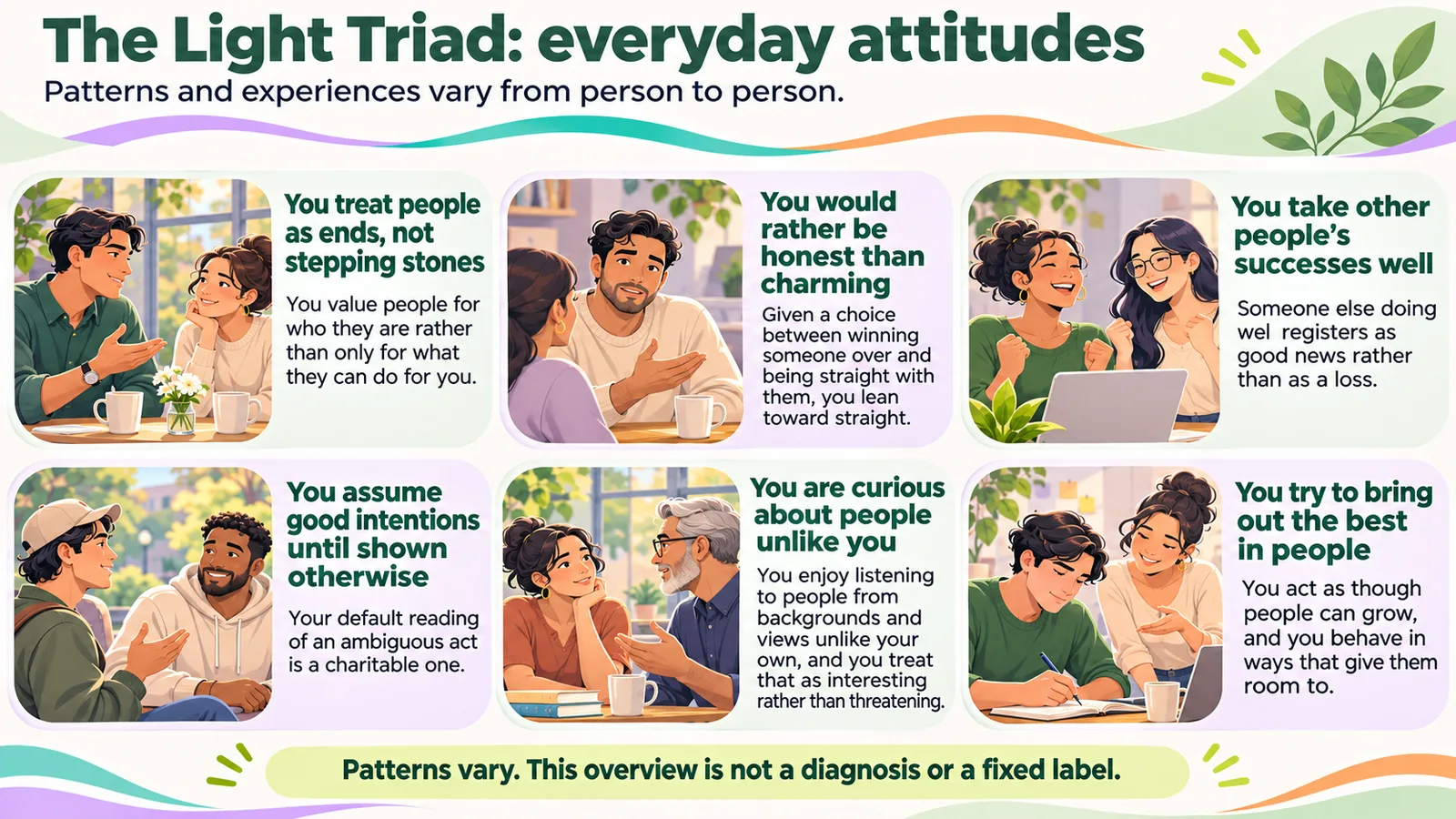
You treat people as ends, not stepping stones
The clearest marker. You deal with people as though their interests matter independently of what they can do for you, and you notice when you are tempted to do otherwise.
You would rather be honest than charming
Given a choice between winning someone over and being straight with them, you lean toward straight. Charm used as a tool sits badly with you even when it would work.
You take other people’s successes well
Someone else doing well registers as good news rather than as a loss. Envy may still arrive, but it does not drive what you do next.
You assume good intentions until shown otherwise
Your default reading of an ambiguous act is a charitable one. This is the Faith in Humanity facet, and it is the one that takes the most knocks.
You are curious about people unlike you
You enjoy listening to people from backgrounds and views unlike your own, and you treat that as interesting rather than threatening.
You try to bring out the best in people
You act as though people can grow, and you behave in ways that give them room to. This is the facet most visible to everyone around you.
Light triad vs. dark triad
These are two separate measures, not two ends of one ruler. The research that produced the light triad was explicitly designed to test that distinction.
| Feature | Light triad | Dark triad |
|---|---|---|
| What it describes | A benevolent orientation toward other people. | A callous, self-serving orientation toward other people. |
| The three parts | Kantianism, Humanism, Faith in Humanity. | Narcissism, Machiavellianism, psychopathy. |
| How they relate | Correlated with the dark triad at r = −0.48 — related, but far from a mirror image. | The same moderate negative correlation, read from the other side. |
| Can you score high on both? | Yes. A moderate negative correlation leaves plenty of room for people who are high, low or mixed on both. | |
How researchers describe it
The three light traits
Kaufman and colleagues arrived at these three facets through exploratory and confirmatory factor analysis of an initial 36-item pool, settling on a three-factor solution. Five of this test’s statements map to each one.
- 01 Kantianism
Treating people as ends in themselves
Dealing with people as though they matter in their own right, rather than as means to an end. The label comes from Kant’s second formulation of the categorical imperative, and it is the facet most about how you use people rather than how you feel about them.
- 02 Humanism
Valuing the dignity and worth of each person
Treating every person as carrying worth, whoever they are, and enjoying the company and successes of people unlike you. This is the warm, outward-facing facet.
- 03 Faith in Humanity
Believing people are fundamentally good
Expecting good intentions from people in general, and continuing to expect them after being let down. This is the most fragile of the three, and the one life experience moves most.
A high score does not certify anyone as a good person, and a low one does not accuse anyone of anything. These are self-reported dispositions, not conduct. People also differ in how generously they rate themselves, which self-report cannot separate out. Read the result as a description of an orientation, not as a moral grade.
Understanding the context
Where does a light profile come from?
The research here is young and largely correlational, so what follows describes what travels with these traits rather than what causes them.
Being treated well, and early
Kaufman and colleagues found the light triad associated with less childhood unpredictability, and with a secure sense of self. Being reliably well treated early on makes expecting good faith later a cheaper bet.
Having enough to be generous with
The light profile travels with higher life satisfaction, self-esteem and a sense of competence. Generosity is easier from a position of security, which is one reason a low score often says more about circumstances than about character.
What experience has taught you
Faith in Humanity is the facet most exposed to evidence. People who have been repeatedly exploited often score lower on it while remaining entirely humane in how they treat others — a sensible update, not a defect.
What can actually change
Can the light traits grow?
Traits are relatively stable, but all three of these describe things you do as much as things you are, and behaviour moves more readily than disposition.
- 01 / NOTICE THE USE
Catch the instrumental moment
Kantianism is the most actionable facet. Noticing the moment you start treating someone as a route to something, and choosing differently, is a concrete act rather than a feeling to summon.
- 02 / CONTACT
Spend time with people unlike you
Humanism is fed by contact and starved by abstraction. It is easier to value people in general when you know some specific ones who are not like you.
- 03 / CALIBRATE, DON’T INFLATE
Aim for accurate, not high
Faith in Humanity is not improved by deciding to trust everyone. The goal is a reading that matches your actual circumstances; indiscriminate trust is a vulnerability, not a virtue.
Research background: Kaufman et al. (2019), The Light vs. Dark Triad of Personality. This page is educational and is not clinical advice.
Practical next steps
What should you do with your result?
Treat it as a description of a stance you take toward people, and one you can examine. The useful question is not “am I good?” but “which of the three is doing the work, and which is thin?”
- 01
Read the three traits separately
A middling total can hide a high Kantianism with a low Faith in Humanity, which is a very different profile from an even spread. Look at which statements you agreed with.
- 02
Check it against someone who knows you
Self-report on desirable traits is the least reliable kind. Ask someone honest whether the profile matches how you actually come across.
- 03
Set it beside the other side
Because light and dark are only moderately related, the fuller picture needs both. Taking the dark triad test as well tells you more than either alone.
It is worth saying plainly: this measures one slice of personality, and a low score is not a diagnosis of anything. If persistent cynicism, mistrust or a low opinion of yourself is making life harder, a therapist is a reasonable person to talk to about it. Anyone in distress can find a helpline at findahelpline.com. A questionnaire is not the right tool for that conversation.
Good questions to ask
Light triad test FAQs
Short, practical answers to the most common questions about the light triad and this test.
“Everyday saint” is the phrase Kaufman and colleagues used to describe the high end of this scale, and it is a shorthand rather than a category. The light triad is a continuum. A high score says your self-reported orientation toward people is consistently benevolent, not that you have been certified as good.
The light triad is a measure of a benevolent orientation toward other people, made up of three facets: Kantianism, treating people as ends in themselves; Humanism, valuing each person’s dignity and worth; and Faith in Humanity, believing people are fundamentally good. It was introduced by Kaufman and colleagues in 2019.
No, and that was one of the study’s main findings. The two correlate at r = −0.48, a moderate negative relationship. If one were simply the inverse of the other you would expect something close to −1. In practice people can be high on both, low on both, or mixed.
Not automatically. Faith in Humanity in particular can be well calibrated or badly calibrated. Expecting good intentions is an asset among trustworthy people and a liability among untrustworthy ones, and the scale cannot tell the difference. Treat a very high score as worth examining rather than as a prize.
Easily, and that is the main limit of a test like this. Every statement has an obviously flattering answer. The result is only informative to the degree you resisted that pull, which is why the page asks you to answer for how you generally are rather than how you would like to be. Dark Triad — the test is a self-reflection tool, and reading it alongside the dark triad gives a fuller picture than either on its own.
No. The light triad is not a condition and there is nothing here to diagnose. This is an educational self-check, not a clinical instrument, and it cannot confirm or rule out anything about you.
Partly. Traits are relatively stable, but each facet describes behaviour as well as disposition, and behaviour moves more readily. Kantianism is the most actionable: it is largely about noticing when you are treating someone as a means and choosing otherwise.
No. The scale measures one orientation, and ordinary caution about strangers pulls scores down without saying anything about how you treat the people in your life. A low score is a prompt to look at which facet is low, not a verdict.
Yes. The test is free, needs no account or sign-up, and your result appears immediately in your browser.
Editorial transparency
Sources and review information
This test is based on the Light Triad Scale introduced by Kaufman, Yaden, Hyde and Tsukayama (2019), whose article is open access under a Creative Commons Attribution licence. Several statements here are adapted from their published scale, which that licence permits with credit; the rest are original statements written to give each of the three facets equal weight. Content is written and reviewed by the PsyMed Editorial Team from the public sources listed here. We are writers and researchers, not clinicians, and this page is educational rather than diagnostic. Read how we build our tests and who we are.
Research and editorial references
- Kaufman, S.B., Yaden, D.B., Hyde, E., & Tsukayama, E. (2019). The Light vs. Dark Triad of Personality: Contrasting Two Very Different Profiles of Human Nature. Frontiers in Psychology, 10, 467. Open access under CC BY 4.0. doi.org/10.3389/fpsyg.2019.00467
- Paulhus, D.L., & Williams, K.M. (2002). The Dark Triad of personality: Narcissism, Machiavellianism, and psychopathy. Journal of Research in Personality, 36(6), 556–563. doi.org/10.1016/S0092-6566(02)00505-6
- Kant, I. (1785). Groundwork of the Metaphysics of Morals — the source of the “ends, not means” formulation the Kantianism facet is named for.
- Kaufman, S.B., et al. (2019), Table 3 — the 12-item Light Triad Scale and its three-factor solution, which this 15-statement version is adapted from.
A stance, not a score
The useful part is which trait is doing the work.
Use this check-in to look at how you actually orient toward other people, and treat the three traits separately rather than chasing a total.
Take the self-check