Self-check · Personality and dark traits
Dark Empath Test: dark traits plus real empathy.
Sixteen statements scored on two separate dimensions — eight for dark traits, eight for empathy — placing you in one of four profiles. Free, private, no sign-up.

A research profile, not a clinical category. The 16-point line is a convenient midpoint rather than a validated cutoff.
-
THE SELF-CHECK16 questions, two scoresEight on dark traits, eight on empathy.
-
PRIVACY FIRSTNo account neededFree to take, with no sign-up. Your result appears right away.
-
CLEAR BOUNDARIESA profile, not a diagnosisThese are ordinary traits on a spectrum.
The self-check
Take the dark empath test
Think about how you generally are, not how you were once. There are no right answers, and a high score on either dimension does not make you a villain. This exercise supports reflection; it does not diagnose anything.
Your result
Two scores, not one band
- Dark Traits questions 1–8, scored 0–32
- Empathy questions 9–16, scored 0–32
- 16 or above counts as high on that dimension
- High on both is the dark empath profile
Each answer scores 0 (Strongly disagree) to 4 (Strongly agree). Both scores are worked out for you and shown with your result, along with which of the four profiles you fit. They are not clinical cutoffs.
Roughly the share who fell into the dark empath profile in the original study.
The short answer
What is a dark empath?
A dark empath is someone who combines elevated dark personality traits with above-average empathy — a mix psychology long assumed barely existed. The Dark Triad has traditionally been associated with low empathy; the stereotype of the manipulator is someone who simply does not feel for others. The dark empath breaks that mould: the self-interested, status-seeking tendencies are there, but so is the ability to read emotions and even share them.
The concept comes from a 2021 study by Nadja Heym, Alexander Sumich and colleagues at Nottingham Trent University. Dark empaths scored higher than both the traditional dark triad group and typical people on both kinds of empathy: cognitive empathy, meaning understanding what others feel, and affective empathy, meaning actually feeling it with them.
The warmth is real. That is precisely what makes the self-serving moments easy to miss.
In a survey of around 1,000 people, Heym, Sumich and colleagues used latent profile analysis and found that respondents clustered into four distinct groups, with roughly one in five falling into the dark empath profile. These are group proportions from one study, not a way to judge an individual.
View sourceKnow the signs
What does a dark empath look like?
Dark empaths share a recognizable set of signs that set them apart from both ordinary empaths and classic dark-triad types. You do not need all of them; the telling thing is the combination of genuine emotional attunement with a self-serving edge.
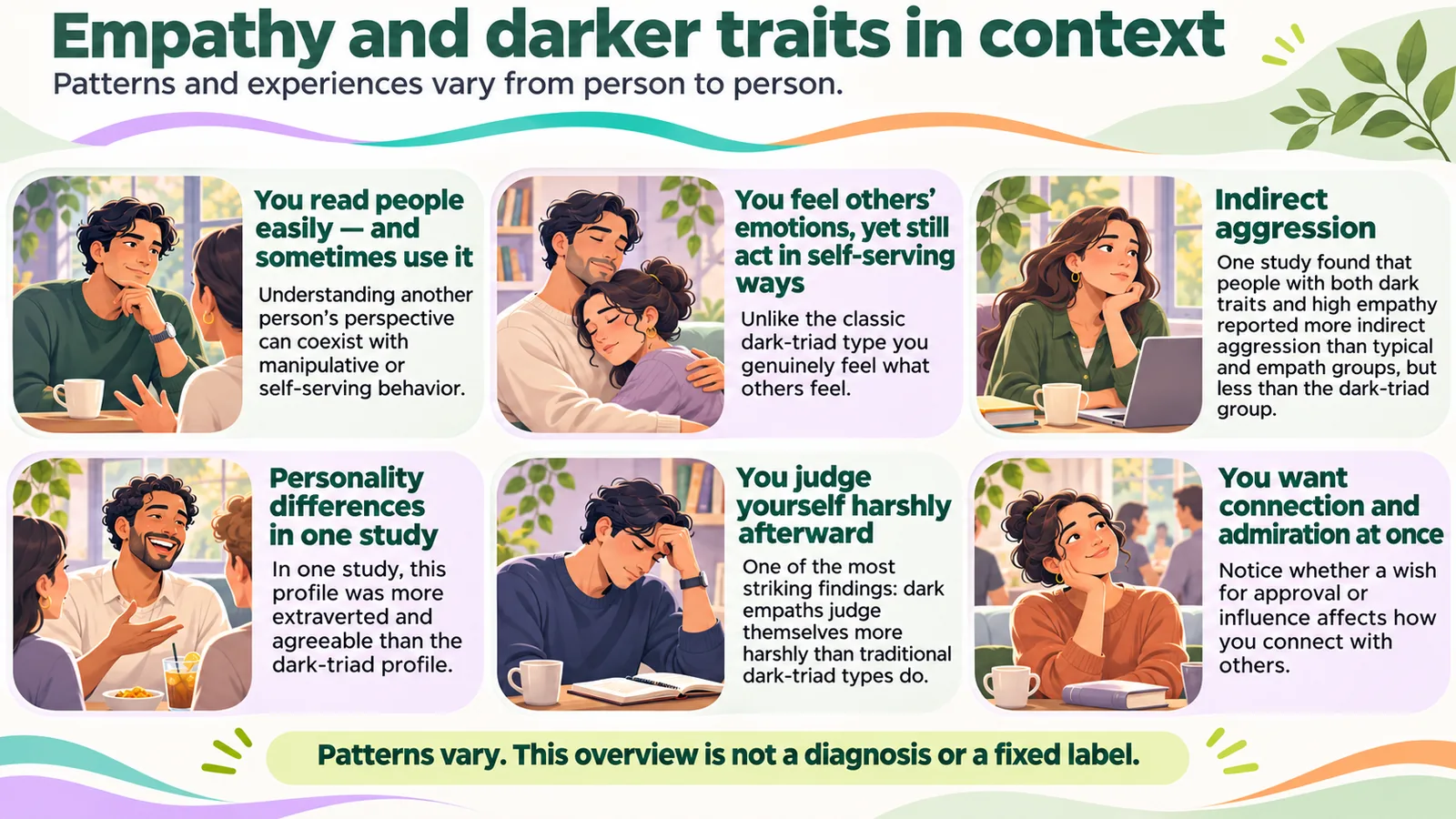
You read people easily — and sometimes use it
Strong cognitive empathy: you quickly sense what someone feels, wants and is vulnerable about. The dark-empath twist is that the skill doubles as a tool, used to influence or get the upper hand rather than only to connect.
You feel others’ emotions, yet still act in self-serving ways
Unlike the classic dark-triad type you genuinely feel what others feel. But that feeling does not always stop you pursuing your own interests or coming out ahead. Living with both impulses at once is the core of the experience.
Your aggression tends to be indirect
Research found dark empaths less overtly aggressive than traditional dark-triad types but more prone to indirect aggression than most people: guilt-tripping, subtle exclusion, backhanded humour. Empathy makes blunt cruelty unappealing but can sharpen the subtler kind.
You’re socially skilled and often well-liked
Dark empaths tend to be more extroverted and agreeable than traditional dark-triad types, with real charm and social fluency. This is part of why the profile is hard to detect: the warmth is genuine, which makes the self-serving moments easy to excuse.
You judge yourself harshly afterward
One of the most striking findings: dark empaths judge themselves more harshly than traditional dark-triad types do. Because you feel for the people affected, you are more likely to experience guilt or inner conflict — your conscience is online even when your actions do not follow it.
You want connection and admiration at once
You enjoy social interaction genuinely, but part of the draw can be a wish to be admired, to influence, or to come out on top. That blend of authentic warmth and a status-seeking undercurrent is distinctive to the pattern.
The four profiles
Two dimensions produce four groups. The percentages are the proportions found in the original study, not fixed facts about the population.
| Profile | Dark traits | Empathy |
|---|---|---|
| Dark empath — around 20% | High | High |
| Traditional dark triad — around 13% | High | Low |
| Empath — around 33% | Low | High |
| Typical — around 34%, the most common profile: low to average on both dimensions, an everyday balance. | ||
How the result is worked out
How this test is scored
Because the profile depends on two things at once, this test produces two scores rather than one severity band.
- 01 Dark traits
Questions 1 to 8
Eight statements tapping self-interest, manipulation and status-seeking, scored 0 to 4 each for a subtotal of 0–32.
- 02 Empathy
Questions 9 to 16
Eight statements tapping both understanding others’ emotions and feeling them, scored the same way for a second subtotal of 0–32.
- 03 Your profile
Where the two scores land
A subtotal of 16 or above counts as high on that dimension. High on both is the dark empath profile; the other three combinations give the other three profiles.
Neither dark traits nor empathy is a condition in the DSM-5, and “dark empath” is a research profile rather than a clinical category. The 16-point line is a convenient midpoint, not a validated cutoff, and this page cannot confirm or rule out anything about you.
Understanding the context
Where does the combination come from?
Research on this profile is recent and largely descriptive, so there is no established account of its origins. What follows is context about the two ingredients rather than a causal explanation.
Empathy is a skill as well as a feeling
Cognitive empathy — accurately reading people — can be developed, practised and deployed. It does not automatically come with a motive to be kind, which is part of why the combination is possible at all.
Environments that reward reading the room
Settings where social perceptiveness pays, and where advancement depends on influence, can sharpen both the attunement and the willingness to use it.
Conscience without a brake
Dark empaths report more guilt than traditional dark-triad types, which suggests the moral feeling is present but does not always govern behaviour. That gap, rather than an absence of conscience, is what characterises the profile.
What to do with it
Living with a dark empath profile
There is nothing to treat in the clinical sense. But if the self-serving side keeps overriding the empathic one, that gap is workable, and your empathy is the lever.
- 01 / SELF-AWARENESS
Notice which one is driving
In any given moment you are either reading someone in order to help them or in order to position yourself. Learning to tell the difference in real time is the single most useful thing this profile can be given.
- 02 / PROFESSIONAL SUPPORT
Talking to someone qualified
The guilt that dark empaths report is genuinely uncomfortable to live with, and a therapist can work with both halves of the pattern. You do not need a diagnosis to start, and the inner conflict is a legitimate reason on its own.
- 03 / INDIRECT AGGRESSION
Watch the subtle channel
Because blunt cruelty feels unappealing, the harm tends to travel through guilt-tripping, exclusion and barbed humour instead. Naming those specific behaviours makes them much easier to stop than a vague resolve to be nicer.
Research background: Heym et al. (2021), The Dark Empath. This page is educational and is not clinical advice.
Practical next steps
What should you do with your result?
Treat it as self-knowledge rather than a label. Of the four profiles, the dark empath is the one where self-awareness changes the most.
- 01
Look at both scores, not the label
The profile name is a convenience. What is actually informative is how high each subtotal ran and how far apart they were.
- 02
Ask where the guilt comes from
If the result landed and something in you recognised it, that recognition is data. The specific episodes your mind goes to are more useful than the score.
- 03
Check the subtle behaviours
Guilt-tripping, quiet exclusion and malicious humour are the characteristic channels. Pick one and watch for it over a week before trying to change anything.
A licensed mental health professional can help with interpersonal patterns, and you do not need a diagnosis to start. If you are in distress, in the US call or text 988 (Suicide & Crisis Lifeline, 24/7). If anyone is in immediate danger, call 911 or your local emergency number. Elsewhere, find a helpline at findahelpline.com.
Good questions to ask
Dark empath test FAQs
Short, practical answers to the most common questions about the dark empath profile and this test.
This test gives you two scores and tells you which of the four profiles they place you in, with high on both dimensions being the dark empath pattern. Treat that as a description rather than an identity: the 16-point line is a convenient midpoint rather than a validated cutoff, and all four profiles are ordinary positions on two ordinary spectrums. What is genuinely informative is how high each subtotal ran and whether the description of the pattern rings true to you.
Someone who combines elevated dark personality traits with above-average empathy. The concept comes from a 2021 study by Nadja Heym, Alexander Sumich and colleagues at Nottingham Trent University, who surveyed around 1,000 people and found four distinct clusters. Dark empaths scored higher than both the traditional dark triad group and typical people on cognitive empathy, meaning understanding what others feel, and on affective empathy, meaning feeling it with them.
Less overtly than the traditional dark triad profile, but the research found a distinctive pattern of indirect aggression: guilt-tripping, subtle social exclusion, backhanded humour and quiet manipulation rather than open confrontation. Empathy makes blunt cruelty unappealing, but it can sharpen the subtler kind. No questionnaire can predict what any individual will do.
Because the profile is defined by a combination. A high dark-traits score on its own describes the traditional dark triad; a high empathy score on its own describes an empath. Only the two together make the dark empath pattern, so collapsing them into a single severity band would destroy the thing the test is measuring.
Yes, and that is precisely the finding that made the profile interesting. Empathy has a cognitive component — accurately reading people — that is a skill, and a skill can be used for connection or for leverage. Feeling what someone feels does not automatically produce a motive to protect them, although dark empaths do report more guilt about it afterward than traditional dark-triad types.
No. Neither dark traits nor empathy is a condition in the DSM-5, and “dark empath” is a research profile rather than a clinical category. The 16 statements here are an original educational questionnaire written to reflect the two dimensions used in the research; they are not a validated instrument and the 16-point line is not a clinical cutoff.
In the original study of around 1,000 people, roughly one in five fell into it, making it the second most common of the four groups after the typical profile at about a third. Those are proportions from a single sample rather than established population figures, and they will vary with who is surveyed and how the dimensions are measured.
You can work it out from your answers directly. Add up questions 1 to 8 for your Dark Traits score and questions 9 to 16 for your Empathy score, each out of 32, scoring Strongly Disagree as 0 up to Strongly Agree as 4. A subtotal of 16 or above is high on that dimension, and high on both is the dark empath profile.
Yes. The test is free, needs no account or sign-up, and your result appears immediately on this page. You are welcome to take it more than once, and nothing obliges you to share the outcome with anyone.
Editorial transparency
Sources and review information
This test is based on the dark empath profile identified by Nadja Heym, Alexander Sumich and colleagues. Its 16 items are original statements written to reflect the two dimensions the research uses — dark traits and empathy — and it is not a reproduction of the Short Dark Triad, the Questionnaire of Cognitive and Affective Empathy or any other published instrument. It is not a diagnostic tool. Prepared by the PsyMed Editorial Team from the public sources listed here. We are writers and researchers, not clinicians, and no licensed clinician is claimed as a reviewer. Read how we build our tests and who we are.
Research and editorial references
- Heym, N., Kibowski, F., Bloxsom, C.A.J., Blanchard, A., Harper, A., Wallace, L., Firth, J., & Sumich, A. (2021). The Dark Empath: characterising dark traits in the presence of empathy. Personality and Individual Differences, 169, 110172. doi.org/10.1016/j.paid.2020.110172
- Paulhus, D.L., & Williams, K.M. (2002). The Dark Triad of personality: narcissism, Machiavellianism, and psychopathy. Journal of Research in Personality, 36(6), 556–563. doi.org/10.1016/S0092-6566(02)00505-6
- Moshagen, M., Hilbig, B.E., & Zettler, I. (2018). The dark core of personality. Psychological Review, 125(5), 656–688. doi.org/10.1037/rev0000111
- American Psychiatric Association. (2022). Diagnostic and Statistical Manual of Mental Disorders (5th ed., text rev.) — referenced above only to note that these traits are not DSM-5 conditions.
Self-awareness is the lever
Both halves of the pattern are real.
Use this check-in to see how your two dimensions sit together, and speak with a qualified professional if the self-serving side keeps overriding the empathic one.
Take the self-check