
Self-check · Personality and dark traits
Sadism Test: measure everyday sadism honestly.
Fifteen statements on finding reward in others' pain, fear or humiliation. Free, private and scored 0–60 across the three forms the trait takes — a trait measure, not a diagnosis.
A reflection exercise on a personality trait. This does not assess sexual sadism disorder, which is a separate clinical diagnosis.
-
THE SELF-CHECK15 focused questionsCovering the three forms everyday sadism takes.
-
PRIVACY FIRSTNo account neededFree to take, with no sign-up. Your result appears right away.
-
CLEAR BOUNDARIESA trait, not a diagnosisThis measures everyday sadism, not sexual sadism disorder.
The self-check
Take the sadism test
Think about how you generally are, not how you felt once. Answering honestly takes a willingness to look at an uncomfortable part of personality. There are no right answers, and this exercise supports reflection rather than diagnosing anything.
Your score
What the bands mean
- 0–15 Very low — others’ suffering is genuinely unpleasant to you
- 16–30 Low to moderate — mostly mild, common tendencies
- 31–45 Elevated — notable tendencies that may extend beyond the vicarious
- 46–60 High — a consistent pattern of finding reward in others’ suffering
Each answer scores 0 (Strongly disagree) to 4 (Strongly agree), for a total of 0–60. Bands describe how strongly you endorsed these statements. They are not clinical cutoffs.
Vicarious, verbal and physical. Most people lean toward one or two.
The short answer
What is everyday sadism?
Everyday sadism is the tendency of otherwise ordinary people to derive enjoyment, satisfaction or a sense of power from others’ pain, fear or humiliation. Unlike the extreme, criminal or sexual sadism that dominates headlines, the “everyday” or subclinical version describes a trait found across the general population in varying degrees, among people who function perfectly normally.
It was brought into mainstream personality research by Erin Buckels, Daniel Jones and Delroy Paulhus. What distinguishes it from the other dark traits is its signature feature: while the others involve harming someone in pursuit of a goal such as status, gain or dominance, sadism involves harming someone because the harm itself is the reward.
Subclinical means ordinary-range, not harmless. The milder vicarious forms are common; the direct ones are not.
In the study that established the trait, participants scoring higher on sadism were more likely to choose to harm bugs when offered the option, and to blast an unprovoking opponent with loud noise. The researchers also found that sadists reported lower baseline positive emotion, suggesting cruelty may generate feeling for people who otherwise feel little.
View sourceKnow the signs
What does everyday sadism look like?
The trait shows up as a recognizable cluster of signs, all centred on finding reward in others’ suffering. You do not need all of them, and the milder, more common ones carry far less weight than the direct ones.
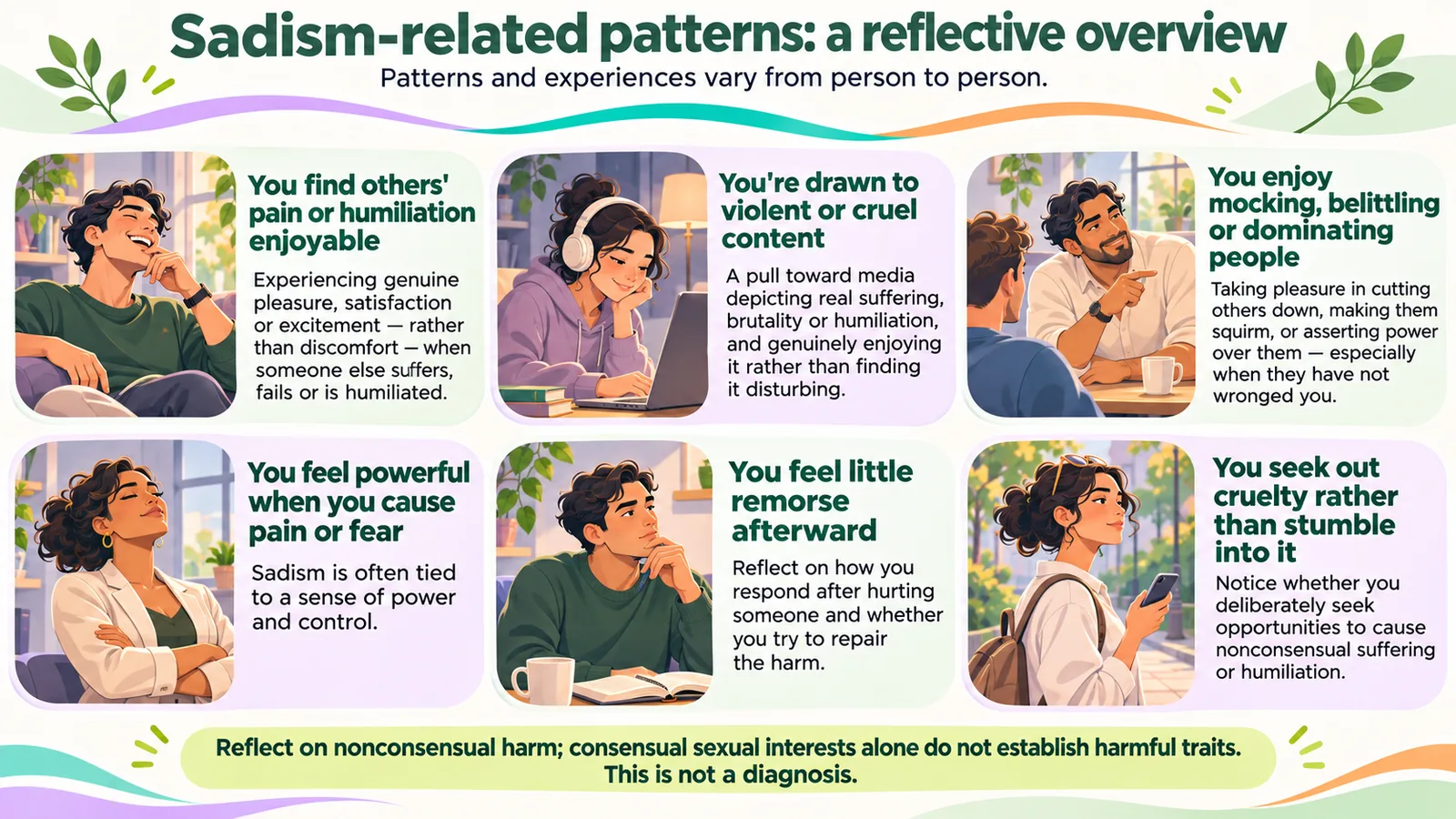
You find others’ pain or humiliation enjoyable
Experiencing genuine pleasure, satisfaction or excitement — rather than discomfort — when someone else suffers, fails or is humiliated. Where most people flinch, you feel a flicker of enjoyment.
You’re drawn to violent or cruel content
A pull toward media depicting real suffering, brutality or humiliation, and genuinely enjoying it rather than finding it disturbing. Alone and in moderation this is very common; it tells you more in combination with the other signs.
You enjoy mocking, belittling or dominating people
Taking pleasure in cutting others down, making them squirm, or asserting power over them — especially when they have not wronged you. The enjoyment comes from their discomfort, not from any goal it serves.
You feel powerful when you cause pain or fear
Sadism is often tied to a sense of power and control. If causing someone pain, fear or distress gives you a feeling of strength or superiority, that link between their suffering and your own sense of power is a central marker.
You feel little remorse afterward
Unlike people who feel guilt after hurting someone, those high in sadism tend to feel little remorse and sometimes satisfaction instead. The absence of the usual emotional brake is part of what defines the trait.
You seek out cruelty rather than stumble into it
Perhaps the most significant sign: going out of your way for the chance to dominate or torment. In the original research, sadists would even endure boredom for the opportunity. That deliberate pursuit separates the trait from a momentary cruel impulse.
Everyday sadism vs. sexual sadism disorder
These are genuinely different things, and confusing them helps nobody. This test measures the first.
| Feature | Everyday (subclinical) sadism | Sexual sadism disorder |
|---|---|---|
| What it is | A normal-range personality trait studied across the general population. | A clinical diagnosis in the DSM-5. |
| What it involves | Enjoying others’ suffering in non-sexual ways, in varying degrees. | Recurrent sexual arousal from another person’s physical or psychological suffering. |
| When it is a disorder | It is not a disorder; it is a dimension of personality. | When it causes significant distress or impairment, or involves non-consenting people. |
| Does this test assess it? | Only the first. A high score here reflects an everyday personality trait, not a paraphilic disorder. Concerns about non-consensual urges warrant a conversation with a qualified professional. | |
How researchers describe it
The three forms of everyday sadism
Research using instruments such as the Comprehensive Assessment of Sadistic Tendencies finds that the trait shows up in three main forms. Most people with sadistic tendencies lean toward one or two rather than all three.
- 01 Vicarious
Enjoying cruelty at a distance
Taking pleasure in violence or suffering through films, games, news, sport or online content. This is by far the most common and most socially acceptable form; enjoying a violent film is a mild example.
- 02 Verbal
Pleasure in cutting people down
Taking pleasure in mocking, humiliating or belittling others with words, and enjoying the discomfort it causes them.
- 03 Physical
Direct enjoyment of causing harm
Deriving enjoyment from directly causing physical pain or harm. This is the rarest and most serious form, and the one that most warrants a conversation with a professional.
Everyday sadism is a dimension of normal personality, not a condition in the DSM-5. There is no clinical threshold to cross and no diagnosis to receive. A score describes where you reported sitting on a spectrum, and this page cannot confirm or rule out anything about you.
Understanding the context
Where does everyday sadism come from?
There is no single cause, and research into the trait is younger than research into the other dark traits. Personality is generally understood to emerge from a mix of inherited temperament, experience and environment.
Blunted emotional response
The original research found that people higher in sadism reported lower baseline positive emotion, raising the possibility that cruelty generates feeling for people who otherwise feel relatively little.
Power, status and dominance
Sadistic enjoyment is frequently tied to a sense of control. Environments that reward dominance, or in which someone has felt powerless, may shape how that link develops.
Desensitisation and context
Repeated exposure to suffering, and settings where cruelty is normal or rewarded, can dull the ordinary discomfort most people feel. Context does not create the trait, but it can make expressing it easier.
What can actually change
Can sadistic tendencies change?
Personality traits are relatively stable, but behaviour is not fixed, and what you do with a tendency is largely within your control. There is nothing to “treat” in the clinical sense unless the behaviour is harming you or someone else.
- 01 / SELF-AWARENESS
Noticing the pattern
Recognising when the enjoyment arrives, and what it attaches to, is the step that makes everything else possible. Most people have never examined this honestly, which is the point of a test like this one.
- 02 / PROFESSIONAL SUPPORT
Talking to someone qualified
If the direct forms apply to you, if urges are getting harder to resist, or if your behaviour is damaging relationships, a mental health professional is the right person to talk to. Seeking that out is not an admission of being dangerous.
- 03 / BEHAVIOUR, NOT FEELING
Changing what you do
You are not responsible for an impulse arriving, but you are responsible for acting on it. Distance from situations that invite cruelty, and repair when you have caused harm, are concrete and achievable.
Research background: Paulhus (2014), Toward a taxonomy of dark personalities. This page is educational and is not clinical advice.
Practical next steps
What should you do with your result?
Treat it as self-knowledge rather than a verdict. The useful question is not “am I a bad person” but “what do I do with this”.
- 01
Separate the forms
Work out whether your score came mainly from the vicarious items or from the verbal and direct ones. Enjoying violent media is a very different matter from enjoying humiliating a real person.
- 02
Ask who is affected
Consider whether anyone around you has been on the receiving end of this. If the honest answer is yes, that is the most useful thing the result can tell you.
- 03
Talk to someone if the direct forms apply
If you take pleasure in causing real harm, or urges are becoming harder to resist, speak to a qualified mental health professional. That conversation is available to you and it is confidential.
Please speak to a mental health professional. In the US you can call or text 988 (Suicide & Crisis Lifeline, 24/7), which also supports people distressed about harming others. If anyone is in immediate danger, call 911 or your local emergency number. Elsewhere, find a helpline at findahelpline.com. A questionnaire is not the right tool for an urgent situation.
Good questions to ask
Sadism test FAQs
Short, practical answers to the most common questions about everyday sadism and this test.
“Sadist” is not a category you are either in or out of. Everyday sadism is a dimension of personality that the whole population sits somewhere on, and this test describes roughly where you reported sitting. A higher score does not make you dangerous or a monster, and a lower one does not make you a saint. What matters far more than the number is which forms it came from: enjoying violent media is common and mild, while taking pleasure in humiliating or hurting real people is the part worth acting on.
Everyday sadism is a personality trait describing the tendency of ordinary people to take pleasure in others’ suffering, humiliation or discomfort, in non-sexual, everyday ways. It exists on a spectrum in the general population, from mild forms such as enjoying violent entertainment to more serious ones such as deliberately tormenting others. It was established in mainstream research by Erin Buckels, Daniel Jones and Delroy Paulhus, whose 2013 studies showed that people higher in sadism would choose to hurt innocent targets even without provocation.
Mildly, and very commonly — but on its own it means little. Enjoying violent or intense media is called vicarious sadism, the most common and most socially acceptable form, and vast numbers of people who are not meaningfully sadistic enjoy action films, true crime or combat sports. It becomes telling only in combination with the other signs, particularly taking pleasure in the real suffering of actual people around you.
They are different things. The everyday sadism this test measures is a non-sexual personality trait found across the normal population. Sexual sadism disorder is a separate clinical diagnosis in the DSM-5, involving recurrent sexual arousal from another person’s physical or psychological suffering that causes significant distress or impairment, or that involves non-consenting people. A high score here reflects an everyday trait, not a sexual disorder. If concerns about non-consensual urges apply to you, that is important to discuss with a qualified professional.
Sadism is often called the fourth dark trait. Researchers originally studied the Dark Triad — narcissism, Machiavellianism and psychopathy — but Buckels and colleagues showed that sadism predicts aggressive, harmful behaviour over and above those three, which led to the Dark Tetrad. The distinguishing feature is that the other traits involve harming someone in pursuit of a goal, while sadism involves harming someone because the harm itself is enjoyable.
No. Everyday sadism is not a condition in the DSM-5, so there is no diagnosis to make. The 15 statements on this page are an original educational questionnaire written to reflect the three recognized forms of the trait; they are not a validated clinical scale and not a reproduction of research instruments such as the SSIS or CAST. The bands are a guide, not cutoffs.
Personality traits are relatively stable, so the honest answer is that the underlying tendency is unlikely to vanish. Behaviour is a different matter and is largely within your control. Noticing when the enjoyment arrives, keeping distance from situations that invite cruelty, repairing harm you have caused, and talking to a professional if the direct forms apply are all realistic. You are not responsible for an impulse arriving; you are responsible for what you do with it.
No. A questionnaire score cannot predict what any individual will do. It describes self-reported attitudes, not behaviour, and most people who score higher on everyday sadism never seriously harm anyone. If you are worried you might, that worry is itself a good reason to speak with a mental health professional rather than to rely on a test.
Yes. The test is free, needs no account or sign-up, and your result appears immediately on this page. You are welcome to take it more than once, and nothing obliges you to share the outcome with anyone.
Editorial transparency
Sources and review information
This test is based on the research concept of everyday (subclinical) sadism established by Erin Buckels, Daniel Jones and Delroy Paulhus. Its 15 items are original statements written to reflect the three recognized forms of the trait and the core experience of finding reward in others’ suffering. It is not a reproduction of the Short Sadistic Impulse Scale or the Comprehensive Assessment of Sadistic Tendencies, and it is not a diagnostic instrument. Prepared by the PsyMed Editorial Team from the public sources listed here. We are writers and researchers, not clinicians, and no licensed clinician is claimed as a reviewer. Read how we build our tests and who we are.
Research and editorial references
- Buckels, E.E., Jones, D.N., & Paulhus, D.L. (2013). Behavioral confirmation of everyday sadism. Psychological Science, 24(11), 2201–2209. doi.org/10.1177/0956797613490749
- Paulhus, D.L. (2014). Toward a taxonomy of dark personalities. Current Directions in Psychological Science, 23(6), 421–426. doi.org/10.1177/0963721414547737
- Buckels, E.E., & Paulhus, D.L. (2014). Comprehensive Assessment of Sadistic Tendencies (CAST). Unpublished measure, University of British Columbia.
- American Psychiatric Association. (2022). Diagnostic and Statistical Manual of Mental Disorders (5th ed., text rev.) — for the sexual sadism disorder criteria referenced above.
Self-knowledge, not a verdict
Knowing where you sit is the useful part.
Use this check-in to look honestly at a real and well-studied part of personality, and speak with a qualified professional if the direct forms apply to you.
Take the self-check