
Emotional & trait assessments
Masochistic Personality Spectrum Test: reflect with care
Explore self-critical habits, over-giving, and difficulty accepting care in 15 statements. This historical term is not a current diagnosis; the score does not define you.
For adults. Not a diagnosis, a sexual-interest test, or an explanation for abuse.
-
THE SELF-CHECK15 statementsReflect on your general tendencies with care.
-
PRIVACY FIRSTNo account neededFree to take, with no sign-up. Your result appears right away.
-
CLEAR BOUNDARIESInformation, not a diagnosisLearn what your answers can and cannot tell you.
The self-check
Take the masochistic personality spectrum test
An adult self-reflection exercise about self-criticism, over-giving, and difficulty accepting care. Answer for how you generally are, rather than one difficult moment. This is not a diagnosis or an assessment of sexual interests. Stop if a statement feels upsetting; you do not need to finish.
Your answer total
What the bands mean
- 0–15 Total range 1
- 16–30 Total range 2
- 31–45 Total range 3
- 46–60 Total range 4
Each answer scores 0 (Strongly Disagree) to 4 (Strongly Agree). The 0–60 total summarizes agreement across these statements. It cannot establish a personality type, a disorder, or why something happened to you.
An item count, not evidence that this is a validated scale.
The short answer
What does masochistic personality mean here?
The masochistic personality spectrum test uses a historical term to explore self-defeating patterns such as harsh self-criticism or over-sacrifice. Masochistic personality is not a current DSM diagnosis, and this quiz cannot identify a disorder.
Prefer a concrete description of what troubles you over a fixed label. Difficulty accepting compliments, for example, is a different concern from someone controlling your choices. Our Self-Esteem Test explores another aspect of self-evaluation.
Consensual sexual interests are separate from this questionnaire. Abuse is the responsibility of the person using it; this score cannot show that you chose or deserved harm.
Self-esteem can change. NHS guidance describes challenging negative beliefs, practicing assertiveness, and seeking talking therapy as options for low self-esteem. This does not validate the quiz or prove a treatment for a supposed masochistic personality disorder.
Know the signs
Patterns you might want to reflect on
These are themes in the preserved questionnaire, not diagnostic signs or evidence about anyone’s motives. Consider individual examples and circumstances rather than treating the list as a profile.
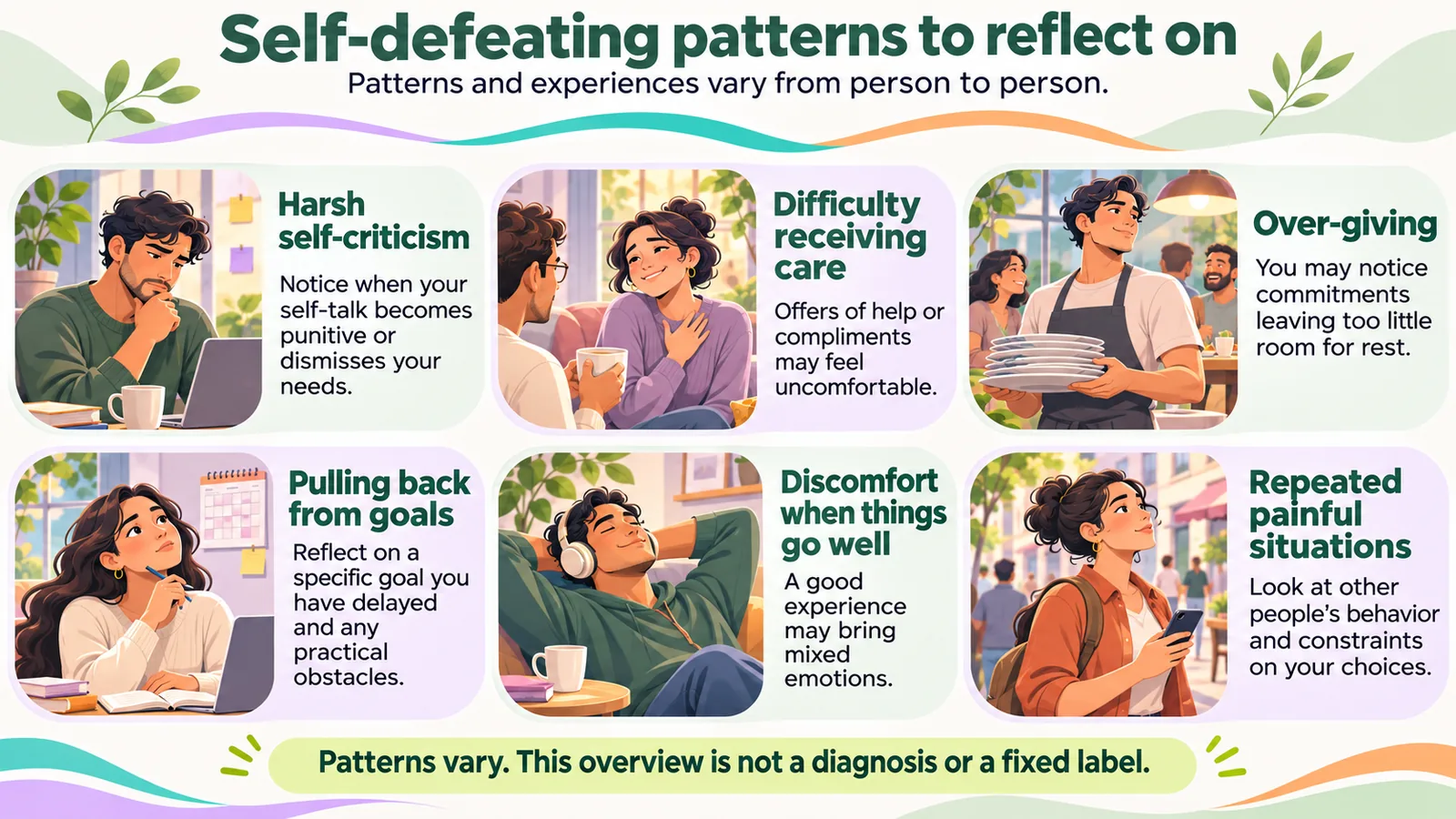
Harsh self-criticism
Notice when your self-talk becomes punitive or dismisses your needs. A feeling of guilt does not establish that you did anything wrong.
Difficulty receiving care
Offers of help or compliments may feel uncomfortable. Ask which forms of support feel useful and safe to you.
Over-giving
You may notice commitments leaving too little room for rest. The Codependency Test explores boundaries from another angle. Your needs matter too.
Pulling back from goals
Reflect on a specific goal you have delayed and any practical obstacles. The Imposter Syndrome Test explores doubts about accomplishments; neither quiz establishes a cause.
Discomfort when things go well
A good experience may bring mixed emotions. Feeling anxious about it is not proof that you want suffering.
Repeated painful situations
Look at other people’s behavior and constraints on your choices. Our Toxic Relationship Quiz focuses on relationship experiences. Repetition does not mean consent to harm.
Different experiences need different questions
A similar word does not make these the same thing.
| Topic | What to consider | What this quiz cannot establish |
|---|---|---|
| Self-critical habits | Specific thoughts, choices, and their impact. | A personality diagnosis or the origins of a habit. |
| Consensual sexual interests | Consent, personal distress, and individual circumstances. | Sexual interests or a sexual disorder. |
| Abuse or coercion | Another person’s harmful behavior and your safety. | That harm is wanted, caused by you, or deserved. |
| Low self-esteem | How you view yourself and what support may help. | A validated self-esteem assessment. |
Reading the total
How should you interpret this score?
Start with the experiences you recognize. A total gives much less information than the circumstances behind an answer.
- 01 Your answers
Read the items individually
The same total can come from very different answers. Review which statements fit, partly fit, or do not capture your situation.
- 02 The score
Keep the limitations visible
The inherited four ranges divide the 0–60 total. They have not been established as clinical thresholds and do not measure the likelihood of a disorder.
- 03 Your context
Discuss impact and safety
A qualified professional can explore distress, daily functioning, relationships, and what you want to change. A quiz cannot replace that conversation.
A high total cannot establish trauma, childhood experiences, a hidden desire for pain, or future behavior. A low total cannot rule out distress, coercion, or a need for support.
Understanding the context
What context might matter?
There is no single proven explanation for the broad collection of experiences in this house quiz. Explore what fits your life without assuming an origin story.
Self-beliefs
NHS guidance describes how negative beliefs and avoidance can reinforce low self-esteem. That is one possible concern, not an explanation for everyone’s answers.
Current demands
Consider workload, health, money, caring responsibilities, and the support available to you. Record real constraints instead of calling every setback self-sabotage.
Relationships and safety
Coercion and abuse can restrict choices. If another person is causing harm, focus on support and safety rather than assigning yourself a personality label.
Support that fits your concern
Support for the concerns behind your answers
You do not need a diagnosis or a high score to ask for support. Choose help for the concern you actually have.
- 01 / SELF-KINDNESS
Question punitive beliefs
Try writing a self-critical thought and a fairer alternative, supported by an example. NHS self-esteem guidance offers exercises of this kind.
- 02 / TALKING SUPPORT
Discuss what gets in the way
Counseling or CBT may help with low self-esteem. A professional can work with your goals; there is no treatment recommendation that follows from this quiz total alone.
- 03 / SAFETY AND CHOICE
Get support with harmful relationships
A relationship safety advocate can help you consider options without requiring you to confront someone or leave immediately. Use support in ways that account for your safety.
Practical next steps
What can you do next?
Choose a small, realistic step based on what is affecting you, whatever your score.
- 01
Choose one example
Describe a recent situation, your thoughts, what you did, and what you needed. Keep notes only if storing them is safe.
- 02
Try a safe adjustment
In a respectful setting, practice a small boundary, accept a manageable offer of help, or set aside time for a personal priority.
- 03
Ask for the right support
Talk with someone you trust or a qualified professional if distress persists. For controlling or abusive behavior, seek a safety advocate’s guidance.
If someone is hurting, threatening, or controlling you, it is not your fault. Consider personalized relationship safety planning using a device you can access safely. Avoid confrontation if it could increase danger. In immediate danger, contact local emergency services.
Good questions to ask
Masochistic personality spectrum test FAQs
Clear answers about this historical term, the questionnaire, and your next steps.
This quiz cannot tell you that, and masochistic personality is not a current DSM diagnosis. Describe the specific experiences concerning you instead of using the total as a personal label.
No. It does not assess sexual interests. Consensual atypical sexual interests do not by themselves establish a mental disorder; this questionnaire cannot assess a sexual disorder either.
No. It is an inherited 15-item house questionnaire. Its descriptive ranges are not validated clinical cutoffs, and its accuracy for identifying a condition has not been established.
No. A total cannot establish your history or explain why you answered as you did. There is no basis here for inferring childhood trauma, abuse, or a particular cause.
No. Abuse is the responsibility of the person causing it. A quiz cannot show that you want or deserve harm. Safety, practical barriers, and other circumstances matter; individualized safety planning can help you explore options.
Several inherited items combine experiences. Choose the closest answer if you want to continue, but recognize that it may not represent you well. You can stop; the total is less useful than your own account.
Yes, you can try small changes and ask for support. NHS guidance offers self-esteem exercises and notes that talking therapies can help with low self-esteem. This is not evidence for treating a supposed disorder identified by the quiz.
Nothing clinically. It does not rule out low self-esteem, distress, an unsafe relationship, or a mental health condition. Seek help for what is happening in your life regardless of the score.
Editorial transparency
Sources and review information
Prepared by the PsyMed Editorial Team. No licensed clinical reviewer is claimed. Independent source and scoring review: . The inherited item provenance and reproduction rights have not been independently established. Preserving them is not a claim that permission or validation has been verified.
Read how we build our tests and about PsyMed.
A gentler starting point
You deserve care without earning it through suffering.
Use the questions as prompts, then choose support for your real concerns. Your worth and right to safety do not depend on a result.
Take the self-check