

EAT-26: The Eating Attitudes Test
A free, private version of the 26-item Eating Attitudes Test (Garner et al., 1982), the most widely used screening questionnaire for eating disorder risk. Scored 0 to 78 exactly as published, with a cutoff of 20. This is a screening tool, not a diagnosis.
Published Updated
The EAT-26 (Eating Attitudes Test) is one of the most widely used screening questionnaires for eating disorder risk, and this is a free, private version you can take in a few minutes. Developed by researchers at the University of Toronto, it uses 26 questions about your attitudes toward food, eating, and body image to flag whether a professional conversation about disordered eating might be worthwhile. You’ll get an instant, confidential result.
An important note before you begin: the EAT-26 is a screening tool, not a diagnosis. A high score doesn’t mean you have an eating disorder, and a low score doesn’t rule one out — only a qualified health professional can assess and diagnose. What this test can do is help you notice patterns worth taking seriously. If anything here brings up distress, please be gentle with yourself, and know that support is available and that eating disorders are treatable — people recover.
What Is the EAT-26?
The EAT-26 is a 26-item self-report questionnaire that measures attitudes, feelings, and behaviors related to eating and body image, used worldwide to screen for the possibility of an eating disorder. It was created by David Garner and colleagues at the University of Toronto in 1982, as a shorter version of the original 40-item Eating Attitudes Test (EAT-40), and it has since become one of the most established and extensively researched screening instruments in the field. It’s used in schools, universities, clinics, and research studies as a simple, standardized first step.
Crucially, the EAT-26 does not diagnose a specific eating disorder such as anorexia nervosa or bulimia nervosa. Instead, it identifies whether someone shows enough eating-related concern to warrant a fuller evaluation by a professional. It’s a doorway, not a label. The questions tap three underlying areas: dieting and preoccupation with being thinner; thoughts about food and symptoms associated with bulimia; and control over eating, including pressure from others around food. A higher total score, or certain behaviors reported separately, signal that it would be wise to talk with a professional.
Signs of Disordered Eating
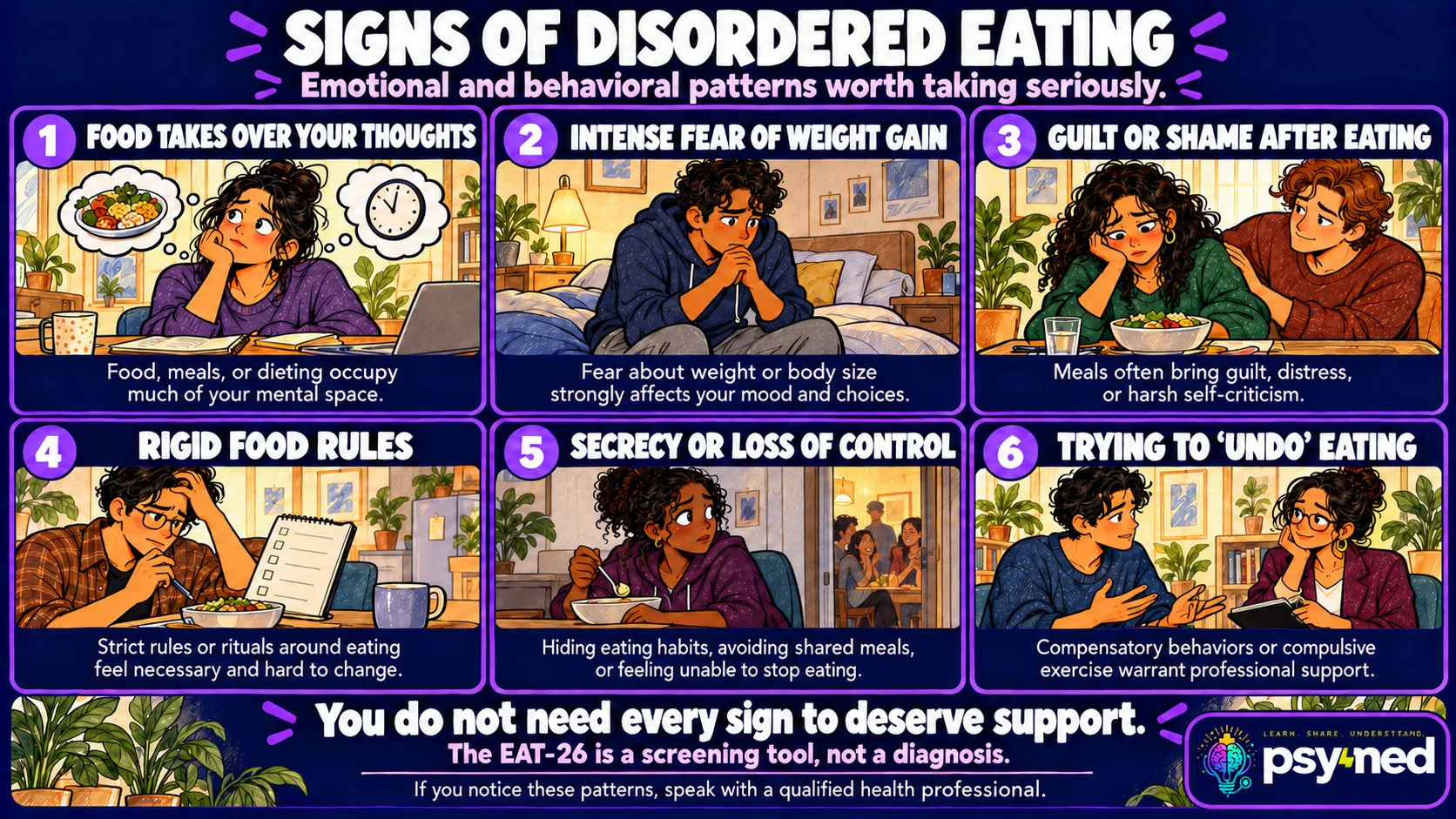
Disordered eating shows up as a recognizable set of warning signs — many of them emotional and behavioral rather than physical, and often hidden. You don’t need all of them, and noticing some doesn’t mean you have an eating disorder, but these are patterns worth taking seriously. Read them as the signs the EAT-26 is designed to help surface.
Preoccupation with food, eating, or dieting
Thoughts about food, meals, or dieting take up a large share of your mental space — planning, worrying, or feeling that food controls your life rather than the other way around. This ongoing preoccupation is one of the most consistent signs.
Intense fear of gaining weight or being larger
A persistent, distressing fear of weight gain, or feeling preoccupied with the idea of having fat on your body, that goes beyond ordinary health or appearance concerns and significantly affects your mood and choices.
Guilt, shame, or distress around eating
Eating — especially certain foods, or eating at all — is routinely followed by strong guilt, shame, or self-criticism, rather than being a neutral or enjoyable part of life.
Rigid rules or rituals around food
Strict rules about what, when, or how you can eat; cutting food into very small pieces; eating very slowly; avoiding whole categories of food; or other rituals that feel necessary and hard to break.
Secrecy, avoidance, or loss of control
Hiding eating habits, avoiding meals with others, eating in secret, or experiencing episodes that feel out of control — eating in a way you feel you can’t stop — followed by distress.
Compensatory behaviors
Trying to “undo” eating through behaviors like self-induced vomiting, using laxatives or diet pills, or compulsive exercise driven by a need to control weight or shape rather than for health or enjoyment. These are serious signs that warrant professional support regardless of anything else.
How This EAT-26 Test Works
The test presents 26 statements about your attitudes and behaviors around eating. For each, choose the response that best fits how you generally feel — Always, Usually, Often, Sometimes, Rarely, or Never. Answer based on your current attitudes, as honestly as you can. Your responses are completely private.
The EAT-26 is scored so that the responses reflecting more eating concern count toward your total, which ranges from 0 to 78. A score of 20 or higher is the established threshold that indicates it would be worthwhile to speak with a qualified professional for a fuller assessment. Just as importantly, there are a few additional questions about specific behaviors (below the main test) that indicate the same thing regardless of your total score — so please read those too.
Additional Behavioral Questions
These questions ask about specific behaviors over the past 6 months. A “yes” to any of them indicates it would be wise to speak with a professional, no matter what your EAT-26 score is:
- Have you gone on eating binges where you feel you may not be able to stop?
- Have you ever made yourself sick (vomited) to control your weight or shape?
- Have you ever used laxatives, diet pills, or diuretics to control your weight or shape?
- Have you ever been treated for an eating disorder?
Understanding Your EAT-26 Results
Your result centers on one validated threshold: a total score of 20 or more indicates that a conversation with a qualified professional is recommended. The ranges below add context, but the 20-point line — and any “yes” on the behavioral questions — are what matter most. Remember: this is a screen, not a diagnosis.
| Score | Range | What It Suggests |
|---|---|---|
| 0 – 10 | Low | Few eating-concern indicators on this screen. |
| 11 – 19 | Below Cutoff | Some concerns present, below the referral threshold — worth monitoring. |
| 20 – 39 | At/Above Cutoff | At or above the validated threshold — a professional evaluation is recommended. |
| 40 – 78 | High | Well above the threshold — a professional evaluation is strongly recommended. |
What to Do With Your Results
Whatever your score, the most useful next step is to treat this as information, not a verdict. If your score was 20 or above, or you answered “yes” to any behavioral question, the single best move is to share the result with a healthcare professional — your doctor is a good starting point and can refer you onward. It can feel daunting, but you don’t need the perfect words; “I’m worried about my relationship with food” is enough to begin.
If reaching out feels like too much right now, a smaller step helps: tell one trusted person what you’re experiencing, or contact the Alliance for Eating Disorders helpline (1-866-662-1235) for free, judgment-free guidance on where to turn. Because eating difficulties and low mood so often go together, it can also help to take our Clinical Depression Test to bring a fuller picture to whoever you speak with. Above all: struggling with food is not a failure of willpower or character, and it is not something you have to manage alone.
Methodology & Sources
This test reproduces the Eating Attitudes Test (EAT-26), developed by David M. Garner, Marion P. Olmsted, Yvonne Bohr, and Paul E. Garfinkel, and published in Psychological Medicine in 1982. The EAT-26 is made freely available by its authors for educational, clinical, and research use with appropriate citation. It is a standardized screening instrument, not a diagnostic tool, and results should always be interpreted in the context of a professional evaluation. This page presents the EAT-26 as an educational self-screening and is intentionally designed to be supportive and non-triggering, leaving out the body-measurement and numeric targets that the validated total-score screen does not require.
References
- Garner, D.M., Olmsted, M.P., Bohr, Y., & Garfinkel, P.E. (1982). The Eating Attitudes Test: psychometric features and clinical correlates. Psychological Medicine, 12(4), 871–878. doi.org/10.1017/S0033291700049163
- Garner, D.M., & Garfinkel, P.E. (1979). The Eating Attitudes Test: an index of the symptoms of anorexia nervosa. Psychological Medicine, 9(2), 273–279. doi.org/10.1017/S0033291700030762 [The original EAT-40]
- EAT-26 self-test and scoring information. eat-26.com
Frequently Asked Questions
What is the EAT-26 test?
The EAT-26 (Eating Attitudes Test) is a 26-question screening questionnaire that measures attitudes and behaviors related to eating, weight, and body image. Developed by David Garner and colleagues at the University of Toronto in 1982, it’s one of the most widely used eating disorder screening tools in the world. It doesn’t diagnose a specific eating disorder; instead, it indicates whether someone shows enough eating-related concern that a fuller professional evaluation would be worthwhile. It’s used in clinics, schools, universities, and research as a standardized, reliable first step.
What is a high score on the EAT-26?
A total score of 20 or more is the established cutoff indicating that a referral for professional evaluation is recommended. The score ranges from 0 to 78. However, the total score isn’t the only thing that matters: the EAT-26 also includes behavioral questions about binge eating, self-induced vomiting, and laxative or diet-pill use, and answering “yes” to any of these indicates a professional conversation is warranted regardless of your total score. A high score is a signal to seek assessment, not a diagnosis in itself.
Is the EAT-26 a diagnosis?
No. The EAT-26 is a screening tool, not a diagnostic instrument. It can indicate that eating-related concerns are present and that further evaluation would be helpful, but it cannot tell you whether you have a specific eating disorder such as anorexia nervosa, bulimia nervosa, or binge eating disorder. Only a qualified health professional can make that determination through a comprehensive assessment. A high score means “this is worth looking into with a professional,” and a low score doesn’t rule out a problem — if you’re struggling, your experience matters regardless of the number.
Can I have an eating disorder with a low EAT-26 score?
Yes. No screening tool is perfect, and it’s possible to have a serious problem with eating and not score above the cutoff — for example, if you don’t recognize or don’t report certain attitudes, or if your difficulties aren’t well captured by these particular questions. This is exactly why the behavioral questions matter regardless of score, and why a low number should never override your own sense that something is wrong. If you’re worried about your relationship with food, please talk to a professional even if your score is low. Trust your experience.
Related Tests
- Eating Disorder Test — a broader first look across eating disorder patterns
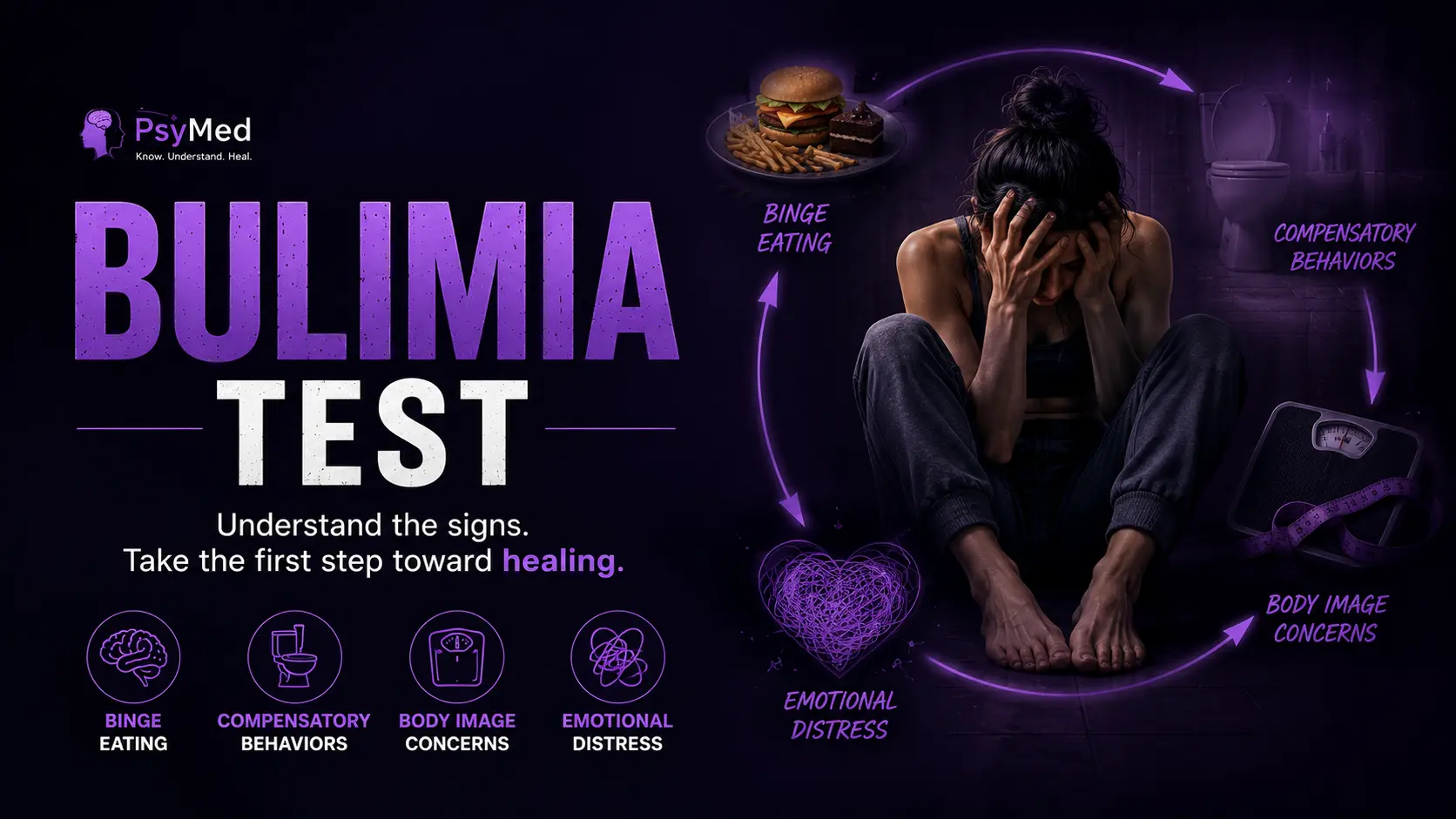
- Bulimia Test — focused screening for binge-and-compensate patterns
- Binge Eating Disorder Test — recurrent loss-of-control eating without compensating
- Anorexia Test — restriction and fear of weight gain
- ARFID Test — avoidant/restrictive eating not driven by body image
- Clinical Depression Test — depression often co-occurs with eating difficulties
- Anxiety Test — anxiety frequently accompanies disordered eating
- Self-Esteem Test — self-worth and body image are closely linked
The EAT-26 is a screening tool for educational purposes and is not a diagnosis or a substitute for professional care. If you’re concerned about an eating disorder, the National Alliance for Eating Disorders helpline (1-866-662-1235) offers free, confidential support and treatment referrals. If you are in crisis or having thoughts of harming yourself, call or text 988 (Suicide & Crisis Lifeline, US, 24/7). Outside the US, find international helplines at findahelpline.com. EAT-26 © Garner et al. (1982), reproduced with attribution.
Related Tests
See All Quiz →
You may also like
See All Quiz →