
Dyslexia Test
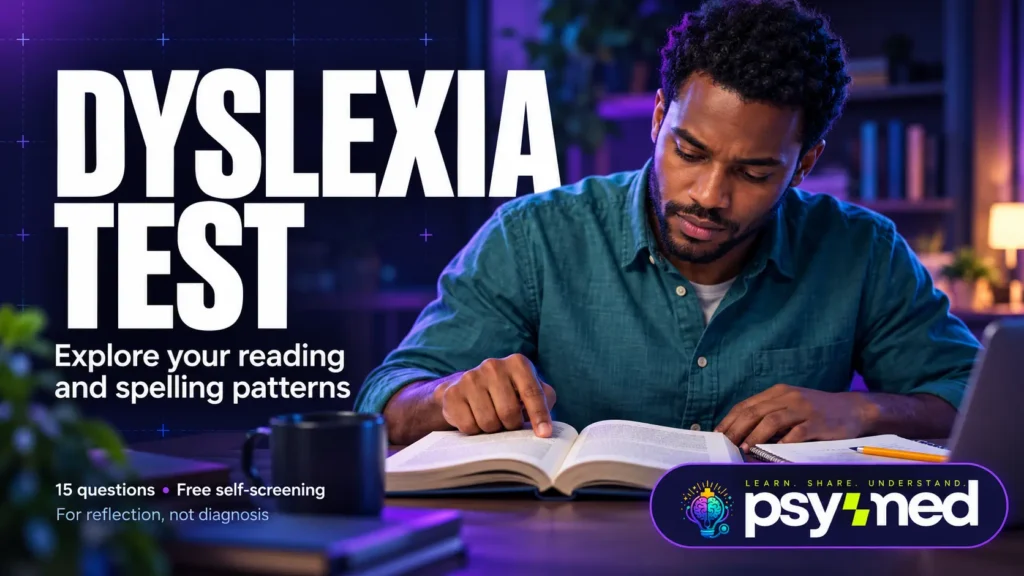
A free, private screen for the common signs of dyslexia in adults and children - slow or effortful reading, spelling that will not stick, trouble decoding words, and the gap between how much you understand and how hard reading feels. Fifteen questions, scored 0 to 60. Only a formal assessment can diagnose dyslexia, and it is not a reflection of intelligence.
Published Updated
This free dyslexia test screens for the common signs of dyslexia — slow or effortful reading, spelling that won’t stick, trouble sounding out words, and the frustrating gap between how much you understand and how hard reading and writing feel. In 15 questions, it looks at the everyday experiences associated with dyslexia and gives you an instant, private result.
Dyslexia is a real, well-recognized learning difference — and one of the most important things to know is that it has nothing to do with intelligence. People with dyslexia have typical or often above-average ability; their brains simply process written language differently. Many adults go years, even decades, without knowing they’re dyslexic, having been wrongly labeled “lazy” or “not trying hard enough” at school. This test can’t diagnose dyslexia — only a formal assessment can — but for many people, it’s the moment a lifelong struggle finally has a name and an explanation.
Checking for your child? You can take this on their behalf by answering based on what you observe — but note that dyslexia looks different in children who are still learning to read. See the signs of dyslexia in children section below, and if you have concerns, ask your child’s school about a formal evaluation.
What Is Dyslexia?
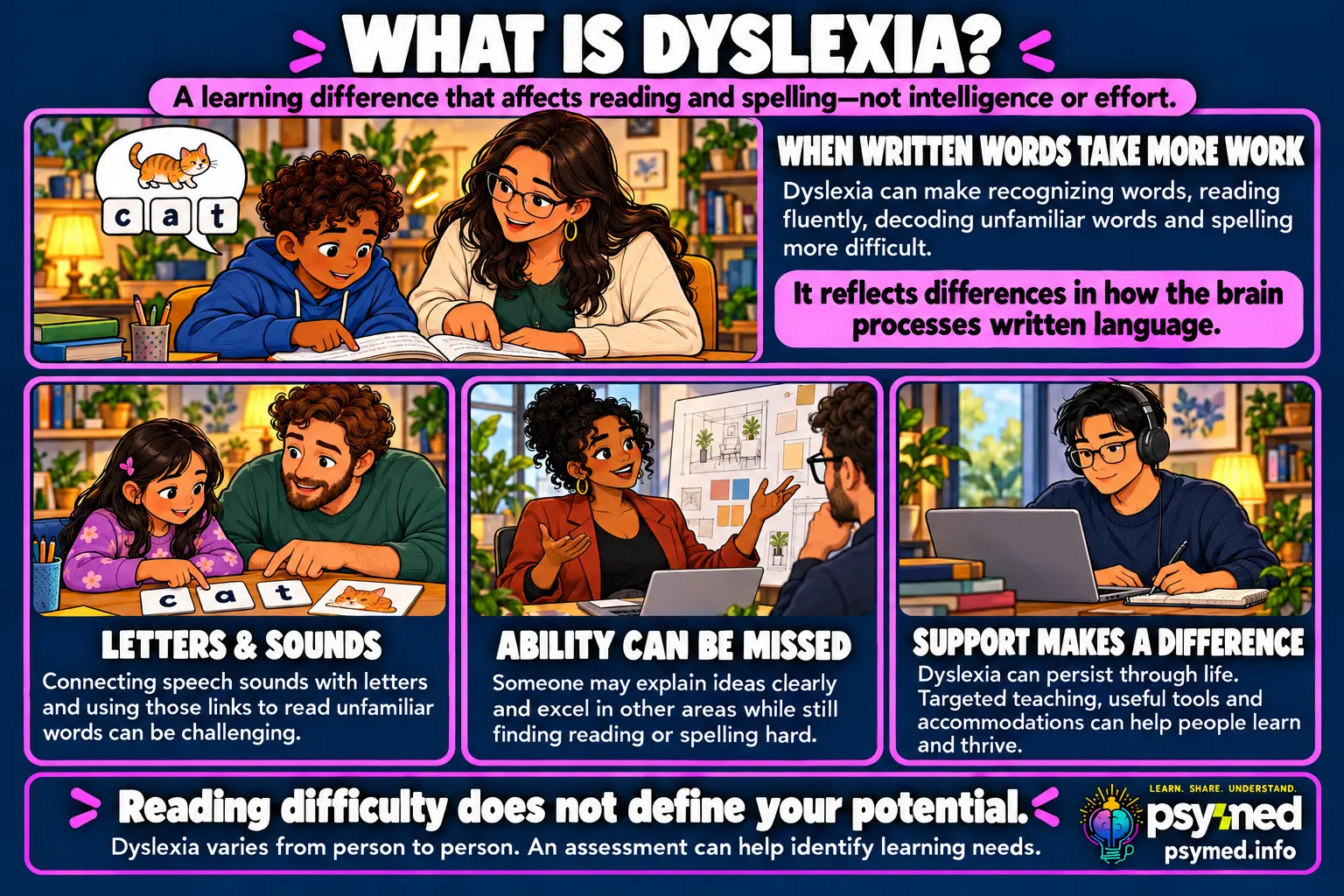
Dyslexia is a specific learning difficulty of neurobiological origin, meaning it reflects how the brain is wired rather than any lack of effort or intelligence. According to the International Dyslexia Association, it’s characterized by difficulties with accurate and fluent word recognition, and by poor spelling and decoding — difficulties that typically stem from a problem in the phonological part of language, the system that connects letters to the sounds they make. In the DSM-5, it falls under Specific Learning Disorder with impairment in reading. It’s common, affecting an estimated 1 in 10 people to some degree, and it doesn’t go away with age — though with the right strategies, people manage it well and often thrive.
The defining feature is that the difficulty is unexpected. A dyslexic person may be articulate, insightful, and capable in many areas, which is exactly why their struggle with reading or spelling can confuse teachers, employers, and themselves. Researchers like Sally Shaywitz (whose book Overcoming Dyslexia shaped modern understanding) and Maryanne Wolf have shown that this gap between ability and reading performance is the signature of dyslexia, not a contradiction of it.
Signs of Dyslexia in Adults
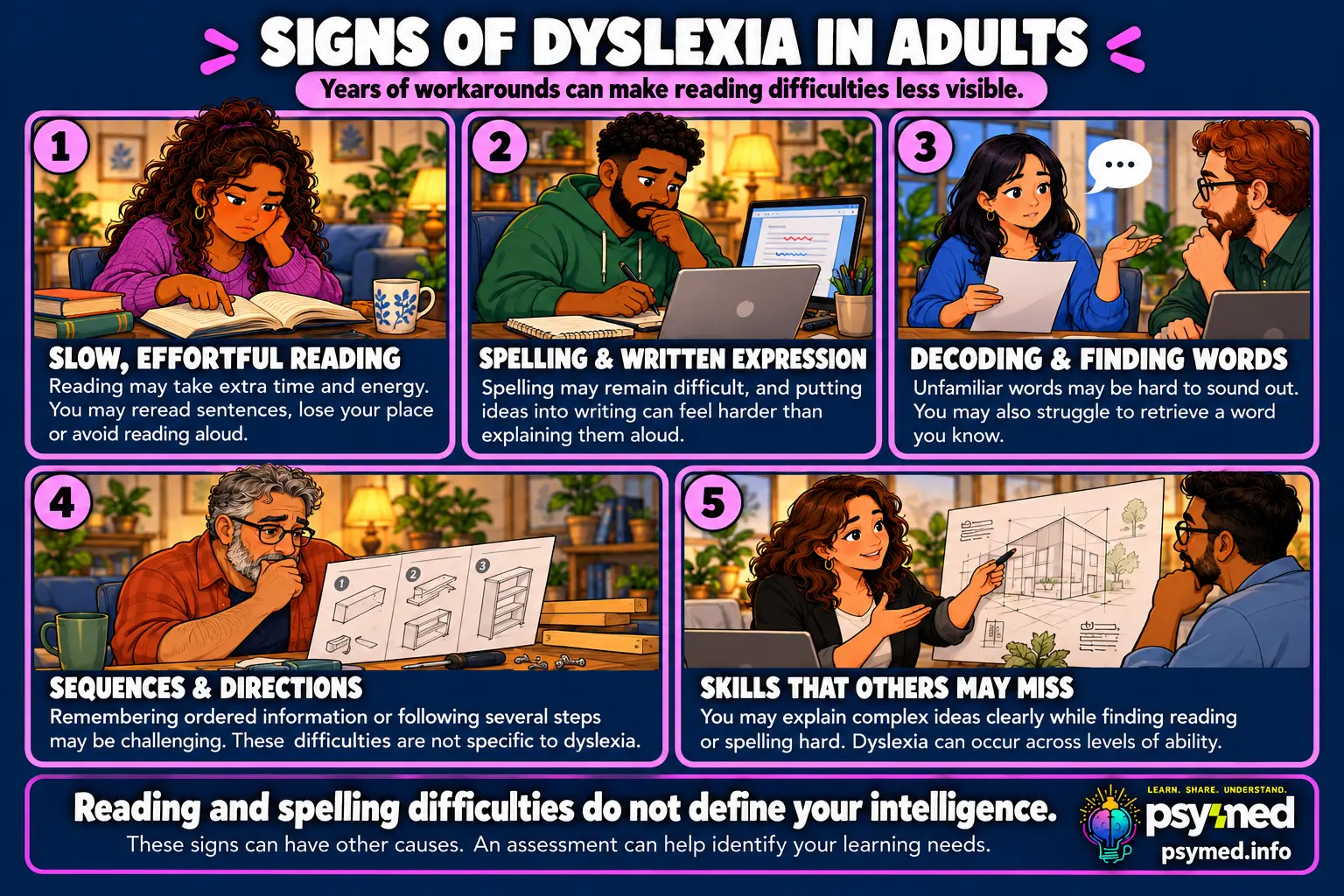
In adults, dyslexia is often hidden behind years of clever workarounds, so the signs can be subtle. You don’t need all of them. This test screens for these experiences.
Slow, effortful reading — and avoiding it
Reading takes more time and energy than it seems to for others. You may re-read sentences to absorb them, lose your place, tire quickly, or quietly avoid reading aloud and reading-heavy tasks whenever you can.
Spelling and written expression
Persistent trouble with spelling — even common words, sometimes spelled different ways in the same document — and a sense that your writing never reflects how well you actually understand something. Getting thoughts onto paper feels disproportionately hard.
Decoding and word retrieval
Difficulty sounding out long or unfamiliar words, and frequent “tip of the tongue” moments where you know the word but can’t quite summon it. This links to what researchers call rapid naming — the speed of retrieving words — which is often slower in dyslexia.
Sequences, directions, and memorization
Trouble with things that must be held in a particular order: remembering phone numbers, reciting months, following multi-step directions, telling left from right, or rote memorization. Learning a foreign language at school may have been especially hard.
The “unexpected” gap
The hallmark of dyslexia: your difficulty with reading, spelling, or writing seems out of step with how capable and intelligent you clearly are in other areas. If people have ever been surprised that you, of all people, struggle with reading or spelling, that mismatch is itself a clue.
Signs of Dyslexia in Children
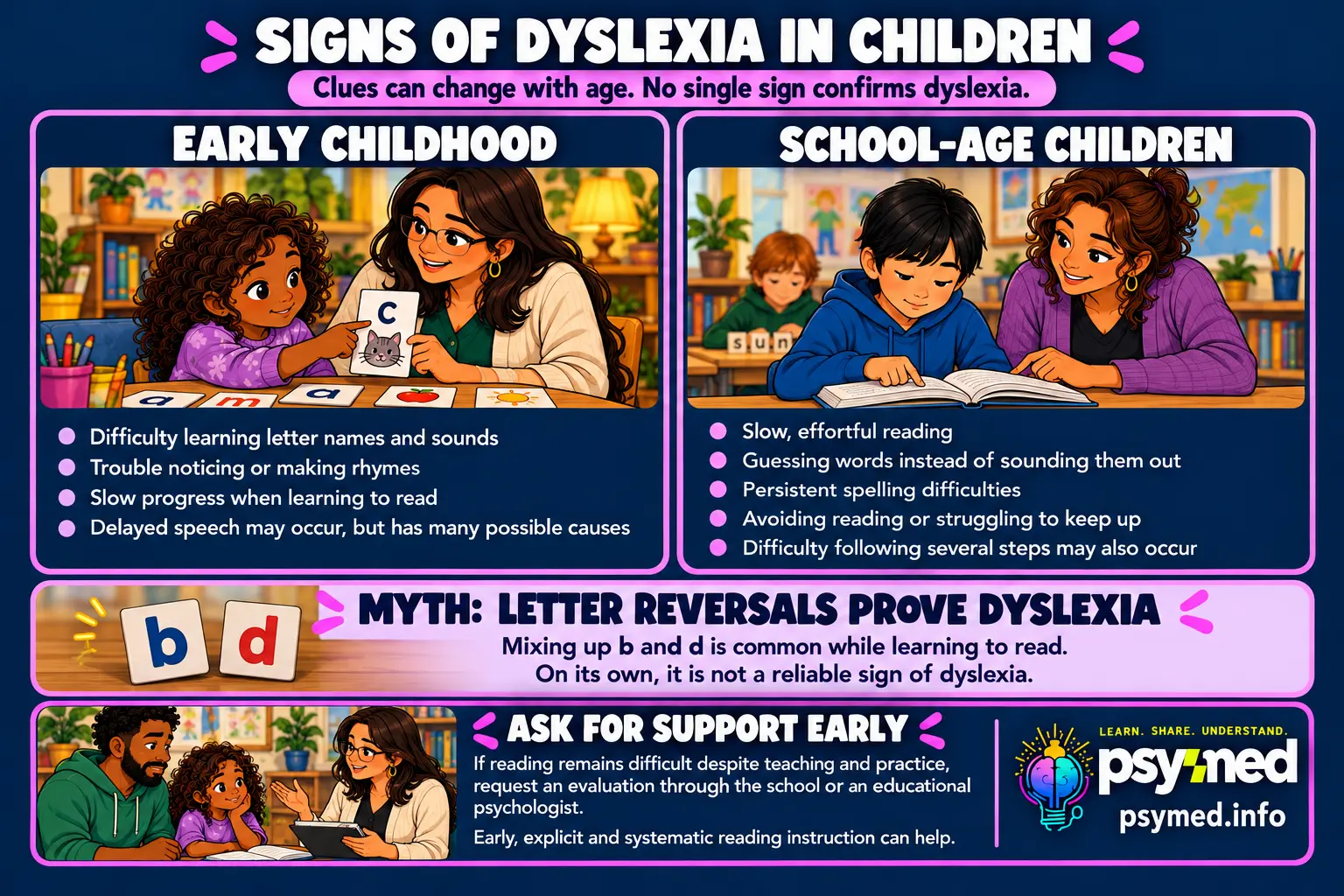
Because the test above is written for adults, here’s what dyslexia tends to look like in children, for parents who are checking. In early childhood: late talking, difficulty learning and remembering letter names and their sounds, trouble rhyming, and slow progress learning to read. In school-age children: reading well below the level expected for their age, guessing at words rather than decoding them, very poor spelling, avoiding reading, difficulty following multi-step instructions, and slow, labored reading. One common myth to set aside: reversing letters like b and d is normal in all young children learning to read and is not, on its own, a reliable sign of dyslexia.
If your child struggles with reading despite good teaching and effort, the most useful step is to request a formal evaluation through their school or an educational psychologist—early, structured literacy support (such as Orton-Gillingham approaches) makes a real difference.
How This Dyslexia Test Works
This test has 15 statements about reading, spelling, and how you handle written language. For each, choose how true it is for you, thinking about how you generally are across your life rather than on one bad day:
Not at all = 0 | A little = 1 | Somewhat = 2 | Mostly = 3 | Completely = 4
Your answers add up to a score from 0 to 60, reflecting how many signs of dyslexia you identify with. A higher score suggests it’s worth pursuing a formal assessment; it does not, by itself, mean you are or aren’t dyslexic. Your responses are private.
Understanding Your Results
Your score reflects how many signs of dyslexia you identify with. Read it as a guide, not a diagnosis. A screening questionnaire can point you in the right direction, but only a full assessment by a qualified professional can actually diagnose dyslexia.
| Score | Range | What It Suggests |
|---|---|---|
| 0 – 15 | Few Signs | Few signs of dyslexia — reading and spelling appear within a typical range. |
| 16 – 30 | Some Signs | Some signs worth noting, though they may reflect other factors too. |
| 31 – 45 | Many Signs | Many signs consistent with dyslexia; a formal assessment is worth pursuing. |
| 46 – 60 | Strong Signs | Strong signs consistent with dyslexia; a professional evaluation is recommended. |
Is Dyslexia Linked to Low Intelligence?
No — and this is the single most important myth to put to rest. Dyslexia is entirely unrelated to intelligence. By definition, the reading difficulty in dyslexia is unexpected given a person’s overall cognitive ability, which means dyslexic people span the full range of intelligence, including the very highest. Dyslexia affects a specific process—connecting written symbols to sounds and retrieving them quickly and automatically—not reasoning, creativity, or understanding. In fact, Sally Shaywitz’s research describes a “sea of strengths” that often accompanies dyslexia: strong reasoning, big-picture thinking, problem-solving, and creativity. The old assumption that struggling to read means struggling to think has done real harm, leaving generations of bright dyslexic people believing they were “stupid.” They weren’t, and aren’t.
Dyslexia and Related Conditions
Dyslexia often comes with other neurodevelopmental differences, which matters because they can compound each other and support works best when you understand the whole picture. It commonly co-occurs with ADHD (the two overlap often enough that many people have both), with dyscalculia (difficulty with numbers and math), with dysgraphia (difficulty with handwriting and written expression), and with developmental coordination disorder (dyspraxia). If reading is only one of several areas you find hard, a comprehensive assessment can map which differences are present rather than attributing everything to one.
Getting a Formal Dyslexia Assessment
If this test suggests dyslexia is likely, the next step is a full diagnostic assessment. For children, this usually runs through the school system or an educational psychologist; for adults, through an educational psychologist, a specialist dyslexia assessor, or sometimes a university’s disability service. A proper assessment looks at phonological processing, reading accuracy and fluency, spelling, rapid naming, and working memory, and places the results against overall ability to identify that telltale unexpected gap. A diagnosis isn’t just a label — for students and employees, it can unlock formal accommodations (extra time, assistive technology, alternative formats), and it points toward the structured, evidence-based literacy approaches (such as Orton-Gillingham) that genuinely help.
Methodology & Sources
This test is an educational screening tool informed by the International Dyslexia Association’s definition of dyslexia, the DSM-5 criteria for Specific Learning Disorder with impairment in reading, and the adult-dyslexia screening literature (including the work of Sally Shaywitz on the unexpected ability–reading gap and Maryanne Wolf on rapid naming and the “double-deficit”). Its 15 items are original statements reflecting the signs of dyslexia as they commonly present in adults — reading fluency, spelling, decoding, word retrieval, and sequencing. It is a self-reflection screen, not a diagnostic instrument. A qualified professional, such as an educational psychologist or specialist assessor, can formally diagnose dyslexia through a comprehensive assessment.
References
- International Dyslexia Association. (2002). Definition of Dyslexia. Adopted by the IDA Board of Directors.
- Shaywitz, S.E. (2003). Overcoming Dyslexia: A New and Complete Science-Based Program for Reading Problems at Any Level. Alfred A. Knopf.
- Wolf, M., & Bowers, P.G. (1999). The double-deficit hypothesis for the developmental dyslexias. Journal of Educational Psychology, 91(3), 415–438. doi:10.1037/0022-0663.91.3.415
- American Psychiatric Association. (2013). Diagnostic and Statistical Manual of Mental Disorders (5th ed.) — Specific Learning Disorder.
Frequently Asked Questions
Can an online test diagnose dyslexia?
No. An online dyslexia test — including this one — is a screening tool, not a diagnosis. It can tell you whether you have enough signs of dyslexia to make a formal assessment worthwhile, which is genuinely useful, but a real diagnosis requires a comprehensive evaluation by a qualified professional. That assessment directly measures things a questionnaire can’t, such as phonological processing, reading fluency, spelling, and rapid naming, and compares them against your overall ability. Think of this test as a helpful first step that tells you whether the next step is worth taking.
Is dyslexia related to intelligence?
No — they’re completely separate. Dyslexia is defined by a reading difficulty that is unexpected given a person’s intelligence, which means dyslexic people are found across the entire range of ability, including the most gifted. Dyslexia affects a specific process (linking letters to sounds and retrieving words quickly), not reasoning, creativity, or comprehension. The long-standing myth that difficulty reading means low intelligence is both false and harmful; in reality, many dyslexic people have notable strengths in areas like problem-solving, spatial reasoning, and creative thinking.
Can adults be diagnosed with dyslexia?
Absolutely. Dyslexia is lifelong, and plenty of people reach adulthood without ever being identified — often because they were bright enough to develop workarounds that masked the difficulty, or because dyslexia simply wasn’t recognized when they were at school. Many adults seek assessment when reading and writing demands increase at work or university, or when their own child is diagnosed, and the description sounds familiar. An adult diagnosis can be valuable: it provides an explanation, access to accommodations, and strategies and technology that make daily life easier.
What’s the difference between dyslexia and a general reading difficulty?
Not every reading difficulty is dyslexia. Reading can be slow or weak for many reasons — limited schooling, attention difficulties, anxiety, vision problems, or simply not having been taught effective strategies. Dyslexia is specifically a neurobiological difficulty rooted in phonological processing; it’s typically lifelong and persistent, and it shows up as that characteristic gap between reading ability and overall capability. A proper assessment is what distinguishes dyslexia from other causes of reading difficulty, which matters because the right support depends on the right explanation.
Related Tests
- ADHD Test — ADHD and dyslexia co-occur very often; worth screening both
- Autism Test — another neurodevelopmental difference that can co-occur
- Anxiety Test — years of undiagnosed reading struggle can fuel anxiety
- Rejection Sensitive Dysphoria Test — sensitivity to criticism, common after a hard time at school
This test is an educational screening tool, not a diagnosis. Dyslexia can only be formally diagnosed through a comprehensive assessment by a qualified professional such as an educational psychologist or specialist dyslexia assessor. Dyslexia is a difference in how the brain processes written language — it is not a reflection of intelligence, effort, or potential.
Related Tests
See All Quiz →

You may also like
See All Quiz →
Emotional and Trait Assessments
Are You a Psychopath? Take This Free Psychopath Test (PCL-R Based)
→