
Neurodevelopment & attention
Rejection Sensitive Dysphoria Test: Understand your response to rejection.
Explore 15 statements about rejection, criticism and emotional reactions. This original self-check can help you organize your experience; it cannot diagnose RSD, ADHD or another condition.
This original self-reflection questionnaire has not been clinically validated. Its score bands are descriptive, not clinical cutoffs. RSD is not a formal diagnosis.If you are thinking about suicide or self-harm, call or text 988 in the US. If you are in immediate danger, call 911 or your local emergency number. Outside the US, find support at findahelpline.com.
- THE SELF-CHECKRejection Sensitive Dysphoria Test15 original statements for reflection.
- YOUR CHOICENo account neededYou can pause or stop when you choose.
- CLEAR BOUNDARIESInformation, not a diagnosisYour circumstances matter beyond a score.
The self-check
Take the rejection sensitive dysphoria test
This self-check is written for adults. Choose how true each statement is for you generally, rather than using only one difficult day.
Your score
What the bands mean
- 0–15 Low — less endorsement of the listed experiences
- 16–30 Moderate — some endorsement of the listed experiences
- 31–45 High — higher total endorsement of the listed experiences
- 46–60 Very High — very high total endorsement of the listed experiences
Each answer scores 0–4; the total is 0–60. This original self-reflection questionnaire has not been clinically validated. Its score bands are descriptive, not clinical cutoffs. RSD is not a formal diagnosis.
A self-check opens a conversation. It cannot settle a diagnosis.
The short answer
What is rejection sensitive dysphoria?
Rejection sensitive dysphoria (RSD) is an informal term for intense emotional pain in response to perceived rejection, criticism or failure. It is not an officially recognized diagnosis.
The experience can be distressing even when other people do not see the same meaning in an interaction. A label should help you describe what is happening, rather than settle why it happens.
Your answers describe your experience of the listed statements. The bands have not been established as clinical cutoffs.
The research on emotional dysregulation in ADHD is broader than the research on RSD itself. An association between ADHD and emotional difficulties does not establish an RSD diagnosis.
Understand the pattern
Signs and patterns to notice
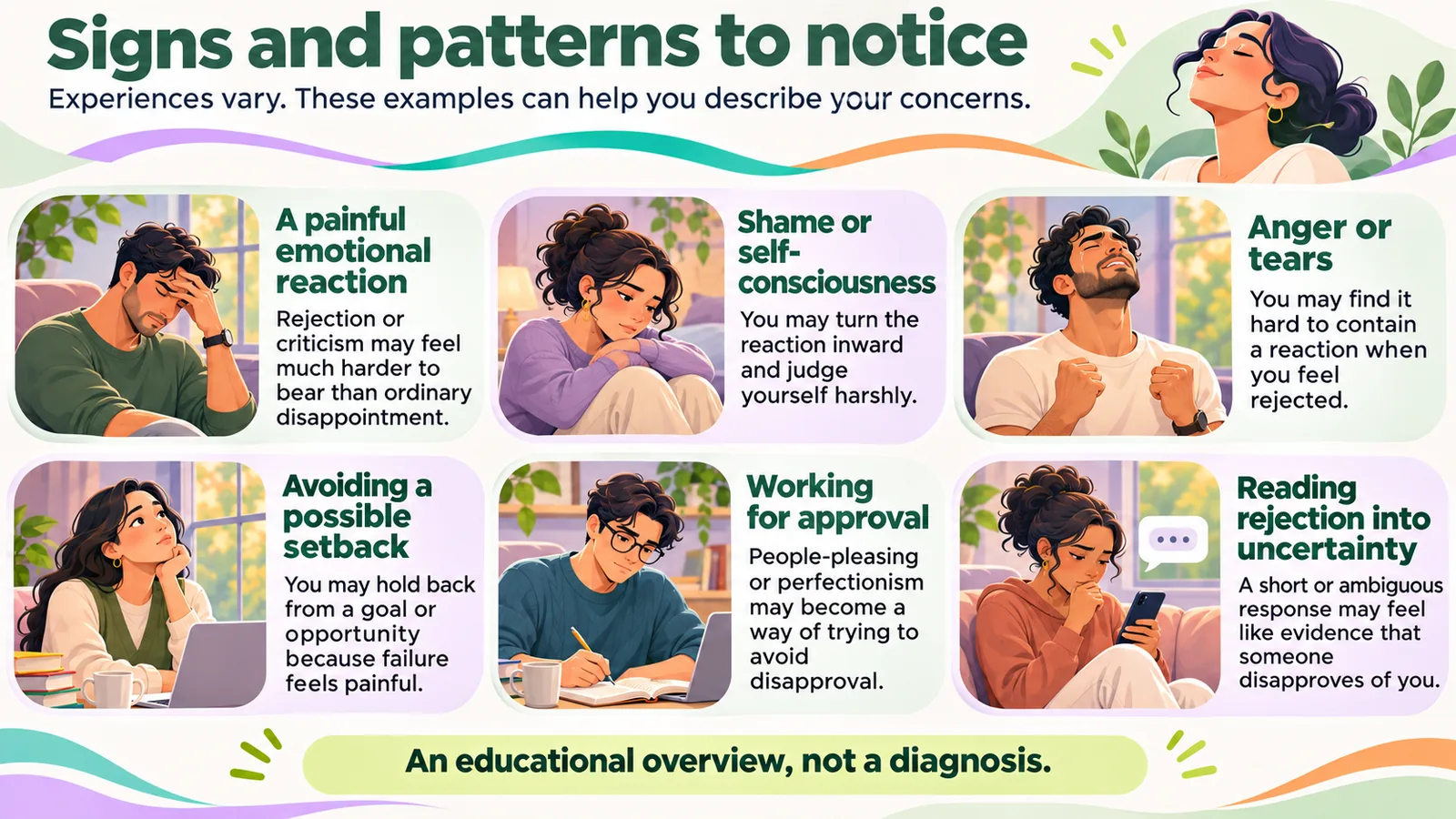
A painful emotional reaction
Rejection or criticism may feel much harder to bear than ordinary disappointment.
Shame or self-consciousness
You may turn the reaction inward and judge yourself harshly.
Anger or tears
You may find it hard to contain a reaction when you feel rejected.
Avoiding a possible setback
You may hold back from a goal or opportunity because failure feels painful.
Working for approval
People-pleasing or perfectionism may become a way of trying to avoid disapproval.
Reading rejection into uncertainty
A short or ambiguous response may feel like evidence that someone disapproves of you.
Related ideas are not interchangeable
Look at the full picture rather than treating one reaction as a diagnosis.
| Topic | Focus | Limit |
|---|---|---|
| RSD | An informal description of particularly painful rejection-related reactions. | No established diagnostic cutoff on this site. |
| Social anxiety | Fear of scrutiny, embarrassment or negative judgment in social situations. | Requires professional assessment when persistent or impairing. |
| ADHD | A developmental pattern involving inattention and/or hyperactivity-impulsivity. | Rejection sensitivity alone does not establish it. |
Understanding the result
What can this RSD self-check tell you?
The result organizes your answers. It does not establish a diagnosis or explain why rejection feels painful.
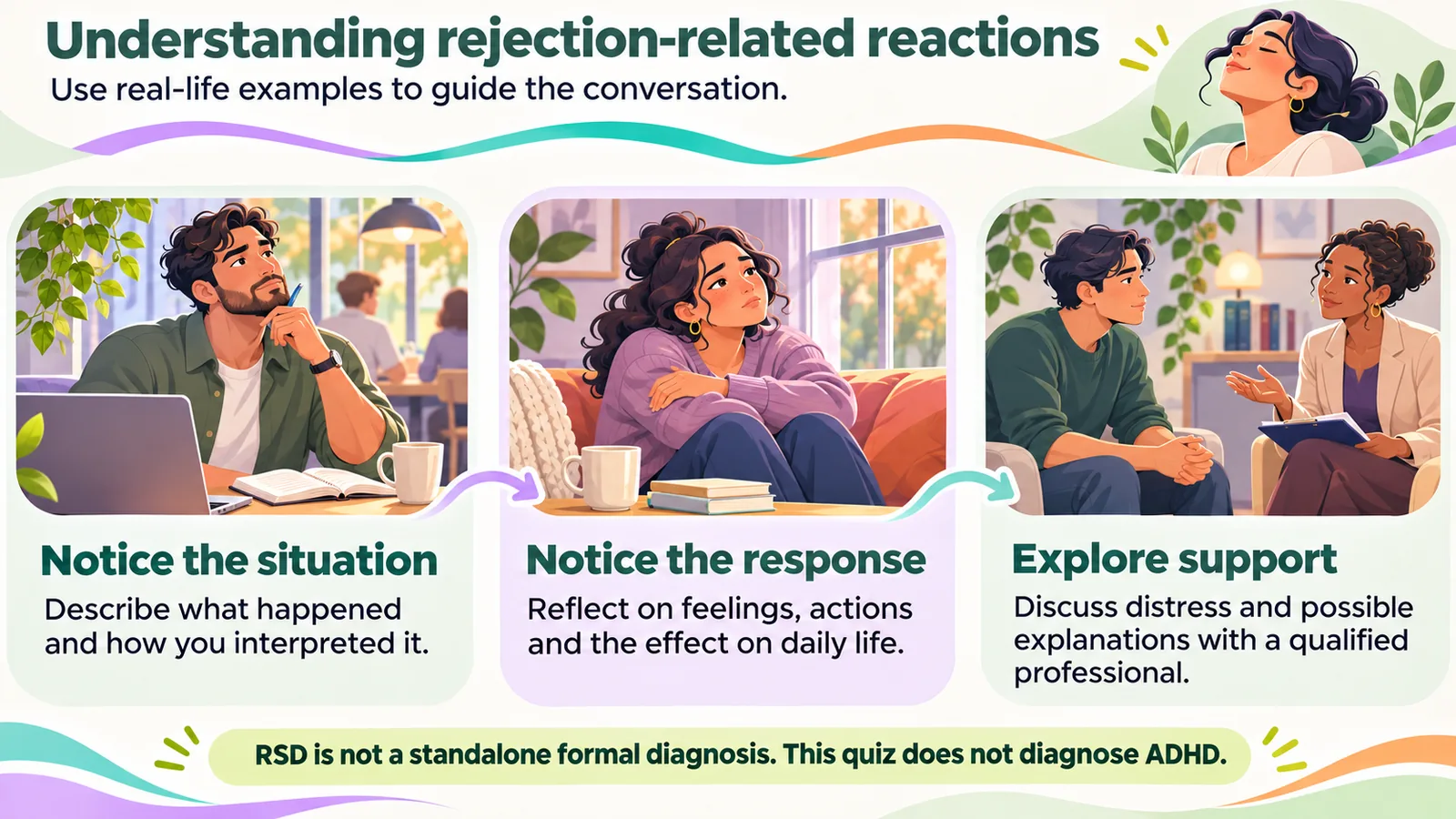
- 01 The questionnaire
Your reported experiences
These 15 original statements ask how strongly you identify with rejection-related reactions and coping patterns.
- 02 The score
A descriptive total
Each answer contributes 0–4 points. The 0–60 total places your answers in a descriptive band, not a clinical category.
- 03 The wider picture
Context and daily impact
A professional can discuss the distress and consider related conditions. The score cannot decide whether you have ADHD or another condition.
These descriptive bands are preserved from the existing quiz and are not research-derived clinical thresholds. You can ask for support at any score.
Understanding the context
RSD, rejection sensitivity and ADHD
Research supports a link between adult ADHD and emotion-regulation difficulties. It does not show that every person with ADHD experiences RSD, or that intense rejection sensitivity proves ADHD.
ADHD needs a broader assessment
ADHD assessment considers attention, activity and impulse patterns over time, including childhood history.
Fear of judgment may need its own context
If fear of judgment dominates social situations, the Social Anxiety Test explores a related but different concern.
Overlapping experiences need care
These experiences can overlap; comparing quiz scores cannot sort them into diagnoses.
Support that fits your circumstances
What support can you explore?
Choose support around the experiences affecting you, rather than treating a descriptive band as a treatment recommendation.
- 01 / SELF-UNDERSTANDING
Describe one example
If it feels manageable, note the situation, what you understood it to mean and how you reacted. You can share that example rather than relying only on a score.
- 02 / PROFESSIONAL ASSESSMENT
Ask for an assessment
A professional can discuss emotional distress and consider related conditions when appropriate. The Anxiety Test can be another conversation starter.
- 03 / PERSONALIZED SUPPORT
Choose support with a clinician
Therapy can help you work on responding to feelings. Medication decisions should be based on a professional assessment, not this self-check.
Understand the pattern
What can you do with this result?
- 01
Review your answers
Notice which statements felt most relevant. The total cannot capture everything you wanted to describe.
- 02
Keep the context
Use an example from your own experience alongside the number when discussing the result.
- 03
Choose your next conversation
You can ask a mental health professional for support without waiting for a particular score.
If you are thinking about suicide or self-harm, call or text 988 in the US. If you are in immediate danger, call 911 or your local emergency number. Outside the US, find support at findahelpline.com.
Good questions to ask
Frequently asked questions
What this self-check can and cannot tell you.
This quiz cannot tell you. RSD is an informal description, not a formal diagnosis, and the questionnaire is not clinically validated. A professional can help you understand the distress and consider other explanations.
It is often discussed in connection with ADHD. Research on emotion dysregulation in ADHD does not make RSD an official diagnostic criterion or mean that everyone with ADHD has it.
It means you agreed more strongly with this questionnaire’s statements. The bands are not population norms or diagnostic thresholds. Consider the impact on your life alongside the number.
No. Your answers cannot capture every concern or rule out a mental health condition. You can seek support at any score.
No. These are 15 original PsyMed self-reflection statements. The quiz is not a reproduction of the Rejection Sensitivity Questionnaire and does not use its scoring.
Social anxiety focuses on fear of scrutiny and negative evaluation. RSD describes a painful reaction to perceived rejection. They can overlap, so the distinction is not a diagnosis you can make by comparing online scores.
A mental health professional can help you explore triggers and coping responses, and assess related conditions if needed. There is no treatment recommendation that follows automatically from this score.
Editorial transparency
Sources and review information
Editorially reviewed by the PsyMed Editorial Team on . This is an editorial source review, not a clinical review.
Methodology
Prepared by the PsyMed Editorial Team. We are writers and researchers, not clinicians, and no licensed clinician is claimed as a reviewer. This is an original 15-item house questionnaire. It is not a validated diagnostic instrument. Items, answer labels, weights and band boundaries are preserved from the existing quiz; result explanations have been clarified.
Each item contributes 0–4 points, producing 0–60 in total. The four descriptive bands are 0–15, 16–30, 31–45 and 46–60. These descriptive bands are preserved from the existing quiz and are not research-derived clinical thresholds.
Read how we build our tests and who we are.
References
- Cleveland Clinic: Rejection Sensitive Dysphoria (RSD)
- Beheshti, Chavanon & Christiansen (2020). Emotion dysregulation in adults with ADHD: a meta-analysis. BMC Psychiatry 20,120.
- NIMH: Attention-Deficit/Hyperactivity Disorder: What You Need to Know
- NIMH: Social Anxiety Disorder: What You Need to Know
- 988 Suicide & Crisis Lifeline
- Find A Helpline
A place to begin
Your experience deserves attention.
Use this self-check to organize your thoughts, then choose support that fits your circumstances.
Take the self-check