
Self-reflection · Neurodevelopment and attention
Autism Test for Women: Explore your experiences.
Reflect on social effort, sensory experiences, routines, and daily life with this free 15-item self-check for adults. It can help organize your thoughts, but cannot diagnose autism.
For reflection only. This original questionnaire has not been clinically validated and cannot confirm or rule out autism.
- THE SELF-CHECK15 original statementsReflect on social, sensory, and everyday experiences.
- NO ACCOUNT NEEDEDFree to takeYour result appears after you finish, with no sign-up.
- CLEAR BOUNDARIESReflection, not diagnosisA total cannot confirm or rule out autism.
The self-check
Take the autism test for women
For adults exploring their usual experiences. Choose how true each statement feels, rather than how you think you should respond. This original questionnaire does not diagnose autism.
Your score
What the bands mean
- 0–15 answer total
- 16–30 answer total
- 31–45 answer total
- 46–60 answer total
Each of the 15 answers scores 0–4, giving a total of 0–60. Higher totals mean stronger overall endorsement of these statements, not a clinical severity level.
A count of this quiz’s items, not a clinical statistic or diagnostic threshold.
The short answer
What can autism look like in women?
Autism is a neurodevelopmental condition involving differences in social communication and patterns of interests, behavior, or sensory experience. Women can be autistic, but there is no single female presentation. A clinician considers the person’s developmental history and daily life.
Some autistic women adapt their behavior to fit social expectations, sometimes called masking. Outwardly managing a conversation does not reveal how effortful it feels. The general Autism Test offers another self-reflection page, rather than a separate way to diagnose autism.
It is not universal among autistic people or exclusive to women. Recognizing yourself here can start a conversation; it cannot establish a diagnosis.
Assessment looks beyond a score. NICE recommends considering childhood history, current functioning, sensory differences, and other possible or coexisting conditions.
Experiences to understand
Which experiences are worth noticing?
These examples are not a checklist of requirements. They are not unique to autism, and not every autistic person has each one.
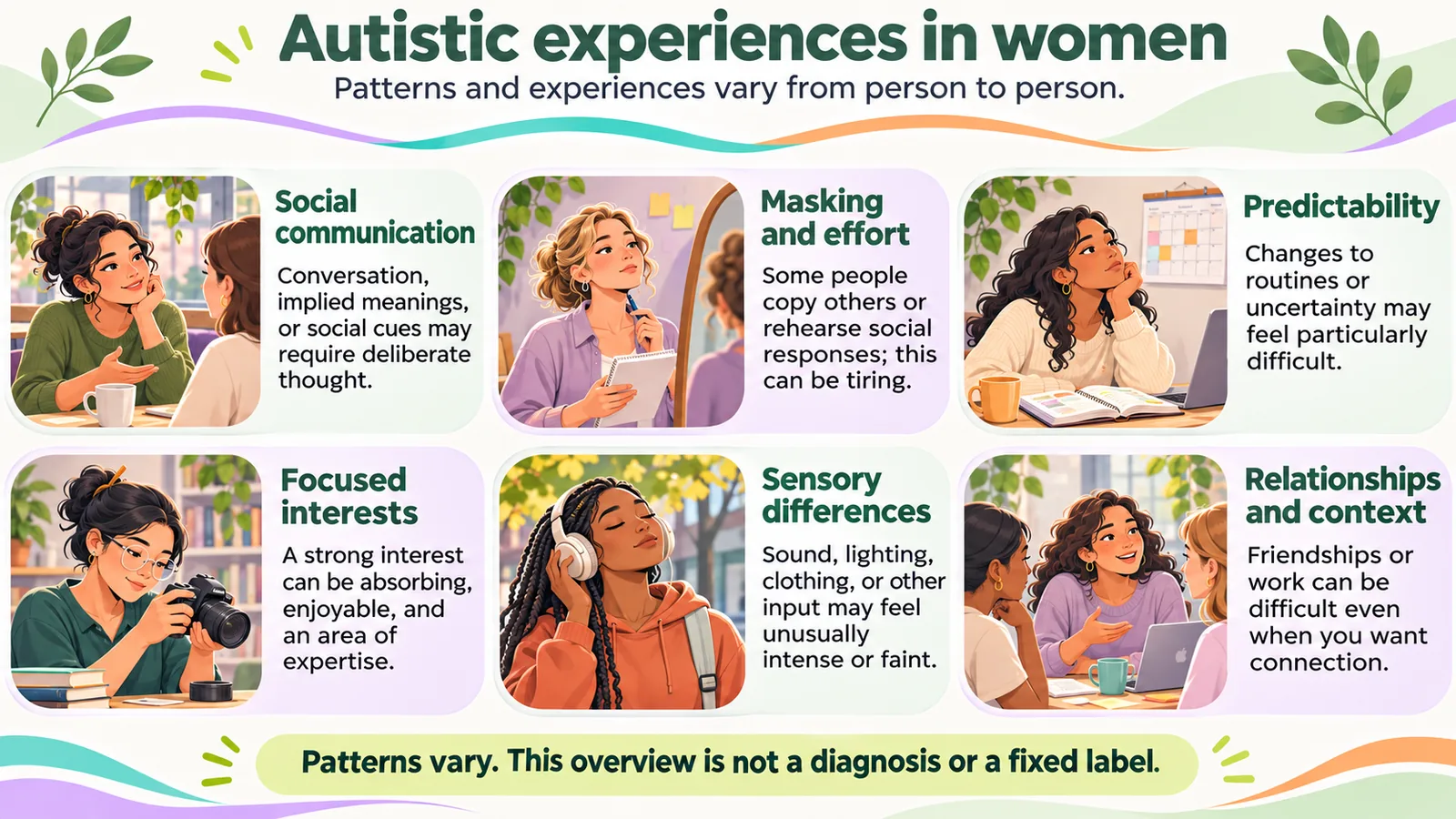
Social communication
Conversation, implied meanings, or social cues may require deliberate thought.
Masking and effort
Some people copy others or rehearse social responses; this can be tiring.
Predictability
Changes to routines or uncertainty may feel particularly difficult.
Focused interests
A strong interest can be absorbing, enjoyable, and an area of expertise.
Sensory differences
Sound, lighting, clothing, or other input may feel unusually intense or faint.
Relationships and context
Friendships or work can be difficult even when you want connection. Needs vary between people and settings.
Similar experiences can have different explanations
A comprehensive assessment can consider differences and overlap without forcing an either-or choice.
| Experience | What it may tell you | What it cannot establish |
|---|---|---|
| Social effort or masking | How much work a situation takes for you. | Whether you are autistic from this experience alone. |
| Sensory sensitivity | Which environments may need adjustments. | The cause of the sensitivity by itself. |
| Anxiety or attention difficulties | A reason to discuss your wider needs. | That autism is either present or absent. |
| A high quiz total | Stronger overall endorsement of these house items. | A diagnosis, probability, or level of support. |
What clinicians consider
How is autism assessed in adults?
A qualified professional with adult autism experience looks at the whole pattern. An online total is not a substitute.
- 01 History
Patterns across development
Discuss childhood and adult experiences. If available and with your agreement, school records or someone who knew you earlier can add context.
- 02 Current life
Communication, routines, and sensory needs
An assessment explores social communication, repeated patterns or focused interests, sensory experiences, and their impact in different settings.
- 03 Wider picture
Strengths and other explanations
Clinicians consider physical and mental health, other neurodevelopmental conditions, and your strengths and support needs.
This questionnaire has no validated diagnostic threshold. Bring examples that matter to you, even if your total is low or your experiences differ from the items.
Understanding the context
Why look beyond one explanation?
Autism involves development, not a failure to try hard enough socially. An individual assessment can explore both lifelong patterns and what is making life difficult now.
Development and biology
Research points to genetic and environmental contributions to autism; there is no single explanation for every person.
Other conditions can coexist
Anxiety or attention difficulties may overlap with autism. The ADHD Test is a separate reflection tool, not a way to settle that distinction.
Environment changes the experience
Sensory demands and communication expectations can affect everyday comfort. The Sensory Processing Disorder Test explores sensory experiences without establishing their cause.
Individual support
What support can help autistic adults?
Support should reflect your priorities, preferences, and needs. It is not about curing a person or making everyone behave the same way.
- 01 / ADJUSTMENTS
Make environments more manageable
Discuss changes to lighting, noise, personal space, breaks, or communication format. Choose adjustments around the situations you actually find difficult.
- 02 / PRACTICAL SUPPORT
Build a plan around daily life
Depending on your needs, support can include help with work, education, communication, or everyday tasks. Your interests and strengths belong in that plan.
- 03 / HEALTH AND CONNECTION
Address additional needs
Ask about care for coexisting anxiety, depression, or other health concerns. Peer support or one-to-one support may also be useful if it suits you.
Practical next steps
What can you do with your result?
Use the answers as notes about your experience. You do not need a high total to ask for help.
- 01
Save a few examples
Note situations that are hard, what helps, and patterns you remember from childhood. Specific examples are more useful than the total alone.
- 02
Ask about an assessment
A primary care professional can discuss concerns and local referral routes. Ask whether the service has experience assessing adults, including women.
- 03
Identify support now
Discuss practical adjustments and any distress with a healthcare professional. Ask what is available while you wait; support needs deserve attention whatever the eventual diagnosis.
Good questions to ask
Autism test for women FAQs
Practical answers about this self-check, assessment, and support.
This quiz cannot tell you. Autism assessment considers developmental history, communication, patterns of behavior and interests, sensory experiences, and daily functioning. If you recognize a pattern that matters to you, discuss it with a qualified professional.
No. These 15 PsyMed house items and four descriptive score bands have not been clinically validated. This is not the AQ, RAADS-R, or CAT-Q, and it cannot estimate your probability of an autism diagnosis.
Yes. There is no single presentation shared by all autistic women. The experiences described here are examples, not requirements, and they can also occur in people of other genders.
No. Masking by itself cannot establish autism. Some autistic people mask, but it is not universal and is not exclusive to women. A professional assessment considers a much broader pattern.
No. This self-check has no validated rule-out threshold. A low total does not settle the question. Bring your own examples to a clinician if you remain concerned.
Yes. Adult assessment considers other possible and coexisting conditions, rather than assuming every experience has one explanation. Discuss your full history and current needs with the assessor.
The questionnaire is written for adults and is not a validated assessment for children or teenagers. A young person can speak with a trusted adult and healthcare professional about an age-appropriate assessment.
It means stronger overall endorsement of this particular set of statements. It does not measure clinical severity, prove autism, or determine support needs. Consider discussing specific examples and their impact with a professional.
Editorial transparency
Sources and review information
Editorially reviewed by the PsyMed Editorial Team on . This is an editorial source review, not a clinical review.
Prepared by the PsyMed Editorial Team. We are writers and researchers, not clinicians, and no licensed clinician is claimed as a reviewer. These original house items are an educational reflection tool, not a validated instrument. Clinical information is informed by the public resources listed here. Read how we build our tests and who we are.
Understand your own experience
Your support needs deserve attention.
Use this self-check to gather your thoughts and consider a conversation about what would make daily life easier.
Take the self-check