
Love & Relationships · Self-reflection
Am I Being Love Bombed? A free quiz and love bombing test
This am I being love bombed quiz has fifteen questions about how a new partner or date is treating you: the compliments, the gifts, the messages, the pace and what happens when you say no. Intense affection at the start of a relationship is not automatically a red flag. This free, private love bombing test helps you look at whether the attention feels warm and steady, or overwhelming and hard to refuse.

This self-check is for reflection only. It has not been validated, it cannot tell you what another person intends, and it is not a substitute for advice from a domestic abuse service.
-
THE FORMAT15 questionsEach question has the same five answers, from Never to Very often, about one person you are dating or seeing.
-
WHAT IT COVERSAffection, pace and pressureEarly declarations, flattery, gifts, constant contact, rushing commitment and how they react to your limits.
-
NO VERDICTA mirror, not a judgmentThe total shows how many warning signs your answers describe. It cannot prove anyone’s intentions.
The self-check
Take the love bombing test
Think about one person you are dating, seeing or have recently started a relationship with, and answer for how they have generally treated you since you met. Choose the answer closest to what usually happens. This is a house-written questionnaire for reflection. It has not been validated, and it cannot tell you what another person intends.
Your result
What the answer ranges describe
- 0–14 Few signs of love bombing in your answers
- 15–29 Some signs worth keeping an eye on
- 30–44 Many signs of pressure and intensity
- 45–60 A strong pattern of pressure and control
This self-check is for reflection only. It has not been validated, it cannot tell you what another person intends, and it is not a substitute for advice from a domestic abuse service.
A questionnaire length, not a threshold.
The short answer
What is love bombing?
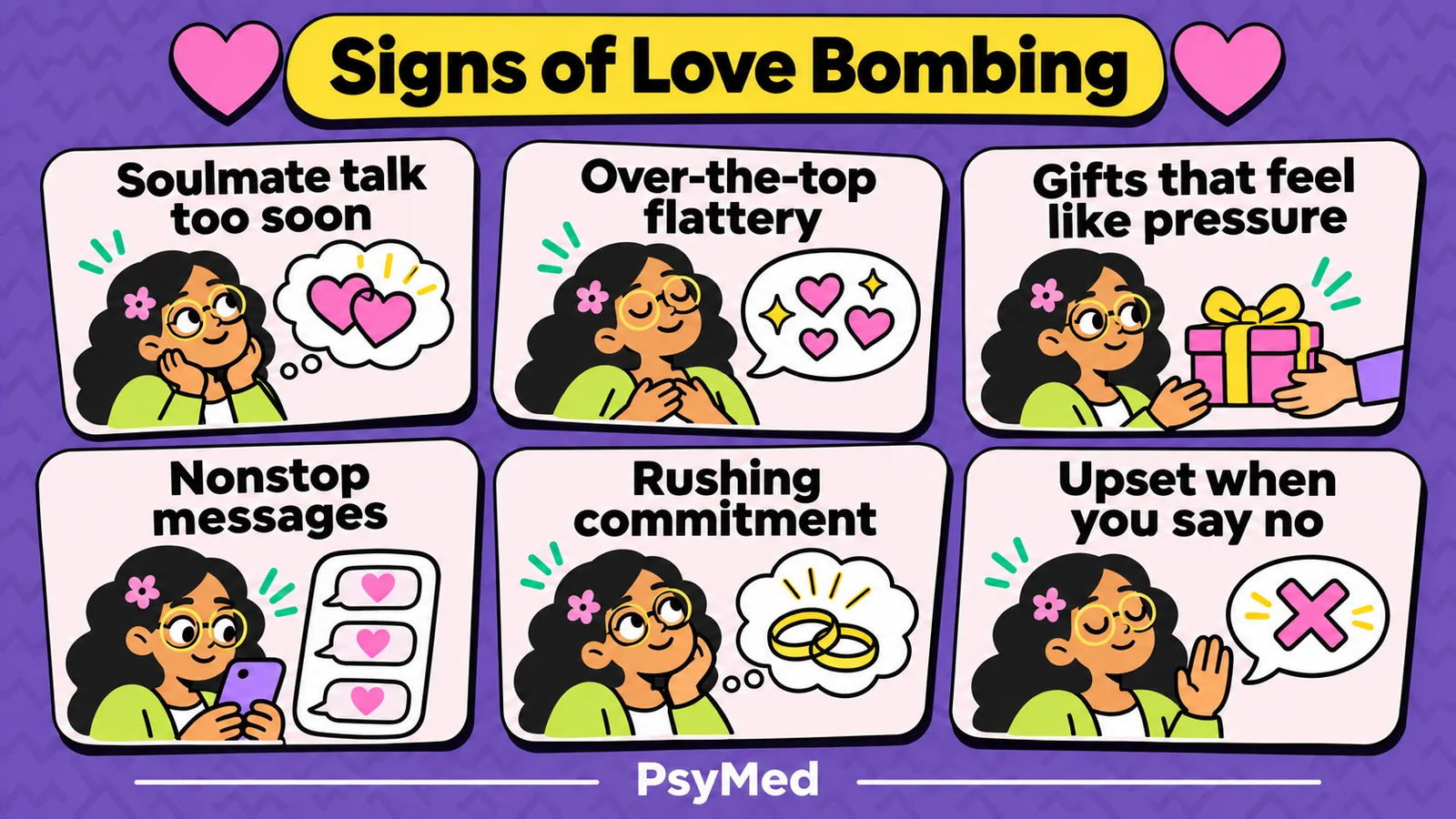
Love bombing is a pattern of over-the-top attention and affection early in a relationship that is used to influence or control the other person. Cleveland Clinic describes it as a form of psychological and emotional abuse that involves a person going above and beyond for you, and the Western Australian Government calls it a manipulation tactic designed to make you feel dependent on someone. Typical signs include being called a soulmate very early, extreme flattery, gifts that feel too much, constant messages and pressure to commit fast. An am I being love bombed quiz like this one can help you notice those patterns. It cannot prove what the other person intends.
What separates love bombing from ordinary new-relationship excitement is pressure. The Hotline notes that it is not unusual to exchange compliments while you are getting to know each other, and love is respect says lots of communication is natural at the beginning of a relationship. The warning signs are intensity that feels overwhelming, a pace you did not choose, and irritation or guilt when you hold back. Cleveland Clinic notes that love bombers want to create a sense of intimacy, closeness and commitment very quickly, and that the goal is not just to seek love but to gain control over someone else. For how the affectionate phase can later turn cold, see our guide to the love bombing and devaluation cycle.
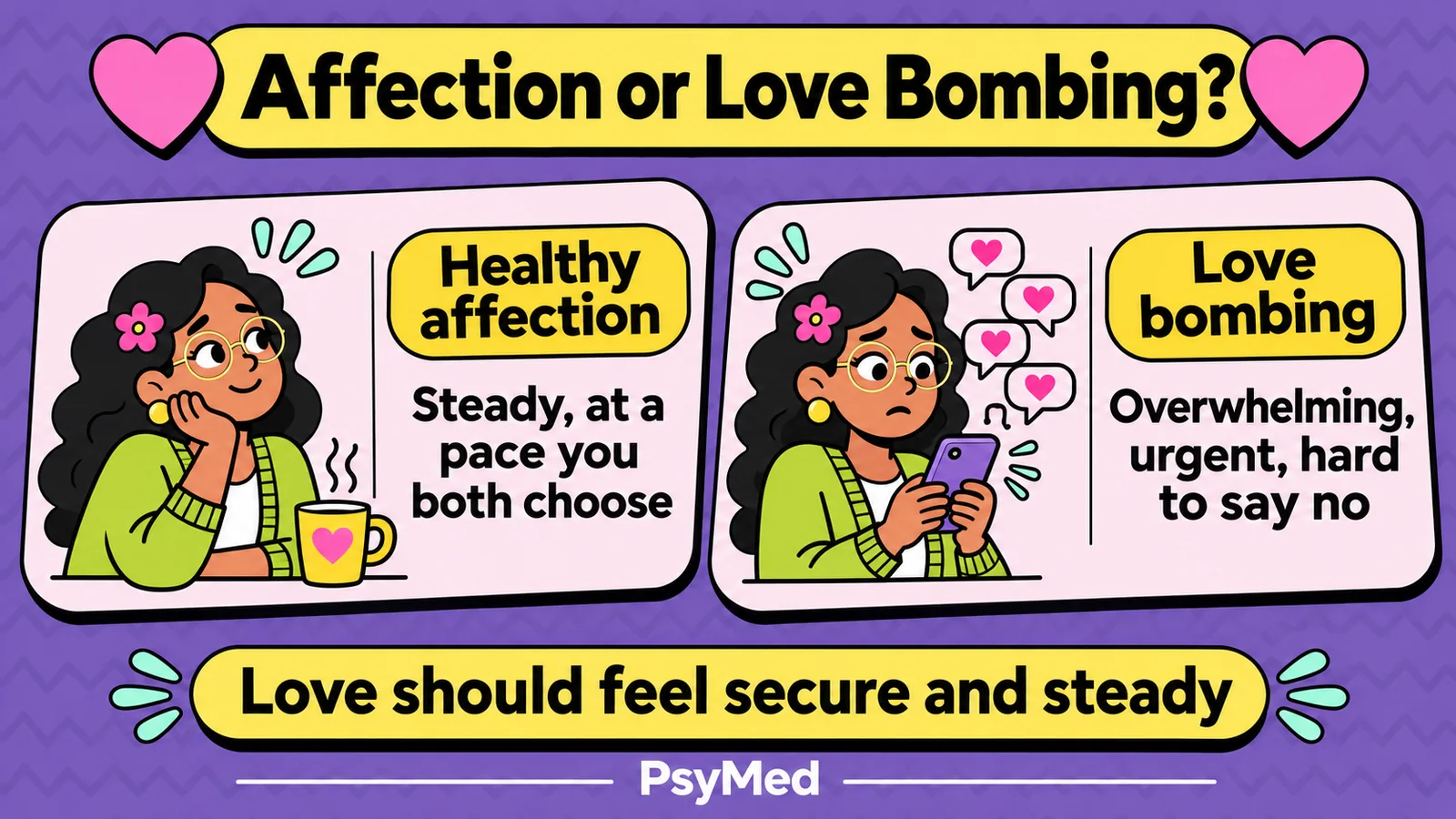
Love bombing can look like the romance people are told to hope for, which is part of why it works. The Western Australian Government puts the difference simply: love should feel secure and steady, while love bombing feels overwhelming and urgent. If you are being love bombed, it is not your fault.
Love bombing is not counted separately, but in England and Wales police recorded 49,557 coercive control offences of all kinds in the year ending March 2025 (ONS figures, via Women’s Aid). Crown Prosecution Service guidance tells prosecutors to consider whether apparently loving acts, including love bombing, form part of a controlling or coercive course of conduct.
View sourceUnderstand the themes
Six signs the questions look at
No single sign proves love bombing, and most of these can happen in a healthy relationship too. What matters is the pattern: how intense it is, how fast it moves and what happens when you say no.
“Soulmate” talk very early (question 1)
The Hotline notes that labels such as “soulmate”, “their person” or “their other half” are often applied early in the relationship.
Flattery that feels over the top (question 2)
love is respect notes that extreme flattery can be an early sign of manipulation, especially when it describes someone who does not yet know you well.
Gifts and gestures that come with pressure (questions 3, 4 and 10)
Cleveland Clinic notes that if you have said you do not want the gifts and they keep coming anyway, that is a red flag.
Constant contact and checking up (questions 5, 6 and 9)
The Hotline notes you should not feel overwhelmed by the amount of communication. The WA Government lists being guilt-tripped for not replying immediately as a sign.
Rushing commitment and your time (questions 7 and 8)
The WA Government lists a relationship that moves much faster than you would expect and feeling pushed to make big commitments.
Pushback, hot and cold, and how it leaves you feeling (questions 11 to 15)
Cleveland Clinic flags continued disrespect of your boundaries. Watch for hot and cold swings, for you changing yourself to keep the peace, and for people close to you saying it seems off.
Healthy early affection or love bombing?
The same behaviour can be healthy or a warning sign. The difference is usually pace, pressure and how your limits are treated.
| Area | Healthy early affection | Possible love bombing |
|---|---|---|
| Compliments | Genuine compliments that grow as you get to know each other. | Extreme flattery before they really know you (love is respect). |
| Gifts | Thoughtful presents that show care (The Hotline). | Gifts that feel too much, or keep coming after you say no (Cleveland Clinic). |
| Messages and calls | Lots of communication is natural at the start (love is respect). | Communication you find overwhelming, or guilt when you do not reply at once (The Hotline, WA Government). |
| Pace | Both of you set the pace and either can slow it down. | Feeling pushed to make it official, say “I love you” or make big commitments (WA Government). |
| Friends and family | Your other relationships carry on as before. | Irritation or anger about your friendships, or requests that you end them (love is respect). |
| When you say no | Your limit is respected without a fight. | Arguing, sulking or continued disrespect of your boundaries (Cleveland Clinic). |
Interpretation and context
How to read your answers without jumping to conclusions
Your total counts how often these signs appear. It cannot read anyone’s mind, so look at the pattern behind it.
- 01 01
Separate intensity from pressure
Excitement and lots of attention are common at the start. The questions that matter most are the ones about pace, guilt and your limits (questions 4, 6, 7, 10 and 11), because those are where affection turns into pressure.
- 02 02
Watch how they react to “no”
love is respect suggests deciding whether you are okay with the pace and saying so if something seems odd. A partner who respects you can slow down. Irritation, sulking or guilt-tripping in response is important information.
- 03 03
Look at what happens over time
Cleveland Clinic describes an idealization phase in which a partner bombards you with affection to draw you in. The WA Government notes that love bombing can return during a remorse phase after harmful behaviour, to draw you back in.
These 15 questions have no validation, no published norms and no cut-off, so the four ranges describe how often your answers reported each sign and nothing more. A quiz only hears one side and cannot see intentions: someone who is simply enthusiastic can score higher, and someone who is controlling may not show it yet. A low total does not mean a relationship is safe, and a high total does not prove abuse. If you feel afraid, trust that feeling over any score.
Context matters
Why love bombing happens, and where it can lead
Love bombing is about the person doing it, not about something you did to deserve it.
It creates closeness fast
Cleveland Clinic says love bombers want to create a sense of intimacy, closeness and commitment very quickly, which can make it hard to step back.
It can set the scene for control
Women’s Aid calls love bombing a tactic used in the early stages of a relationship to set the scene for coercive control, and the WA Government calls it a form of coercive control.
What one study found, and its limits
A 2017 survey of 484 students at one US university, aged 18 to 30 and published in a student research journal, found that people who reported more love bombing behaviour tended to score higher on narcissistic tendencies and insecure attachment, lower on self-esteem, and used more texting and media in relationships (Strutzenberg et al.). It was a single correlational study of the people doing it, so it cannot explain why any one person behaves this way.
Useful support
Support if something feels wrong
You do not need proof, or a high score, to ask for advice. Specialist services talk through situations like this every day, in confidence.
- 01 / ADVOCATES
Domestic abuse helplines
Trained advocates can help you think through a relationship that feels controlling, even if nothing physical has happened. In the US, The Hotline offers phone, text and live chat; in the UK, the National Domestic Abuse Helpline is free and open 24 hours a day.
- 02 / PEOPLE YOU TRUST
Friends and family
Love bombing can pull you away from the people who know you best. Talking to them, and noticing whether you have started seeing them less, keeps your support around you.
- 03 / HEALTH SUPPORT
Your doctor or a counsellor
Cleveland Clinic suggests that if you ever feel unsafe or are experiencing physical violence or abuse, you can talk to your doctor. A counsellor can give you space to talk it through and trust your own judgment.
Primary references: The Hotline, Signs of love bombing and Western Australian Government, What is love bombing?. Educational notes only.
Practical next steps
Three things worth doing next
Small steps that keep your choices in your own hands.
- 01
Name the pace you want
Say plainly how fast you want things to go, for example that you want to keep your own plans or see each other less often. Then watch the response. The Hotline notes that you are the only one who knows what makes you comfortable. If you are worried about how they will react, talk it through with a helpline before you do this.
- 02
Keep your own people and routines
Keep seeing friends and family and keep doing the things you did before you met. If that has become hard, or the other person objects, take that seriously.
- 03
Get a second view, and plan for safety if needed
Tell someone you trust what has been happening, or talk it through confidentially with a domestic abuse helpline. The Am I Being Manipulated? check looks at wider manipulation tactics.
If you feel afraid of this person, are being threatened or hurt, or worry about how they will react if you pull back, you do not have to handle it alone. In the US, call The Hotline on 1.800.799.SAFE (7233), text START to 88788 or chat at thehotline.org; love is respect is on 1.866.331.9474 or text LOVEIS to 22522. In the UK, call the free, 24-hour National Domestic Abuse Helpline on 0808 2000 247. In Australia, call 1800RESPECT on 1800 737 732. If you are having thoughts of suicide, call or text 988 in the US or call Samaritans on 116 123 in the UK & Ireland. Anywhere else, findahelpline.com lists free, confidential helplines. If you are in immediate danger, call 911 (US), 999 (UK), 000 (Australia) or your local emergency number. If you think they check your phone or browsing, use a device they cannot access or a private browsing window.
Good questions to ask
“Am I being love bombed?” quiz FAQs
Answers to the questions people most often search when they wonder whether they are being love bombed.
Only you can judge that, but some signs are worth noticing: being called a soulmate very early, extreme flattery, gifts that keep coming after you say no, overwhelming contact, pressure to commit fast and guilt when you hold back. This quiz can help you see how often those signs appear. It cannot prove what the other person intends.
Love bombing is a pattern of over-the-top affection, attention and gifts early in a relationship that is used to influence or control someone. The WA Government calls it a manipulation tactic designed to make you feel dependent on someone, and Women’s Aid says it can set the scene for coercive control.
Common signs include early “soulmate” talk, exaggerated compliments, excessive gifts and communication overload (The Hotline), a relationship that moves much faster than you expect and being guilt-tripped for not replying immediately (WA Government).
The difference is usually pressure and respect for your limits. Compliments, gifts and lots of contact can all be normal at the start. The WA Government says love should feel secure and steady, while love bombing feels overwhelming and urgent.
Cleveland Clinic describes it as a form of psychological and emotional abuse, and The Hotline calls it a form of emotional abuse. Women’s Aid says it can set the scene for coercive control, and UK CPS guidance names it among behaviours to consider in coercive control cases.
Some relationships move from an idealization phase into criticism, coldness or control, sometimes called the love bombing and devaluation cycle. The WA Government notes that love bombing can return in a remorse phase to draw you back in. Our guide to the love bombing and devaluation cycle explains this in more detail.
Not always, and a quiz cannot tell. What you can judge is the effect: whether the affection respects your pace and your limits. A 2017 student survey linked love bombing behaviour with narcissistic tendencies and lower self-esteem, but it was a single study and cannot describe any one person.
If it feels safe, slow things down, keep your own friends and routines, and say plainly what pace you want. love is respect suggests voicing your concerns if the situation seems odd. If you feel unsafe, contact a domestic abuse helpline before confronting the person.
It is a house-written reflection tool, not a validated measure, and it has no cut-off. It counts how often your answers describe common warning signs. It cannot confirm love bombing, rule it out or tell you whether a relationship is safe.
Editorial transparency
Sources and review information
Prepared by the PsyMed Editorial Team. This is an educational page, not a clinical assessment, and no licensed clinical reviewer is claimed. Sources checked: November 26, 2026. The 15 questions are new house-written items; this page does not establish validation. Read how we build our tests and who we are.
References
- National Domestic Violence Hotline. Signs of love bombing
- love is respect. Signs of love bombing
- Cleveland Clinic (2023, February 1). What is love bombing? 7 signs to look for
- Government of Western Australia, Department of Communities (2026). What is love bombing?
- Strutzenberg, C. C., Wiersma-Mosley, J. D., Jozkowski, K. N., & Becnel, J. N. (2017). Love-bombing: A narcissistic approach to relationship formation. Discovery, 18(1), 81–89
- Crown Prosecution Service (2023, updated 2025). Controlling or coercive behaviour in an intimate or family relationship
- Women’s Aid (2023, April 24). Women’s Aid responds to inclusion of love bombing in CPS’s guidance on abuse
- Women’s Aid. What is coercive control?
- NSW Government. What are the signs of coercive control?
- Refuge. National Domestic Abuse Helpline
- 988 Suicide & Crisis Lifeline
- Samaritans
One useful observation
You are allowed to slow things down.
Real affection can wait for you. If a relationship only feels good when you go along with its pace, or you feel guilty for wanting space, that is worth taking seriously. Getting love bombed is not your fault, and you do not need certainty to ask for support.
Take the self-check