

Free Emotional Availability Test: Am I Emotionally Available?
Take our Emotional Availability Test to discover how open, connected, and emotionally responsive you are in relationships. Start your self-insight now.
Published Updated
Have you ever wondered why some relationships feel emotionally close and safe, while others stay at arm’s length no matter how much you care? Or been told you’re “distant” or “hard to read,” and wondered whether it’s true? Emotional availability — the capacity to be open, present, and responsive in your close relationships — is often the quiet factor underneath those experiences.
This free emotional availability test helps you reflect on how emotionally available you are: how easily you access and share your own feelings, let people in, stay present when things get close, and respond to the people who matter to you. It’s a self-reflection tool, not a diagnosis or a judgment. And an important note before you begin: if your result points toward being guarded, that is not a flaw or a verdict on your worth — emotional walls are almost always something you built for good reasons, and they can soften with time and safety. 15 questions, completely private.
What Is Emotional Availability?
Emotional availability is your capacity to be emotionally present and connected in relationships — to be, as the psychologist Zeynep Biringen (who developed the concept of emotional availability) put it, both emotionally responsive and emotionally receptive. In plain terms, it has two sides: being able to access and share your own feelings, and being able to receive and respond to someone else’s.
When you’re emotionally available, you can let people see the real you, sit with difficult feelings without shutting down, offer comfort and accept it in return, and stay connected even when a relationship gets vulnerable or hard. When you’re emotionally unavailable, you might struggle to identify or express your feelings, keep others at a comfortable distance, withdraw or go quiet when things get close, or find that your relationships stay strangely surface-level even when you genuinely want more.
It’s worth being honest about one thing: there’s no official “emotional availability score” for adults. The formal psychological scales for emotional availability were designed to assess parent-child relationships through trained observation, and they don’t map neatly onto adult romantic and social life. So this test — like most adult emotional-availability tools — is a structured self-reflection informed by that research and by attachment theory, not a clinical measurement. Used honestly, it can still tell you something real about your patterns.
Emotional Availability and Attachment Style
Emotional availability is closely tied to attachment style — the blueprint for closeness that each of us develops early in life, based on how the people who raised us responded to our emotional needs. Understanding your attachment style often explains why emotional availability comes easily or doesn’t.
| Attachment Style | How Emotional Availability Tends to Look |
|---|---|
| Secure | Generally emotionally available — comfortable with closeness, able to share feelings and receive others’, stays present in difficulty |
| Anxious (preoccupied) | Often very emotionally expressive and craving closeness, but availability can be driven by fear of abandonment rather than steady openness |
| Dismissive-avoidant | Often appears emotionally unavailable — highly self-sufficient, uncomfortable with vulnerability, tends to withdraw when things get close |
| Fearful-avoidant (disorganized) | The most complex — craves closeness and fears it, so availability can run hot and cold, open one day and walled-off the next |
Two things are worth holding onto here. First, attachment styles are not fixed — they can and do shift throughout life, especially through secure, patient relationships and through therapy. Emotional availability can genuinely be built. Second, availability isn’t only about words: some people (often those with a dismissive-avoidant style) show up powerfully through actions — being reliable, solving problems, providing stability — even when verbal vulnerability is hard. That’s a real form of availability too, just one our culture doesn’t always name. If you’d like to understand your own pattern more deeply, our Attachment Style Test is a natural companion to this one.
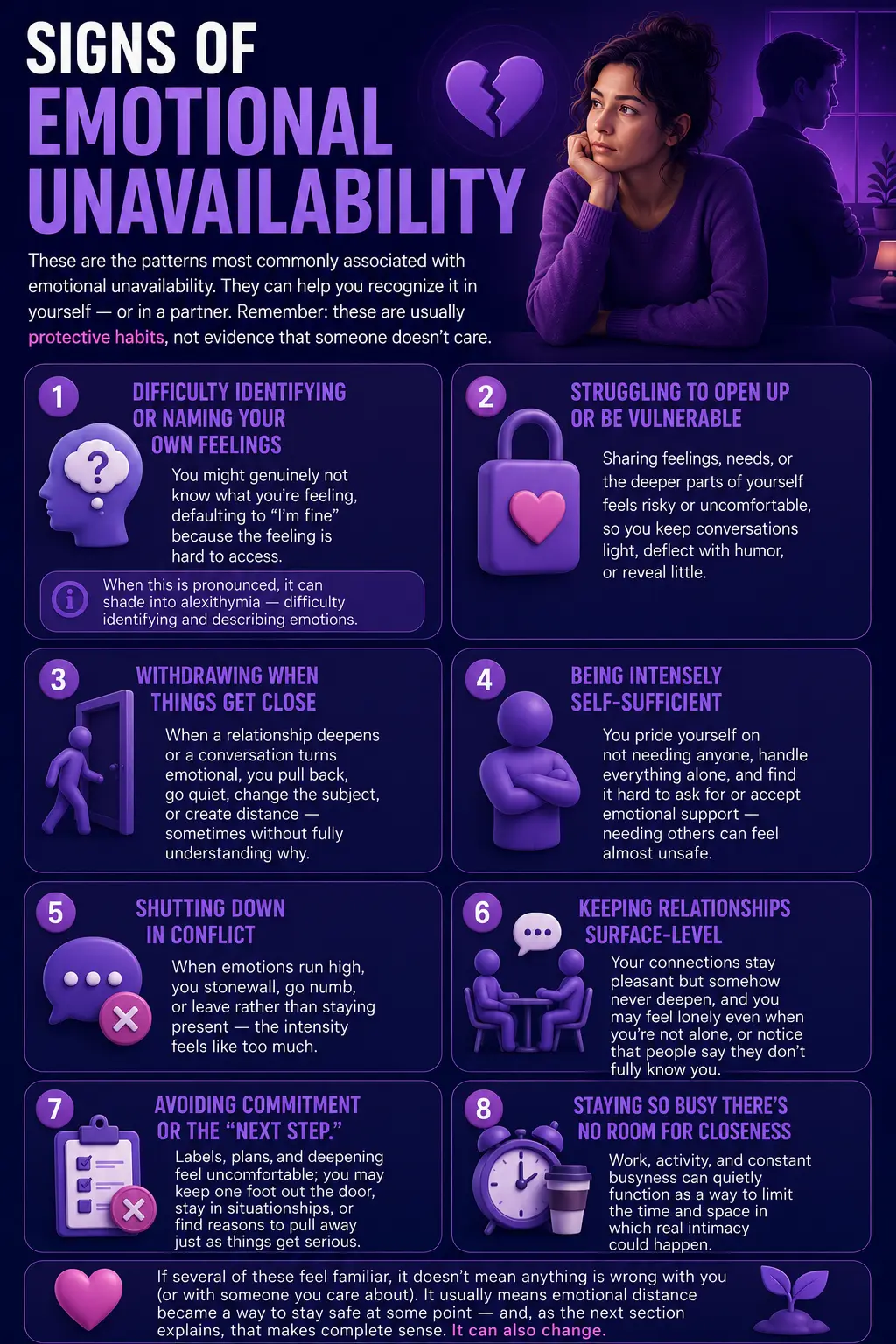
Signs of Emotional Unavailability
These are the patterns most commonly associated with emotional unavailability. They can help you recognize it in yourself — or, if you took this test wondering about someone else, in a partner. As you read, hold them gently: these are usually protective habits, not evidence that someone doesn’t care.
-
Difficulty identifying or naming your own feelings
You might genuinely not know what you’re feeling, defaulting to “I’m fine” not as avoidance but because the feeling is hard to access. (When this is pronounced, it can shade into alexithymia — difficulty identifying and describing emotions.)
-
Struggling to open up or be vulnerable
Sharing feelings, needs, or the deeper parts of yourself feels risky or uncomfortable, so you keep conversations light, deflect with humor, or reveal little even to people close to you.
-
Withdrawing when things get close
When a relationship deepens, or a conversation turns emotional, you feel an urge to pull back, go quiet, change the subject, or create distance — sometimes without fully understanding why.
-
Being intensely self-sufficient
You pride yourself on not needing anyone, handle everything alone, and find it hard to ask for or accept emotional support — needing others can feel almost unsafe.
-
Shutting down in conflict
When emotions run high, you stonewall, go numb, or leave rather than staying present — the intensity feels like too much.
-
Keeping relationships surface-level
Your connections stay pleasant but somehow never deepen, and you may feel lonely even when you’re not alone, or notice that people say they don’t fully know you.
-
Avoiding commitment or the “next step.”
Labels, plans, and deepening feel uncomfortable; you may keep one foot out the door, stay in situationships, or find reasons to pull away just as things get serious.
-
Staying so busy there’s no room for closeness
Work, activity, and constant busyness can quietly function as a way to limit the time and space in which real intimacy could happen.
If several of these feel familiar, it doesn’t mean anything is wrong with you (or with someone you care about). It usually means emotional distance became a way to stay safe at some point — and, as the next section explains, that makes complete sense. It can also change.
What Makes Someone Emotionally Unavailable?
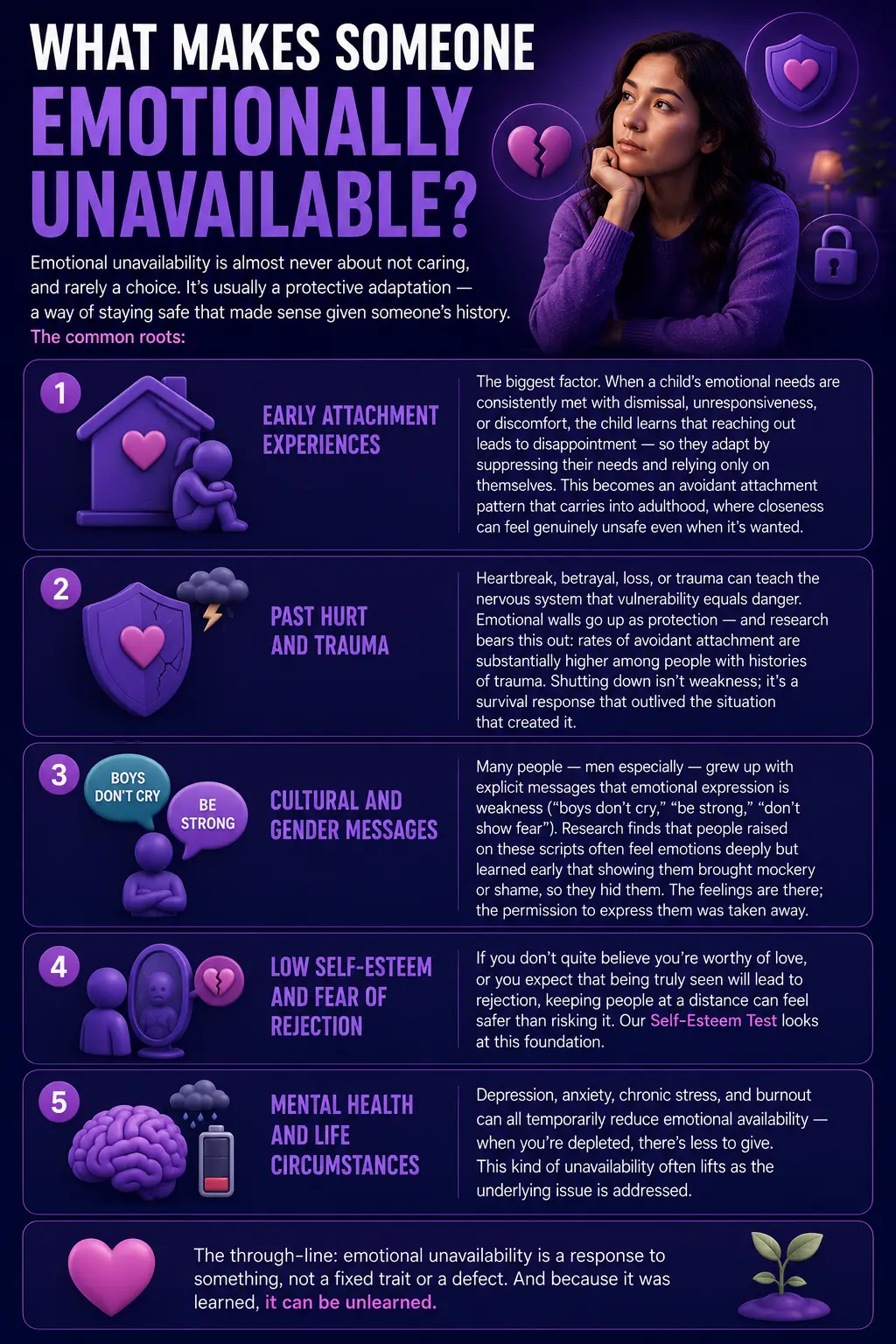
Emotional unavailability is almost never about not caring, and rarely a choice. It’s usually a protective adaptation — a way of staying safe that made sense given someone’s history. The common roots:
-
Early attachment experiences
The biggest factor. When a child’s emotional needs are consistently met with dismissal, unresponsiveness, or discomfort, the child learns that reaching out leads to disappointment — so they adapt by suppressing their needs and relying only on themselves. This becomes an avoidant attachment pattern that carries into adulthood, where closeness can feel genuinely unsafe even when it’s wanted.
-
Past hurt and trauma
Heartbreak, betrayal, loss, or trauma can teach the nervous system that vulnerability equals danger. Emotional walls go up as protection — and research bears this out: rates of avoidant attachment are substantially higher among people with histories of trauma. Shutting down isn’t weakness; it’s a survival response that outlived the situation that created it.
-
Cultural and gender messages
Many people — men especially — grew up with explicit messages that emotional expression is weakness (“boys don’t cry,” “be strong,” “don’t show fear”). Research finds that people raised on these scripts often feel emotions deeply but learned early that showing them brought mockery or shame, so they hid them. The feelings are there; the permission to express them was taken away.
-
Low self-esteem and fear of rejection
If you don’t quite believe you’re worthy of love, or you expect that being truly seen will lead to rejection, keeping people at a distance can feel safer than risking it. Our Self-Esteem Test looks at this foundation.
-
Mental health and life circumstances
Depression, anxiety, chronic stress, and burnout can all temporarily reduce emotional availability — when you’re depleted, there’s less to give. This kind of unavailability often lifts as the underlying issue is addressed.
The through-line: emotional unavailability is a response to something, not a fixed trait or a defect. And because it was learned, it can be unlearned.
How This Emotional Availability Test Works
This test has 15 questions about how you tend to show up in close relationships. Each is a statement — choose how much you agree with it, thinking about your general pattern rather than one moment:
Strongly Disagree = 0 | Disagree = 1 | Neutral = 2 | Agree = 3 | Strongly Agree = 4
Your answers add up to a score from 0 to 60. A higher score reflects greater emotional availability — more openness, presence, and connection. A lower score suggests more emotional guardedness, which (as you’ve read) is usually protective and always changeable. Please read your result as compassionate information, not a grade. There’s no “good” or “bad” person here — just patterns, and patterns can shift. Answer honestly and privately; no one sees your results but you.
Understanding Your Emotional Availability Score
| Score Range | Level | What It Suggests |
|---|---|---|
| 46 – 60 | Emotionally Available | Open, present, and responsive in relationships. You access and share feelings and let others in. |
| 31 – 45 | Mostly Available | Generally open, with some protective guardedness in certain areas or relationships. |
| 16 – 30 | Somewhat Guarded | Walls tend to go up around vulnerability. Workable, and often protective in origin. |
| 0 – 15 | Emotionally Guarded | Significant emotional distance, usually built for protection. Real closeness is learnable. |
Is Your Partner Emotionally Unavailable?
Many people arrive at an emotional availability test like this not (or not only) wondering about themselves, but because they’re involved with someone who feels distant, hard to reach, or emotionally closed off. If that’s you, a few things are worth knowing.
First, emotional unavailability in a partner is usually about their history and protective patterns, not about your worth or lovability — you can’t love someone out of it, and their walls are not your failing.
Second, people can become more available, but only if they want to and are willing to do the work; genuine change has to come from them.
And third, there’s a meaningful difference between a partner who is guarded but caring and working on it, and a dynamic that’s leaving you chronically lonely, hurt, or diminished. If your relationship consistently leaves you feeling unseen, anxious, or alone, it may be worth looking more broadly at its health — our Toxic Relationship Quiz can help, and if you find yourself over-giving to earn a distant person’s love, our Codependency Test and Attachment Style Test may be illuminating. You deserve a relationship where emotional closeness goes both ways.
How to Become More Emotionally Available
Emotional availability isn’t a fixed trait you either have or don’t — it’s a capacity that grows with awareness and practice. If you’d like to become more open, these steps genuinely help.
-
Get better at naming your feelings
Availability starts with access. Practice identifying and naming what you feel with specific words (“I feel hurt,” “I feel anxious”) rather than vague ones (“I’m fine,” “I’m stressed”). Journaling helps, and so does simply pausing to ask yourself what you’re actually feeling.
-
Take small vulnerability risks
You don’t have to fling the doors open. Share one real feeling with one trusted person. Let someone help you with something. Say “that hurt me” instead of going quiet. Each small risk that goes okay teaches your nervous system that closeness can be safe.
-
Notice your urge to withdraw — and stay a moment longer
When you feel the pull to shut down, go quiet, or create distance, try to notice it in real time, and practice staying present just a little longer than is comfortable. Presence is a muscle.
-
Let yourself receive
Availability isn’t only about giving; it’s about letting others in. Practice accepting support, comfort, and care rather than insisting you’re fine and handling everything alone.
-
Understand your patterns
Learning about your attachment style and where your guardedness came from turns “what’s wrong with me?” into “oh, this is why” — which is where self-compassion and change begin. Our Attachment Style Test is a good place to start.
-
Consider therapy
If your guardedness is rooted in past hurt or trauma, a good therapist can help you understand and gently soften it in a safe, paced way. This is one of the things therapy does best.
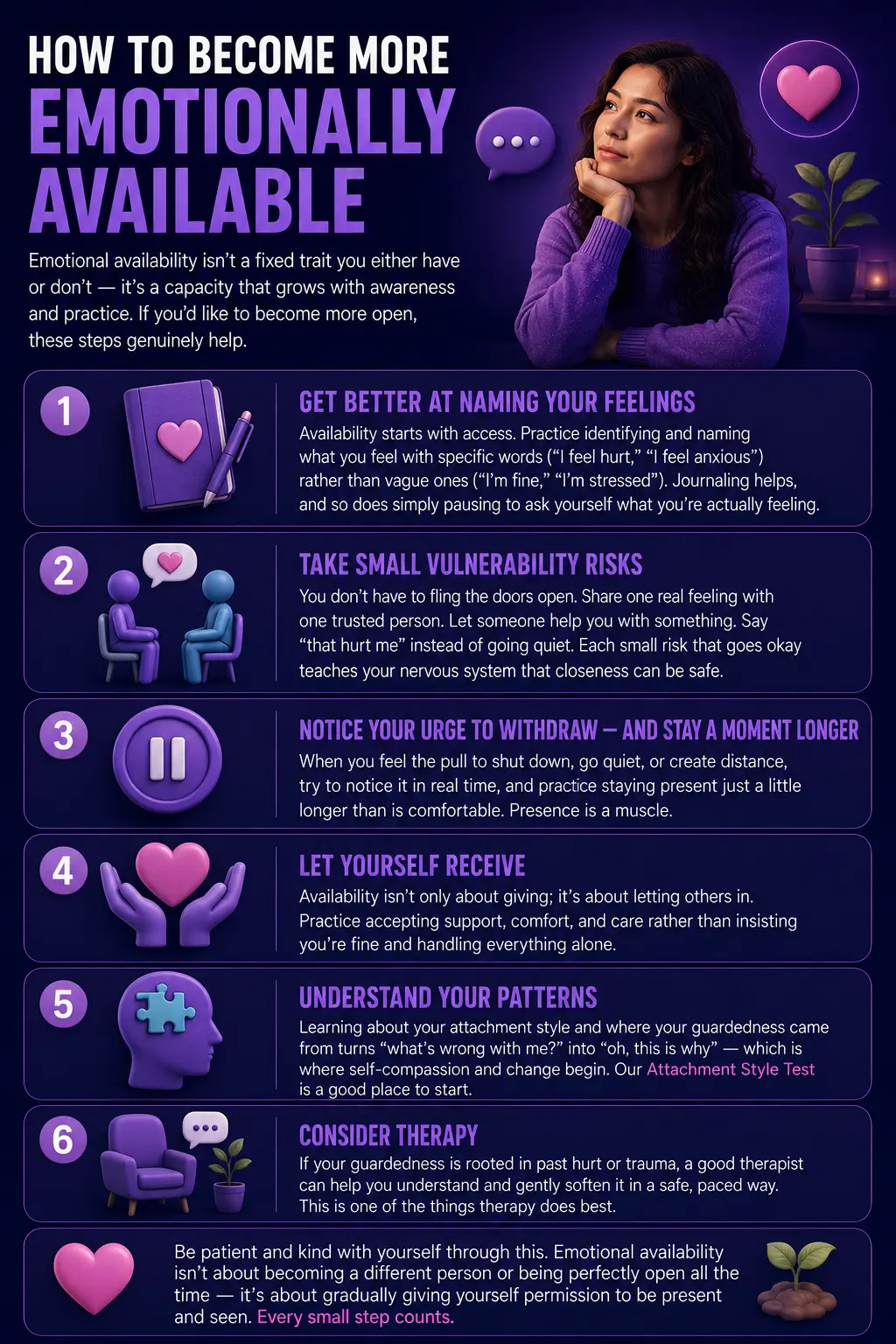
Be patient and kind with yourself through this. Emotional availability isn’t about becoming a different person or being perfectly open all the time — it’s about gradually giving yourself permission to be present and seen. Every small step counts.
Frequently Asked Questions
What does it mean to be emotionally available?
Being emotionally available means having the capacity to be open, present, and responsive in your relationships — both able to access and share your own feelings, and able to receive and respond to someone else’s. It looks like letting people see the real you, staying present rather than shutting down when things get emotional or hard, offering comfort and accepting it in return, and being willing to be vulnerable with people you trust.
Emotional availability doesn’t mean being an open book with everyone or having no boundaries; healthy availability includes knowing who has earned your openness. It’s less about intensity and more about presence — being genuinely reachable to the people who matter to you.
Can emotional availability change over time?
Yes — this is one of the most hopeful and well-established things about it. Emotional availability is a capacity, not a fixed trait, and it’s closely tied to attachment patterns, which research shows can shift throughout life. People become more emotionally available through corrective experiences (secure, patient relationships that teach them closeness is safe), through deliberate practice (naming feelings, taking small vulnerability risks, staying present), and through therapy, which is particularly effective when guardedness is rooted in past hurt.
Change tends to be gradual rather than sudden, and it doesn’t require becoming a different person — just gradually giving yourself permission to be more open. Someone who has been guarded for decades can absolutely become more available.
Why am I emotionally unavailable even though I want connection?
This painful contradiction — wanting closeness while also pulling away from it — is extremely common, and it makes complete sense once you understand it. Emotional unavailability is usually a protective pattern learned early or reinforced by hurt: if closeness once led to disappointment, rejection, or pain, your nervous system learned to keep distance as a way to stay safe, even though part of you longs for connection.
This is especially characteristic of what’s called fearful-avoidant attachment, where the desire for closeness and the fear of it coexist. So wanting connection and struggling with it isn’t a contradiction or hypocrisy — it’s two parts of you, one that needs closeness and one that’s trying to protect you from being hurt by it. Understanding that can be the beginning of gently teaching the protective part that it’s safe to let the door open.
Is being emotionally unavailable the same as not caring?
No — and this is one of the most important and most misunderstood things about it. Emotional unavailability is very rarely about not caring; often the person cares deeply but struggles to show it or to tolerate the vulnerability that expressing it requires. Someone can love you profoundly and still find it hard to say so, to open up, or to stay present when emotions run high, because their history taught them that vulnerability is dangerous.
In fact, some emotionally guarded people (particularly those with a dismissive-avoidant style) express care powerfully through actions — showing up reliably, solving problems, providing stability — even when words fail them. That’s real caring, and real availability of a kind, just not the verbally expressive kind our culture tends to recognize. Unavailability is about capacity and safety, not the absence of love.
How do I know if I’m emotionally unavailable or just introverted?
They’re genuinely different, though they can look similar from outside. Introversion is about where you get your energy — introverts recharge through solitude and may prefer smaller, quieter social settings, but they can be deeply emotionally open and connected within their close relationships. Emotional unavailability is about difficulty with emotional openness itself — accessing, sharing, and staying present with feelings — regardless of how social or solitary you are.
An introvert can be entirely emotionally available (just selective about how much socializing they do); an extrovert can be highly social yet emotionally unavailable (surrounded by people but never truly opening up). The question isn’t how much you socialize, but whether, in your close relationships, you can be genuinely vulnerable and present. If you’re emotionally open with the people closest to you but simply need lots of alone time, that’s introversion, not unavailability.
Can an emotionally unavailable person change?
Yes, but with an important condition: they have to want to, and be willing to do the work. Emotional availability can absolutely be developed — through self-awareness, practice with vulnerability, corrective relationship experiences, and often therapy. But change can’t be forced from outside, and no amount of love or patience from a partner can make an unwilling person open up.
This matters especially if you’re waiting on someone else to change: you can support and encourage, but the motivation and effort have to be theirs. If you’re the one wanting to become more available, the fact that you want to is itself a strong starting point — it means the door is already cracked open. Genuine, lasting change is very possible for people who are motivated to pursue it.
Further reading
How emotionally available someone is tends to track broader traits, particularly agreeableness and neuroticism. The free personality test maps those dimensions directly. Emotional availability is about openness in close relationships. The broader skill set behind it — recognising emotions, regulating them, and reading other people — is what the emotional intelligence test measures. Being emotionally available is part of being a good friend, but not the whole of it. Am I a good friend? adds the other pieces: reliability, honesty, keeping confidences and repairing things after you get them wrong.
Related Tests
- Attachment Style Test — the deepest companion to this test; your attachment style largely shapes your emotional availability
- Alexithymia Test — for difficulty identifying and describing your own emotions, a common root of unavailability
- Codependency Test — if you tend to over-give to earn love from distant people, this looks at that pattern
- Toxic Relationship Quiz — if a relationship is leaving you chronically lonely, hurt, or diminished
- Self-Esteem Test — self-worth is a foundation of the capacity to be openly seen and to receive love
- Fake Friend Test — for reflecting on the give-and-take and emotional reciprocity in a friendship
References
- Biringen, Z. (2008). The Emotional Availability (EA) Scales (4th ed.). [The emotional availability construct — emotional responsiveness and receptivity; note: the EA Scales assess parent-child relationships] researchgate.net
- Bowlby, J. (1988). A Secure Base: Parent-Child Attachment and Healthy Human Development. Basic Books. [Attachment theory foundations] psycnet.apa.org
- Hazan, C., & Shaver, P. (1987). Romantic love conceptualized as an attachment process. Journal of Personality and Social Psychology, 52(3), 511–524. [Adult romantic attachment styles] pubmed.ncbi.nlm.nih.gov
- Mikulincer, M., & Shaver, P.R. (2016). Attachment in Adulthood: Structure, Dynamics, and Change (2nd ed.). Guilford Press. [Avoidant attachment, emotional distancing, and how attachment changes] guilford.com
- Fraley, R.C. (2019). Attachment in adulthood: Recent developments, emerging debates, and future directions. Annual Review of Psychology, 70, 401–422. [Stability and change in adult attachment] pubmed.ncbi.nlm.nih.gov
Related Tests
See All Quiz →
You may also like
See All Quiz →