
Self-reflection · Relationships
Polyamorous Quiz: explore your relationship preferences
Reflect on what appeals to you about different relationship structures, and what does not. These 15 questions cannot decide whether you are polyamorous, whether a relationship should change, or what a partner must agree to.
An educational reflection, not a diagnosis, identity classification or relationship recommendation.
-
THE REFLECTION15 questionsExplore the questions at your own pace.
-
YOUR CHOICEYou can stop at any timeAnswer only while you feel comfortable continuing.
-
CLEAR BOUNDARIESA reflection, not a labelYour result cannot decide your identity or choices.
The reflection
Take the polyamorous quiz
Answer about your own experience and preferences, rather than the answer a partner wants. Some statements are hypothetical or assume experience with multiple partners; if they do not fit, the resulting total will be less informative. There is no correct relationship structure and no pass mark.
Your answers
What the ranges mean
- 0–35 Lower combined endorsement
- 36–55 Mixed combined endorsement
- 56–75 Higher combined endorsement
The stored ranges are 0–35, 36–55 and 56–75. Because every answer contributes at least one point, 0–14 cannot be reached on a completed quiz. These inherited ranges are descriptive groupings, not researched cutoffs.
An inherited educational questionnaire about several different aspects of relationships.
The short answer
What does polyamorous mean?
Polyamory describes the practice of, or interest in, more than one loving or intimate relationship with the knowledge and agreement of everyone involved.
It is one form of consensual non-monogamy, an umbrella that also includes other arrangements. People use these words in different ways. This page is about understanding preferences and agreements, not deciding which relationship structure is best for you. The Attachment Style Test explores a different topic: patterns of closeness, rather than relationship structure.
Finding the idea appealing does not change a commitment you have already made. Your preferences and other people’s boundaries both matter.
Explicit consent distinguishes consensual non-monogamy from infidelity. The Division 44 Committee on Consensual Non-monogamy includes polyamory among several forms of CNM; it does not define one personality type that everyone must have.
View sourceReflection prompts
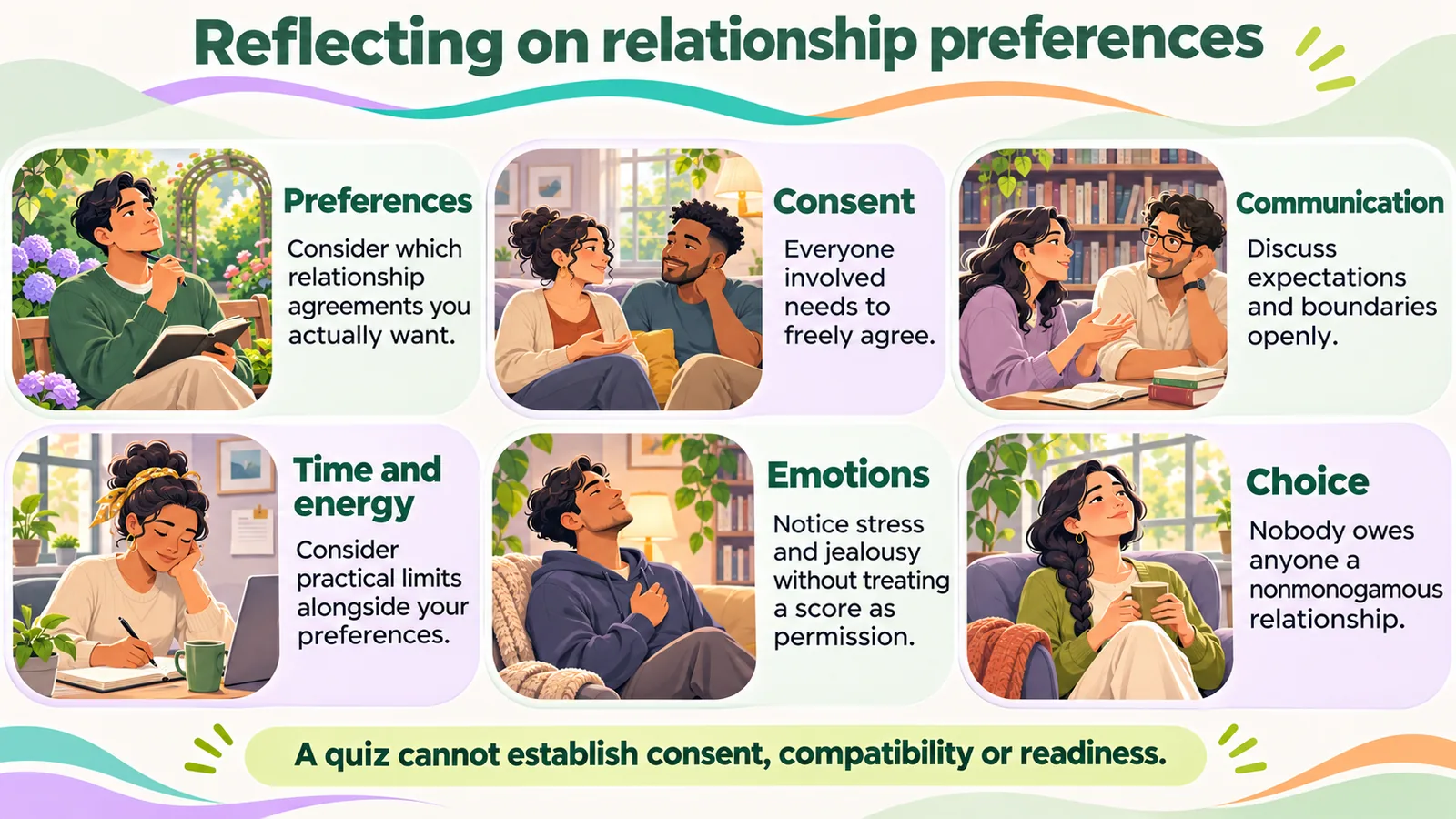
Six questions to reflect on beyond the score
These are conversation prompts, not signs that prove you are polyamorous or suitable for multiple relationships.
Your own interest
What appeals to you about more than one relationship: emotional connection, autonomy, sexual variety, or something else? You do not have to want all of these.
Other people’s independence
Consider what you would want for a partner as well as for yourself. An appealing personal possibility may feel different when it includes someone else’s choices.
Clear agreements
Notice whether you can describe what you are proposing and hear a different answer. A vague “be open-minded” conversation is not the same as an agreement.
Time and commitments
Think about the time and care you already promise to people. A questionnaire cannot establish how much additional capacity you have.
Jealousy and reassurance
Jealousy can arise in monogamous and non-monogamous relationships. Rather than using it as a pass/fail test, ask what it signals and how you would discuss it.
Freedom to decline
Ask whether each person could reject a proposed change without being shamed or threatened. A high score cannot override a boundary.
Polyamory, other CNM and breaking an agreement
The distinction rests on what people know and agree to, not simply on the number of people involved.
| Question | Consensual arrangement | Agreement breached |
|---|---|---|
| Knowledge | People know the arrangement they are agreeing to. | Important information is hidden or an agreed boundary is crossed. |
| Romantic connections | Polyamory can include multiple loving relationships. Other CNM arrangements may differ. | The relationship’s actual commitments determine what counts as a breach. |
| Attraction alone | An attraction can be acknowledged without acting on it. | A feeling alone is not evidence that someone broke an agreement. |
| What a quiz can do | Offer words for a conversation about preferences. | It cannot establish consent, justify secrecy or decide another person’s boundaries. |
Understanding the result
What can a polyamorous quiz tell you?
The useful information is in individual answers. The total is not a label, compatibility score or measure of readiness.
- 01 Preferences
What you want
Notice the statements about exclusivity and multiple connections that fit your experience. A preference does not require a diagnostic assessment.
- 02 Different domains
What the total mixes
The questions combine interest, beliefs about benefits, communication, confidence and stress. Adding those together does not establish one underlying trait.
- 03 Consent
What a score cannot decide
No range authorizes a relationship change. Current agreements and each person’s informed, freely given consent remain separate from your result.
The final question asks about stress and scores Never as 5 and Always as 1. People without relevant experience may find it hard to answer. Do not interpret a low-stress answer—or the overall total—as evidence that you can safely manage multiple relationships. For a separate reflection on needs and boundaries, see the Codependency Test.
Your context
Put the answers in the context of your life
There is no requirement to be monogamous or polyamorous. Before interpreting a total, consider what the questions actually assumed about you.
Hypothetical versus experienced
An imagined situation may feel different from something you have lived. Note which answers reflect curiosity and which reflect experience.
Belief versus outcome
Thinking polyamory could improve happiness is not a prediction. Keep the question’s opinion separate from what a relationship change would actually do.
Agreements versus labels
People may use the same label while wanting different boundaries. Ask about concrete expectations rather than assuming the word settles them.
Support and information
What support can be useful?
Support can help you clarify your wishes and communicate them. Its purpose is not to persuade anyone toward a particular structure.
- 01 / LEARN
Read clear definitions
Compare descriptions of polyamory, open relationships and other forms of CNM. Use them as vocabulary rather than a checklist you must satisfy.
- 02 / TALK
Make room for disagreement
Choose a calm moment to ask what each person wants. You can be honest about a preference while recognizing that a partner may want something different.
- 03 / SUPPORT
Choose an informed counselor
If you want professional help, ask about experience with consensual non-monogamy and monogamy. Seek a respectful space for your own priorities and boundaries.
You can explore language and preferences without changing your relationships. A quiz is not a reason to pressure yourself or anyone else.
Practical next steps
What to do with your result
Use a small, specific next step rather than making a major decision from a total.
- 01
Choose one meaningful answer
Write down the question you found most informative, including why it fit or did not fit. You do not need to interpret every item at once.
- 02
Separate wants from agreements
Make one list of what you might want and another of your current commitments. Neither list automatically changes the other.
- 03
Discuss without a deadline
If you choose to talk with a partner, ask for their perspective rather than presenting the result as a conclusion you both must accept. The Emotional Availability Test offers a separate reflection on expressing and receiving support.
You can decline a proposed relationship arrangement. If you feel pressured, seek support from someone you trust and focus on what you need to make your own decision.
Your questions
Polyamorous Quiz FAQs
Clear answers about the terms, this questionnaire and the limits of a score.
Only you can decide whether that word is useful for your preferences or experience. This quiz cannot establish a relationship identity. More importantly, an identity or preference does not decide what anyone else must agree to.
No. Consensual non-monogamy involves people knowing and agreeing to the arrangement. Cheating involves breaching an agreement. Multiple relationships can still involve commitments and boundaries.
No. The total combines different themes and has not been validated as a readiness assessment. It cannot measure a partner’s consent, your available time or how a particular change would work.
That is the inherited stored band. Every item contributes at least one point, so a completed questionnaire can total 15–75 and cannot reach 0–14. The ranges are retained during this migration and are descriptive, not researched thresholds.
Yes. The final item scores Never as 5 and Always as 1, while the other items score in the opposite direction. That preserves the original scoring; it does not turn the questionnaire into a validated measure.
Yes. Jealousy can occur in different relationship structures. An emotion is not a verdict about your identity. Consider what it means in the particular situation and how you want to communicate about it.
No. You do not have to accept a relationship structure you do not want. A respectful discussion leaves room for different preferences and for someone to decline.
You can offer it as an optional conversation prompt, but do not use the score as leverage. A direct discussion of wishes and boundaries is more important than getting matching totals.
If you want help sorting out a disagreement or preference, a counselor familiar with diverse relationship structures may provide space to discuss it. The goal should be your wellbeing and agency, rather than persuading you toward monogamy or non-monogamy.
Editorial transparency
Sources and review information
Prepared by the PsyMed Editorial Team using the resources listed here. No clinician or validated assessment is claimed. Updated 2026-11-15. Independent review status is recorded in the package notes. Read how we build our tests and who we are.
Definitions and educational references
Your experience matters
You choose the words and the next step.
Use the questions for reflection. Your boundaries and self-description do not need a quiz’s approval.
Take the reflection