
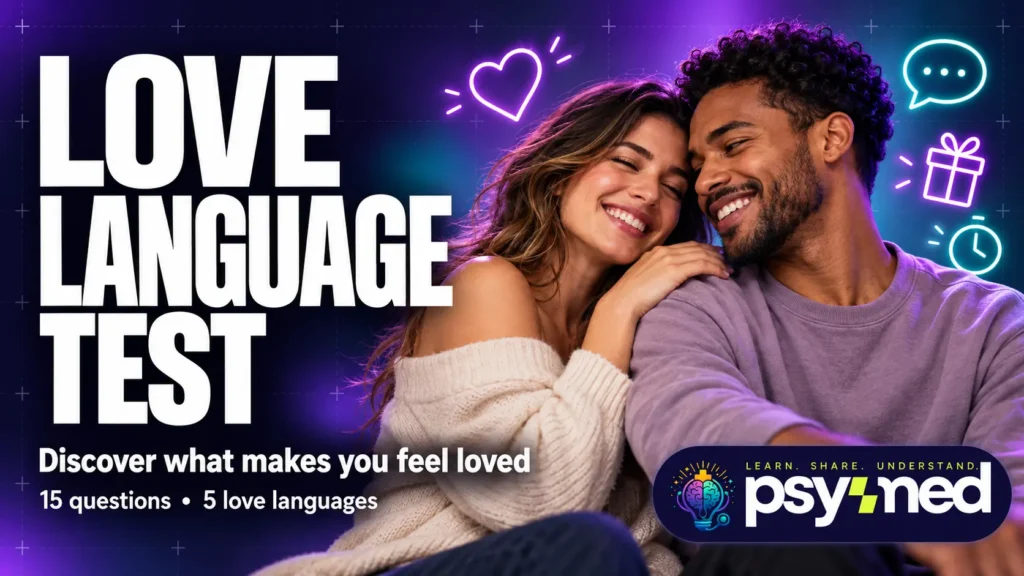

Love Language Test: What’s Your Love Language?
A 15-item forced-choice quiz that identifies which of the five love languages - words of affirmation, quality time, acts of service, physical touch or receiving gifts - best describes how you prefer to give and receive love. Built on Gary Chapman's framework as a conversation starter, not a clinical measure.
Published Updated
This free Love Language Test reveals how you most naturally give and receive love — your primary love language — in about five minutes and 15 quick questions. Based on the famous five love languages (words of affirmation, quality time, acts of service, physical touch, and receiving gifts), it turns a vague sense of “I just feel loved differently” into something you can name, understand, and actually talk about with the people closest to you.
It’s free, private, and gives you instant results — no sign-up, nothing stored. One honest note before you begin: this is a self-reflection tool and a conversation starter, not a diagnosis or a compatibility verdict. The love languages are a popular framework from relationship counselor Gary Chapman, best used to open a conversation about how you each feel cared for — which, as you’ll see below, is where their real value lies.
What Are the 5 Love Languages?
The five love languages are five different ways people express and experience love: words of affirmation, quality time, acts of service, physical touch, and receiving gifts. The idea comes from marriage counselor Gary Chapman, who introduced it in his 1992 book The Five Love Languages after noticing a pattern across decades of counseling couples: partners often love each other sincerely but “speak” love in different dialects, so the care gets lost in translation.
The core insight is simple and genuinely useful — we tend to give love in the way we most like to receive it, which isn’t always the way our partner receives it best. Someone whose language is acts of service might show love by handling chores, while their partner, whose language is words of affirmation, is quietly longing to hear “I appreciate you.” Neither is wrong; they’re just speaking different languages. Learning to express love in your partner’s language — and telling them yours — is the practical payoff of the whole framework, and finding your own is where it starts.
The 5 Love Languages Explained
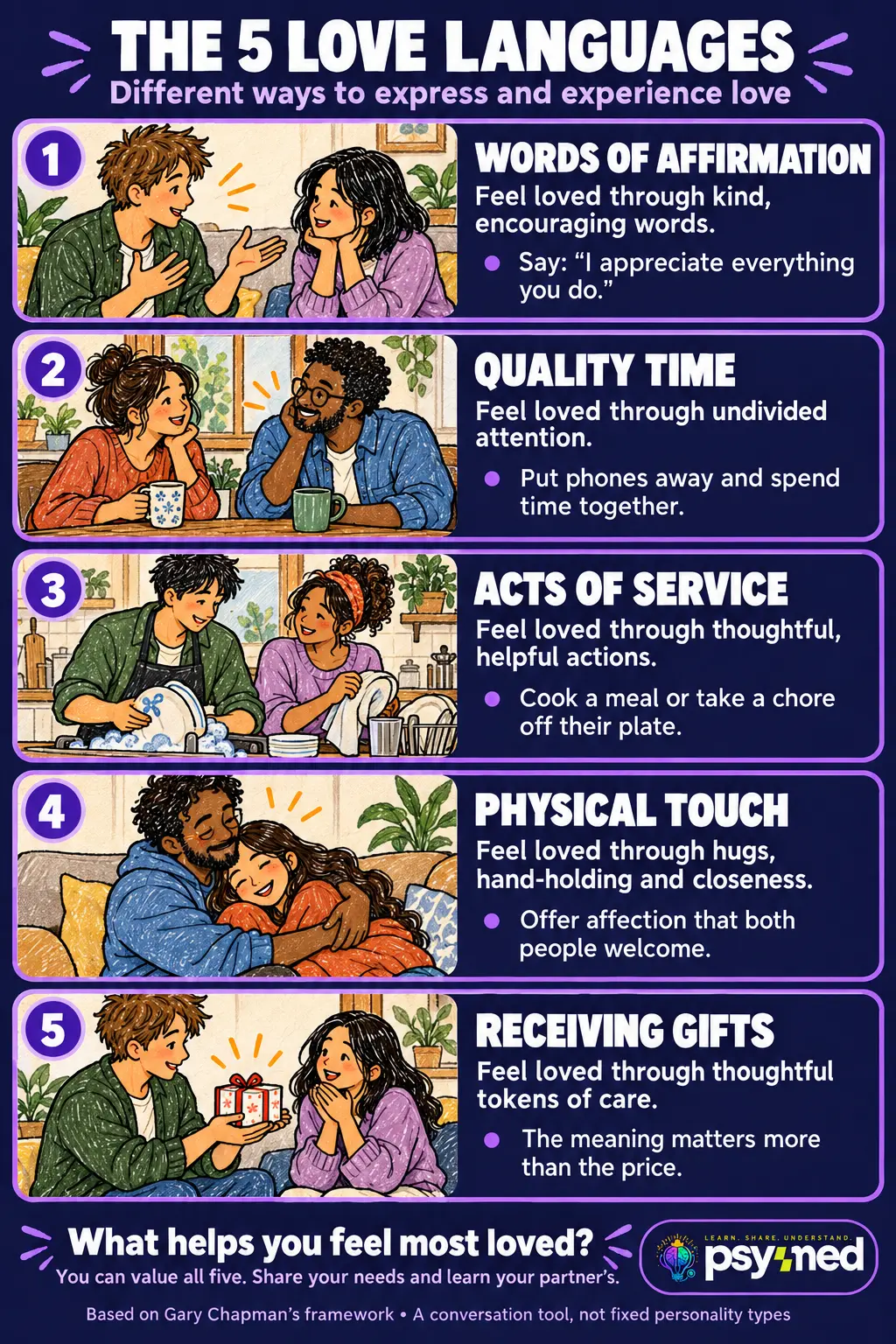
Each love language describes a primary way of feeling loved. Most people value all five to some degree but have one or two that matter most. Here’s what each one looks like — read them as the “signs,” and notice which makes your heart respond most strongly.
Words of Affirmation
If this is your language, you feel most loved through spoken and written words — compliments, encouragement, appreciation, and hearing “I love you.” Kind, affirming words land deeply for you, and you remember them for a long time. The flip side: harsh or careless words cut especially deep and are hard to forget. A heartfelt text, a note, or simply being told what someone values about you means more to you than almost anything.
Quality Time
If this is your language, you feel most loved through undivided attention — real togetherness, with phones down and distractions away. It’s not just being in the same room; it’s being truly present with each other, whether that’s deep conversation, a shared activity, or simply focused time together. Nothing says love to you like someone choosing to spend their time and full attention on you. The flip side: distraction, canceled plans, or feeling like an afterthought hurts the most.
Acts of Service
If this is your language, you feel most loved when people do helpful things for you — easing your load, lending a hand, taking a task off your plate. “Actions speak louder than words” is practically your motto. When someone cooks you a meal, handles a chore, or steps in to help without being asked, you feel genuinely cared for. The flip side: broken commitments or someone making more work for you can feel like they don’t care.
Physical Touch
If this is your language, you feel most loved through physical closeness — hugs, hand-holding, a hand on the back, cuddling, and physical affection generally. Touch is deeply reassuring to you; it’s how you feel connected and safe. This isn’t only about intimacy — everyday physical warmth communicates love powerfully for you. The flip side: physical distance or coldness can feel like genuine rejection. (A note that matters: valuing touch is about how you feel loved; it never creates an obligation on anyone else to give touch or intimacy they don’t want.)
Receiving Gifts
If this is your language, you feel most loved through thoughtful gifts — not because of money or materialism, but because a gift is a visual symbol that someone was thinking of you. The thought and effort behind it is what counts: a small “this made me think of you” token can mean the world. You likely remember gifts you’ve been given for years. The flip side: a forgotten birthday or a thoughtless, last-minute gift can sting more than the giver realizes.
Take the Love Language Test
The test below presents 15 everyday relationship scenarios. For each one, simply choose the option that would mean the most to you — the one that would make you feel most loved, appreciated, or cared for. There are no right answers; pick the one that resonates most, thinking about how you generally prefer to give and receive love. It tallies which of the five languages you choose most often, and your result is your primary love language. Answer honestly and from the heart — your answers are private.
How This Love Language Test Is Scored
This test uses a “forced choice” method rather than a points score, which is what lets it find your primary language. In each of the 15 scenarios, every answer option corresponds to one of the five love languages, and choosing an option counts as one “vote” for that language. Because you pick only one option per scenario, the languages compete directly against each other — so your result reflects what you value most, not just everything you happen to like.
When you finish, the test tallies your votes and your primary love language is simply the one you chose most often. If two come out tied, that’s a real and common result — it means you’re effectively “bilingual,” with two languages that matter to you equally. This design mirrors how the love languages are meant to work: not as a score of how loving you are, but as a picture of which expressions of love speak loudest to you. It’s a reflection exercise, not a measurement of anything clinical.
What to Do With Your Love Language Results
Your result is most useful as the start of a conversation, not the end of one. The single most valuable thing you can do is simply tell the people close to you what you learned — “I realized I feel most loved when we have real, undistracted time together” gives your partner, friend, or family member something concrete to act on, instead of leaving them to guess. Naming it out loud is often where the whole benefit lives.
From there, a few practical moves help. Ask about theirs — have them take the test too, and swap results; the goal isn’t to match, but to understand. Translate, don’t just default — if your partner’s language is physical touch and yours is words of affirmation, make a point of offering more of what they need, and ask the same of them. And stay flexible: your result is a snapshot of what you value now, and it can shift with stress, seasons of life, and different relationships. If you’d like to go deeper than preferences into the underlying patterns of how you bond and trust, our Attachment Style Test rests on a stronger research base and pairs naturally with this one.
Using the Love Languages as a Couple
The love languages were designed with couples in mind, and that’s where they tend to be most useful — as a shared vocabulary for a conversation many partners struggle to have. When both people know each other’s languages, a lot of everyday friction suddenly makes sense: the partner who keeps doing helpful chores and the partner who keeps wishing they’d just say something loving aren’t failing each other, they’re speaking different dialects. Naming that out loud tends to replace blame with understanding.
The key thing to hold onto is that the aim is not to have matching love languages — in fact, research finds no evidence that couples with matching languages are happier. The aim is to learn to speak each other’s, deliberately, even when it doesn’t come naturally. A quick, low-pressure exercise: each of you name your top language and one specific thing the other could do this week that would land in it. Small, specific, and mutual beats grand and vague. If a relationship feels less like a language gap and more like it’s genuinely hurting you, that’s a different question — our Toxic Relationship Quiz looks at that directly.
Methodology & Sources
This test is built on Gary Chapman’s five love languages framework, introduced in his 1992 book The Five Love Languages. The questions are original scenarios written to reflect the five categories; they are not from Chapman’s official questionnaire, which is proprietary. We designed the test as an accessible, forced-choice reflection tool to help you identify which expression of love resonates with you most.
In the interest of honesty, it’s worth being clear about the framework’s scientific status: the five love languages are a popular self-help model, not a validated clinical instrument. A 2024 review by Emily Impett, Gideon Park, and Amy Muise in Current Directions in Psychological Science examined the evidence and found limited support for some of Chapman’s central claims — in particular, that each person has a single “primary” language (most people say all five matter to them) and that matching partners’ languages predicts relationship success.
The researchers proposed a “balanced diet” metaphor instead: healthy relationships need the full range of loving behaviors, plus things like companionship, emotional support, and respect — not one dominant category. We think that’s the right way to hold your result: as a useful conversation starter and a window into your preferences, not a rule or a label. Used that way, the framework has helped millions of couples put feelings into words.
References
- Chapman, G. (1992). The Five Love Languages: How to Express Heartfelt Commitment to Your Mate. Northfield Publishing.
- Impett, E.A., Park, G., & Muise, A. (2024). Popular psychology through a scientific lens: Evaluating love languages from a relationship science perspective. Current Directions in Psychological Science. University of Toronto summary
- Egbert, N., & Polk, D. (2006). Speaking the language of relational maintenance: A validity test of Chapman’s five love languages. Communication Research Reports, 23(1), 19–26.
Cite This Page
PsyMed. (2026). Love Language Test: What’s Your Love Language? PsyMed.info. Retrieved from https://psymed.info/all_quiz/love-language-test/
Frequently Asked Questions
What are the 5 love languages?
The five love languages are words of affirmation (spoken and written appreciation), quality time (undivided attention and togetherness), acts of service (doing helpful things), physical touch (hugs, closeness, and affection), and receiving gifts (thoughtful tokens). They were introduced by relationship counselor Gary Chapman in his 1992 book The Five Love Languages, based on his observation that people tend to give and receive love in different “dialects.” Most people value all five to some degree but have one or two that resonate most strongly — and this test is designed to reveal which is your primary one.
Can your love language change over time?
Yes. While some people feel they’ve always had the same primary love language, there’s nothing fixed about it — your result can shift with life circumstances, different relationships, and personal growth. Someone going through a stressful, overloaded period might find acts of service suddenly matters most, while at another time quality time or physical touch takes the lead. This is actually one reason researchers caution against treating your love language as a permanent label. Think of your result as a snapshot of what you value right now, and feel free to retake the test as your life and relationships change.
What if my partner and I have different love languages?
Having different love languages is extremely common, and it’s not a problem — it’s just useful information. The whole point of Chapman’s framework is that partners often love each other deeply but express it in different ways, so the care can get “lost in translation.” The solution isn’t to have matching languages; it’s to learn to speak each other’s. If your partner’s language is physical touch and yours is words of affirmation, you can make a point of offering more affection, while they make a point of offering more verbal appreciation. Simply having the conversation — telling each other what makes you feel most loved — is often the biggest benefit of the whole exercise.
Is this the official love languages test?
No — this is a free, original test built on Gary Chapman’s widely known five love languages framework, not the official questionnaire from Chapman’s own organization. It’s designed as an accessible, educational way to discover your primary love language and reflect on how you give and receive love. The five languages and the concept come from Chapman’s work; the questions here are our own. If you’d like to explore the framework further, Chapman’s book is the original source.
Are the love languages scientifically proven?
Not as a validated science, no — and we’d rather be upfront about that than oversell it. The love languages are a hugely popular self-help framework, and many couples find them genuinely helpful, but a 2024 research review found limited support for the framework’s specific claims, including the idea of a single primary language and the notion that matching partners’ languages makes relationships succeed. The honest, evidence-based way to use your result is as a conversation starter and a tool for self-reflection — a way to put into words how you feel cared for — rather than as a scientific measurement or a compatibility test. For a relationship assessment with a stronger research base, see our Attachment Style Test.
Related Tests
- Attachment Style Test — how you bond and connect in close relationships (stronger research base)
- Emotional Availability Test — how open and present you are emotionally
- Emotional Intelligence (EQ) Test — the skills behind attuned, caring relationships
- Toxic Relationship Quiz — for when a relationship feels more harmful than loving
- Self-Esteem Test — how you feel about yourself, which shapes how you love and are loved
Related Tests
See All Quiz →

You may also like
See All Quiz →