
Self-check · Relationships
Emotional Availability Test: can the people close to you actually reach you?
Being closed off is nearly always protection that once worked, not a character defect. These 15 questions ask about four separate things — knowing what you feel, saying it, responding to others, and staying present when it gets close — because most people are only short on one of them.
Not a diagnosis, and not a verdict on your character. A higher score here means more openness, not more of a problem.
-
FOUR THINGS, NOT ONEFeel, say, show, stayKnowing what you feel, saying it, responding to others, and staying when it gets close.
-
HOLDING IT IN IS NOT NEUTRALSuppression has a measured costAcross five studies it tracked with worse interpersonal functioning, not calmer relationships.
-
PRIVATENothing is saved or sentFree, no account, no sign-up. Your result stays in your browser.
A 15-question self-check
Take the availability test
Fifteen statements about how open you are with the people closest to you. About two minutes.
Your result
What the ranges mean
- 0–15 Mostly closed off right now
- 16–30 Guarded, with moments of openness
- 31–45 Fairly open, with some reserve
- 46–60 Emotionally open and available
Fifteen statements scored 0 to 4 give a total of 0–60. Here the high end is the open end: a higher score means more emotional availability, not more of a problem. The questions cover four things rather than one.
Habitual suppressors reported less positive emotion, more negative emotion, and worse interpersonal functioning.
The short answer
What does emotionally unavailable actually mean?
Being persistently hard to reach emotionally by the people closest to you: not naming what you feel, not saying it, not responding much when they bring you theirs, or pulling back when a relationship starts to get close. It is a description of a pattern, not a diagnosis, and no manual lists it. It is worth being blunt that the phrase is mostly used as an accusation. Used carefully it describes something real and changeable; used as a label it is just a way of ending an argument.
The four parts are worth separating because most people are only short on one or two. Plenty of people know exactly what they feel and cannot say it; plenty of others say a great deal and go quiet the moment someone else needs something.
The question is not whether you have feelings. It is whether the people closest to you can reach them.
Gross and John, 2003 is the source for what this page says about the cost of holding it in: five studies finding that habitual suppression went with experiencing and expressing less positive emotion, experiencing more negative emotion, and worse interpersonal functioning, while habitual reappraisal went the other way.
View sourceThe four parts
What the fifteen questions ask about
Four separate things, and most people are short on one or two rather than all of them.
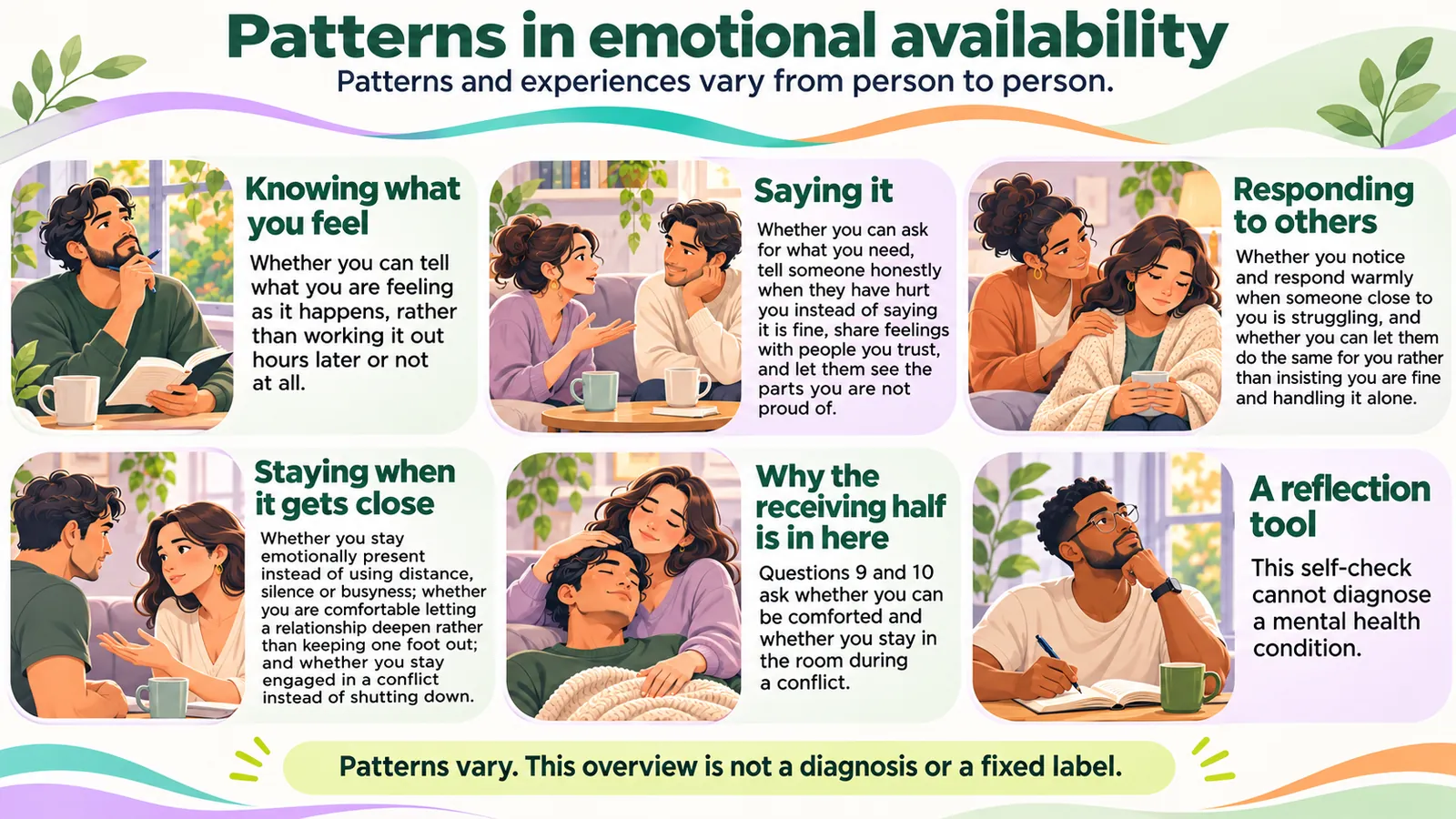
Knowing what you feel (questions 14, 15)
Whether you can tell what you are feeling as it happens, rather than working it out hours later or not at all. This is the upstream one: nothing else on the list is available to you if this is missing.
Saying it (questions 2, 4, 12, 13)
Whether you can ask for what you need, tell someone honestly when they have hurt you instead of saying it is fine, share feelings with people you trust, and let them see the parts you are not proud of.
Responding to others (questions 8, 9)
Whether you notice and respond warmly when someone close to you is struggling, and whether you can let them do the same for you rather than insisting you are fine and handling it alone. Availability runs both directions and the receiving half is the one people miss.
Staying when it gets close (questions 1, 3, 5, 6, 7, 10, 11)
Whether you stay emotionally present instead of using distance, silence or busyness; whether you are comfortable letting a relationship deepen rather than keeping one foot out; and whether you stay engaged in a conflict instead of shutting down.
Why the receiving half is in here
Questions 9 and 10 ask whether you can be comforted and whether you stay in the room during a conflict. People who would never describe themselves as unavailable often score lowest here, because being the reliable one who never needs anything reads as strength and functions as distance.
Why there is no diagnosis to find
Emotional unavailability is a description, not a condition, and nothing in any diagnostic manual corresponds to it. Where the pattern is lifelong, pervasive and distressing, the nearest clinical ideas are avoidant attachment and, separately, avoidant personality disorder, which is a different and much narrower thing.
Distance, alexithymia and avoidance
Three things that look the same from outside, for different reasons.
| Pattern | What it looks like | What it means |
|---|---|---|
| Learned emotional distance | Feelings are there; expressing them was never safe or never modelled. | Changeable, and the most common of the three. |
| Alexithymia | Genuine difficulty identifying and naming what you feel at all. | A trait, often alongside something else. A different route in. |
| Avoidant attachment | Closeness itself triggers withdrawal; distance returns when it deepens. | Costs more the longer a relationship runs. |
| How do I tell distance from alexithymia? | By asking what happens inside, not what comes out. If you can feel the thing clearly and simply cannot get it into words or do not want to, that is expression. If someone asks how you feel and the honest answer is that you do not know, and you often work it out days afterwards or not at all, that is closer to alexithymia. The two feel identical to a partner and need different things from you. | |
Reading your result
What should you take from the number?
Three things more useful than the total.
- 01 Which of the four parts is low
Feeling, saying, responding or staying
A person who feels everything and says nothing has a different problem from one who talks freely and goes blank when someone else needs them. Knowing which is yours is the difference between useful change and resolving to be warmer. more useful than the total and it points at different things to practise.
- 02 Whether it is everywhere or only here
With everyone, or with one person
If you are open with friends and closed with a partner, the pattern is about closeness rather than about you, and that is worth knowing before you conclude anything about your character.
- 03 What the people close to you would say
The measure that counts
If someone has told you more than once that they cannot reach you, or has stopped bringing you things, that is the finding that matters most and it is not on this page, it is in your house.
It cannot diagnose anything, because emotional availability is not a diagnosis. It only has your own view of how open you are, which is exactly the thing a closed-off person is least able to judge. And it cannot tell you whether the distance is yours, your partner’s, or something the two of you built together.
Things people ask early
The questions that come up first
Three worth answering before the detail.
Is being emotionally unavailable a bad thing?
It is a costly thing rather than a bad one. Across five studies, habitual suppression tracked with less positive emotion, more negative emotion and worse interpersonal functioning — the cost is measurable, which is a different claim from a moral one.
Is it a mental illness?
No. It is a description of a pattern. No diagnostic manual lists it.
Can it actually change?
Yes, and in small concrete increments rather than by deciding to be a more open person. The practice is saying one true thing at the time it happens.
What works
What actually makes someone more available
Not resolving to be warmer. Specific, small, and at the time rather than afterwards.
- 01 / START HERE
Say the smaller version, at the time
The practice is not a big disclosure. It is naming the ordinary thing in the moment — that stung, I am worried about Thursday, I would like you to stay — while it is still small enough to say. Gross and John found habitual suppression associated with worse interpersonal functioning across five studies, and reappraisal with better; the difference is not how much you feel but whether the feeling gets out in some usable form. raise arousal came out at −0.02. That is nothing.
- 02 / THE HARDER HALF
Let someone do something for you
Receiving is the half most people skip. Let a person help with something you could manage alone, and do not pay it back immediately. If being the one who never needs anything is your whole position in a relationship, this will feel disproportionate, and that is the useful information.
- 03 / IF IT IS LIFELONG
Get a proper look at it
If the distance has been there as long as you can remember and is across every relationship rather than one, that is worth taking to a therapist rather than managing alone. Avoidant patterns are workable, and Hadden and colleagues found they cost more the longer a relationship runs, so this is not a thing that improves by waiting.
Background: Hadden and colleagues, 2014. This page is educational and is not medical advice.
What to do next
What should you do with your result?
Three things, whatever the number said.
- 01
Name which of the four parts is lowest
Feeling, saying, responding, or staying. One sentence. It is the difference between useful practice and a vague resolution.
- 02
Say one true thing this week
Small, at the time, to one person. Not a conversation about the relationship — one sentence about what you are actually feeling, while it is happening.
- 03
Ask the person closest to you
Not whether you are emotionally available — whether there is something they have stopped telling you. That answer is the real score.
“Emotionally unavailable” is also one of the commonest things said about a partner during an argument, and it is worth separating a real pattern from a label used to win. If someone is using it to explain why your needs do not count, why you should expect less, or why their behaviour is your fault, that is a different problem and a questionnaire about you will not find it. If you are being made responsible for someone else’s feelings as well as your own, that is worth looking at directly. For distress you cannot place, find a line in your country at findahelpline.com. Distance is a habit, and habits belong to whoever has them.
Good questions to ask
Emotional availability test — FAQs
What people actually ask about emotional availability.
Being persistently hard to reach emotionally by the people closest to you — through not naming what you feel, not saying it, not responding when they bring you theirs, or withdrawing as a relationship deepens. It is a description of a pattern rather than a diagnosis, and the phrase is used far more often as an accusation than as a description.
No, and it is one of the more workable patterns in this field, because the unit of change is small. The practice is saying the ordinary thing at the time it happens rather than deciding to become a more open person.
Most commonly because closeness has previously been the thing that preceded being hurt, left or engulfed, and withdrawing worked. That is the avoidant pattern, and Hadden and colleagues’ meta-analysis found that avoidant attachment is associated with lower relationship satisfaction and commitment, with the association growing more negative the longer the relationship lasts.
The evidence says it tracks with worse interpersonal functioning. Gross and John ran five studies on habitual reappraisal and habitual suppression, and suppressors reported experiencing and expressing less positive emotion while experiencing more negative emotion, with poorer interpersonal outcomes. It is an association across studies rather than proof of cause, but the direction is consistent.
No, and conflating them is common. Introversion is about where your energy comes from and how much company you want. Availability is about whether the people you have chosen to be close to can reach what you feel. A quiet person can be entirely available; a very sociable one can be unreachable. Codependency Test is worth a look if you recognise the opposite shape.
Often, where the distance is acknowledged and being worked on, and the other person is not left carrying the whole emotional load indefinitely. What does not work is waiting: the association between avoidance and dissatisfaction gets stronger with relationship duration, not weaker.
Describe the specific behaviour rather than applying the label — what you said, what came back, what you needed. “You are emotionally unavailable” invites a defence; “when I told you about Thursday you changed the subject” invites an answer. If nothing shifts over time, the question becomes what you are prepared to live with.
Yes. The test is free, needs no account or sign-up, and your result appears only in your browser. Nothing is sent to us.
Because availability is about closeness, not about company, and a partner usually represents more of it than a friend does. A pattern that only appears in your most intimate relationship is telling you something about intimacy rather than about your personality.
Editorial transparency
Sources and review information
The fifteen statements cover knowing what you feel, saying it, responding to others and staying present, and were written for this site. They are not a clinical instrument and no score here is diagnostic — nor could it be, since emotional availability has no diagnosis. In particular this is not Biringen’s Emotional Availability Scales, which is an observational coding system for parent–child interaction and measures something else entirely. What the page states about suppression and about avoidant attachment comes from the two sources below. Written and reviewed by the PsyMed Editorial Team. We are writers and researchers, not clinicians, and this page is educational rather than diagnostic. Read how we build our tests and who we are.
Research and editorial references
- Gross JJ & John OP (2003). Individual differences in two emotion regulation processes: implications for affect, relationships, and well-being. Journal of Personality and Social Psychology 85(2):348–362 — five studies; habitual suppression was associated with experiencing and expressing less positive emotion, experiencing more negative emotion, and worse interpersonal functioning, and habitual reappraisal with the reverse. The source for everything this page says about the cost of holding it in. doi.org/10.1037/0022-3514.85.2.348
- Hadden BW, Smith CV & Webster GD (2014). Relationship duration moderates associations between attachment and relationship quality. — Personality and Social Psychology Review 18(1):42–58. Avoidant and anxious attachment are both negatively associated with relationship satisfaction and commitment, and those associations are more negative in longer relationships. The source for the claim that avoidance costs more over time. doi.org/10.1177/1088868313501885
- This page publishes no prevalence figure for emotional unavailability, because it is a description rather than a condition and no such figure exists. It also quotes no effect size from Hadden and colleagues, because the abstract gives none — the direction and the moderation by duration are what is claimed, and nothing more.
- Both sources are associational. Suppression going with worse interpersonal functioning across five studies is a consistent pattern, not a demonstration that suppression causes the distance. People who are already struggling in relationships may suppress more for that reason. The practical advice does not depend on resolving that.
A questionnaire, not a verdict
Emotional distance is nearly always learned somewhere it was the sensible thing to do. The only question is whether it is still buying you anything.
If your result pointed that way, the useful next steps are naming which of the four parts is lowest, saying one true thing at the time this week, and letting someone do something for you without paying it straight back.
Take the test