
Free Avoidant Personality Disorder Test (AVPD)
Do you avoid social situations due to fear of rejection or criticism? This free Avoidant Personality Disorder Test screens for AVPD using DSM-5-TR criteria.
Published Updated
The difference between shyness and Avoidant Personality Disorder is not a matter of degree — it is a matter of structure. Shyness is situational and typically eases with familiarity. Avoidant Personality Disorder is pervasive: a chronic, deeply ingrained pattern of social withdrawal, intense fear of rejection and negative evaluation, and a persistent sense of being fundamentally inadequate — that affects relationships, occupational functioning, and daily life across virtually all contexts.
What makes AVPD particularly difficult to recognize is that the person with AVPD typically wants a deep connection. Unlike Schizoid Personality Disorder, where social isolation reflects genuine indifference to relationships, people with AVPD withdraw not because they don’t want closeness but because they are convinced that exposure to others will result in rejection, humiliation, or ridicule. The withdrawal is protective. The isolation is painful. The pattern reinforces itself: avoidance prevents the disconfirming experiences that might challenge the core beliefs driving the avoidance.
This free Avoidant Personality Disorder Test (AVPD) screens for Avoidant Personality Disorder using all seven DSM-5-TR diagnostic criteria (APA, 2022). 15 questions. Based on the past 12 months. Results are instant and private.
What Is Avoidant Personality Disorder?
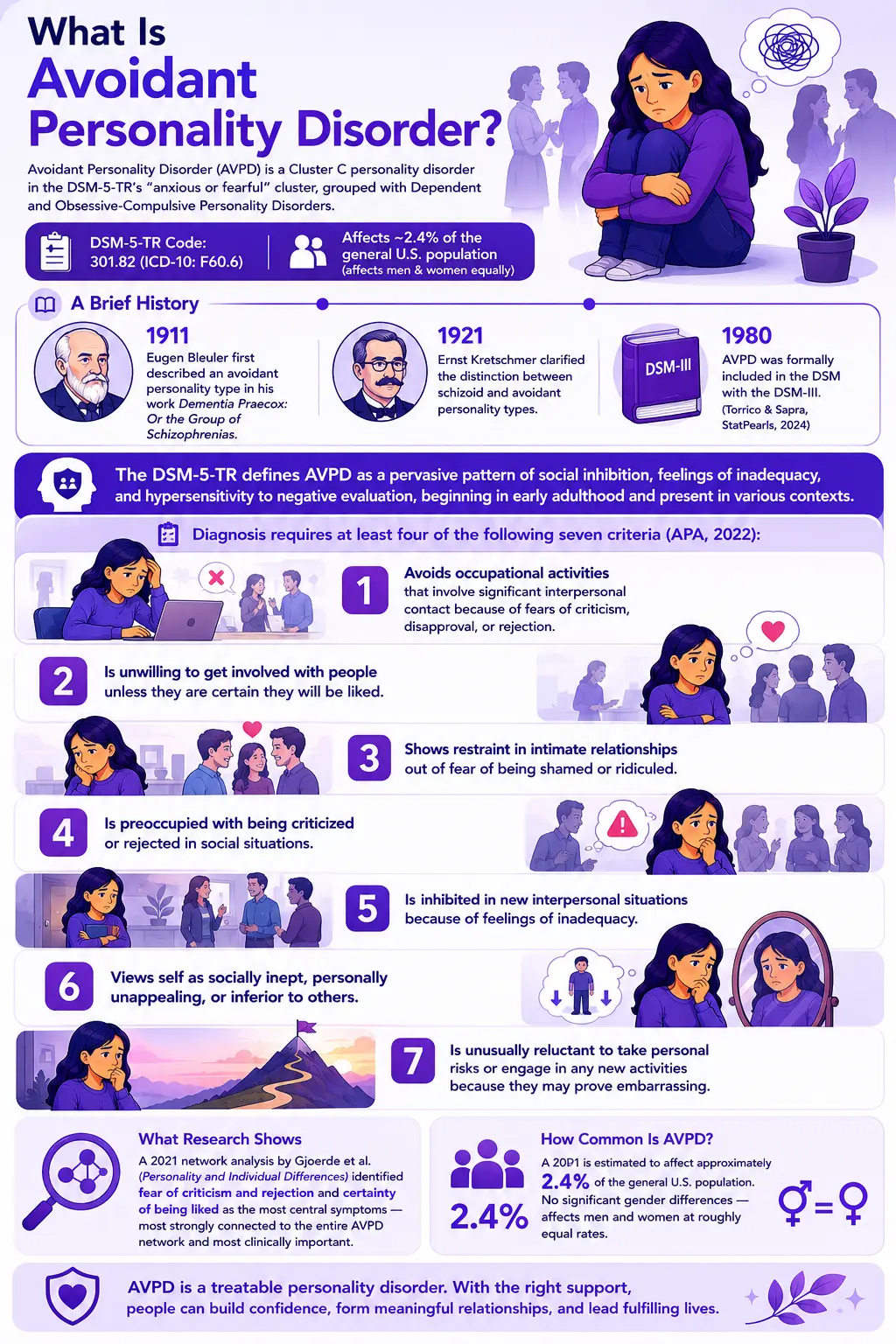
Avoidant Personality Disorder (AVPD) is a Cluster C personality disorder — grouped alongside Dependent Personality Disorder and Obsessive-Compulsive Personality Disorder under the DSM-5-TR’s “anxious or fearful” cluster. DSM-5-TR code: 301.82 (ICD-10: F60.6).
Swiss psychiatrist Eugen Bleuler first described an avoidant personality type in his 1911 work Dementia Praecox: Or the Group of Schizophrenias. German psychiatrist Ernst Kretschmer clarified the distinction between schizoid and avoidant personality types in 1921. AVPD was formally included in the DSM in 1980 with the DSM-III (Torrico & Sapra, StatPearls, 2024).
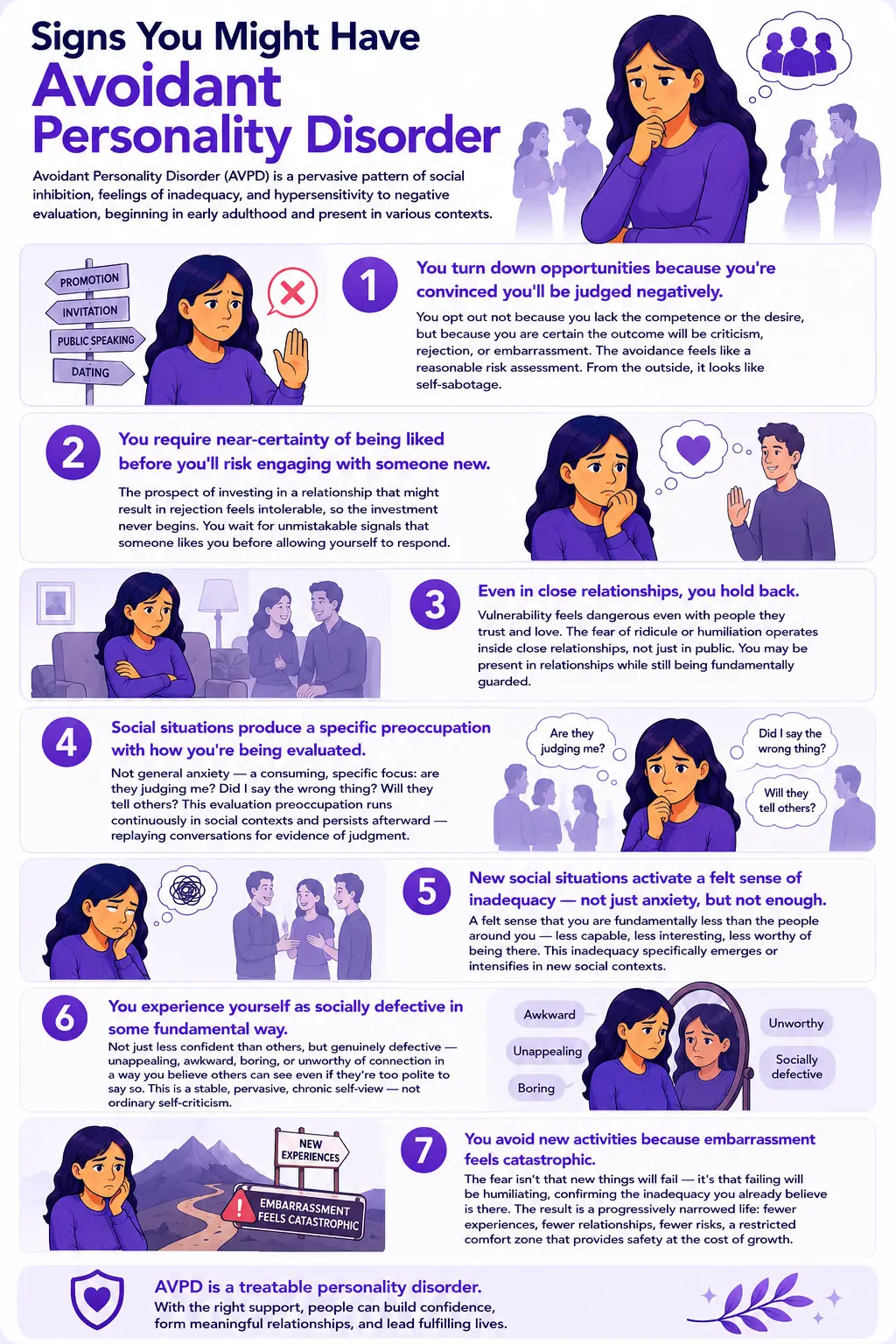
The DSM-5-TR defines AVPD as a pervasive pattern of social inhibition, feelings of inadequacy, and hypersensitivity to negative evaluation, beginning in early adulthood and present in various contexts. Diagnosis requires at least four of the following seven criteria (APA, 2022):
- Criterion 1. Avoids occupational activities that involve significant interpersonal contact because of fears of criticism, disapproval, or rejection.
- Criterion 2. Is unwilling to get involved with people unless they are certain they will be liked.
- Criterion 3. Shows restraint in intimate relationships out of fear of being shamed or ridiculed.
- Criterion 4. Is preoccupied with being criticized or rejected in social situations.
- Criterion 5. Is inhibited in new interpersonal situations because of feelings of inadequacy.
- Criterion 6. Views self as socially inept, personally unappealing, or inferior to others.
- Criterion 7. Is unusually reluctant to take personal risks or engage in any new activities because they may prove embarrassing.
AVPD is estimated to affect approximately 2.4% of the general U.S. population, with no significant gender differences in diagnostic frequency — AVPD affects men and women at roughly equal rates (SAGE Encyclopedia of Abnormal and Clinical Psychology, citing DSM-5, 2017).
A 2021 network analysis of the seven DSM-5-TR criteria by Gjoerde and colleagues (Personality and Individual Differences) identified fear of criticism and rejection and certainty of being liked as the most central symptoms — most strongly connected to the entire AVPD diagnostic network and therefore the most clinically important.
It can also be helpful to understand where you fall on the broader personality spectrum — particularly the Introversion and Identity dimensions — before interpreting avoidant traits. Our Free Personality Test measures both, alongside three other core Big Five dimensions, giving you a fuller personality picture to place these patterns in context.
Signs You Might Have Avoidant Personality Disorder
You turn down opportunities because you’re convinced you’ll be judged negatively. Job promotions, social invitations, public speaking, dating — you opt out not because you lack the competence or the desire, but because you are certain the outcome will be criticism, rejection, or embarrassment. The avoidance feels like a reasonable risk assessment. From the outside, it looks like self-sabotage.
You require near-certainty of being liked before you’ll risk engaging with someone new. Most people accept some uncertainty in new relationships. People with AVPD typically cannot. The prospect of investing in a relationship that might result in rejection feels intolerable, so the investment never begins. You wait for unmistakable signals that someone likes you before allowing yourself to respond.
Even in close relationships, you hold back. For people with AVPD, vulnerability feels dangerous even with people they trust and love. The fear of ridicule or humiliation operates inside close relationships, not just in public. You may be present in relationships while still being fundamentally guarded.
Social situations produce a specific preoccupation with how you’re being evaluated. Not general anxiety — a consuming, specific focus: are they judging me? Did I say the wrong thing? Will they tell others? This evaluation preoccupation runs continuously in social contexts and persists afterward — replaying conversations for evidence of judgment.
New social situations activate a felt sense of inadequacy — not just anxiety, but not enough. A felt sense that you are fundamentally less than the people around you — less capable, less interesting, less worthy of being there. This inadequacy specifically emerges or intensifies in new social contexts.
You experience yourself as socially defective in some fundamental way. Not just less confident than others, but genuinely defective — unappealing, awkward, boring, or unworthy of connection in a way you believe others can see even if they’re too polite to say so. This is a stable, pervasive, chronic self-view — not ordinary self-criticism.
You avoid new activities because embarrassment feels catastrophic. The fear isn’t that new things will fail — it’s that failing will be humiliating, confirming the inadequacy you already believe is there. The result is a progressively narrowed life: fewer experiences, fewer relationships, fewer risks, a restricted comfort zone that provides safety at the cost of growth.
AVPD vs Social Anxiety Disorder — The Most Important Distinction
Both conditions involve social fear and avoidance and are frequently confused. The distinction matters because it affects treatment approach, prognosis, and clinical conceptualization.
| Feature | Normal Shyness | Social Anxiety Disorder (SAD) | Avoidant Personality Disorder (AVPD) |
|---|---|---|---|
| Core driver | Discomfort in social situations; resolves with familiarity | Fear of humiliation or embarrassment; anxiety is the primary feature | Deep-seated belief in personal inadequacy and near-certainty of rejection; low self-esteem drives avoidance as much as anxiety |
| Onset and duration | Situational; resolves over time | Specific social performance situations; more episodic | Pervasive and chronic; begins by early adulthood; present across virtually all contexts; stable over time |
| Self-perception | Generally intact self-esteem | Fears negative evaluation; self-esteem may be affected but not necessarily core | Persistent view of self as socially inept, unappealing, or inferior — core, stable, pervasive, not situational |
| Close relationships | Sought and maintained normally | Generally intact — fear is more about public performance | Restraint and guardedness even in close relationships; fear of ridicule operates in intimate contexts |
| Diagnostic overlap | Not a disorder | Roughly two-thirds of people with AVPD do NOT meet SAD criteria (Cleveland Clinic, 2025) | When both co-occur, symptoms are more severe than either alone |
| Classification | Not applicable | Anxiety disorder — episodic treatment target | Personality disorder (Cluster C) — pervasive, long-term treatment target |
| PsyMed screening | No screening needed | Social Anxiety Test | This test |
A critical clinical note: researchers once thought AVPD was simply a severe form of SAD. But studies show that roughly two-thirds of people with AVPD do not meet the diagnostic criteria for SAD (Cleveland Clinic, 2025). The social avoidance in AVPD is driven more by core beliefs of personal inadequacy and near-certainty of rejection than by anxiety per se — making the two conditions clinically distinct.
What Causes Avoidant Personality Disorder?
Childhood rejection and humiliation. Research consistently links AVPD with repeated experiences of rejection, criticism, humiliation, or social marginalization during childhood. According to the Merck Manual (2026), avoidance behaviors in social situations have been detected as early as approximately age 2. The interaction of childhood adversity with innate temperament appears to be the most consistent developmental pathway.
Innate temperament — behavioral inhibition. Behavioral inhibition — a temperamental style characterized by withdrawal from unfamiliar situations, heightened physiological reactivity to novelty, and a tendency toward caution — has been identified as a developmental precursor to social anxiety and avoidant personality patterns. Children with high behavioral inhibition raised in invalidating or critical environments are at elevated risk for AVPD development.
Core schema formation. Jeffrey Young’s schema therapy model identifies the core maladaptive schema underlying AVPD as the “defectiveness/shame” schema — the deep-seated belief that one is fundamentally flawed or inferior, and that this defectiveness would make one unlovable if known to others. This schema drives the characteristic AVPD pattern of avoidance and guardedness as self-protective strategies.
Comorbidities. AVPD has high rates of comorbid major depressive disorder, dysthymia, anxiety disorders, and Social Anxiety Disorder. Studies have linked AVPD with elevated risk for suicidal ideation and suicide attempts, particularly when co-occurring with dysthymia, and AVPD is considered an independent risk factor for suicidality (HealthCentral, citing published research). Common personality disorder comorbidities include Dependent Personality Disorder, Paranoid Personality Disorder, and Borderline Personality Disorder.
How This AVPD Test Works
This test screens for Avoidant Personality Disorder using all seven DSM-5-TR diagnostic criteria (APA, 2022) across 15 questions — two questions per criterion plus one chronicity marker. Answer based on your consistent experience over the past 12 months — the chronic, recurring pattern across contexts.
Never = 0 | Rarely = 1 | Sometimes = 2 | Often = 3 | Always = 4
Total range: 0–60. This is a screening tool — only a qualified mental health professional can diagnose AVPD through a comprehensive clinical assessment.
Understanding Your AVPD Test Score
| Score Range | Category | What It Suggests |
|---|---|---|
| 0 – 15 | Low — Few AVPD Indicators | Responses suggest few significant AVPD patterns. Normal shyness or situational social discomfort may be present without a pattern consistent with Avoidant Personality Disorder. |
| 16 – 30 | Mild — Some Avoidant Patterns Present | Some avoidant personality patterns are present across at least some domains. May not reach full AVPD threshold, but warrants monitoring and professional discussion. |
| 31 – 45 | Moderate — Significant AVPD Pattern | Significant pattern of avoidant personality symptoms across multiple domains. Consistent with AVPD; warrants professional evaluation. |
| 46 – 60 | High — Strong AVPD Indicators | Pervasive and severe avoidant personality patterns across most domains. Professional evaluation and support are strongly recommended. |
Treatment for Avoidant Personality Disorder
Cognitive Behavioral Therapy (CBT) with Social Skills Focus. The most evidence-supported primary treatment. CBT for AVPD targets cognitive distortions — overestimation of rejection probability, catastrophizing of negative evaluation, and core inadequacy beliefs — while building social skills through graduated exposure and behavioral practice. Group-based CBT is specifically recommended by the Merck Manual (2026) because the group provides gradual social exposure most relevant to AVPD.
Schema Therapy. Developed by Dr. Jeffrey Young specifically for personality disorders with deep developmental roots. Targets the “defectiveness/shame” schema through cognitive, behavioral, and experiential techniques, including imagery rescripting and limited reparenting. Addresses the developmental origins of the avoidant pattern in a way that standard CBT typically does not.
Psychodynamic approaches. For individuals with histories of early childhood adversity or attachment disruption, psychodynamic approaches exploring the developmental origins of core shame and inadequacy beliefs can be effective alongside behavioral interventions. The therapeutic relationship becomes an important vehicle for change.
Pharmacotherapy. No medications are specifically approved for AVPD. SSRIs or SNRIs are used adjunctively for comorbid depression or anxiety. Medication does not address core personality patterns but can reduce symptom intensity enough to make psychotherapy more accessible.
Frequently Asked Questions
What is Avoidant Personality Disorder?
Avoidant Personality Disorder (AVPD) is a Cluster C personality disorder (DSM-5-TR 301.82 / F60.6) characterized by a pervasive pattern of social inhibition, feelings of inadequacy, and hypersensitivity to negative evaluation, beginning by early adulthood and present across multiple contexts. Diagnosis requires at least four of seven DSM-5-TR criteria. It affects approximately 2.4% of the general population with no significant gender differences in prevalence (APA DSM-5-TR; SAGE Encyclopedia, 2017).
What is the difference between AVPD and Social Anxiety Disorder?
Both conditions involve social fear and avoidance, but the mechanisms differ significantly. In Social Anxiety Disorder, anxiety is the primary driver — fear of humiliation in specific social performance situations. In AVPD, avoidance is driven more deeply by core beliefs of personal inadequacy and near-certainty of rejection — low self-esteem is as central as anxiety. AVPD also affects intimate relationships and core identity in ways SAD typically does not, and is classified as a personality disorder (pervasive, trait-level) rather than an anxiety disorder. Research shows roughly two-thirds of people with AVPD do not meet SAD diagnostic criteria (Cleveland Clinic, 2025). The Social Anxiety Test is worth completing alongside this one.
Can AVPD be confused with introversion?
Yes — and this is one of the reasons AVPD is frequently unrecognized. Introverts prefer less social stimulation but don’t experience their social preferences as driven by fear of rejection or a sense of personal inadequacy. An introvert may decline a social invitation because they’re tired or prefer quieter activities; a person with AVPD declines because they’re convinced the situation will result in humiliation or rejection. The distinction is in the internal experience — avoidance driven by preference versus avoidance driven by fear of inadequacy exposure.
Is AVPD related to childhood experiences?
Research supports a significant association between AVPD and adverse childhood experiences, particularly repeated rejection, criticism, humiliation, or emotional neglect. The Merck Manual (2026) notes that avoidance behaviors have been detected as early as approximately age 2, suggesting very early developmental roots. The disorder appears to require both a temperamental vulnerability (behavioral inhibition) and a developmental environment that activates and reinforces core inadequacy beliefs.
Can AVPD be treated?
Yes — AVPD is treatable, and meaningful improvements in social functioning and quality of life are achievable. CBT with a social-skills focus (particularly in group settings) and Schema Therapy are the most evidence-supported approaches (Merck Manual, 2026). Treatment is typically longer-term than for episodic conditions. Starting treatment is often the hardest step — AVPD itself makes engagement with help-seeking difficult. Once a stable therapeutic alliance is established, meaningful change becomes possible.
How does AVPD affect relationships?
AVPD affects relationships in two ways. First, it prevents many relationships from forming — the unwillingness to engage unless certain of being liked means many potential connections are avoided before they begin. Second, in relationships that do form, AVPD produces specific restraint and guardedness even with people trusted and cared about, creating a painful loneliness — not from not wanting connection, but wanting it deeply while being convinced you’re not safe to have it.
What is the relationship between AVPD and depression?
AVPD has high comorbidity rates with major depressive disorder and dysthymia. The social isolation and restricted life that AVPD produces directly causes or worsens depression, and depression’s negative self-view intensifies AVPD’s core inadequacy beliefs. Studies have linked AVPD with elevated risk for suicidal ideation and suicide attempts, particularly when co-occurring with dysthymia — AVPD is considered an independent risk factor for suicidality. If you are experiencing depressive symptoms alongside these avoidant patterns, please take the Clinical Depression Test and speak with a professional promptly.
Related Tests
- Social Anxiety Test — most important companion; shares surface features with AVPD but different primary mechanisms
- Anxiety Test — generalized anxiety frequently co-occurs with AVPD; assess separately
- Dependent Personality Disorder Test — both are Cluster C; DPD = fear of abandonment vs AVPD = fear of rejection and criticism
- Schizoid Personality Disorder Test — both involve social withdrawal, but for entirely different reasons; schizoid = genuine indifference, AVPD = painful desire blocked by fear
- Paranoid Personality Disorder Test — frequently co-occurs with AVPD; both involve hypervigilance in social situations
- Borderline Personality Disorder Test — BPD comorbidity documented; both involve fear of rejection with different emotional regulation patterns
- Clinical Depression Test — the most common AVPD comorbidity; the restricted life of AVPD directly contributes to depressive symptoms
- Dysthymia Test — co-occurring dysthymia and AVPD specifically linked to elevated suicidality risk
- Imposter Syndrome Test — core inadequacy beliefs in AVPD overlap significantly with imposter syndrome patterns
- Full Personality Disorder Test Hub — all ten DSM-5-TR personality disorder types across Clusters A, B, and C
References
- American Psychiatric Association. (2022). Diagnostic and Statistical Manual of Mental Disorders, Fifth Edition, Text Revision (DSM-5-TR). Avoidant Personality Disorder 301.82 (F60.6), pp. 764-768. psychiatry.org
- Torrico, T.J., & Sapra, A. (2024). Avoidant Personality Disorder. In: StatPearls [Internet]. Treasure Island (FL): StatPearls Publishing. NBK559325. ncbi.nlm.nih.gov
- Merck Manual Professional Edition. (2026). Avoidant Personality Disorder (AVPD). merckmanuals.com
- Gjoerde, L.G., et al. (2021). A network analysis of DSM-5 avoidant personality disorder diagnostic criteria. Personality and Individual Differences, 183, 111126. sciencedirect.com
- Cleveland Clinic. (2025). Avoidant Personality Disorder. my.clevelandclinic.org
- SAGE Encyclopedia of Abnormal and Clinical Psychology. (2017). Avoidant Personality Disorder. sagepub.com
- HealthCentral. (2022). Avoidant Personality Diagnosis: DSM-5, Comorbidities and More. healthcentral.com
- Theravive. (2025). Avoidant Personality Disorder DSM-5 301.82 (F60.6). theravive.com
- Wikipedia. (2025). Avoidant personality disorder. en.wikipedia.org
Related Tests
See All Quiz →
You may also like
See All Quiz →