

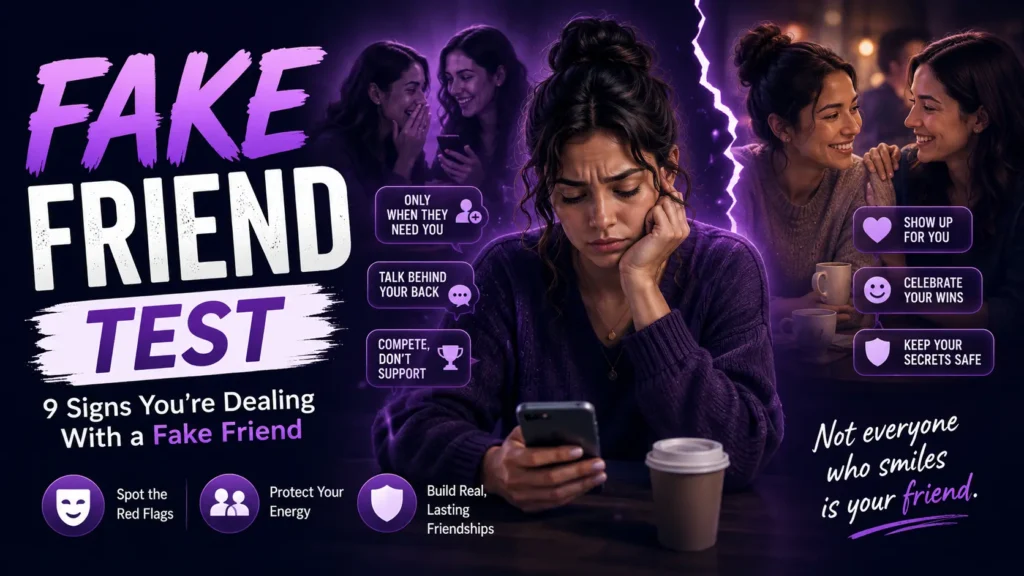

Fake Friend Test: Is Your Friend Real or Fake?
Real friend or fake friend? This free 15-question fake friend test spots the signs of a one-sided or toxic friendship — and what to do next.
Published Updated
Real friendship is one of the best things in life — and a fake one is a quiet drain you can carry for years without quite naming it. Most friendships aren’t all-good or all-bad, which is exactly what makes this hard to see clearly. A genuinely good friend can still forget your birthday once; a fake friend can be enormous fun right up until you actually need them. The question isn’t whether your friend is perfect. It’s whether, taken as a whole, this friendship gives back something like what you put in — or whether you’re the only one holding it up.
This free fake friend test walks through 15 honest questions about how your friendship actually works: who reaches out, who shows up when it counts, how they react to your good news, and how you feel after spending time together. It’s grounded in real friendship research, not just vibes. And a fair warning up front: this is a reflection tool, not a verdict. It can help you see a pattern more clearly, but it can’t read your friend’s heart — only you, over time, can do that.
What Is a Fake Friend, Really?
A “fake friend” isn’t necessarily a villain scheming against you. More often it’s someone whose friendship is one-sided, conditional, or hollow — pleasant enough on the surface, but lacking the reciprocity, reliability, and genuine care that make a friendship real. Psychologists who study friendship point to a few core things that separate the real thing from the fake.
Reciprocity. Real friendship flows both ways. You each reach out, you each show up, you each carry the relationship at different times. Fake friendship is lopsided — one person does nearly all the initiating, remembering, and emotional labor, while the other coasts. This is more common than people think: research on social networks has found that only about half of friendships are actually mutual — meaning around 50% of the time, someone you consider a friend doesn’t quite feel the same way back.
It’s earned over real time. Genuine closeness isn’t instant. Research by Professor Jeffrey Hall at the University of Kansas found it takes roughly 50 hours together to become casual friends, about 90 to become friends, and more than 200 hours to become close friends. Real friendship is built through consistent, invested time — which is part of why a friend who only surfaces when it’s convenient for them never quite feels solid.
The “frenemy” problem. Some of the most draining relationships aren’t openly hostile — they’re ambivalent, a confusing mix of warmth and letdown. Psychologist Julianne Holt-Lunstad’s research found that these ambivalent ties are genuinely bad for you: people actually showed higher blood pressure around ambivalent friends than around reliably negative ones, because the unpredictability keeps you subtly on guard. Her work suggests around half of the average person’s social network is made up of these mixed, uncertain ties. The uncertainty is the harm.
Put simply: a real friend adds to your life, fairly consistently, over time. A fake friend takes more than they give, shows up conditionally, and tends to leave you feeling a little worse than before — even when you can’t point to anything dramatic.
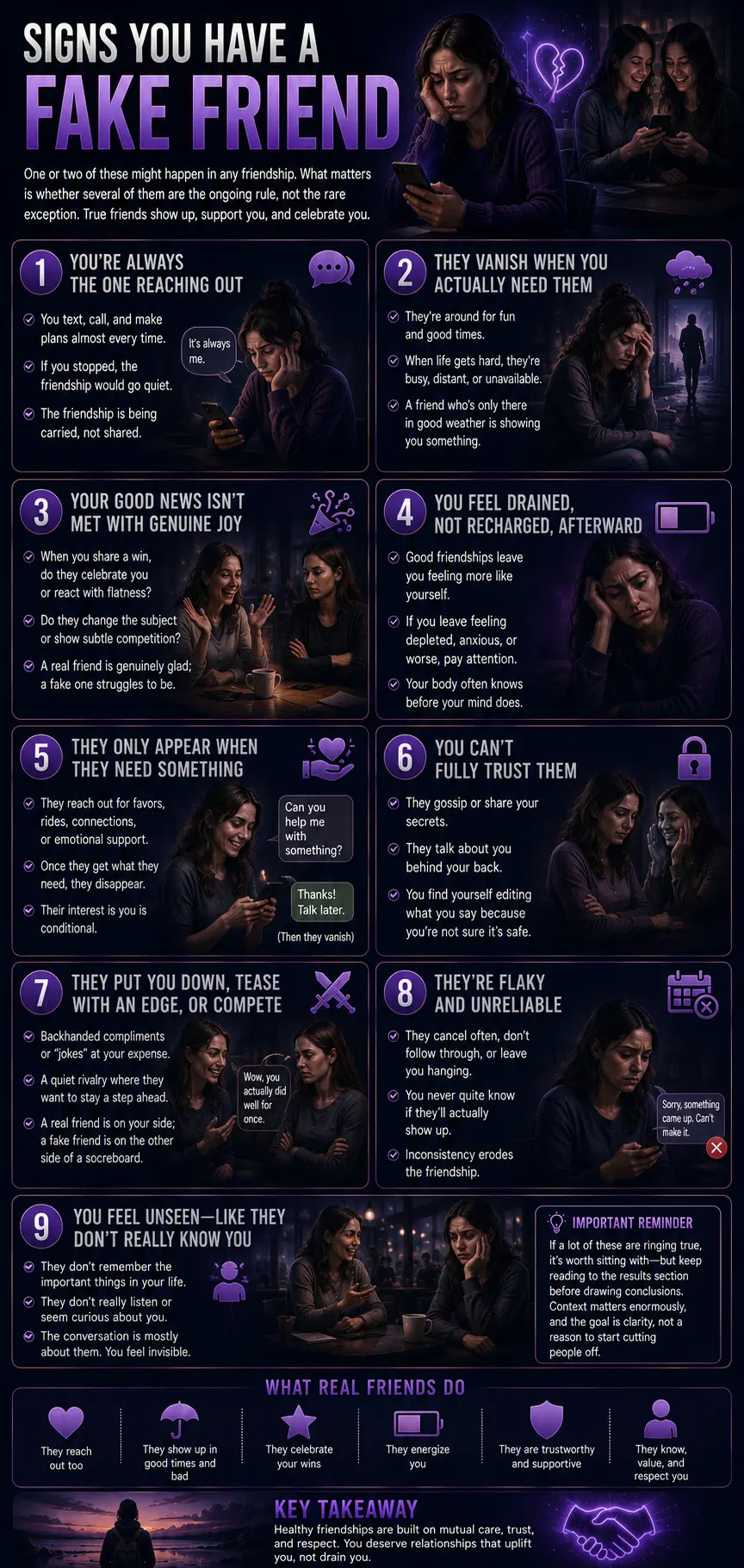
Signs You Have a Fake Friend
These are the patterns most consistently linked to fake or one-sided friendships. A quick but important note before you read: one or two of these, occasionally, describe almost every friendship on earth, including great ones. What matters is whether several of these are the ongoing rule rather than the rare exception.
-
You’re always the one reaching out
If you stopped texting, calling, and making plans, would the friendship simply go quiet? When nearly all the initiating falls to one person, the friendship is being carried, not shared.
-
They vanish when you actually need them
They’re around for the fun, the favors, and the good times — but when you’re going through something hard and need real support, they’re suddenly busy, distant, or unavailable. A friend who’s only there in good weather is showing you something.
-
Your good news isn’t met with genuine joy
When you share a win — a promotion, good news, something you’re proud of — do they light up for you, or do you get flatness, a quick subject-change, or a subtle competitiveness? How someone handles your success is one of the clearest tells in friendship. A real friend is genuinely glad; a fake one struggles to be.
-
You feel drained, not recharged, afterward
Pay attention to how you feel after spending time together. Good friendships generally leave you feeling more like yourself; if you consistently leave interactions feeling depleted, anxious, small, or vaguely worse, your body may be registering something your mind hasn’t named yet.
-
They only appear when they need something
The friendship runs on their needs. They surface when they want a favor, a ride, a connection, someone to vent to, or a boost — and recede once they’ve got it. Their interest in you is conditional on what you can provide.
-
You can’t fully trust them
They gossip, share things you told them in confidence, or talk about you behind your back — and you find yourself editing what you reveal because you’re not sure it’s safe with them. Trust is the foundation of friendship; without it, the rest is performance.
-
They put you down, tease with an edge, or subtly compete
Backhanded compliments, “jokes” at your expense that aren’t really jokes, or a quiet rivalry where they seem to want to stay a step ahead of you. A real friend is on your side; a fake friend is often, quietly, on the other side of a scoreboard only they can see.
-
They’re flaky and unreliable
They cancel often, don’t follow through, leave you hanging, and you never quite know if they’ll actually show up. Inconsistency erodes a friendship even when there’s no ill intent behind it.
-
You feel unseen — like they don’t really know you
They don’t remember the things going on in your life, don’t really listen, and don’t seem curious about you. The conversation is mostly about them. You can be around them and still feel invisible.
If a lot of these are ringing true, it’s worth sitting with — but keep reading to the results section before drawing conclusions, because context matters enormously, and the goal here is clarity, not a reason to start cutting people off.
How This Fake Friend Test Works
Answer these 15 questions about one specific friendship — pick the friend you had in mind when you clicked. For each, choose how often it’s true of that friendship:
- Never = 0
- Rarely = 1
- Sometimes = 2
- Often = 3
- Always = 4
Your answers add up to a score from 0 to 60. A higher score means more fake-friend signals; a lower score points toward a real one. Answer honestly about the overall pattern — not one great day, and not one bad week. And remember: this reflects the patterns in how this friendship treats you, which is genuinely useful information — but it’s a starting point for your own thinking, not a final ruling on another human being.
Your Results: Is Your Friend Real or Fake?
| Score Range | Verdict | What It Suggests |
|---|---|---|
| 0 – 15 | Real Friend | This looks like a genuine, reciprocal friendship. Worth appreciating — and keeping. |
| 16 – 30 | Mostly Solid | A real friendship with some rough spots. Usually workable, often just human. |
| 31 – 45 | Warning Signs | A meaningfully one-sided or unreliable pattern. Worth an honest look and maybe a conversation. |
| 46 – 60 | Fake Friend | A consistently one-sided, draining, or untrustworthy dynamic. Time to rethink this one. |
Why Do People End Up With Fake Friends?
Ending up with a fake friend doesn’t mean you’re naive or a bad judge of character — it happens to almost everyone, for reasons that make sense. Friendships often start genuinely and drift into imbalance as people and circumstances change. Fake friends can be genuinely charming and fun, which masks the lack of substance underneath — the enjoyment is real even when the loyalty isn’t. Proximity and history keep many friendships alive long past their expiry date: we stay because we’ve “always” been friends, or because we work together or share a group, not because the friendship still serves either person.
There are also patterns on our own side worth noticing. People who are highly empathetic, who over-give, who struggle to set boundaries, or who fear conflict or abandonment can find themselves repeatedly in lopsided friendships — pouring in far more than they get back, and feeling guilty at the thought of pulling away. If that sounds familiar, the issue may be less about one fake friend and more about a pattern worth understanding; our Codependency Test and Self-Esteem Test both speak to it. Recognizing the pattern is the first step to choosing friendships that actually give back.
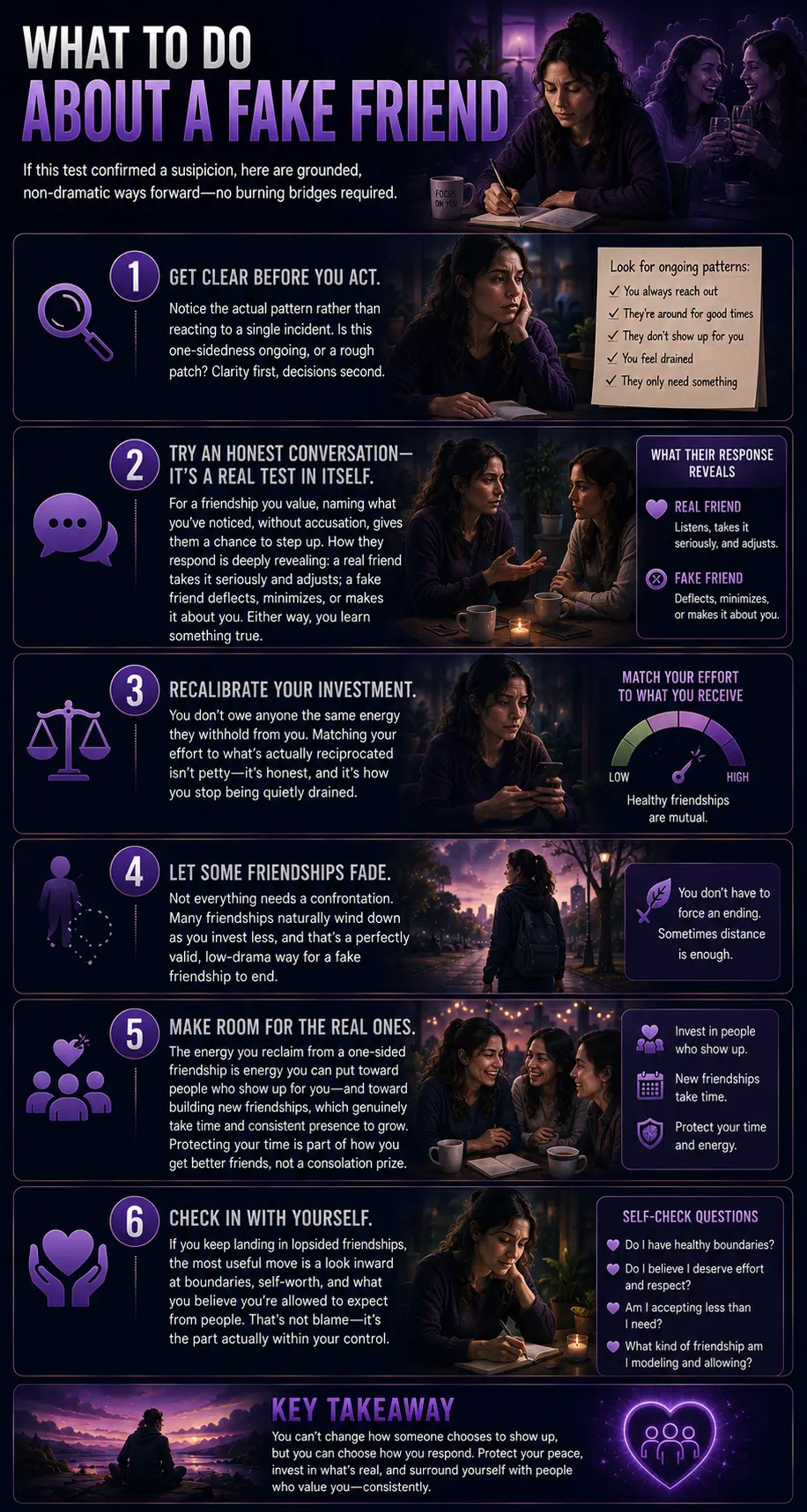
What to Do About a Fake Friend
If this fake friend test confirmed a suspicion, here are some grounded, non-dramatic ways forward — no burning bridges required.
-
Get clear before you act
Notice the actual pattern rather than reacting to a single incident. Is this one-sidedness ongoing, or a rough patch? Clarity first, decisions second.
-
Try an honest conversation — it’s a real test in itself
For a friendship you value, naming what you’ve noticed, without accusation, gives them a chance to step up. How they respond is deeply revealing: a real friend takes it seriously and adjusts; a fake friend deflects, minimizes, or makes it about you. Either way, you learn something true.
-
Recalibrate your investment
You don’t owe anyone the same energy they withhold from you. Matching your effort to what’s actually reciprocated isn’t petty — it’s honest, and it’s how you stop being quietly drained.
-
Let some friendships fade
Not everything needs a confrontation. Many friendships naturally wind down as you invest less, and that’s a perfectly valid, low-drama way for a fake friendship to end.
-
Make room for the real ones
The energy you reclaim from a one-sided friendship is energy you can put toward people who show up for you — and toward building new friendships, which, remember, genuinely take time and consistent presence to grow. Protecting your time is part of how you get better friends, not a consolation prize.
-
Check in with yourself
If you keep landing in lopsided friendships, the most useful move is a look inward at boundaries, self-worth, and what you believe you’re allowed to expect from people. That’s not blame — it’s the part actually within your control.
Frequently Asked Questions
How can I tell if my friend is fake or just busy?
This is the fairest and most important question to ask, because genuinely good friends do go through busy, distracted, or difficult stretches. A few distinctions help. First, look at the pattern over time rather than a single lapse — one missed birthday isn’t a fake friend, a years-long one-way street is. Second, notice whether they’re busy for everything or selectively busy — a friend who has no time when you need support but plenty of time when they need something is telling you where you rank. Third, watch what happens when you gently name it: a real but overwhelmed friend usually appreciates the honesty and tries, while a fake friend deflects or gets defensive. Being busy is temporary and mutual; being fake is a consistent, one-directional pattern. When in doubt, an honest conversation clarifies faster than a quiz can.
Is it normal for friendships to be one-sided?
To some degree, temporarily, yes — friendships naturally ebb and flow, and it’s normal for the balance of effort to shift depending on what each person is going through. What’s not healthy is a friendship that’s persistently, chronically one-sided, where the same person always initiates, always accommodates, and always gives more, indefinitely. Interestingly, research suggests imbalance is more common than we’d like to think — studies of social networks have found only about half of friendships are fully mutual. So if you’ve discovered a one-sided friendship, you’re far from alone. A temporary imbalance during a hard season is part of real friendship; a permanent one is worth addressing.
What’s the difference between a fake friend and a toxic friend?
They overlap, but there’s a useful distinction. A fake friend is typically hollow or one-sided — they lack genuine investment, show up conditionally, and take more than they give, but they’re not necessarily out to harm you. A toxic friend is actively damaging — manipulative, controlling, cruel, or someone whose presence consistently hurts your wellbeing or self-esteem. A fake friend leaves you feeling unimportant; a toxic friend can leave you feeling genuinely worse about yourself. Some relationships are both. If your situation involves manipulation, control, feeling afraid, or a dynamic you can’t escape, that’s in toxic territory and worth taking more seriously — our Toxic Relationship Quiz looks at those patterns specifically.
Should I confront a fake friend or just walk away?
It depends on the friendship’s history and what you want from it. For a friendship you’ve valued and would like to save, an honest, non-accusatory conversation is worth trying — it gives a friend who genuinely cares the chance to recognize the imbalance and change it, and their response tells you whether the friendship is real underneath. For a friendship that’s been consistently draining, or where you’ve already tried and nothing changed, you don’t owe anyone a formal confrontation — quietly reducing your investment and letting the friendship fade is a completely valid, lower-drama route. There’s no single right answer; the only real rule is that you’re allowed to stop pouring energy into something that isn’t giving any back.
Why do fake friends hurt so much?
Because friendship is built on trust and the expectation of mutual care, and discovering that a friend doesn’t actually have your back is a genuine loss and a real betrayal of that expectation. It can also shake your confidence in your own judgment (“how did I not see this?”) and, if the friendship was long-standing, mean grieving not just the person but the history and the version of them you believed in. There’s even a physiological layer: research on ambivalent, unreliable friendships found they raise stress responses precisely because the uncertainty keeps you on guard. So if a fake friendship has hit you harder than you expected, that’s not you being dramatic — it’s a real response to a real loss. Be as kind to yourself about it as you would be to a friend going through the same thing.
Can a fake friendship become a real one?
Sometimes, yes — especially if the “fakeness” is really immaturity, poor communication, or a rough patch rather than a fundamentally self-serving character. Friendships can deepen when both people become more honest about what they need and both are willing to invest. The key word is both: one person’s effort can’t turn a one-sided friendship into a mutual one. If you raise the imbalance and your friend genuinely hears it and starts showing up differently, the friendship may well be real and simply have been neglected. If they dismiss it, promise change that never comes, or only shift briefly, the pattern will reassert itself. Give real change a fair chance to show itself in actions over time — but don’t keep investing indefinitely on the strength of words alone.
Further reading
Working out whether a friend is genuine is one half of the picture. The other half is your own side of it — the good friend quiz is a private self-reflection on dependability, honesty and mutual effort.
Related Tests
- Toxic Relationship Quiz — for dynamics that go beyond “fake” into manipulation, control, or harm, in friendships or relationships
- Codependency Test — if you tend to over-give and stay in one-sided relationships, this looks at the pattern underneath
- Self-Esteem Test — fake friendships can quietly erode self-worth; the Rosenberg scale checks where yours stands
- Gaslighting Test — if a friend consistently makes you doubt your own perception of reality
- Narcissistic Personality Disorder Test — for a friend whose self-focus, need for admiration, and low empathy fit a bigger pattern
- Attachment Style Test — understanding your attachment style can shed light on the friendships you’re drawn to
References
- Hall, J.A. (2019). How many hours does it take to make a friend? Journal of Social and Personal Relationships, 36(4), 1278–1296. [~50 hours to casual friend, ~90 to friend, 200+ to close friend] journals.sagepub.com
- Holt-Lunstad, J., Uchino, B.N., Smith, T.W., et al. Research on ambivalent (“frenemy”) relationships and cardiovascular response. [Ambivalent ties raise blood pressure; ~half of social networks are ambivalent] scientificamerican.com
- Almaas, A., et al. Reciprocity of friendship nominations in social networks. [Only about half of friendships are mutual] scienceofpeople.com
- Blieszner, R., & Roberto, K.A. (2004). Friendship across the life span: Reciprocity in individual and relationship development. In Growing Together: Personal Relationships Across the Life Span (pp. 159–182). Cambridge University Press.
- Holt-Lunstad, J., Smith, T.B., & Layton, J.B. (2010). Social relationships and mortality risk: a meta-analytic review. PLoS Medicine, 7(7). [Relationship quality and health outcomes] journals.plos.org
Related Tests
See All Quiz →
You may also like
See All Quiz →
Sexual Orientation & Gender Identity
Free Kinsey Scale Test — Where Do You Fall on the Sexual Spectrum?
→


Sexual Orientation & Gender Identity
What’s Your Sexual Orientation or Gender Identity? Take This Free LGBTQ+ Test
→
Emotional and Trait Assessments
Are You a Psychopath? Take This Free Psychopath Test (PCL-R Based)
→