Educational self-assessment · Learning & neurodiversity
Dyslexia Test: Explore reading and spelling patterns.
Reflect on reading, spelling and written-language experiences with 15 original questions. Learn what a self-check can show and how to find an assessment or support.
For self-reflection, not a diagnosis. A score does not measure intelligence or potential.
- THE SELF-CHECK15 questionsReflect on your usual experience, including your learning history.
- NO SIGN-UPFree to takeYour result appears after you finish.
- CLEAR BOUNDARIESInformation, not a diagnosisLearn what the score can and cannot tell you.
Take Test
Take the dyslexia test
This dyslexia test is written for adults reflecting on their own experiences. Answer for how things generally are for you, including your learning history. It is an original educational questionnaire, not a validated diagnostic instrument. Parents can use the information below to start a conversation with a child’s school rather than interpreting this adult score for a child.
Your score
What the bands mean
- 0–15 Few signs
- 16–30 Some signs
- 31–45 Many signs
- 46–60 Strong signs
The bands describe the level of experiences you endorsed. They are descriptive PsyMed ranges, not validated cutoffs or probabilities of dyslexia.
Original self-reflection statements. This count does not make the questionnaire a validated assessment.
The short answer
What is dyslexia?
Dyslexia is a learning difference and specific learning disability involving persistent difficulties with accurate or fluent word reading, spelling, or both. It is not a measure of intelligence or effort.
The International Dyslexia Association’s current definition recognizes variation in how dyslexia appears. Difficulties with speech-sound processing are common, but they are not present in every person.
A checklist cannot show why a task is hard. If attention is also a concern, the ADHD Test explores that topic separately; it cannot confirm the reason for reading difficulties.
This self-check does not replace an individual assessment. Read the methodology and limitations before interpreting your result.
The International Dyslexia Association updated its definition in 2025. It describes word-reading and spelling difficulties along a continuum, rather than one uniform profile.
Symptoms
Signs to notice
These experiences can be worth discussing. No single sign identifies the cause.
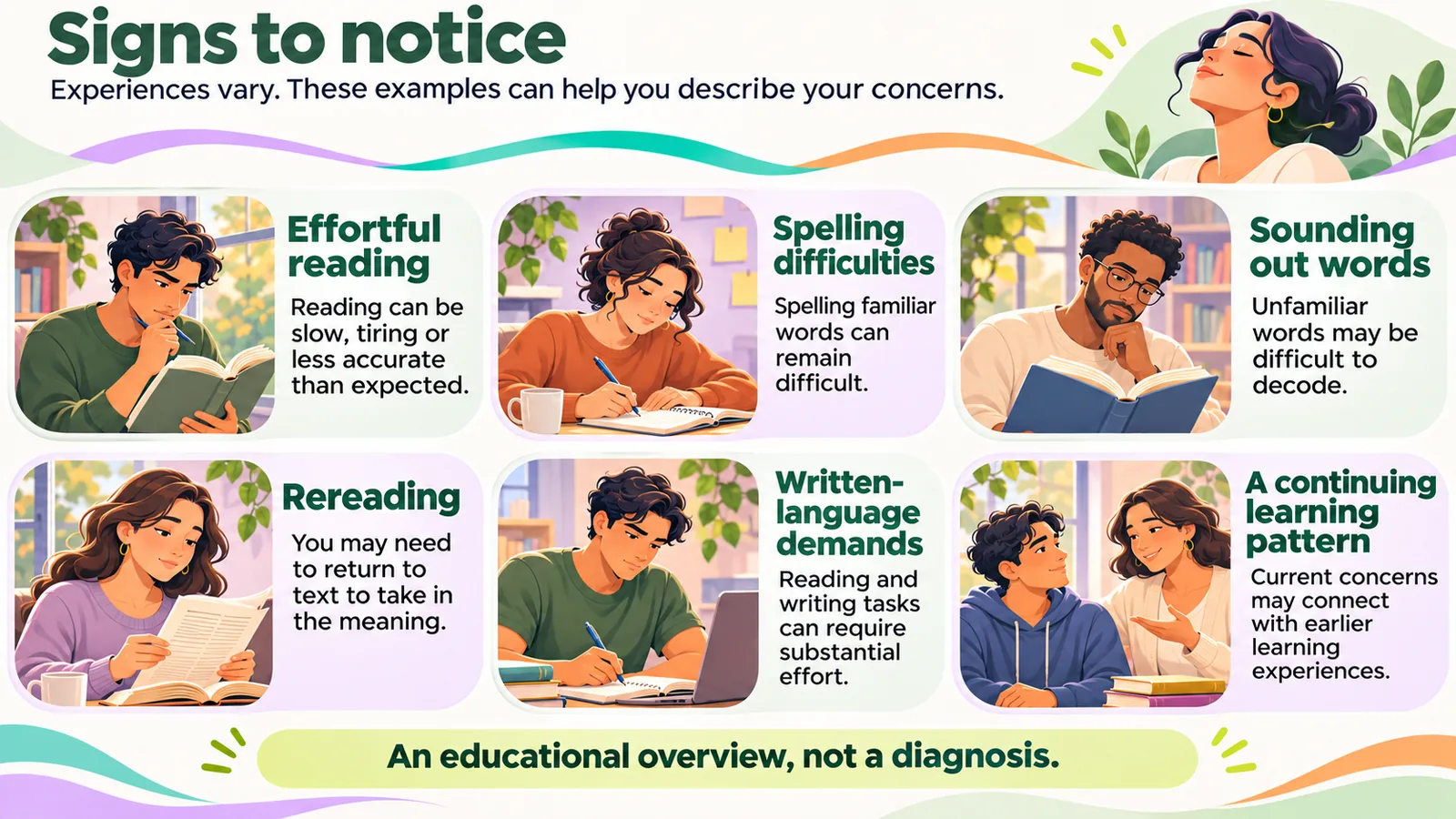
Effortful reading
Reading can be slow, tiring or less accurate than expected.
Spelling difficulties
Spelling familiar words can remain difficult.
Sounding out words
Unfamiliar words may be difficult to decode.
Rereading
You may need to return to text to take in the meaning.
Written-language demands
Reading and writing tasks can require substantial effort.
A continuing learning pattern
Current concerns may connect with earlier learning experiences.
A self-check vs. a dyslexia assessment
Both can be useful, but they answer different questions.
| Feature | This self-check | Specialist assessment |
|---|---|---|
| Method | Your answers about everyday experiences. | Assessment of learning history and relevant skills. |
| Interpretation | Descriptive bands without diagnostic validation. | A professional interpretation of your individual profile. |
| Purpose | Organize concerns and questions. | Clarify learning needs and guide suitable support. |
Diagnosis
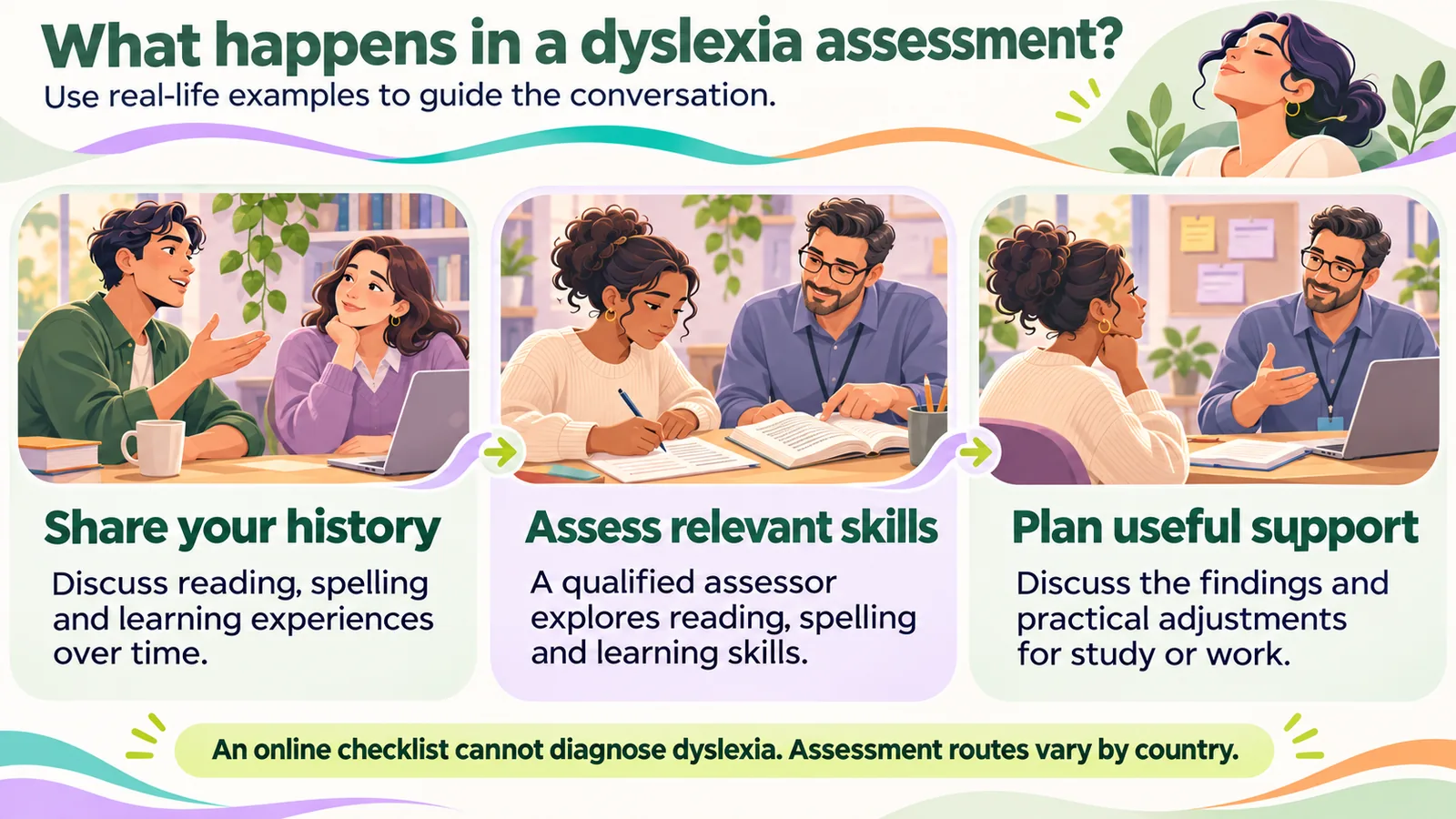
How is dyslexia assessed?
An online score does not replace an individual assessment.
- 01 Assessment
Share your history
Describe reading, spelling and learning experiences, including school and current demands.
- 02 Assessment
Assess the relevant skills
A qualified assessor examines reading and spelling alongside other relevant learning skills.
- 03 Assessment
Plan appropriate support
Ask the assessor to explain the findings and practical recommendations. Assessment routes differ by country.
Bring your experiences and their everyday impact to a qualified professional. You can ask for support regardless of this result.
Causes
Why can dyslexia look different across people?
An individual assessment considers the wider context. A questionnaire score cannot explain a person’s experiences on its own.
Multiple influences
The IDA describes genetic, neurobiological and environmental influences that interact over development.
Different profiles
Speech-sound and word-structure processing difficulties are common but not universal.
Overlapping needs
Dyslexia can coexist with other developmental differences, including ADHD. One label does not explain every difficulty.
Treatment
What support can help?
A useful plan responds to your individual needs.
- 01 / SUPPORT
Targeted literacy instruction
Ask about instruction matched to the person’s reading and spelling needs.
- 02 / SUPPORT
Accessible ways to work
Discuss tools such as text-to-speech and alternative formats, alongside the person’s preferences.
- 03 / SUPPORT
Support at school or work
A learning-support service or employer can discuss available adjustments. Eligibility and arrangements vary.
Next Steps
What can you do next?
You can ask for support without waiting for a particular score.
- 01
Gather examples
Bring examples of tasks that are difficult and strategies that already help.
- 02
Ask about assessment
Contact a qualified specialist or educational psychologist. Children’s concerns can start with the school team.
- 03
Discuss wider needs
If worry or confidence is also affecting you, mention it. The Anxiety Test and Self-Esteem Test offer separate reflections, not explanations of your reading profile.
Questions and answers
Dyslexia Test FAQs
Practical context for interpreting this self-check.
This self-check cannot tell you. A qualified assessor considers your learning history and relevant skills. Your score can help organize questions, but neither a high nor a low score confirms or excludes dyslexia.
No. These are original PsyMed self-reflection statements, not a validated diagnostic scale. The bands are descriptive ranges, not clinical cutoffs or a probability of dyslexia.
Yes. Adults can seek assessment from a qualified dyslexia specialist or educational psychologist. The appropriate professional and referral route depend on where you live.
No. Dyslexia is not a measure of intelligence. It concerns learning and literacy difficulties; a questionnaire score does not measure intelligence either.
This questionnaire is written for adult self-reflection. A parent should discuss a child’s reading and spelling concerns with school staff or a qualified assessor, rather than treating this score as a child diagnosis.
No. Current definitions focus on difficulties with word reading and spelling, including accuracy and fluency. A single behavior is not enough to identify dyslexia.
Support can make learning and work more accessible. Ask about instruction and tools that address your needs and respect your strengths and preferences.
Editorial transparency
Sources and review information
Editorially reviewed by the PsyMed Editorial Team on . This is an editorial source review, not a clinical review.
Prepared by the PsyMed Editorial Team, writers and researchers rather than clinicians. No licensed clinician is claimed as a reviewer. Read how we build our tests and who we are.
Methodology
These 15 original PsyMed statements cover self-reported reading, spelling, word retrieval and related everyday difficulties. Existing items and answer weights are preserved. Some items are broad and are not specific to dyslexia. The questionnaire has not been validated; it does not measure reading skills directly.
A place to start
Your learning needs deserve to be understood.
Use this self-check to organize your experiences, then ask about an assessment and support that fit you.
Take the self-check