
Scrupulosity Test: Do You Have Religious OCD?
A 15-item private screen for scrupulosity, the form of OCD in which obsessive fear about religion, sin or being a bad person drives compulsions like excessive praying, confessing or mental checking. It covers the moral, non-religious form too. Scrupulosity is not weak faith - it is OCD attaching to what you value most, and it is highly treatable.
Published Updated
This free scrupulosity test is a private screen for scrupulosity — a form of OCD in which obsessive fears about religion, morality, sin, or being a bad person take over, driving compulsions like excessive praying, confessing, reassurance-seeking, or mental checking. In 15 questions, it gives you an instant read on whether what you’re experiencing fits the pattern of scrupulosity, from minimal to severe.
If this resonates, here is the most important thing to know first: scrupulosity is not a sign of weak faith, a guilty conscience, or being a bad person. It’s an anxiety disorder — and OCD has a cruel habit of attacking exactly what you value most, which is why it latches onto your faith or your goodness. People who suffer from scrupulosity are often the most conscientious and devout. This test respects your beliefs, whatever they are (it also covers non-religious, moral scrupulosity), it can’t diagnose you, and scrupulosity is very treatable.
What Is Scrupulosity?
Scrupulosity is a subtype of obsessive-compulsive disorder (OCD) characterized by pathological guilt and obsessive fear around religious or moral themes. Where a person without OCD might have a fleeting worry about whether they did something wrong and then move on, a person with scrupulosity gets stuck — trapped in relentless doubt, fear of having sinned or offended God, or terror of being fundamentally bad, and driven to perform compulsions to try to relieve the anxiety. The term has been used for centuries; clinically, it’s understood today as OCD applied to matters of conscience.
There are two recognized forms. Religious scrupulosity (sometimes called “religious OCD”) centers on fears of sin, blasphemy, divine punishment, or not being devout enough, and it can affect people of any faith. Moral scrupulosity is the secular counterpart — obsessive doubt about whether you’re a good or ethical person, whether you’ve lied, cheated, or harmed someone, often with no religious element at all. Both share the same engine: intrusive doubt that can never be fully satisfied, and compulsions that bring only brief relief before the fear returns. Scrupulosity has been studied with measures like the Penn Inventory of Scrupulosity (Abramowitz and colleagues), and it responds to the same treatment as other forms of OCD.
Signs of Scrupulosity
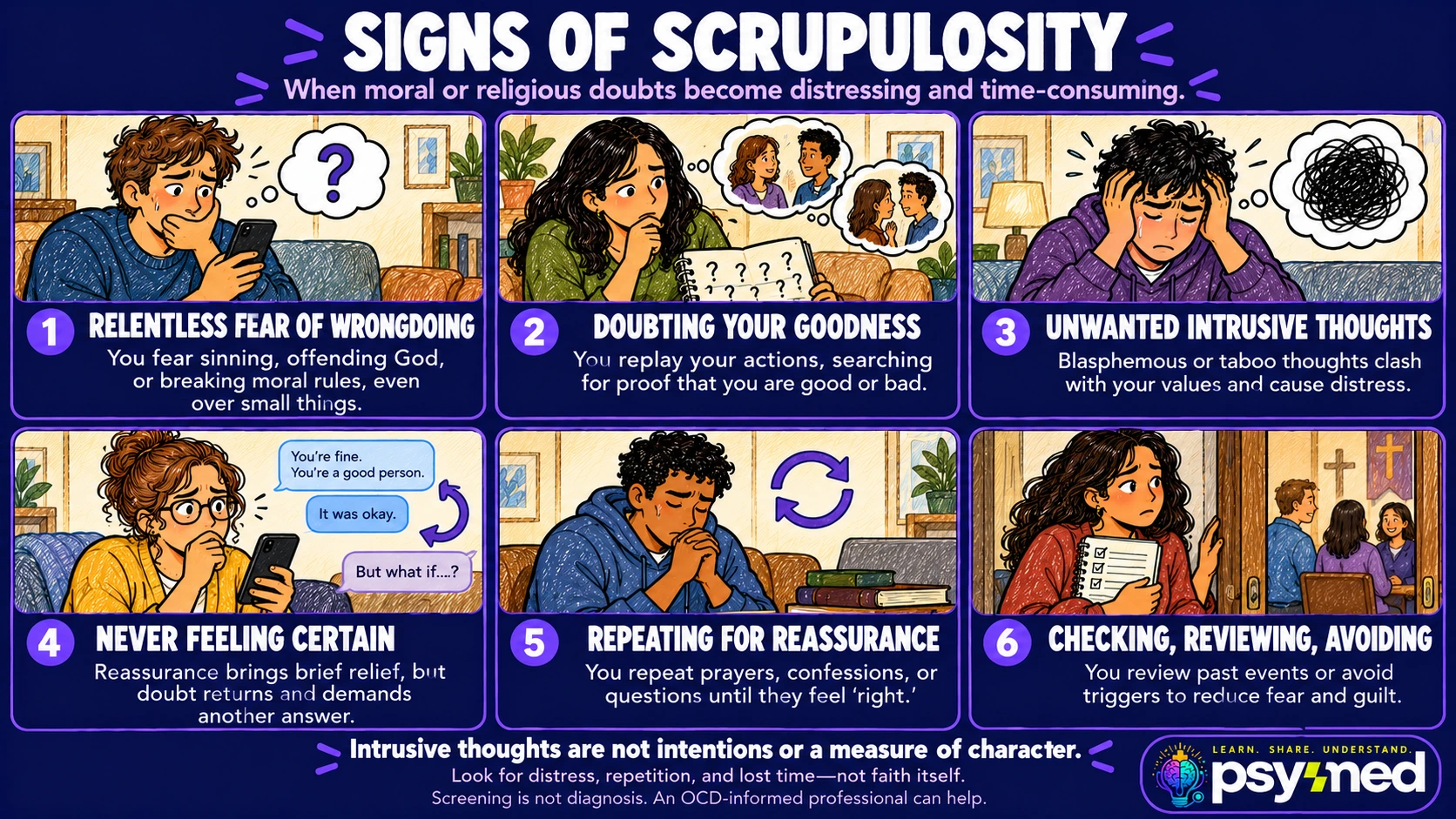
Scrupulosity shows up as a recognizable set of obsessions (intrusive fears) and compulsions (behaviors done to relieve them). You don’t need all of them, and having a few religious or moral worries is part of a normal conscience — but the more these feel relentless, distressing, and time-consuming, the more they may point to scrupulosity. Read these as the signs this test screens for.
Relentless fear of having sinned or done something wrong
A persistent, tormenting fear that you’ve sinned, offended God, broken a moral rule, or done something unforgivable — often over things most people wouldn’t give a second thought. The fear feels urgent and won’t quiet down.
Doubt about whether you’re a good person
Chronic, painful uncertainty about your own goodness or character — replaying your actions searching for evidence that you’re secretly bad, selfish, or immoral, and never reaching a verdict that sticks.
Intrusive blasphemous, taboo, or immoral thoughts
Unwanted, horrifying thoughts — blasphemous images, sacrilegious impulses, or taboo ideas — that feel completely against your values and fill you with shame. Crucially, these thoughts are unwanted; having them is a symptom, not a reflection of who you are.
A need for certainty that can never be satisfied
No amount of praying, confessing, or reassurance ever makes you feel truly sure you’ve been forgiven, done the right thing, or are a good person. The doubt always creeps back, demanding to be resolved again.
Compulsive praying, confessing, or reassurance-seeking
Repeating prayers until they feel “right,” confessing small or imagined wrongs over and over, or repeatedly asking others (or searching online) for reassurance that you’re okay — far beyond what your faith or conscience actually requires.
Checking, reviewing, and avoiding
Mentally reviewing past events for sins or mistakes, repeating rituals until they feel pure, avoiding people, places, or religious materials that might trigger the fears, or doing excessive good deeds to “cancel out” guilt and prove you’re good.
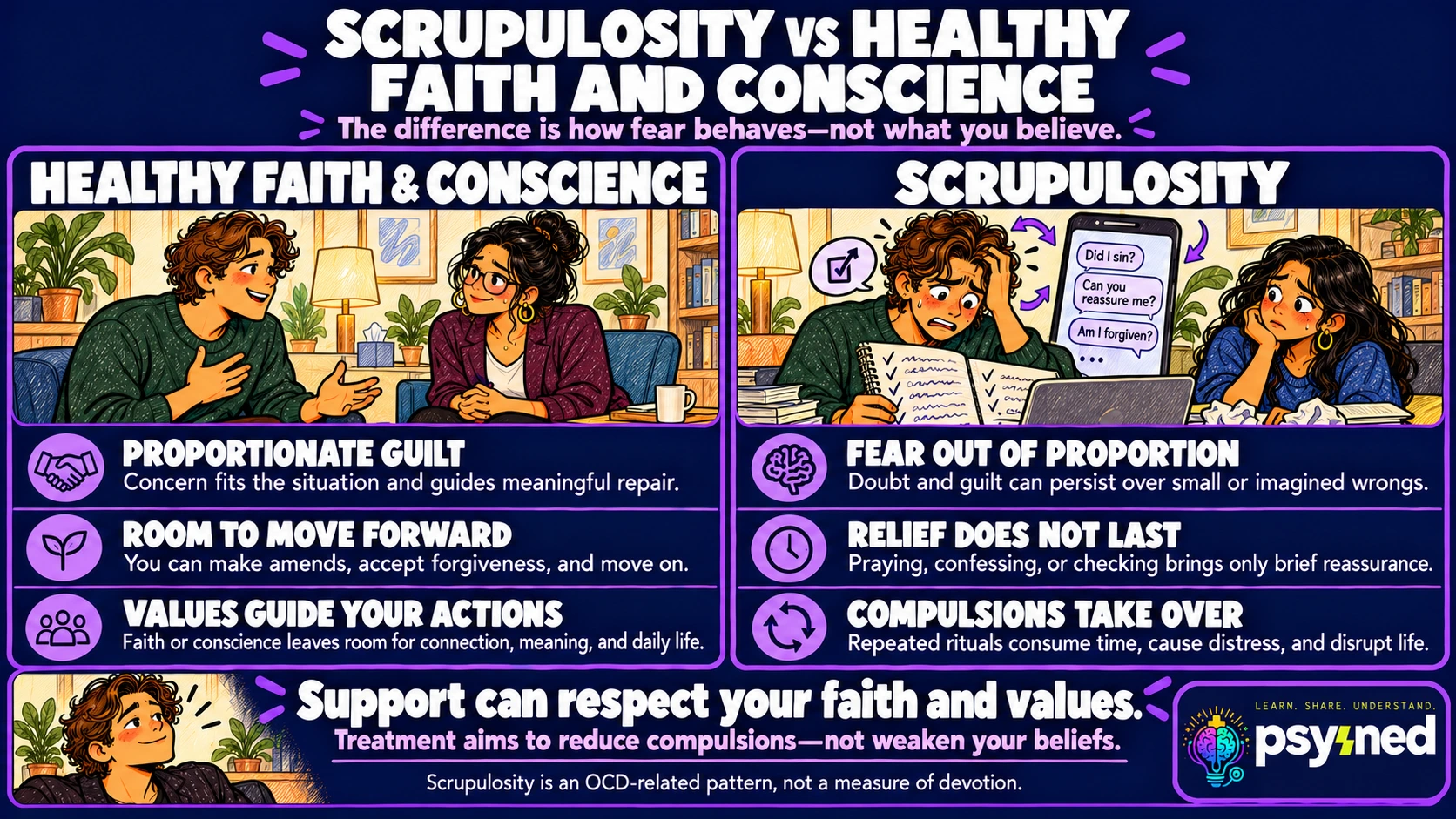
Scrupulosity vs Healthy Faith and Conscience
This distinction matters enormously, because scrupulosity is often mistaken — by sufferers and sometimes others — for being especially devout or moral. The difference isn’t what you believe or how seriously you take right and wrong; it’s how the fear behaves. Healthy faith and a healthy conscience can bring guilt, but it’s proportionate, it motivates genuine growth, and it resolves — you can feel forgiven, make amends, and move on. Scrupulosity is different: the fear is out of proportion to any actual wrongdoing, it can’t be resolved no matter what you do, and the compulsions consume significant time and cause real distress and impairment.
Many religious leaders across traditions recognize scrupulosity as distinct from genuine devotion — and often as an obstacle to it, since fear crowds out the love, peace, or meaning that faith is meant to provide. In fact, effective treatment doesn’t ask anyone to abandon or weaken their beliefs. It helps people practice their faith (or live by their values) out of conviction rather than fear. If your relationship with faith or morality has become dominated by dread, doubt, and endless checking, that’s not devotion — it’s a treatable anxiety disorder wearing devotion’s clothing.
How This Scrupulosity Test Works
This test contains 15 statements about the obsessions and compulsions seen in scrupulosity. For each, choose how much it applies to you, thinking about your experience over recent times rather than a single moment. The statements cover both religious and moral scrupulosity, so you can answer them whatever your beliefs:
Not at all = 0 | Rarely = 1 | Sometimes = 2 | Often = 3 | Very much = 4
Your answers add up to a score from 0 to 60, placing you in one of four ranges from minimal to severe. A higher score means the scrupulosity pattern fits more strongly — it doesn’t diagnose OCD, but it tells you whether talking to a professional is worthwhile. Answer honestly; your results are private.
Understanding Your Results
Your score reflects how closely your experiences match the pattern of scrupulosity. Read it as a guide to whether professional support is worthwhile — not as a diagnosis. Only a qualified professional can diagnose OCD or scrupulosity.
| Score | Range | What It Suggests |
|---|---|---|
| 0 – 15 | Minimal | Few signs of scrupulosity; likely a normal-range conscience. |
| 16 – 30 | Mild | Some scrupulous tendencies worth noticing, especially if they’re growing. |
| 31 – 45 | Moderate | A significant scrupulosity pattern; a professional conversation is worthwhile. |
| 46 – 60 | Severe | Strong scrupulosity symptoms likely affecting your life; professional support is recommended. |
How Scrupulosity Is Treated
Scrupulosity is treated like other forms of OCD, and the outlook is hopeful. The first-line, most effective treatment is Exposure and Response Prevention (ERP), a form of cognitive behavioral therapy. In ERP, you gradually and safely face the fears that trigger your anxiety — an intrusive thought, an uncertain situation — while learning to resist the compulsions (praying, confessing, checking, reassurance-seeking) that normally bring short-term relief. Over time, this teaches your brain that the doubt can be tolerated and doesn’t need to be neutralized, and the obsessions lose their grip. Medication (typically SSRIs) also helps many people, alone or alongside therapy.
A crucial point for anyone worried about their faith: good treatment is not about believing less or caring less about morality. Therapists — who come from all backgrounds and work respectfully with people of every faith and none — aim to help you practice your faith or live your values out of genuine conviction rather than fear. Many people describe recovery as finally being able to reconnect with the meaning, peace, or love that scrupulosity had buried under dread. If anxiety more broadly is part of your picture, our Anxiety Test may help you see the fuller shape of it.
Methodology & Sources
This test is an educational screening tool informed by the clinical understanding of scrupulosity as a subtype of OCD, and by the domains of the Penn Inventory of Scrupulosity (PIOS; Abramowitz et al., 2002) along with the standard obsession–compulsion structure of OCD. Its 15 items are original statements covering both religious and moral scrupulosity, written to be usable by people of any faith or none. It is a screen, not a diagnostic instrument, and it does not diagnose OCD or scrupulosity — only a qualified mental health professional can, through a full assessment.
References
- Abramowitz, J.S., Huppert, J.D., Cohen, A.B., Tolin, D.F., & Cahill, S.P. (2002). Religious obsessions and compulsions in a non-clinical sample: The Penn Inventory of Scrupulosity (PIOS). Behaviour Research and Therapy, 40(7), 825–838. doi:10.1016/S0005-7967(01)00070-5
- Abramowitz, J.S., & Jacoby, R.J. (2014). Scrupulosity: A cognitive-behavioral analysis and implications for treatment. Journal of Obsessive-Compulsive and Related Disorders, 3(2), 140–149. doi:10.1016/j.jocrd.2013.12.007
- International OCD Foundation. Scrupulosity. iocdf.org/about-ocd/related-disorders/scrupulosity
Frequently Asked Questions
What is scrupulosity?
Scrupulosity is a form of obsessive-compulsive disorder (OCD) in which obsessions and compulsions center on religion, morality, or ethics. People with scrupulosity experience relentless, distressing fears — of having sinned, offended God, or being a bad person — and perform compulsions like excessive praying, confessing, reassurance-seeking, or mental checking to try to relieve the anxiety. It comes in a religious form (sometimes called religious OCD) and a secular, moral form. Despite looking like intense devotion or conscientiousness, it’s an anxiety disorder, and it’s treatable.
Is scrupulosity the same as being very religious or moral?
No, and this distinction is important. Being devout or holding high moral standards is healthy; scrupulosity is different in how the fear behaves. With healthy faith or conscience, guilt is proportionate, it motivates genuine growth, and it resolves — you can feel forgiven and move on. With scrupulosity, the fear is out of proportion to any real wrongdoing; it can’t be resolved no matter what you do, and the compulsions consume time and cause distress. Many religious leaders recognize scrupulosity as distinct from true devotion, and often as an obstacle to it. It’s not “too much faith” — it’s OCD attaching to faith. Scrupulosity is also distinct from obsessive-compulsive personality disorder, which is about perfectionism and control rather than intrusive fear.
Can you have scrupulosity without being religious?
Yes. While religious scrupulosity is the more familiar form, there’s also moral or “secular” scrupulosity, which has no religious element. It involves obsessive doubt about whether you’re a good or ethical person, intense fear of having lied, cheated, or harmed someone, and long periods of distressing moral rumination. Non-religious people can absolutely have scrupulosity, and this test is written to include both forms. The underlying mechanism — intrusive doubt plus compulsions that never bring lasting relief — is the same.
How is scrupulosity treated?
Scrupulosity is treated like other forms of OCD, and treatment works well. The most effective approach is Exposure and Response Prevention (ERP), a type of cognitive behavioral therapy in which you gradually face feared thoughts and situations while resisting compulsions, teaching your brain that the doubt can be tolerated. Medication (usually SSRIs) helps many people too. Importantly, treatment does not aim to change or weaken your beliefs — therapists work respectfully with people of all faiths and none, and the goal is to free your faith or values from fear. The International OCD Foundation (iocdf.org) can help you find a specialist.
Related Tests
- OCD Test — the broader obsessive-compulsive disorder; this is a form of it
- Anxiety Test — scrupulosity is an anxiety-driven condition
- Clinical Depression Test — depression often accompanies chronic OCD
- Generalized Anxiety Disorder Test — for persistent, wide-ranging worry
- Self-Esteem Test — scrupulosity often attacks a person’s sense of their own goodness
This test is an educational screening tool, not a diagnosis or a substitute for professional care. Scrupulosity and OCD can only be diagnosed by a qualified professional. For OCD support and to find a specialist, see the International OCD Foundation (iocdf.org). If you are in crisis or having thoughts of harming yourself, call or text 988 (Suicide & Crisis Lifeline, US, 24/7). Outside the US, find helplines at findahelpline.com.
Related Tests
See All Quiz →
You may also like
See All Quiz →

Emotional and Trait Assessments · Personality
Big Five Personality Test: Discover Your OCEAN Traits
→