
Personality Disorders
Could You Have OCPD? Take This Obsessive Compulsive Personality Disorder Test
→
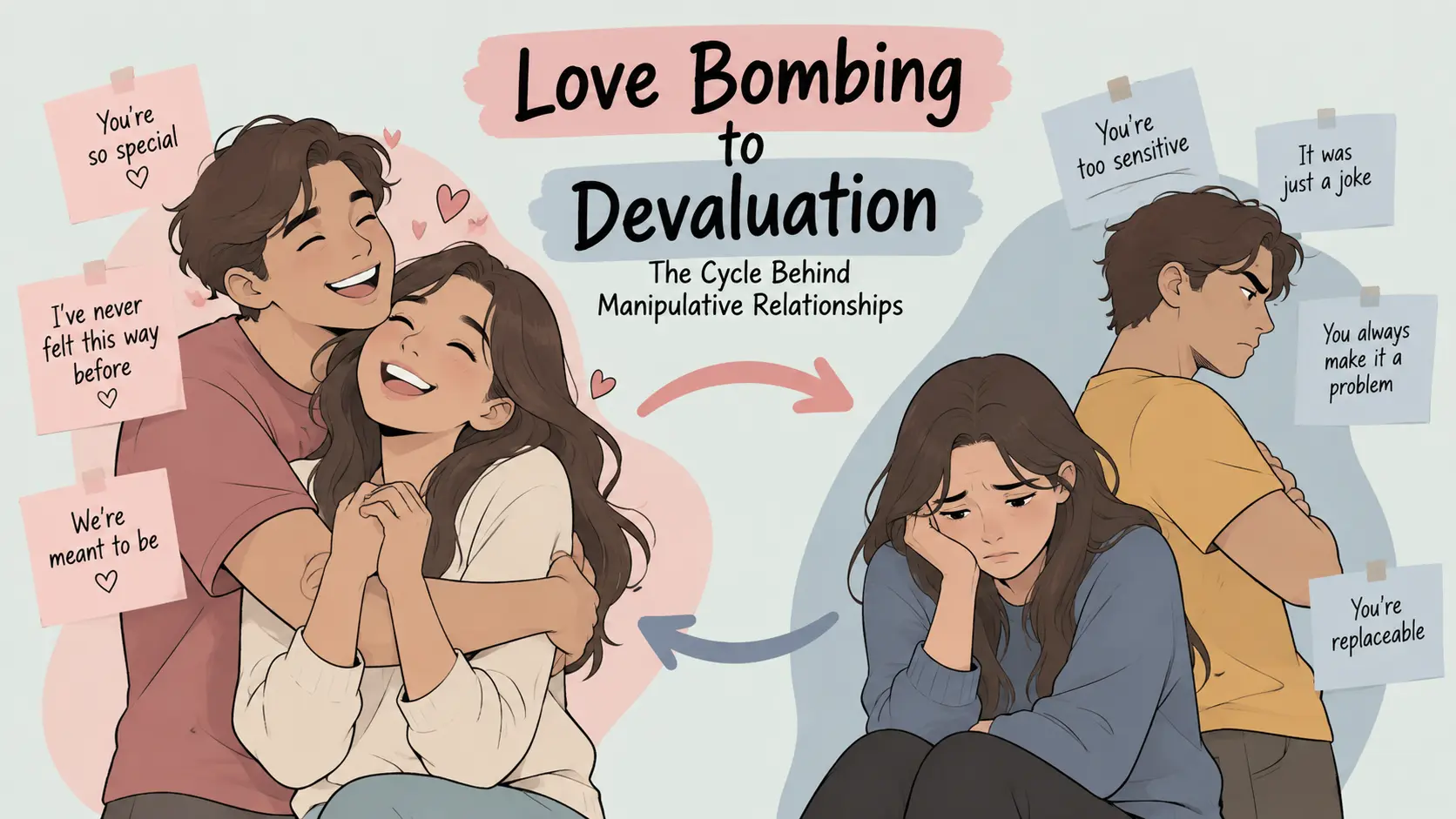
Manipulation rarely announces itself. It usually arrives as something that feels like love, and only later turns into something that feels like walking on eggshells. That sequence — intense warmth first, criticism second — is what makes it so hard to name while it is happening. By the time the treatment turns cold, you have already been given a reason to believe you deserved it.
Most lists of warning signs treat each behaviour as a separate item to tick off. That framing is what trips people up. Any single item on its own can have an innocent explanation: people do get jealous, people do withdraw when they are hurt, people do forget conversations. What distinguishes manipulation is not the individual act but the pattern — a repeating cycle that moves in one direction, and leaves you smaller each time round.
The opening phase is often called love bombing: an overwhelming flood of attention, praise and declarations of connection, delivered far faster than the relationship has earned. It is not a clinical diagnosis, but it is a well-described pattern, first documented in high-control groups and later studied in dating relationships.
It tends to look like this:
None of that is inherently sinister. New relationships are intense, and some people simply feel things quickly and say so. The difference is what the intensity is doing. Healthy early passion leaves room for you to move at your own speed. Love bombing applies pressure: it asks for rapid commitment, discourages hesitation, and sets a standard of closeness that will later be used as a measuring stick you keep failing to reach.
It also does something quieter. It establishes a debt. When someone gives you an extraordinary amount very early, any later request becomes harder to refuse, and any later cruelty becomes easier to excuse — because you remember who they were at the start.
The shift is usually gradual rather than sudden, which is precisely why it is hard to point to a moment when things changed. The warmth does not disappear; it becomes conditional. Four mechanisms tend to do the work.
You start being measured against other people — an ex, a colleague, a friend, a stranger online. Sometimes it is explicit, sometimes it is a passing remark about how someone else handles things better. The function is to move you from chosen to on probation. The same person who called you irreplaceable is now implying you are replaceable, and the contrast itself is the point.
Criticism arrives with a disclaimer attached: it was only a joke, they are just being honest, someone had to tell you. The content is corrosive but the packaging makes objecting look like an overreaction — which conveniently supplies the next accusation, that you are too sensitive.
Attention is removed rather than given: silence, one-word replies, physical presence with emotional absence. Because nothing has technically been done, there is nothing concrete to raise. You are left managing an atmosphere, and the fastest way to end it is usually to apologise for something you are not sure you did.
A third person is introduced into the dynamic — often through social media, where an ambiguous like, photo or comment can manufacture insecurity while remaining perfectly deniable. Triangulation works because it puts you in competition for something that was previously given freely, and because any objection can be reframed as jealousy or surveillance.
The most reliable warning signs are not things the other person does. They are changes in how you operate — and they are easier to spot honestly, because you have direct access to them.
If several of those describe you, that is worth taking seriously on its own. Our Am I Being Manipulated? quiz is built around exactly this — it asks about your experience rather than asking you to diagnose someone else.
One of the most isolating features of this pattern is the gap between public and private behaviour. To everyone else the person may be charming, generous and well-liked. The behaviour you are describing is invisible to them, which produces a particular kind of loneliness: you are not only dealing with the treatment, you are dealing with nobody believing it.
That gap is not proof of anything by itself — plenty of people are simply different in public. But it has a predictable consequence. When you eventually do speak up, the response you meet is often disbelief, and disbelief pushes you back toward silence. If you have started to think nobody would believe me anyway, notice that thought. It is doing a lot of work to keep things as they are.
A recurring theme people describe is the sense that their distress never actually registers. You explain that something hurt; the conversation ends up being about their intentions, their stress, or how unfair it is to be accused. You may get the words I’m sorry, but the behaviour does not change, which is the only thing an apology is really measured by.
There is a specific move worth knowing by name here: DARVO — Deny, Attack, Reverse Victim and Offender. Described by psychologist Jennifer Freyd, it is the pattern where raising a problem results in denial, then an attack on you for raising it, and finally a reversal in which they are the injured party and you are the one who has done harm. Once you can see the shape of it, it becomes considerably harder to be pulled into.
The same is true of gaslighting, where the disagreement is not about what should happen next but about what happened at all: events you remember are denied, and your memory itself becomes the subject. If that is the part you recognise most, the gaslighting test goes into it in more depth.
People who have never experienced it tend to assume that worse treatment makes leaving easier. In practice the opposite is often true, and there is a reason for it.
Rewards that arrive unpredictably produce more persistent behaviour than rewards that arrive reliably — one of the most robust findings in behavioural psychology. A relationship that alternates between warmth and coldness is delivering exactly that schedule. The good days are not the relationship interrupted by bad days; the alternation is the structure, and it is unusually good at holding attention.
Researchers Donald Dutton and Susan Painter described a related process they termed traumatic bonding: strong attachments can form in relationships that combine a power imbalance with intermittent bad treatment. If you have wondered why you feel most attached precisely when things are worst, that is not a character flaw or a failure of self-respect. It is a documented response to a particular set of conditions.
One important caveat. If any of this involves threats, monitoring, controlling your money or movements, or physical fear, that is coercive control, and it is treated as a form of abuse rather than a communication problem. It is a criminal offence in England and Wales and in Scotland. Leaving can be the most dangerous period, so plan it with a domestic abuse service rather than alone.
No. Some people are genuinely effusive early on and stay consistent afterwards. What distinguishes love bombing is what follows: the intensity is withdrawn and then used as leverage. If the warmth never becomes conditional and your independence is never treated as a betrayal, early enthusiasm on its own is not a warning sign.
Not necessarily, and it is worth resisting that conclusion. Narcissistic personality disorder is a clinical diagnosis with specific criteria, made by a professional who has assessed the person — not something identifiable from the outside. Manipulative behaviour is far more common than the disorder, and people arrive at it through many routes, including learned behaviour and their own history. What matters for your decisions is the effect on you, which does not depend on a label.
Yes. Guilt, withdrawal and comparison can all be learned strategies rather than deliberate tactics, and someone may be genuinely unaware of the effect. Intent matters for how you feel about the person; it does not change the effect on you, and it is not a reason to accept treatment that is damaging you.
Direction and repair. Ordinary conflict is bidirectional — both people give ground, and things settle. Manipulation moves one way: the same person concedes, the same person apologises, and each round leaves you with less room than before. Ask whether repair ever actually happens, or whether the matter simply gets buried until the next time.
Noticing it is the part most people never reach, and it is worth taking seriously rather than as proof you are a bad person. These behaviours are learned and they can be unlearned, usually with a therapist. The gaslighting test is written to be answerable from that direction too.
This article is for information and self-reflection. It is not a diagnosis and it is not a substitute for advice from a qualified professional. If you are in immediate danger, contact your local emergency number. In the US, the National Domestic Violence Hotline is 1-800-799-7233, and the 988 Suicide & Crisis Lifeline is available by call or text. In the UK, the National Domestic Abuse Helpline is 0808 2000 247.
Personality Disorders
Could You Have OCPD? Take This Obsessive Compulsive Personality Disorder Test

Here you'll find all collections you've created before.