

Free 15-Item Covert Narcissism Test
Do you feel chronically misunderstood, hypersensitive to criticism, and secretly special This free Covert Narcissism Test is based on the MCNS framework.
Published Updated
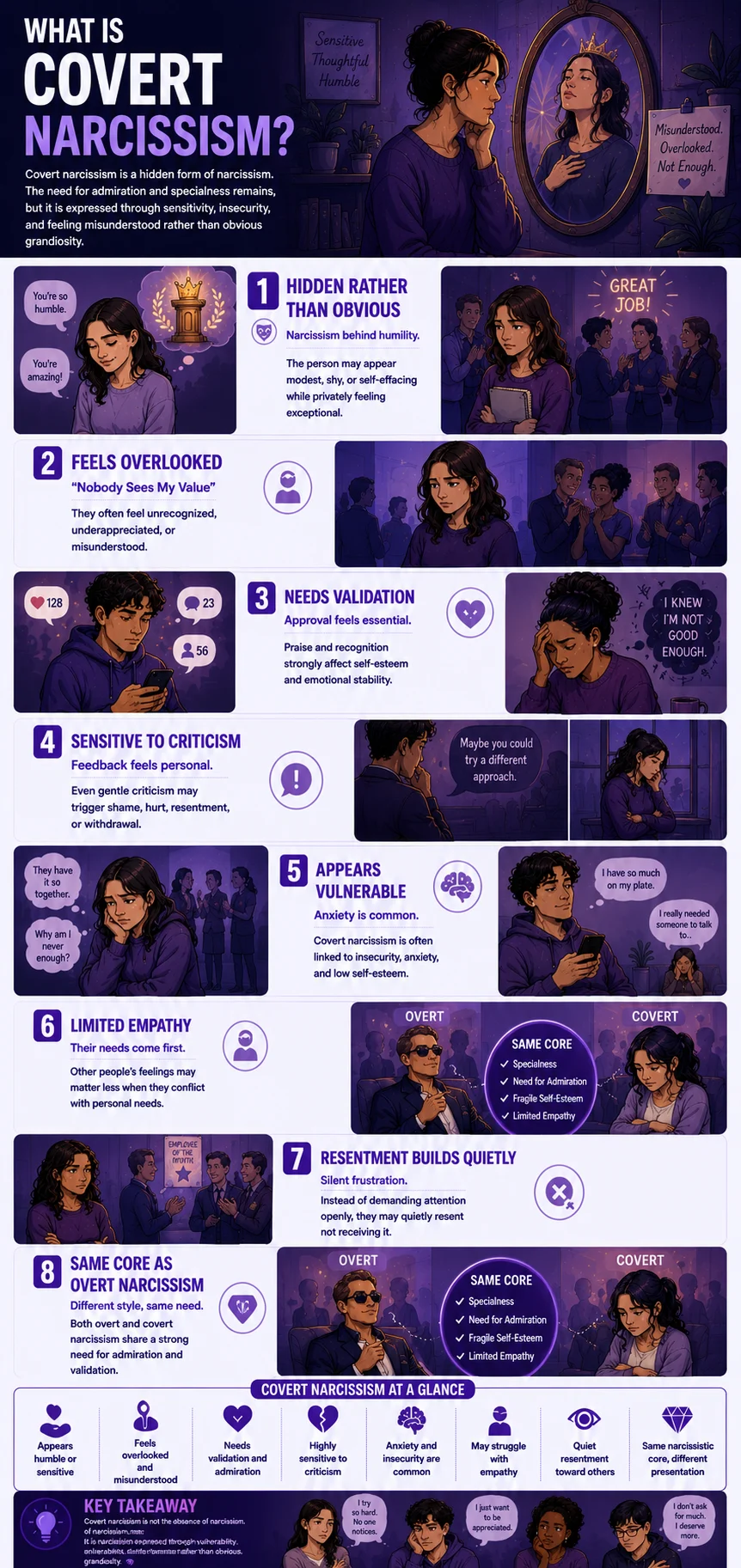
The narcissist most people recognize is visible and loud — dominating conversations, demanding admiration, dismissing everyone who doesn’t confirm their view of themselves. But there is another kind. One that presents as modest, even self-deprecating. One that listens carefully and says little, while privately feeling that the people around them fail to see how truly special they are. One that doesn’t seek the spotlight openly but feels wounded, overlooked, and quietly resentful when it isn’t turned on them anyway.
Covert narcissism — also called vulnerable narcissism, hypersensitive narcissism, or shy narcissism — is the same underlying disorder expressed in a radically different style. The grandiosity is there. The entitlement is there. The inability to genuinely consider others’ needs over one’s own is there. What has changed is the packaging: instead of overt confidence, there is apparent humility; instead of demands for recognition, there is a chronic feeling of not being recognized; instead of aggression when challenged, there is wounded withdrawal. The internal experience — of being special, of deserving more than you receive, of the world consistently failing to appreciate you — is structurally identical to overt narcissism.
This free Covert Narcissism Test is inspired by the Maladaptive Covert Narcissism Scale (MCNS), developed by Dr. Jonathan M. Cheek, Harvey M. Hendin, and Dr. Paul Wink (2013) at Wellesley College. 15 questions. Instant, private results.
What Is Covert Narcissism?
Covert narcissism is not a separate DSM-5-TR diagnosis — it is a clinically recognized subtype of Narcissistic Personality Disorder (DSM-5-TR 301.81 / F60.81) and of subclinical narcissistic personality traits. The distinction between overt and covert narcissism was first formally established by psychologist Dr. Paul M. Wink at Wellesley College in his 1991 paper, which identified two orthogonal facets of maladaptive narcissism: Grandiosity-Exhibitionism (overt) and Vulnerability-Sensitivity (covert). Both facets share the same core — inflated self-importance, fragile externally-dependent self-esteem, persistent need for admiration, and inability to consistently empathize — but express it through opposite surface presentations (Wink, 1991; Hendin & Cheek, 1997).
The covert narcissist does not broadcast their superiority. They protect it behind a facade of modesty, sensitivity, and apparent humility — while privately operating from the same conviction of specialness and the same need for validation that drives their overt counterpart. The difference is structural, not substantive: where the overt narcissist takes the admiration they believe they deserve, the covert narcissist waits for it, resents not receiving it, and feels chronically misunderstood and overlooked.
Covert narcissism is believed to be significantly more prevalent in women than in men and is one of the primary reasons why Narcissistic Personality Disorder is diagnosed three times more often in males — the diagnostic criteria in the DSM-5-TR describe the overt presentation more accurately, leading to systematic underidentification of the covert subtype (APA, 2022).
Key research on covert narcissism: Miller and colleagues (2012) found that vulnerable/covert narcissism is associated with higher anxiety and lower self-esteem than grandiose narcissism — the internal experience of covert narcissism involves significantly more distress than the overt presentation. A 2025 network analysis of NPD criteria by Gori and Topino (Clinical Psychology & Psychotherapy, N=376 mental health professionals) found that need for admiration is the most central node in the NPD criteria network — the feature that connects and maintains all other narcissistic symptoms — and this need is as prominent in the covert presentation as in the overt one, simply expressed differently.
The Maladaptive Covert Narcissism Scale (MCNS)
This test is inspired by the Maladaptive Covert Narcissism Scale (MCNS), developed by Dr Jonathan M. Cheek, Harvey M. Hendin, and Dr Paul Wink at Wellesley College (2013). The MCNS is a 23-item self-report instrument specifically designed to measure covert (vulnerable) narcissistic traits — the hypersensitive, shame-prone, internally superior but externally self-effacing expression of narcissism that the standard Narcissistic Personality Inventory (NPI) consistently fails to capture.
The MCNS was developed to expand and improve on the earlier Hypersensitive Narcissism Scale (HSNS; Hendin & Cheek, 1997). In a survey of 420 adults (Amazon Mechanical Turk), the 23-item MCNS achieved an alpha reliability of .89 compared to .75 for the original HSNS — a significant improvement. Replication in a sample of 182 college women yielded an alpha of .85. The MCNS correlates .65 with the MMPI composite measure of covert narcissism, demonstrating strong convergent validity, while correlating only .30 with maladaptive overt narcissism (NPI) and -.16 with adaptive overt narcissism — confirming that it measures something genuinely distinct from the grandiose narcissism most tests assess (Cheek, Hendin & Wink, 2013).
The MCNS specifically measures: need for external validation and admiration; high introversion; hypersensitivity toward perceived criticism, humiliation, neglect, or belittlement; shame sensitivity; social withdrawal; emotional dysregulation; a tendency toward interpersonal conflict and antagonism despite an apparently humble self-presentation; and a persistent sense of being misunderstood, unappreciated, or overlooked — the felt experience of deserving more than one receives.
Signs You Might Be a Covert Narcissist
Covert narcissism is the presentation most commonly missed — both by clinicians and by the people living with a covert narcissist. The following signs are organized around the MCNS construct domains and the clinical features documented by Miller and colleagues (2012) and Cheek, Hendin, and Wink (2013).
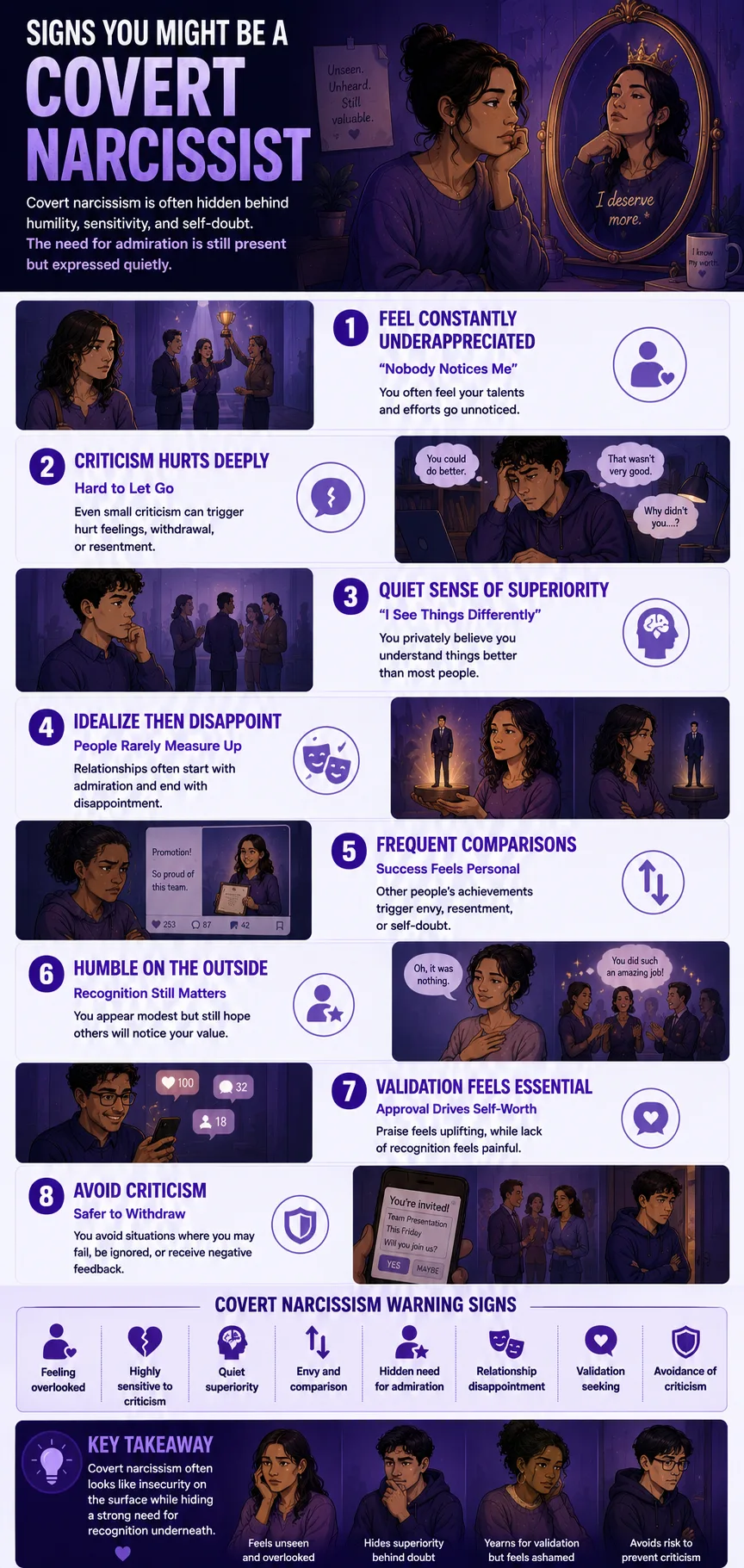
You feel chronically underappreciated — the world consistently fails to recognize what you actually offer. This is the emotional core of covert narcissism: a persistent, stable sense of deserving more recognition, appreciation, and admiration than you receive. It is not the same as low self-esteem — the covert narcissist privately believes they are exceptional. What they experience is a chronic mismatch between the recognition they believe they deserve and the recognition they actually receive from the world. The resulting resentment is quiet but constant.
Criticism lands with disproportionate force — and takes a long time to recover from. Hypersensitivity to perceived criticism, humiliation, neglect, or belittlement is one of the most diagnostically specific features of covert narcissism per the MCNS (Cheek et al., 2013). A minor comment can produce hours or days of rumination and pain. The response is not the explosive anger of overt narcissism but a wounded withdrawal — sulking, extended hurt silence, passive aggression, or a cold distance that communicates that something serious has occurred. The response is disproportionate to the provocation because the self-image being protected is fragile despite its inflation.
You often feel that you see things more clearly than others — but rarely say so directly. The conviction of intellectual, moral, or perceptual superiority is present in covert narcissism as much as in overt. The difference is expression: the covert narcissist does not announce their superiority. They carry it internally, feel quietly impatient or contemptuous when others don’t perceive what seems obvious to them, and experience a specific loneliness in feeling perpetually unseen and unmatched by the people around them.
You tend to see people as either exceptional or deeply disappointing — with little in between. Splitting — the tendency to idealize or devalue others with little stable middle ground — is a characteristic covert narcissism feature identified in the MCNS items. People begin as potential allies who might finally recognize your worth, and become targets of contempt or dismissal when they fail to sustain the idealization. Relationships follow a recognizable arc: initial intense connection, gradual disappointment, withdrawal or devaluation.
You frequently compare yourself to others — and the comparisons produce either resentment or contempt. Envy is a core narcissistic feature (DSM-5-TR Criterion 8) and is particularly prominent in covert narcissism. Where overt narcissists may dismiss others’ achievements, covert narcissists feel them acutely and painfully — the success of others highlights the gap between what they deserve and what they have received. The envy may be expressed as criticism of the person whose success triggered it, or as a quiet, pervasive resentment at a world that rewards the wrong people.
You present as modest or self-deprecating while internally expecting admiration and recognition. The altruistic, humble self-presentation that conceals internal grandiosity is the hallmark structural feature of covert narcissism — and the reason it is so difficult to identify. The covert narcissist may be visibly self-effacing, even genuinely appearing to have low self-esteem to outside observers. The internal experience is of a person who deserves more than they claim. This disconnect between the presented self and the internal experience is characteristic and contributes to the diagnostic confusion between covert narcissism and depression or social anxiety.
In close relationships, you experience your needs as central — but feel guilty or ashamed about it. Unlike the overt narcissist who experiences their centrality as natural and justified, the covert narcissist may have some awareness that their need for admiration and validation is excessive — producing shame alongside the neediness. This shame is itself a core MCNS feature, and it distinguishes covert narcissism from the unapologetic entitlement of overt NPD.
You withdraw from situations where you might not be recognized or might be criticized. Social withdrawal and avoidance of situations that might produce criticism, failure, or non-recognition is a characteristic covert narcissism behavioral pattern. This can look like introversion, social anxiety, or avoidant personality features from the outside — and is one of the primary reasons covert narcissism is confused with these conditions.
Covert Narcissism vs Overt Narcissism vs BPD vs Social Anxiety
| Feature | Covert Narcissism | Overt (Grandiose) Narcissism | Borderline PD (BPD) | Social Anxiety Disorder |
|---|---|---|---|---|
| External presentation | Modest, self-deprecating, shy, sensitive — apparent humility concealing internal grandiosity | Openly boastful, dominant, attention-commanding — grandiosity visible on the surface | Emotionally intense, visibly dysregulated, identity-unstable — vulnerability openly expressed | Anxious, avoidant, self-conscious — fear of negative evaluation by others |
| Internal self-concept | Privately special and superior; chronically underappreciated; fragile self-esteem | Openly superior; entitled; self-esteem dependent on external validation but confidently asserted | Unstable, shifting identity; fear of abandonment; not defined by hidden superiority | Negative self-evaluation; fear of being found inadequate; not driven by hidden superiority |
| Response to criticism | Wounded withdrawal, prolonged hurt silence, sulking, passive aggression — narcissistic injury expressed quietly | Narcissistic rage, contempt, counterattack, devaluation — injury expressed explosively | Intense emotional reaction tied to abandonment fears; may involve self-harm or impulsive behavior | Anxiety, shame, avoidance — not primarily about wounded grandiosity but about social evaluation |
| Empathy | Apparently sensitive; can appear empathic; selectively absent when self-interest conflicts | Openly minimal; may perform empathy strategically; absent when self-interest conflicts | Variable; may show genuine empathy; affected by emotional state and fear of abandonment | Typically present; social anxiety is not associated with empathy deficit |
| Motivation for social withdrawal | Protecting fragile self-image from criticism or failure to be recognized; contempt for others | Rarely withdraws — seeks social contexts for validation; withdraws only after perceived humiliation | Fear of abandonment and rejection; not primarily about protecting grandiosity | Fear of negative evaluation and embarrassment; not related to grandiosity or superiority beliefs |
| Validated instrument | MCNS (Cheek, Hendin & Wink 2013; alpha=.89) | NPI (Raskin & Hall 1979); DSM-5-TR 9 criteria | DSM-5-TR Criterion A (9 criteria) | LSAS (Liebowitz 1987); DSM-5-TR criteria |
| PsyMed test | This test | NPD Test | BPD Test | Social Anxiety Test |
What Causes Covert Narcissism?
Covert narcissism shares the same developmental roots as overt narcissism — the same underlying self-structure that is both inflated and fragile, dependent on external validation, and unable to consistently subordinate its own needs to those of others. The two subtypes differ in which aspects of development and temperament shaped the expression of those features.
Developmental origins — the neglect pathway. Research and clinical observation suggest that covert narcissism more commonly develops from a developmental history of emotional neglect, cold parenting, or unmet validation needs — where the child developed an inflated self-concept as a defensive structure against shame and inadequacy, but without the overt confidence-building that produces grandiose expression. The covert narcissist learned that their specialness would not be recognized or validated openly, and developed a presentation style that conceals the grandiosity while sustaining it internally.
Temperament — introversion and shame sensitivity. The MCNS framework documents that covert narcissism is associated with high introversion and high shame sensitivity — temperamental features that shape how narcissistic traits express. A narcissistic self-structure in a temperamentally introverted, shame-sensitive individual produces the covert presentation; the same self-structure in an extraverted, shame-resistant individual produces the overt presentation (Wink, 1991; Cheek et al., 2013).
Anxiety and neuroticism. Miller and colleagues (2012) found that covert narcissism is associated with significantly higher anxiety and neuroticism than grandiose narcissism — distinguishing it from the low-neuroticism profile of psychopathy and from the relatively low-distress profile of overt NPD. The covert narcissist experiences their situation as distressing in ways that overt narcissists typically do not.
Comorbidities. Covert narcissism has significant comorbidity with major depression — more so than overt narcissism, due to the higher anxiety and lower self-esteem profile. Anxiety disorders are common. The Avoidant Personality Disorder profile overlaps significantly with covert narcissism in behavioral presentation, though the underlying dynamics differ. The BPD differential is important — both involve emotional sensitivity, shame, and relational instability, though BPD is not organized around hidden superiority and entitlement.
How This Test Works
This Covert Narcissism Test is inspired by the Maladaptive Covert Narcissism Scale (MCNS; Cheek, Hendin & Wink, 2013) and covers the core MCNS construct domains: need for external validation, hypersensitivity to criticism, shame sensitivity, envy, splitting, social withdrawal, emotional dysregulation, and the concealed grandiosity that defines covert narcissism.
This test can be taken for yourself or answered with someone in your life in mind — answering how they typically behave rather than how you do. Both uses are valid and produce interpretable results.
Answer based on your habitual patterns — how you typically think and behave across different situations, not specific episodes or your best or worst moments.
- Never = 0
- Rarely = 1
- Sometimes = 2
- Often = 3
- Always = 4
Total range: 0–60. This is a screening tool. Only a qualified mental health professional can diagnose Narcissistic Personality Disorder or its subtypes.
Understanding Your Covert Narcissism Test Score
| Score Range | Category | What It Suggests |
|---|---|---|
| 0 – 15 | Low — Few Covert Narcissism Indicators | Covert narcissism traits are not significantly present. Occasional sensitivity, need for validation, or envy may be present within the normal range. |
| 16 – 30 | Mild — Some Covert Narcissistic Traits Present | Some covert narcissistic features are present — hypersensitivity, need for validation, and intermittent entitlement are noticeable. Below clinical threshold but worth reflection. |
| 31 – 45 | Moderate — Significant Covert Narcissism Pattern | Significant covert narcissism pattern across multiple MCNS domains. Likely affecting relationships and emotional wellbeing in meaningful ways. Professional evaluation recommended. |
| 46 – 60 | High — Strong Covert Narcissism Indicators | Pervasive covert narcissism pattern across most MCNS domains. Strongly consistent with covert/vulnerable NPD. Professional evaluation and therapeutic support are strongly recommended. |
Treatment and Support for Covert Narcissism
Covert narcissism — whether as a subclinical trait pattern or as part of a Narcissistic Personality Disorder diagnosis — can change with appropriate, sustained therapeutic work. The primary challenge is motivational: the ego-syntonic quality of narcissistic patterns means the person typically experiences their perceptions as accurate rather than distorted, making the impetus for change depend on recognizing the concrete costs the pattern produces in relationships and quality of life.
Schema Therapy. The most evidence-supported approach for narcissistic personality patterns. Schema Therapy addresses the early maladaptive schemas — specifically the defectiveness/shame schema and emotional deprivation schema that drive the covert narcissistic pattern — through a combination of cognitive restructuring, experiential techniques, and the therapeutic relationship itself as a corrective emotional experience. It specifically addresses both the vulnerable child mode (the shame and wound underneath) and the self-aggrandizer mode (the narcissistic defense on top).
Transference-Focused Psychotherapy (TFP). Developed by Dr. Otto Kernberg, TFP addresses the splitting and identity disturbance in personality disorders through the therapeutic relationship — making the relational patterns visible and interpretable in real time.
Individual psychotherapy with a narcissism-experienced therapist. CBT approaches targeting the cognitive distortions (the entitlement schemas, the splitting, the hypersensitivity) alongside emotion regulation work can produce meaningful improvement in functioning and relationship quality.
For partners and family members of covert narcissists. If you scored this test about someone in your life rather than yourself, individual therapy is the most important support resource available to you. A therapist experienced in narcissistic relationship dynamics can help you understand the pattern, establish appropriate boundaries, and make informed decisions about the relationship. You cannot change a covert narcissist through love, patience, or trying harder — you can protect and support yourself.
Frequently Asked Questions
What is covert narcissism?
Covert narcissism (also called vulnerable narcissism or hypersensitive narcissism) is a subtype of narcissistic personality characterized by concealed grandiosity, chronic hypersensitivity to criticism, a persistent feeling of being misunderstood and underappreciated, social withdrawal, shame sensitivity, envy, and a need for admiration expressed through resentment at not receiving it rather than overt demands. It was first formally distinguished from overt (grandiose) narcissism by Dr. Paul Wink (1991), who identified two facets of maladaptive narcissism: Grandiosity-Exhibitionism (overt) and Vulnerability-Sensitivity (covert). It is measured specifically by the Maladaptive Covert Narcissism Scale (MCNS; Cheek, Hendin & Wink, 2013; alpha=.89).
What is the difference between covert and overt narcissism?
Both subtypes share the same core: inflated self-importance, fragile externally-dependent self-esteem, persistent need for admiration, and inability to consistently empathize when self-interest conflicts. The difference is expression. Overt (grandiose) narcissism expresses the grandiosity openly — through boastfulness, dominance, and explicit demands for recognition. Covert narcissism conceals it behind apparent humility and sensitivity — while privately feeling equally superior, entitled to recognition, and wounded when that recognition is not provided. The covert presentation involves significantly higher anxiety and lower self-esteem than the overt presentation (Miller et al., 2012), making the internal experience substantially more distressing.
Is covert narcissism the same as Narcissistic Personality Disorder?
Covert narcissism can exist at subclinical levels (as a trait pattern in the normal population) or at clinical levels that meet the DSM-5-TR threshold for Narcissistic Personality Disorder (301.81 / F60.81). The DSM-5-TR Section II criteria for NPD describe the overt presentation more precisely, which contributes to systematic underdiagnosis of covert NPD — particularly in women, who more commonly present with the covert pattern. DSM-5-TR’s own Section III Alternative Model acknowledges that the presentation of NPD can include marked insecurity alongside the grandiosity, reflecting the covert subtype (APA, 2022). A definitive NPD diagnosis requires comprehensive clinical assessment. The full NPD Test covers both subtypes.
How can I tell if someone in my life is a covert narcissist?
The covert narcissist is identified by a specific pattern over time rather than by obvious surface behavior.
- The key markers:Relationships follow an idealization-to-devaluation arc.
- Criticism of any kind — however gentle — produces withdrawal or sulking that is disproportionate and prolonged.
- The relationship consistently feels one-sided despite their apparent sensitivity and attentiveness.
- In practice, they treat their own needs, feelings, and experiences as more important than yours, despite never claiming this explicitly.
- They seem perpetually dissatisfied — never quite getting enough appreciation or recognition regardless of how much they receive and their apparent modesty coexists with a private conviction of superiority that occasionally surfaces in contemptuous comments about others.
This test can be answered about someone in your life by responding based on how they typically behave.
Can a covert narcissist change?
Yes — change is possible, but it depends critically on the person’s capacity for genuine self-reflection and their motivation to change based on what the pattern is actually costing them. The primary barrier is the ego-syntonic quality of the pattern: the covert narcissist typically experiences their hypersensitivity as justified, their feeling of being underappreciated as accurate, and their relationship difficulties as the fault of others. Schema Therapy has the strongest evidence base for personality-level change in narcissistic patterns. The prognosis is better when the person has some genuine awareness that the pattern exists and is causing harm — the self-awareness that produces accurate self-report on a test like this is a meaningful positive prognostic indicator.
What is the MCNS?
The Maladaptive Covert Narcissism Scale (MCNS) is a 23-item self-report instrument developed by Dr. Jonathan M. Cheek, Harvey M. Hendin, and Dr. Paul Wink at Wellesley College (2013). It was developed to improve on the earlier Hypersensitive Narcissism Scale (HSNS; Hendin & Cheek, 1997) and specifically measures covert (vulnerable) narcissism — the subtype that standard narcissism measures like the NPI consistently miss. Validated across two samples (N=420 and N=182), it achieves an alpha reliability of .89 and correlates .65 with the MMPI measure of covert narcissism. It is the most widely used validated instrument for covert narcissism assessment and is the framework on which this test is based.
How is covert narcissism different from borderline personality disorder?
BPD and covert narcissism share significant surface features — emotional sensitivity, shame, interpersonal instability, and a tendency toward idealization and devaluation. The key distinctions: BPD is organized around fear of abandonment and an unstable identity, not around concealed grandiosity and entitlement. The person with BPD feels empty and unstable; the covert narcissist privately feels special and deserving. BPD involves an openly expressed vulnerability; covert narcissism conceals its vulnerability behind a facade of modesty. Both conditions can cause significant relationship difficulty. Both can co-occur. The BPD Test covers the borderline presentation specifically.
Further reading
Covert narcissism and Machiavellianism can look alike from outside, since both are quiet and guarded. The difference is motive: one protects a fragile self-image, the other pursues an outcome. Our Machiavellianism quiz measures the strategic version.
Related Tests
- Narcissistic Personality Disorder Test — the full NPD screening covering both grandiose and covert presentations across all nine DSM-5-TR criteria; the natural companion to this test
- Dark Triad Test — narcissism as one of three dark personality dimensions; provides broader trait context alongside covert narcissism specifically
- Gaslighting Test — covert narcissists rely on gaslighting more than open conflict; this looks at that tactic on its own
- Borderline Personality Disorder Test — BPD is the most important differential for covert narcissism; both involve shame, sensitivity, and relational instability through different underlying structures
- Avoidant Personality Disorder Test — AVPD overlaps significantly with covert narcissism in behavioral presentation (social withdrawal, sensitivity to criticism); the underlying dynamics differ fundamentally
- Social Anxiety Test — social anxiety and covert narcissism both produce withdrawal and sensitivity; distinguished by whether superiority beliefs are driving the avoidance
- Imposter Syndrome Test — imposter syndrome and covert narcissism can co-occur; both involve a gap between self-presentation and internal experience, though in opposite directions
- Clinical Depression Test — covert narcissism is associated with higher rates of depression than overt narcissism; comorbid depression needs separate assessment and treatment
- Anxiety Test — covert narcissism is associated with significantly higher anxiety than grandiose narcissism (Miller et al. 2012); anxiety disorders are common comorbidities
- Passive Aggressive Test — passive aggression is a characteristic behavioral expression of covert narcissism; the two patterns frequently co-occur
- Full Personality Disorder Test Hub — all ten DSM-5-TR personality disorder types across Clusters A, B, and C
- Main Character Syndrome Test — the subclinical, pop-culture end of self-focused traits; flexible and changeable rather than a personality disorder
References
- Cheek, J.M., Hendin, H.M., & Wink, P.M. (2013). An expanded version of the Hypersensitive Narcissism Scale: The Maladaptive Covert Narcissism Scale. Presented at the meeting of the Association for Research in Personality, Charlotte, NC, June 2013. [N=420, alpha=.89; .65 correlation with MMPI] academia.edu
- Hendin, H.M., & Cheek, J.M. (1997). Assessing hypersensitive narcissism: A reexamination of Murray’s Narcism Scale. Journal of Research in Personality, 31, 588–599. [Original HSNS; alpha=.75]
- Wink, P. (1991). Two faces of narcissism. Journal of Personality and Social Psychology, 61(4), 590–597. [Grandiosity-Exhibitionism vs Vulnerability-Sensitivity; foundational distinction]
- Miller, J.D., Hoffman, B.J., Gaughan, E.T., Gentile, B., Maples, J., & Campbell, W.K. (2012). Grandiose and Vulnerable Narcissism: A Nomological Network Analysis. Journal of Personality, 79(5), 1013–1042. [Covert: higher anxiety, lower self-esteem than grandiose] doi.org
- Gori, A., & Topino, E. (2025). DSM-5-TR Criteria and Domains for Narcissistic Personality Disorder: Evidence From Network Analysis. Clinical Psychology & Psychotherapy, 32(6), e70179. [Need for admiration = most central NPD node; N=376] doi.org
- American Psychiatric Association. (2022). Diagnostic and Statistical Manual of Mental Disorders, Fifth Edition, Text Revision (DSM-5-TR). Narcissistic Personality Disorder 301.81 (F60.81). [Covert underdiagnosis; Section III alternative model] psychiatry.org
- IDRlabs. (2025). Covert Narcissism Test — MCNS Framework. [MCNS construct domains documentation] idrlabs.com
- PsychologyRoots. (2024). Maladaptive Covert Narcissism Scale. psychologyroots.com
- Wikipedia. (2025). Narcissistic personality disorder. en.wikipedia.org
Related Tests
See All Quiz →
You may also like
See All Quiz →