
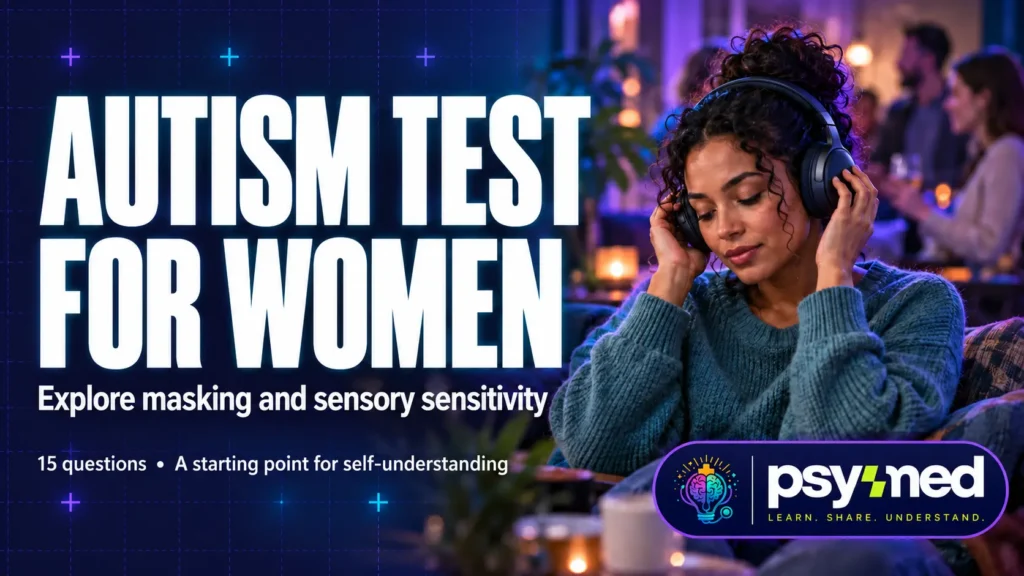
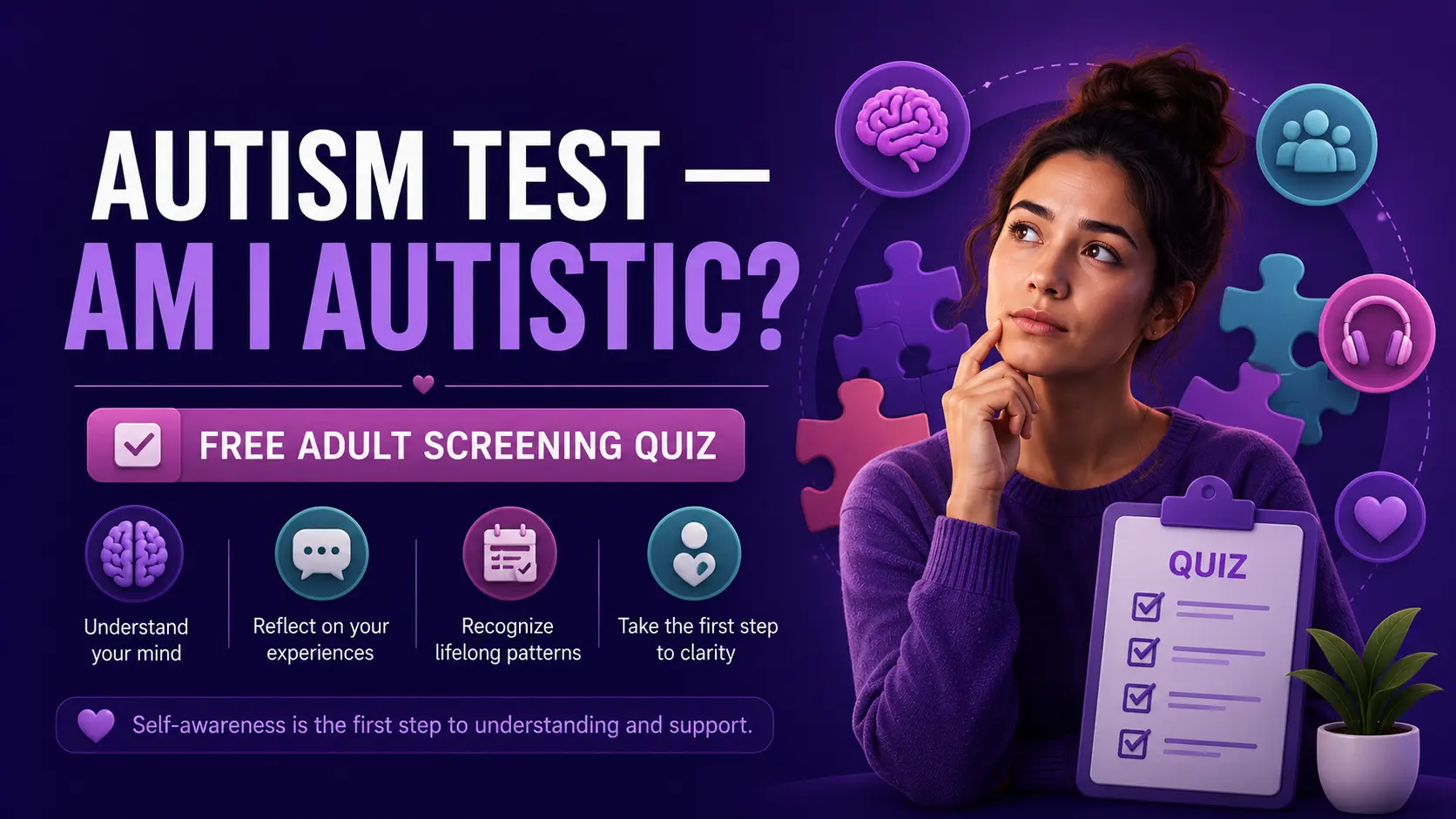
Autism Test for Women
A free, private screen for autistic traits as they present in women and girls, including masking and sensory sensitivity, informed by the AQ, RAADS-R and the camouflaging research behind the CAT-Q. Fifteen questions, scored 0 to 60. Because autistic women often mask, a lower score does not rule autism out.
Published Updated
This free autism test for women screens for autistic traits as they commonly show up in women and girls — a presentation that standard autism tests, built mostly on boys, often miss entirely. In 15 questions, it looks at the signs that tend to fly under the radar in women, including masking, sensory sensitivity, and the exhaustion of constantly working to seem “normal.” You’ll get an instant, private, affirming result.
One thing to know up front, because it’s the whole reason this page exists: autism is under-diagnosed in women not because fewer women are autistic, but because they often present differently and learn to hide their traits so well that even professionals miss it. Many autistic women go their whole lives feeling different without knowing why, or are misdiagnosed with anxiety, depression, or a personality disorder first. Being autistic isn’t a flaw or an illness — it’s a different way of experiencing the world. This test can’t diagnose you, but for a lot of women, it’s the first time things finally start to make sense.
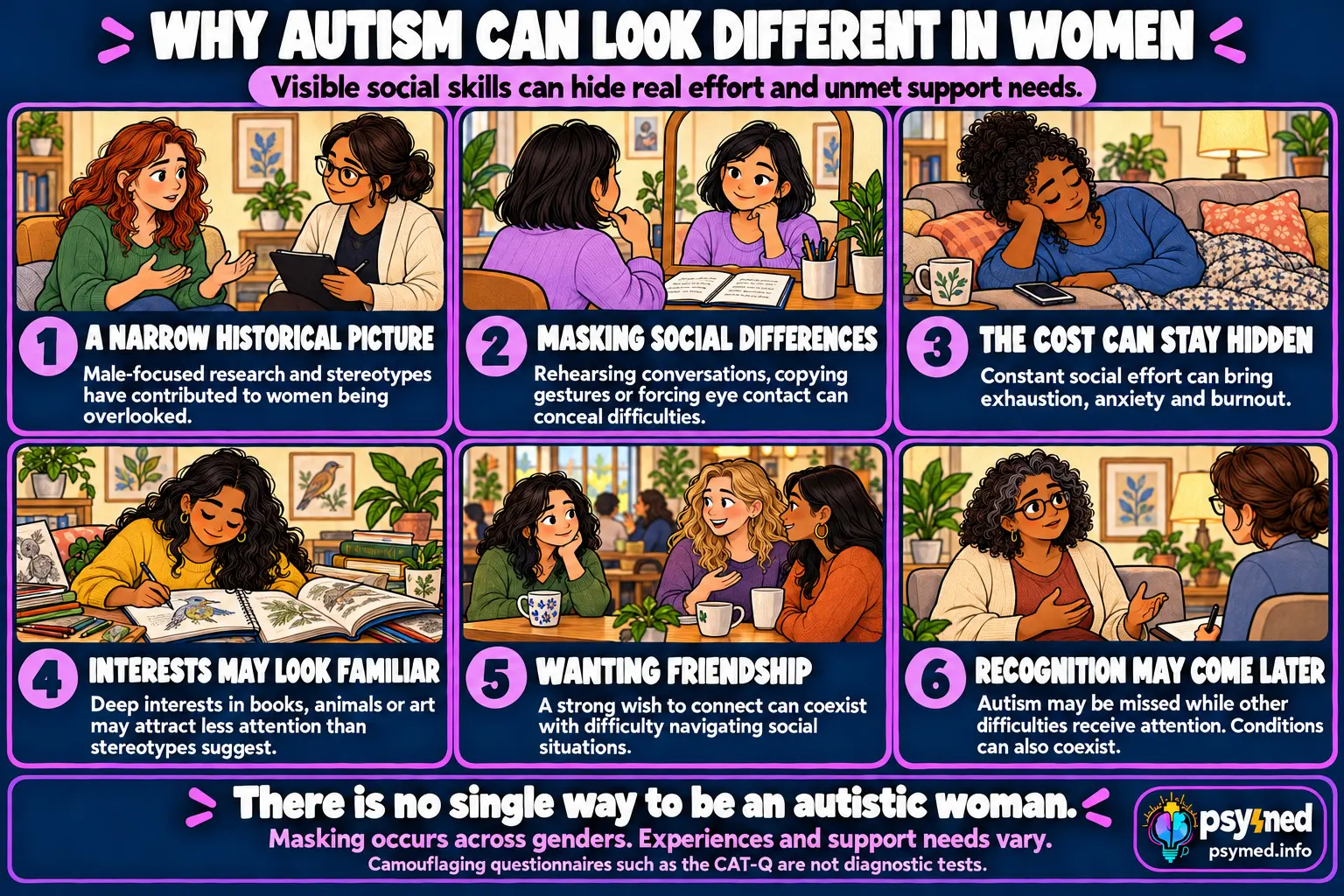
Why Autism Looks Different in Women
Autism has long been understood mainly through how it appears in boys, which is a large part of why so many autistic women and girls are overlooked. For decades, the diagnostic criteria and screening tools were developed and validated largely on male samples, so the “female autism phenotype” — the distinctive way autism tends to present in women — simply wasn’t on the radar. The result is that autistic women are diagnosed far later than men, if at all, and are frequently misdiagnosed along the way with anxiety, depression, eating disorders, or borderline personality disorder.
The biggest difference is masking (also called camouflaging): consciously or unconsciously studying and copying other people’s social behavior, scripting conversations, forcing eye contact, and suppressing natural autistic behaviors like stimming — all to appear neurotypical. Autistic women are often extraordinarily good at this, which hides their struggles but comes at a huge cost: exhaustion, anxiety, loss of identity, and eventually autistic burnout. Autistic women also tend to have intense interests that look more socially ordinary (animals, books, psychology, art, fictional worlds, or particular people) rather than the stereotyped trains-and-timetables image, and they often deeply want friendship, which masks their underlying social difficulties. Researchers including Meng-Chuan Lai, Simon Baron-Cohen, Laura Hull, and Tony Attwood have been central to documenting this presentation — and to showing that measures sensitive to camouflaging (like the CAT-Q) catch what older tools miss.
Signs of Autism in Women
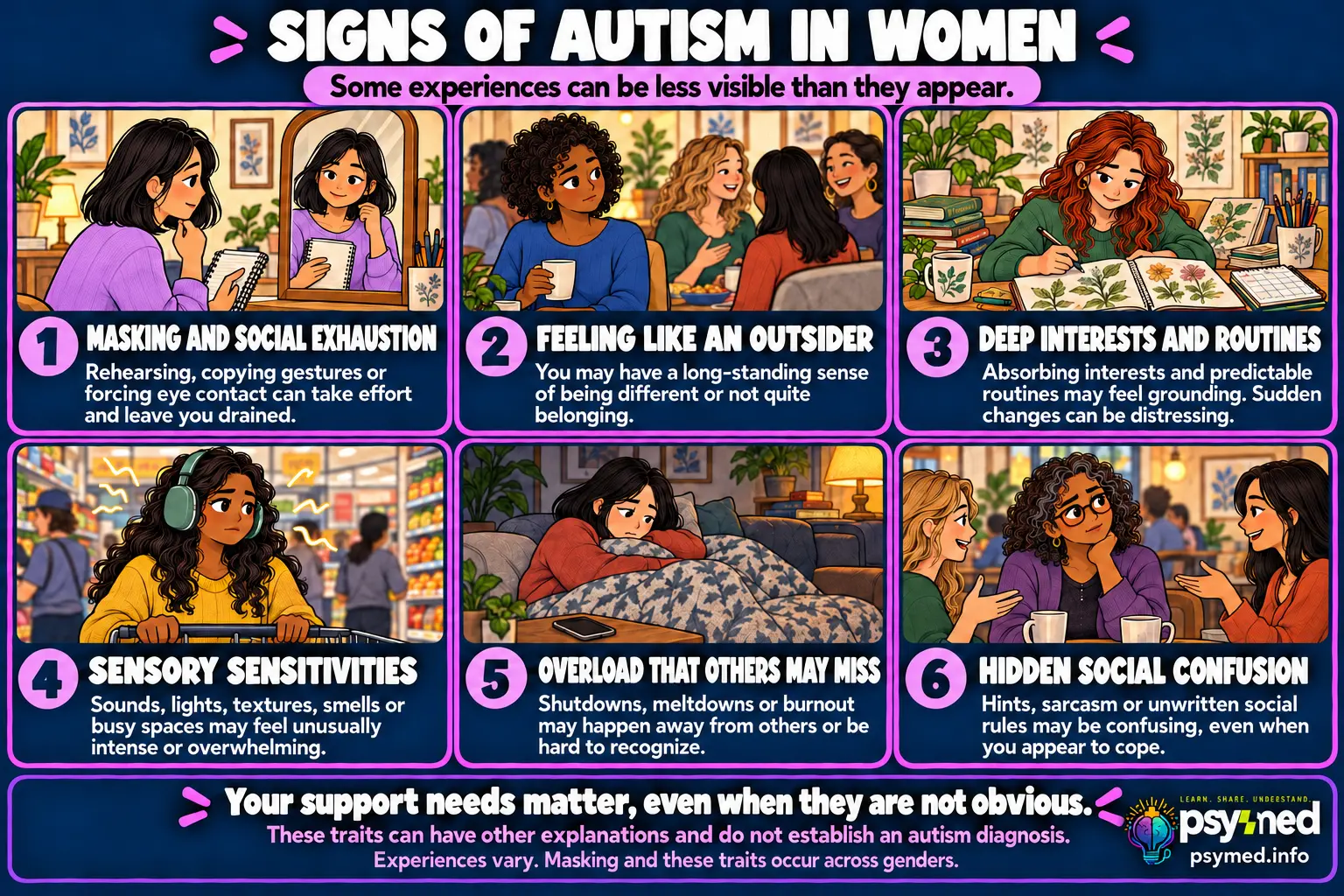
Autism in women shows up as a recognizable cluster of traits — often subtler and more internalized than the stereotype. You don’t need all of them, and many are things you might have spent a lifetime hiding or explaining away. Read these as the signs this test screens for.
Masking and exhausting social performance
Watching how others behave and consciously copying it, rehearsing conversations, forcing eye contact, or using learned scripts to seem “normal” — and feeling drained or depleted after socializing, even when it went well, because it took so much effort.
Feeling different, like an outsider
A lifelong sense of being different from other people, of not quite belonging or of watching social life from the outside — often without being able to say exactly why. Many autistic women describe feeling like an alien among humans.
Intense interests and a need for routine
Deep, absorbing interests or passions you can focus on for hours (often socially “acceptable” ones, which is why they’re overlooked), and a strong reliance on routine and predictability, with real distress when plans change unexpectedly.
Sensory sensitivities
Being highly sensitive to sensory input — sounds, bright lights, textures, smells, tags on clothing, certain foods, or busy environments — in ways that others don’t seem to notice or that feel genuinely overwhelming.
Shutdowns, meltdowns, and burnout — often in private
Experiencing shutdowns, meltdowns, or periods of burnout, but often hiding them until you’re alone, so no one sees the toll. Internalizing distress — anxiety, depression, exhaustion — rather than showing it outwardly is a hallmark of the female presentation.
Social confusion beneath a capable surface
Finding unwritten social rules confusing, taking things literally, missing sarcasm or hints, and feeling you’re getting it subtly wrong — even while appearing, on the surface, to cope well. The gap between how hard it is and how fine you look is itself a clue.
How This Autism Test for Women Works
This test has 15 statements reflecting how autism commonly presents in women, including masking. For each, choose how much it’s true for you, thinking about how you generally are across your life rather than on a single day:
Not at all = 0 | A little = 1 | Somewhat = 2 | Mostly = 3 | Completely = 4
Your answers add up to a score from 0 to 60 reflecting how many autistic traits you identify with. One crucial point about accuracy: because autistic women mask so well, it’s genuinely possible to be autistic and still score lower than expected. A high score suggests exploring further; a lower score does not rule autism out, especially if you relate to the masking questions. Treat your result as a starting point, not an answer. Your responses are private.
Understanding Your Results
Your score reflects how many autistic traits you identify with, as they tend to appear in women. Please read it as a guide, not a verdict — and remember the key caveat: masking means a lower score never rules autism out. Only a professional can diagnose autism, though many autistic women self-identify first, and that process is valid and valuable.
| Score | Range | What It Suggests |
|---|---|---|
| 0 – 15 | Few Traits | Few of these traits — though masking can lower scores, so trust your own sense too. |
| 16 – 30 | Some Traits | Some autistic traits worth exploring, especially if the masking items resonated. |
| 31 – 45 | Many Traits | Many autistic traits; exploring an assessment or learning more is worthwhile. |
| 46 – 60 | Strong Indicators | Strong indicators of the female autism presentation; a formal assessment may bring clarity. |
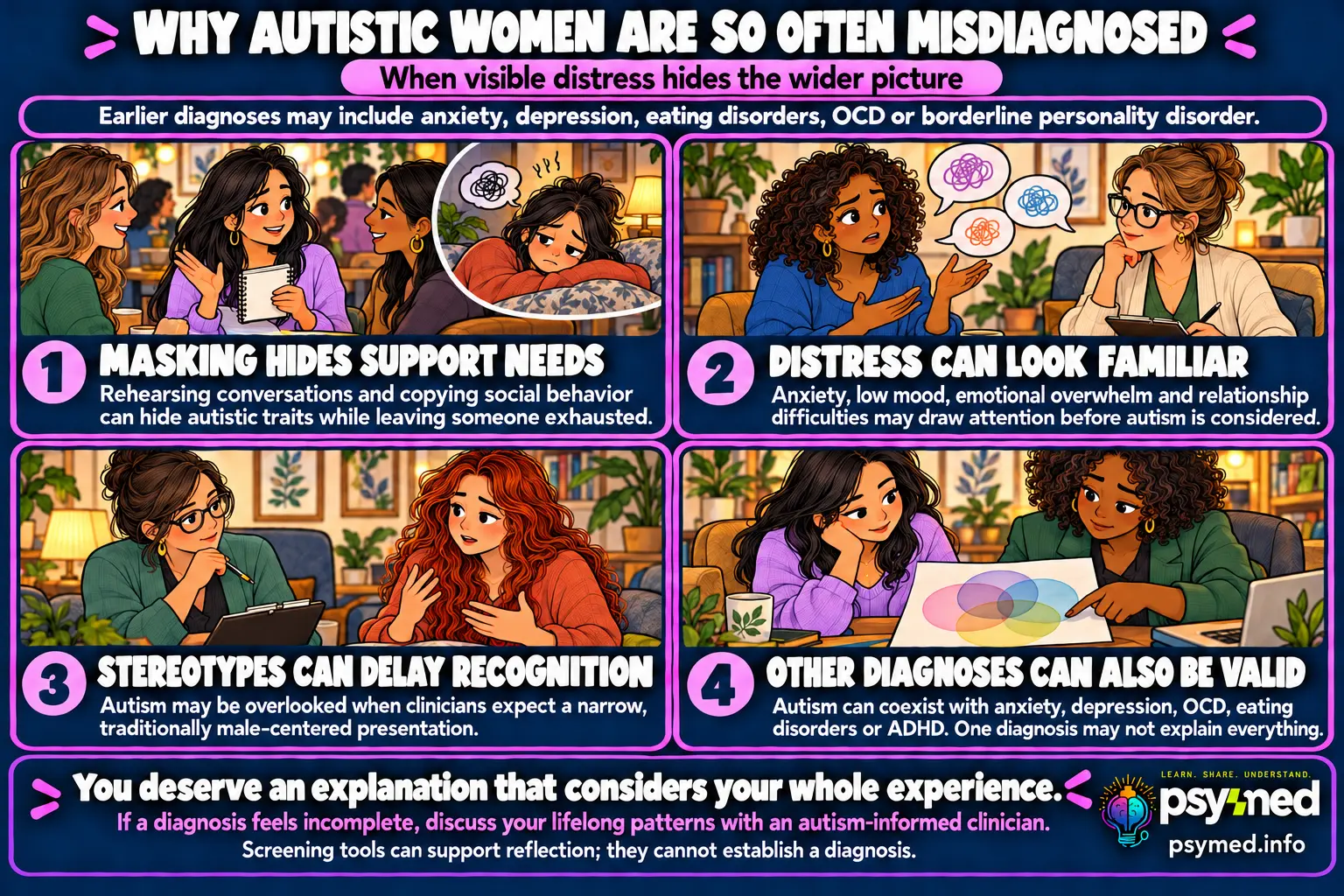
Why Autistic Women Are So Often Misdiagnosed
Many autistic women collect a series of other diagnoses before anyone considers autism — most commonly anxiety, depression, eating disorders, OCD, or borderline personality disorder. There are understandable reasons for this. The internalizing distress of masking looks like anxiety and depression. The emotional intensity and relationship difficulties that come from navigating a neurotypical world without a map can resemble a personality disorder. And because clinicians weren’t trained to recognize the female presentation, autism simply wasn’t considered. These earlier diagnoses aren’t always wrong — autistic women genuinely can have anxiety or depression, often because of years of masking and feeling unseen — but when they never quite capture the whole picture, autism may be the missing piece. If a label you’ve been given has never felt like it fully fit, that’s worth paying attention to. Our general Autism Test and ADHD Test can add context (autism and ADHD frequently co-occur, often called “AuDHD”).
Methodology & Sources
This Autism Test for Women is an educational screening tool informed by established autism measures (the Autism Spectrum Quotient and the RAADS-R), by camouflaging research and the CAT-Q (Hull et al.), and by the literature on the female autism phenotype (including work by Meng-Chuan Lai, Simon Baron-Cohen, and Tony Attwood). Its 15 items are original statements reflecting how autistic traits — including masking — commonly present in women. It is a screen for self-reflection, not a diagnostic instrument. Crucially, because autistic women often camouflage their traits, a lower score does not rule out autism. Only a qualified professional can diagnose autism, and self-identification is also recognized as valid within the autistic community.
References
- Lai, M.C., Lombardo, M.V., Auyeung, B., Chakrabarti, B., & Baron-Cohen, S. (2015). Sex/gender differences and autism. Journal of the American Academy of Child & Adolescent Psychiatry, 54(1), 11–24. doi:10.1016/j.jaac.2014.10.003
- Hull, L., Mandy, W., Lai, M.C., et al. (2019). Development and validation of the Camouflaging Autistic Traits Questionnaire (CAT-Q). Journal of Autism and Developmental Disorders, 49, 819–833. doi:10.1007/s10803-018-3792-6
- Baron-Cohen, S., Wheelwright, S., Skinner, R., Martin, J., & Clubley, E. (2001). The Autism-Spectrum Quotient (AQ). Journal of Autism and Developmental Disorders, 31(1), 5–17. doi:10.1023/A:1005653411471
Frequently Asked Questions
Why is autism missed in women?
Autism is missed in women for several connected reasons. The diagnostic criteria and screening tools were developed mainly on boys, so they don’t capture the female presentation well. Autistic women tend to mask or camouflage their traits — copying social behavior and hiding their difficulties — often so effectively that even professionals don’t notice. Their intense interests look more socially ordinary, and their distress is usually internalized (as anxiety or depression) rather than shown outwardly. As a result, autistic women are diagnosed much later than men, and are often misdiagnosed first with anxiety, depression, eating disorders, or borderline personality disorder.
Can you be autistic and still have good social skills?
Yes — and this is one of the most important things to understand about autism in women. Many autistic women appear socially capable because they’ve spent years consciously learning and performing social behavior: studying how others act, rehearsing conversations, and copying expressions. This is called masking or camouflaging. On the surface it looks like good social skills, but underneath it’s effortful, exhausting, and not intuitive — which is why socializing leaves many autistic women drained. Appearing to cope socially doesn’t rule out autism; sometimes the effort it takes to appear fine is itself a sign.
Does a low score mean I’m definitely not autistic?
No. Because autistic women often mask their traits — sometimes so automatically they’re not fully aware of it — it’s genuinely possible to be autistic and score lower than you’d expect on a screening test, including this one. Standard autism tests were designed around the male presentation, which makes this even more likely for women. If you relate strongly to the experiences described here, especially the masking and the lifelong sense of being different, trust that over the number. A lower score is a reason to keep exploring if it resonates, not a reason to dismiss the question.
Is self-diagnosis of autism valid?
Self-identification is widely respected within the autistic community, and for good reason: formal assessment can be expensive, hard to access, have long waiting lists, and many clinicians still aren’t trained to recognize autism in women, leading to missed or wrong conclusions. Many late-identified autistic women reach a confident understanding of themselves through research, the autistic community, and deep self-reflection. A formal diagnosis can be valuable — it can provide clarity, access to accommodations, and validation — but it isn’t the only valid path to understanding yourself. Whatever route you take, learning that you’re autistic is about self-understanding, not a label of something being wrong.
Related Tests
- Autism Test — our general autism (ASD) screening
- ADHD Test — ADHD and autism frequently co-occur (“AuDHD”), and both are underdiagnosed in women
- Sensory Processing Sensitivity Test — high sensitivity, which overlaps with autistic sensory traits
- Alexithymia Test — difficulty identifying emotions, common in autistic people
- Anxiety Test — anxiety very often accompanies (and masks) autism in women
This test is an educational screening tool, not a diagnosis. Autism can only be formally diagnosed by a qualified professional, and because of masking, a lower score does not rule it out. If you are struggling and having thoughts of harming yourself, please call or text 988 (Suicide & Crisis Lifeline, US, 24/7). Outside the US, find helplines at findahelpline.com. Being autistic is a valid and valuable way of being.
Related Tests
See All Quiz →
You may also like
See All Quiz →