
Personality Disorders · Self-reflection
OCPD Test: perfectionism, control and the need to get it right
Fifteen questions about orderliness, perfectionism and control. Obsessive-compulsive personality disorder is not the same condition as OCD — the difference is the first thing this page explains. No questionnaire can diagnose either.

This self-check cannot diagnose obsessive-compulsive personality disorder or OCD, and it has no validated cut-off. OCPD is diagnosed by a clinician, not by a questionnaire.
-
THE FORMAT15 questionsRate how often each statement fits you, from “Never” to “Very Often”.
-
NOT OCDA different conditionOCD is built on unwanted intrusive thoughts. OCPD is a personality style that feels correct from the inside.
-
CLEAR LIMITSNot a diagnosisA clinician diagnoses OCPD through assessment and history, often involving the people who know you.
The self-check
Take the OCPD self-check
Answer about how you generally are rather than how you were on one unusual day. There are no right answers. This is a house-written questionnaire, not a validated instrument, and it cannot identify obsessive-compulsive personality disorder or OCD.
Your result
What the answer ranges mean
- 0–15 Low — few OCPD indicators
- 16–30 Mild — some patterns present
- 31–45 Moderate — a significant pattern
- 46–60 High — strong indicators
This self-check cannot diagnose obsessive-compulsive personality disorder or OCD, and it has no validated cut-off. OCPD is diagnosed by a clinician, not by a questionnaire.
A questionnaire length, not a diagnostic threshold.
The short answer
What is obsessive-compulsive personality disorder?
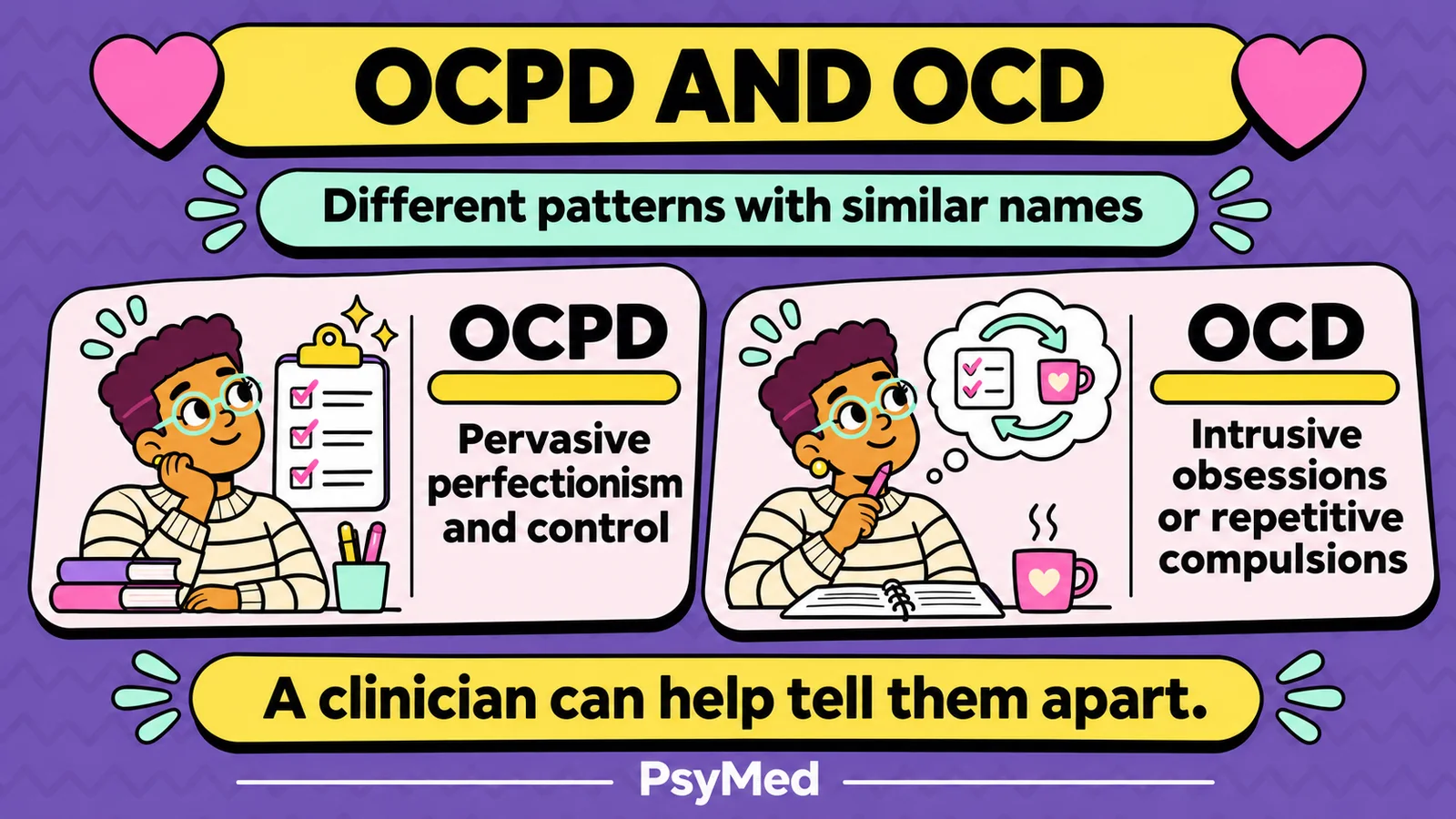
Obsessive-compulsive personality disorder (OCPD) is a personality disorder defined in the DSM-5-TR by a persistent pattern of preoccupation with order, perfectionism and control of oneself, others and situations — a pattern the MSD Manual describes as leaving “no room for flexibility” and which “ultimately slows or interferes with completing a task”. Unlike obsessive-compulsive disorder it is not built from intrusive unwanted thoughts and rituals: it is a long-standing personality style that the person usually experiences as simply the correct way to live, which is why it is so often recognised by partners and colleagues long before it is recognised by the person who has it.
The DSM-5-TR requires a persistent pattern of preoccupation with order, perfectionism and control, shown by at least four of eight features and present since early adulthood. Those features cover preoccupation with details, rules and lists; perfectionism that prevents tasks being finished; devotion to work “not motivated by financial necessity”; inflexible scrupulousness about ethics; “unwillingness to throw out worn-out or worthless objects, even those with no sentimental value”; reluctance to delegate unless others comply exactly; a miserly approach to spending; and rigidity. OCPD sits in DSM-5’s Cluster C, which Cleveland Clinic describes as the personality disorders that “involve anxiety and fear”. The ICD-11 handles the same material completely differently — it has no OCPD category at all, having moved to a dimensional system in which a clinician records one personality disorder diagnosis, rates its severity and adds trait qualifiers. The qualifier that carries this material is the anankastia trait domain, whose core feature is “a narrow focus on one’s rigid standard of perfection and of right and wrong”. Anankastia is a trait domain, not a diagnosis.
Being organised, conscientious or demanding of yourself is not a disorder. The APA Dictionary defines clinical perfectionism as demanding performance “in excess of what is required by the situation”, and researchers separate “positive or adaptive perfectionism, which refers to striving for high standards and order” from the maladaptive kind. Cleveland Clinic notes exacting standards “may even benefit them in certain jobs”.
OCPD is among the most frequently reported personality disorders, though the estimates vary widely. The National Epidemiologic Survey on Alcohol and Related Conditions interviewed 43,093 US adults face to face and found a lifetime prevalence of 7.8%, “with rates the same for men and women”, while the MSD Manual gives a median across studies of 4.7%. Both rest on the older DSM-IV criteria, so treat any single figure as approximate.
View sourceUnderstand the themes
The fifteen themes this self-check asks about
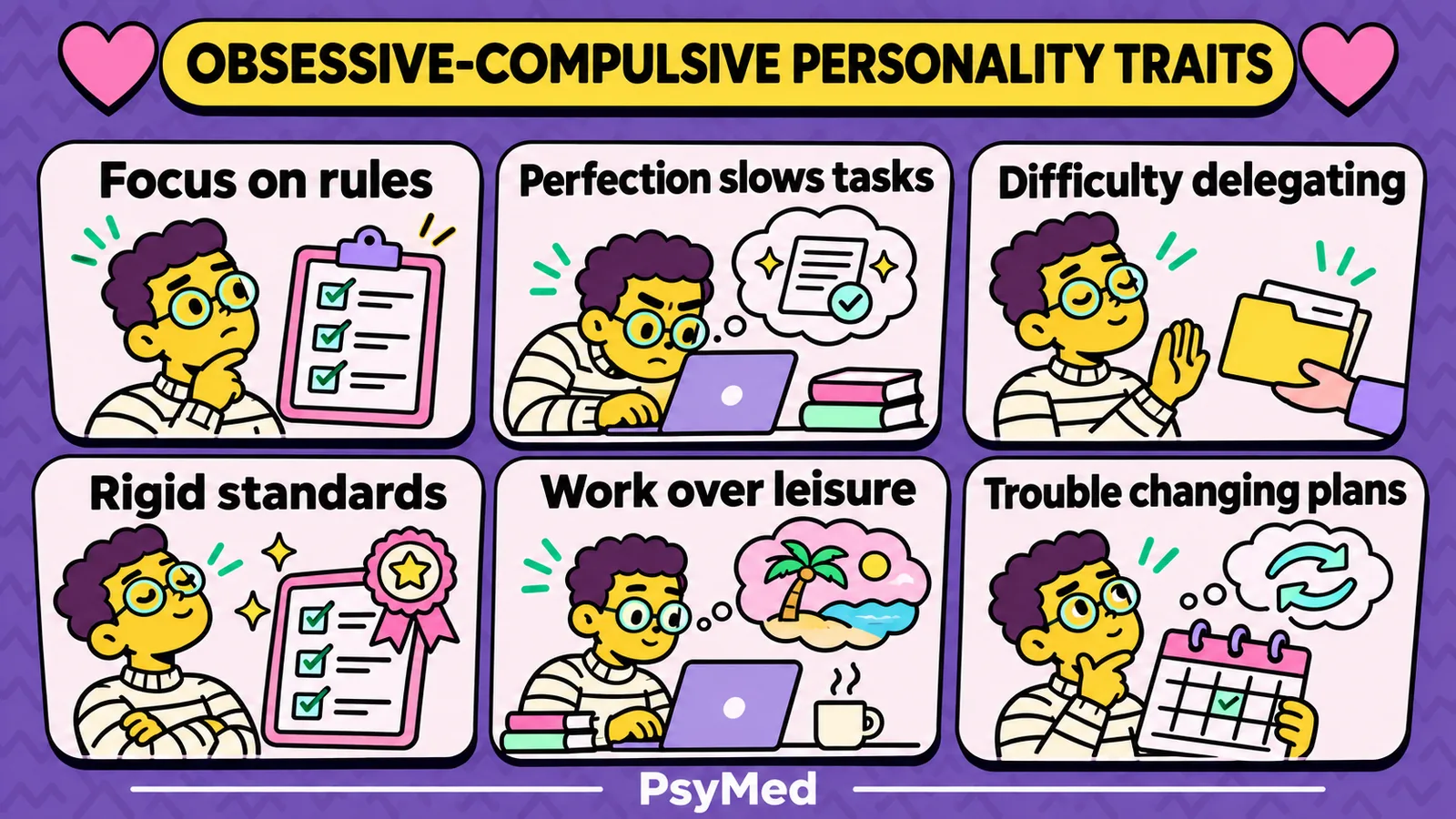
The items track the eight features the DSM-5-TR describes, plus the cost that usually brings someone to look this up in the first place.
Detail that swallows the goal
Getting so caught up in procedure, order or the correct method that the actual purpose slips out of view, or others lose patience with how long it takes.
Perfectionism that prevents finishing
Projects left undone because they could not be brought to the required standard — so nothing was submitted at all. The MSD Manual notes this pattern “ultimately slows or interferes with completing a task”.
Work crowding out everything else
Leisure, friendship and rest sacrificed to productivity, where the DSM-5-TR is specific that the devotion is “not motivated by financial necessity”. Being unproductive feels wrong rather than merely inconvenient.
Difficulty handing things over
Reluctance to delegate unless the other person will do it exactly your way, and checking, correcting or reclaiming work once you have.
Rigidity about rules and right conduct
Inflexible scrupulousness about ethics and procedure, and difficulty making exceptions where most people would apply common sense. Changes to established plans land harder than they seem to for others.
Holding on, and holding back
Keeping worn-out or useless objects in case they are needed, treating spending as risky, and finding emotional expression uncomfortable in close relationships.
OCD and OCPD compared
This is the distinction most people come here for, and the two conditions share a name and very little else. The clinical spine of it is whether the experience feels foreign to you or feels like you.
| OCD | OCPD | |
|---|---|---|
| What drives the behaviour | Compulsions are performed to quiet intrusive obsessions — “repetitive, unwanted, intrusive thoughts that cause marked anxiety”. | The behaviour is driven by order itself. The need for control follows from the preoccupation with order, so it feels consistent with who you are. |
| How it relates to your sense of self | Ego-dystonic. Cleveland Clinic: “It feels out of your control and doesn’t align with how you see yourself.” | Ego-syntonic. Cleveland Clinic: “you don’t see anything wrong with how you think and behave because you feel it’s the correct way to be.” |
| When and where it appears | Cleveland Clinic: “specific situations and thoughts trigger OCD behaviors”. | Cleveland Clinic: “The behaviors of OCPD are general and show up in all aspects of life”, as a pattern present since early adulthood. |
| Where the damage lands | Cleveland Clinic: “OCD is more likely to cause internal distress from intrusive thoughts and compulsions”. | Cleveland Clinic: “OCPD is more likely to create tension in relationships and with work”. |
| What treatment looks like | Exposure and response prevention, which Cleveland Clinic calls “the gold-standard treatment for OCD”. If this column sounds like you, the Obsessive-Compulsive Disorder Test is the better starting point. | No single first-line therapy is established: a 2022 review found “no definitive empirically supported treatment”, and several talking therapies are used. They are not two ends of one scale, and some people have both. |
Interpretation and context
How should you read your result?
Read the total as a description of how much you endorsed, then read the individual items for where it actually costs you something.
- 01 01
Traits are dimensions, not switches
Every one of these features exists on a continuum, and plenty of people with high standards have no disorder at all. There is no total here at which a trait becomes a diagnosis.
- 02 02
The threshold is cost, not intensity
The DSM-5-TR requires at least four of eight features present since early adulthood, and the pattern has to be doing damage. A high score with workable relationships is a different situation from a moderate one that has cost you a job.
- 03 03
Insight is the hard part
Because the traits feel correct from the inside, Cleveland Clinic notes that clinicians “often work with the person’s family and friends to collect more information”. If people close to you have been saying this for years, that is data a questionnaire cannot capture.
There is no validated cut-off for these 15 items and this page has no published psychometrics, so the four ranges describe how much you endorsed and nothing more. If you want an instrument with research behind it, the Pathological Obsessive-Compulsive Personality Scale is a 49-item measure developed by Anthony Pinto, Emily B. Ansell and Aidan G. C. Wright, and the International OCPD Foundation hosts it free at ocpd.org. This page is not the POPS, reproduces none of its items, and its 0–60 total cannot be converted into a POPS score.
Context matters
What else belongs in the picture?
Some things that shape what a high score means, and one distinction people routinely get wrong.
Perfectionism is a trait, not a condition
Researchers separate adaptive perfectionism — striving for high standards and order — from the maladaptive form, and only the second belongs to the clinical picture. One trait is not a disorder, however strongly you recognise it.
Keeping things is not hoarding disorder
The OCPD feature is narrow and about letting go: unwillingness to discard worn-out or worthless objects. Hoarding disorder is a separate DSM-5-TR diagnosis requiring that possessions “congest and clutter active living areas” and substantially compromise their use. An OCPD-style refusal to throw things out may clutter nothing at all.
What usually brings people in
Cleveland Clinic observes that when people with a personality disorder do seek help, “it’s often because of anxiety or depression due to the problems created by their personality disorder, such as losing their job or relationships, not the disorder itself”. If low mood is the live problem, the Clinical Depression Test may be the more useful place to start.
Useful support
What helps, and what the evidence actually shows
Worth reading with realistic expectations, because the evidence base here is thinner than for many conditions and it is better to say so.
- 01 / BE HONEST ABOUT THE EVIDENCE
Thinner than you might expect
The MSD Manual states flatly that “information about treatment for obsessive-compulsive personality disorder is sparse”, and a 2022 review found “no definitive empirically supported treatment for the condition”. Several talking therapies have some evidence. Cognitive (behavioural) therapy is the most studied for OCPD itself; a 2015 review called it “the best validated”, which means most tested, not shown to work better. The MSD Manual notes that psychodynamic therapy and CBT “can help”. In trials of cluster C personality disorders, the group that includes OCPD, schema therapy led to more recovery than usual care, and short-term dynamic therapy and cognitive therapy showed “no statistically significant differences” on any measure, including core personality functioning. No therapy has been shown to be better than the others for OCPD, so the right choice is one to work out with a qualified professional.
- 02 / MEDICATION
Nothing treats OCPD itself
A 2022 systematic review found only two randomised medication trials and judged the findings to have “very low levels of certainty”. Medication may still help co-occurring depression or anxiety, which is a prescriber’s decision rather than a result from this page.
- 03 / HOW TO ASK
Describe the cost, not the label
Bring the specific consequences — the project that never shipped, the delegation that became a row, the evening that could not be wasted — rather than leading with a diagnosis you have read about. Those details are what a clinician can work with.
Clinical reference: MSD Manual Professional Edition, obsessive-compulsive personality disorder. Educational notes only, not a treatment plan.
Practical next steps
Choose one honest next step
Pick whichever of these is least comfortable, which is usually the useful one.
- 01
Name one thing the standards have cost you
A finished project that was never sent, a relationship strained by correction, a holiday that was managed rather than enjoyed. One concrete example is worth more than any total here.
- 02
Ask the people who have been telling you
Because these traits feel correct from the inside, the most accurate information is usually held by the people who live or work with you. Asking them is uncomfortable and informative in roughly equal measure.
- 03
Take the question, not the label, to a clinician
A GP, psychologist or psychiatrist can assess this properly. If you want a research instrument first, take the POPS free at ocpd.org and bring the result with you.
This page covers a personality pattern, not a crisis. If what you are actually dealing with is hopelessness, or thoughts of suicide or self-harm, please treat that as the more urgent thing: in the US, call or text 988 for the Suicide & Crisis Lifeline, free and confidential, 24/7. Elsewhere, findahelpline.com lists verified helplines by country. If someone is in immediate danger, call your local emergency number.
Good questions to ask
OCPD FAQs
Direct answers on the OCD distinction, the POPS, and how a real assessment works.
OCD involves intrusive, unwanted obsessions and the compulsions people perform to quiet them — behaviours they usually want to stop. Cleveland Clinic puts it this way: with OCD “it feels out of your control and doesn’t align with how you see yourself”, while “with OCPD, you don’t see anything wrong with how you think and behave because you feel it’s the correct way to be”. OCPD is a long-standing personality style of perfectionism and control that shows up across all areas of life, whereas OCD behaviours are set off by particular thoughts and situations. They are separate conditions — “one isn’t a mild or more extreme version of the other” — and some people have both.
Yes. Cleveland Clinic confirms “it is possible to have both at the same time”, and the overlap is substantial: a 2025 review in Frontiers in Psychiatry reports OCPD co-occurring in 17 to 45% of people with OCD, while another 2025 review narrows it to 23 to 34%. It works in the other direction too — in one study of 262 people with OCPD, 20% also met criteria for OCD. Because having both is associated with worse outcomes, it is worth telling an assessing clinician about symptoms of each.
No. Perfectionism is a personality trait, not a diagnosis, and researchers distinguish “positive or adaptive perfectionism, which refers to striving for high standards and order” from the maladaptive kind. The APA Dictionary defines clinical perfectionism as demanding performance “in excess of what is required by the situation” — the test is whether your standards are costing you, not whether you have them. Cleveland Clinic notes exacting standards “may even benefit them in certain jobs”.
The Pathological Obsessive-Compulsive Personality Scale (POPS) is a published research instrument developed by Anthony Pinto, Emily B. Ansell and Aidan G. C. Wright. It is a 49-item self-report measure of maladaptive obsessive-compulsive personality traits rated on a six-point scale, producing five trait scores — rigidity, emotional overcontrol, maladaptive perfectionism, reluctance to delegate and difficulty with change — plus an overall severity score. The International OCPD Foundation hosts it free at ocpd.org. This page is not the POPS and reproduces none of its items; the POPS is copyrighted and permission to use or adapt it must be requested from its authors.
A clinician makes the diagnosis, not a questionnaire. Under the DSM-5-TR there must be a persistent pattern of preoccupation with order, perfectionism and control, shown by at least four of eight listed features, with onset by early adulthood. Clinicians typically use a semi-structured interview — the Structured Clinical Interview for DSM-5, Personality Disorders Version is the standard research tool — and Cleveland Clinic notes that because insight is often limited, clinicians “often work with the person’s family and friends to collect more information”.
It is one of the most frequently reported personality disorders, though estimates vary a lot. The general-population range usually cited is 3 to 8% of adults; the largest single study, the National Epidemiologic Survey on Alcohol and Related Conditions, interviewed 43,093 US adults and found a lifetime prevalence of 7.8%, “with rates the same for men and women”. The MSD Manual gives a median across studies of 4.7%. One 2025 review cautions that estimates vary because of methodological differences, so treat any single figure as approximate.
Not as a category. The ICD-11 has moved away from separate personality disorder diagnoses to an entirely dimensional system: a clinician records one personality disorder diagnosis, rates its severity, and then adds trait qualifiers. The qualifier that carries this material is the anankastia trait domain, whose core feature is “a narrow focus on one’s rigid standard of perfection and of right and wrong”. Anankastia is a trait domain and not a disorder, so there is no ICD-11 diagnosis of anankastia. The older ICD-10 term was anankastic personality disorder.
Psychotherapy is the mainstay, and the evidence base is genuinely thinner than for many conditions. The MSD Manual states flatly that “information about treatment for obsessive-compulsive personality disorder is sparse”, while noting that psychodynamic therapy and cognitive behavioural therapy “can help”. A 2022 review found “no definitive empirically supported treatment”. CBT is the most studied approach for OCPD, and schema therapy and short-term dynamic therapy have trial evidence in cluster C personality disorders, but no therapy has been shown to be better than the others. In the cluster C trial that compared short-term dynamic and cognitive therapy, about 40% of patients in both groups had recovered in personality functioning two years after treatment. No medication treats OCPD itself — a 2022 systematic review found only two randomised trials and rated the findings as having very low certainty — though medication may help co-occurring depression or anxiety.
Because the traits do not feel like symptoms. Cleveland Clinic notes that “most people with a personality disorder don’t think there’s a problem with their behavior or way of thinking”, and that when they do seek help “it’s often because of anxiety or depression due to the problems created by their personality disorder, such as losing their job or relationships, not the disorder itself”. Psychiatrists describing OCPD observe that such patients “do not harbour ego dystonia or question themselves”. Recognising yourself in a description like this is often the first step.
Editorial transparency
Sources and review information
Prepared by the PsyMed Editorial Team. This is an educational page, not a clinical assessment, and no licensed clinical reviewer is claimed. Sources checked: November 16, 2026. The stored questions, answer labels, weights and score ranges are preserved from the existing test; this redesign does not establish validation. Read how we build our tests and who we are.
References
- MSD Manual Professional Edition. Obsessive-Compulsive Personality Disorder (OCPD)
- Cleveland Clinic. Obsessive-Compulsive Personality Disorder (OCPD)
- Cleveland Clinic. OCD vs. OCPD: What’s the Difference?
- APA Dictionary of Psychology. Perfectionism
- APA Dictionary of Psychology. Ego-syntonic
- ICD-11 personality disorder trait domains and the DSM-5 OCPD criteria: a scoping review
- Rowland et al. Obsessive-compulsive personality disorder. BJPsych Bulletin, 2017
- Pinto, Teller & Wheaton. Obsessive-Compulsive Personality Disorder: A Review of Symptomatology, Impact on Functioning, and Treatment. Focus, 2022
- Diedrich & Voderholzer. Obsessive-compulsive personality disorder: a current review. Current Psychiatry Reports, 2015
- Bamelis et al. Randomized controlled trial of schema therapy for personality disorders. American Journal of Psychiatry, 2014
- Svartberg, Stiles & Seltzer. Short-term dynamic psychotherapy and cognitive therapy for cluster C personality disorders. American Journal of Psychiatry, 2004
- International OCPD Foundation. The POPS (Pathological Obsessive-Compulsive Personality Scale)
One useful observation
Standards are not the problem. What they cost you might be.
High standards are not a disorder, and recognising yourself in a description is not a diagnosis. What is worth acting on is whatever the need to get it right is costing you and the people around you.
Take the self-check