
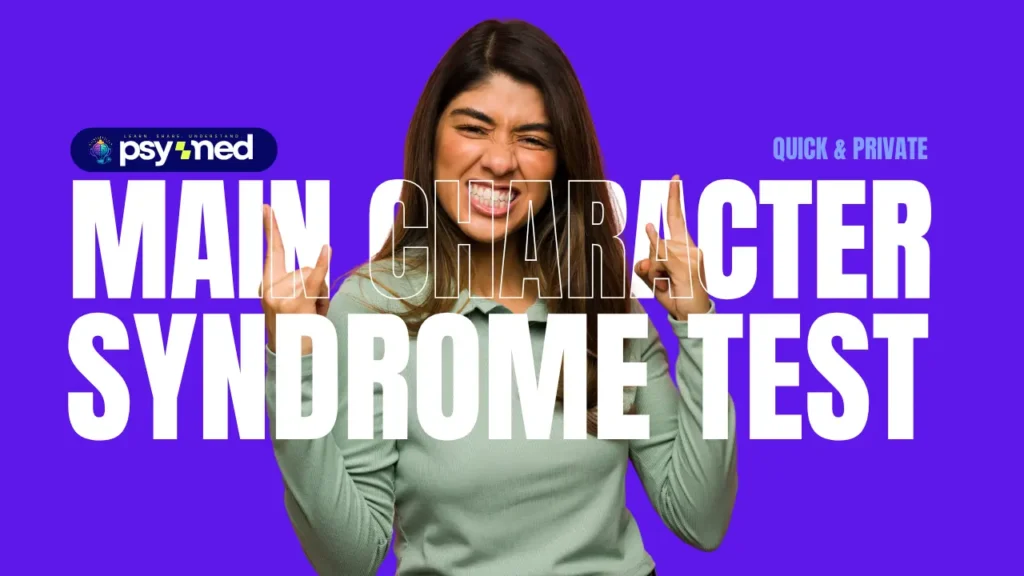
Main Character Syndrome Test: Are You the Protagonist?
Take the free Main Character Syndrome test to see if you have "main character energy" or tip into self-absorption - and where empathy draws the line.
Published Updated
This free Main Character Syndrome test helps you see where you land on a very modern spectrum: from healthy “main character energy” to full-blown main character syndrome. The term comes from social media, and it describes a mindset where you see yourself as the protagonist of your life story — which is completely normal in small doses, and starts to cause problems when everyone else becomes a background character in your movie. This quiz gives you an instant, private read on where you fall.
Quick reassurance before you start: main character syndrome is not a clinical diagnosis or a disorder — it’s a pop-psychology description of a self-focused mindset that everyone has to some degree. A bit of it is genuinely healthy (confidence, chasing your goals, setting boundaries). The question this quiz really answers isn’t “are you self-focused?” but “does your self-focus still leave room for other people to matter?” That line — empathy — is what separates main character energy from main character syndrome.
What Is Main Character Syndrome?
Main character syndrome is a popular, social-media-born term for a mindset in which a person frames their life as a story with themselves as the protagonist — and everyone else as supporting characters, sidekicks, or background extras. It isn’t a medical diagnosis or a recognized disorder; it’s a pop-culture way of describing a pattern of self-centered thinking and behavior that exists on a spectrum, from mild and harmless to genuinely self-absorbed.
Here’s the key to understanding it: everyone is, naturally, the protagonist of their own life — that’s healthy. Main character syndrome is what happens when that normal self-focus tips over into a worldview where other people stop feeling fully real or important, existing mainly to play roles in your narrative. The dividing line is empathy and reciprocity: healthy self-focus leaves room for others to be the main characters of their own lives, with their own stories that matter just as much as yours. Main character syndrome quietly erases that — and because it’s often performed and attention-seeking (dramatizing your life, needing to be the center), it can strain relationships even when you don’t mean it to.
Main Character Energy vs. Main Character Syndrome
The same self-focus can be a strength or a problem — what decides which is whether empathy stays switched on. It’s worth knowing the difference, because the goal isn’t to stop valuing yourself; it’s to keep valuing others too.
- Healthy “main character energy” is confident, purposeful, and self-respecting: you prioritize your goals, set boundaries, advocate for yourself, and move through life with agency and intention — while staying genuinely interested in other people and letting them matter. It’s grounded in reality and it lifts you up without pushing others down.
- Main character syndrome is what happens when that tips too far: you expect life to revolve around you, see others as supporting cast, dominate conversations, struggle to empathize with others’ struggles, and need constant attention or validation.
The simplest test is reciprocity — in a healthy version, you’re curious about other people’s “stories”; in the unhealthy version, you’re mostly interested in your own. If your self-focus consistently costs the people around you, it’s drifted from energy into syndrome.
Signs of Main Character Syndrome
Main character syndrome shows up as a recognizable set of self-focused patterns — and the more consistently they appear (and the less room they leave for others), the further along the spectrum you likely are. As you read, notice which feel true. And remember: recognizing these in yourself, and feeling a little uncomfortable about them, is actually a good sign — it means your empathy is intact.
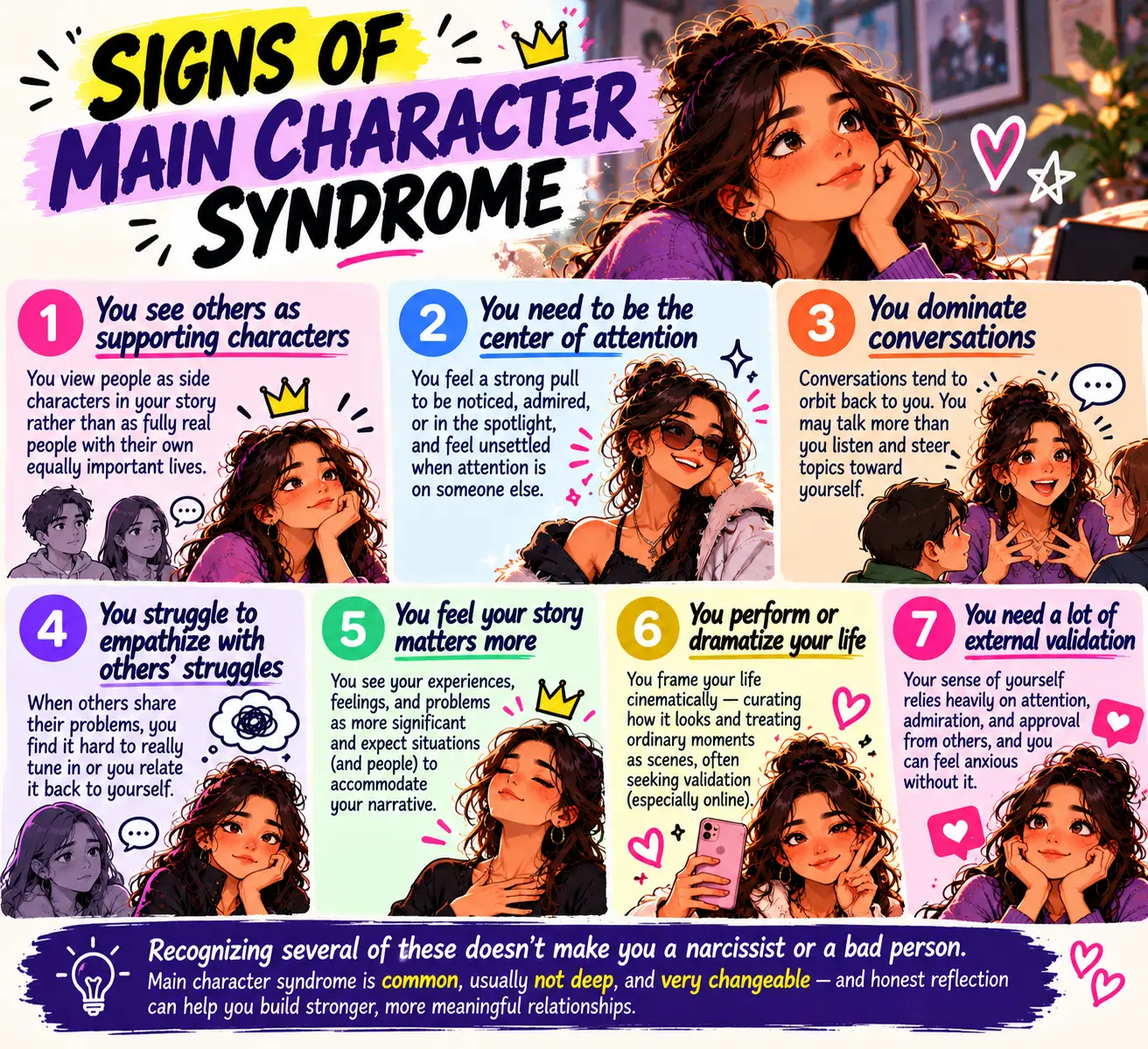
You see others as supporting characters
You tend to experience other people as side characters in your story rather than the protagonists of their own — present mainly in relation to you and your narrative, rather than as fully real people with equally important lives. (The flipside of this mindset is the NPC test — which asks whether you ever feel like a background character in your own life.)
You need to be the center of attention
You feel a strong pull to be noticed, admired, or in the spotlight, and you can feel overlooked or unsettled when attention is on someone else. Being the center is where you feel most comfortable.
You dominate conversations
Conversations tend to orbit back to you — your experiences, your opinions, your stories. You may talk more than you listen, and find yourself steering topics toward yourself without quite meaning to.
You struggle to empathize with others’ struggles
When other people share their problems, you find it hard to really tune in — your attention drifts, or you relate it back to yourself. Others’ difficulties don’t land with the same weight as your own. This empathy gap is the core sign that self-focus has tipped into syndrome.
You feel your story matters more
Deep down, you feel your experiences, feelings, and problems are more significant or interesting than other people’s, and you expect situations (and people) to accommodate you and your narrative.
You perform or dramatize your life
You frame your life cinematically — curating how it looks, narrating it, treating ordinary moments as scenes — and you may seek validation (often online) for the “story” you’re telling about yourself.
You need a lot of external validation
Your sense of yourself leans heavily on attention, admiration, and approval from others, and you can feel deflated or anxious without it. Sometimes this coexists with underlying low self-esteem.
Recognizing several of these doesn’t make you a narcissist or a bad person — main character syndrome is common, usually not deep, and very changeable. But it’s worth honest reflection, because the cost it quietly carries is to the relationships and connection that actually make a life rich.
Is It Main Character Syndrome or Narcissism?
They overlap, but they’re not the same thing — and the difference genuinely matters. Main character syndrome involves some of the same self-centered, attention-seeking traits as narcissism, but it’s a social behavior pattern rather than a clinical condition, and it lacks the deeper, more harmful features of Narcissistic Personality Disorder (NPD).
Three differences stand out.
- Flexibility: main character syndrome is something you can turn up or down depending on context, and it often shows up in certain life phases rather than constantly — NPD is a persistent, inflexible pattern.
- Depth: NPD involves exploiting relationships and a deep inability to recognize others’ needs; main character syndrome is usually more “staying wrapped up in your own inner circle” than deliberately using people.
- Self-awareness: perhaps the biggest tell — people with main character syndrome often feel guilty or uncomfortable about their self-focus and want to change, whereas that insight is typically absent in NPD. So if reading this makes you wince a little in recognition, that discomfort is actually reassuring.
If you’re concerned the pattern runs deeper — persistent, rigid, with little empathy or remorse — our Narcissism Test looks at that, and our Dark Triad Test covers the broader cluster of “dark” traits.
How This Main Character Syndrome Test Works
This test has 15 statements about how you relate to yourself, other people, and attention. For each, choose how much you agree, answering honestly about how you generally are rather than how you’d like to come across:
- Strongly Disagree = 0
- Disagree = 1
- Neutral = 2
- Agree = 3
- Strongly Agree = 4
Your answers add up to a score from 0 to 60, where a higher score reflects stronger main character syndrome traits. Remember that some self-focus is healthy — this quiz is about noticing when it tips into leaving no room for others. Be honest; a real picture is the only kind you can actually learn from. Your result is private.
Understanding Your Results
Your score places you on the main-character spectrum — but read every level as a description of a mindset you can shift, not a label on your character. Some self-focus is healthy; the question is how much room it leaves for other people.
| Score | Level | What It Suggests |
|---|---|---|
| 46 – 60 | Strong Main Character Syndrome | Strong self-focus that likely leaves little room for others and may be costing your relationships. |
| 31 – 45 | Notable Main Character Syndrome | A clear main-character streak worth balancing with more empathy and curiosity about others. |
| 16 – 30 | Main Character Energy | Healthy, confident self-focus that still leaves room for others — a good place to be. |
| 0 – 15 | Grounded | Very other-aware and humble — though make sure you let yourself be a main character too. |
How to Balance Self-Focus and Empathy
If you’d like to soften main character syndrome, the aim isn’t to stop valuing yourself — it’s to let other people back into the story, and that comes from small, repeatable habits more than big resolutions. A few things help.
-
Practice active listening
In conversations, focus fully on the other person, ask follow-up questions about their experience, and consciously resist the urge to redirect everything back to you.
-
Treat others as protagonists
Remind yourself that everyone you meet is the main character of a life as full and important as your own — and get genuinely curious about their “story.”
-
Build real empathy
When someone shares a struggle, pause and sit with their feelings before relating it to yourself; this is a skill that strengthens with practice, and our Empathy Test gives you a baseline to work from.
-
Notice the validation loop
If you rely heavily on attention and approval (especially online) to feel okay, that’s worth gently examining — self-worth that comes from within is steadier, and sometimes low self-esteem hides underneath main-character behavior.
-
Keep the healthy parts
Stay confident, keep chasing your goals, keep setting boundaries — just pair them with real interest in others. If you find your self-worth feels shaky underneath it all, our Self-Esteem Test may offer useful insight.
Frequently Asked Questions
Is main character syndrome a real mental illness?
No. Main character syndrome is not a clinical diagnosis or a recognized mental health condition — it’s a pop-psychology and social-media term used to describe a self-centered mindset where someone sees themselves as the protagonist of their life and others as supporting characters. It exists on a spectrum, and most people have a bit of it. While it overlaps with subclinical narcissistic traits, and in extreme cases can resemble narcissistic personality disorder, the term itself describes a behavioral pattern rather than an illness.
That’s actually good news: because it’s not a fixed disorder, main character syndrome is very changeable with self-awareness and practice. If you’re concerned the pattern is deeper, persistent, and causing real harm, that’s worth exploring with a mental health professional.
Is having “main character energy” a bad thing?
Not at all — in its healthy form, main character energy is genuinely good for you. It means approaching your life with confidence, agency, and intention: prioritizing your goals, setting boundaries, advocating for yourself, and taking up space you deserve. The key is that healthy main character energy leaves room for other people — you can be the confident protagonist of your own life while still recognizing that everyone else is the protagonist of theirs, and staying genuinely interested in their experiences.
It only becomes a problem (tipping into “main character syndrome”) when self-focus crowds out empathy, so that others stop feeling real or important and exist mainly to support your story. So embrace the confident, purposeful part — just keep your empathy switched on alongside it.
What’s the difference between main character syndrome and narcissism?
They overlap but differ in depth, stability, and self-awareness. Main character syndrome shares narcissism’s self-centeredness and attention-seeking, but it’s a social behavior pattern rather than a clinical condition, and it lacks narcissistic personality disorder’s deeper features — the exploitation of relationships and the profound inability to recognize others’ needs.
Three practical differences: main character syndrome is flexible (you can turn it up or down, and it may come and go with life phases), while NPD is persistent and inflexible; main character syndrome is more about being wrapped up in your own world than deliberately using people; and crucially, people with main character syndrome often feel guilty about their self-focus and want to change, whereas that self-awareness is typically missing in NPD. In short, main character syndrome is lighter and more changeable — but if the traits are deep, rigid, and harmful, that points more toward clinical narcissism, which a professional can assess.
Does social media cause main character syndrome?
Social media didn’t invent self-centeredness, but it does seem to encourage and reward main-character behavior. Platforms are built around presenting a curated version of your life as a continuous story, performing for an audience, and seeking validation through likes and attention — all of which can amplify the tendency to see yourself as the protagonist and others as your supporting cast or audience. The constant feedback loop of attention and approval can also deepen a reliance on external validation.
That said, social media is a magnifier rather than a sole cause, and plenty of people use it without developing main character syndrome. Being mindful of how much your self-worth depends on online attention, and staying genuinely connected to the real people around you, helps keep the healthy “main character energy” from tipping into something more self-absorbed.
Related Tests
- Narcissism Test — if you’re concerned the pattern runs deeper than a pop-culture trait
- Dark Triad Test — narcissism, Machiavellianism, and psychopathy traits together
- Self-Esteem Test — self-focus and need for validation sometimes mask low self-worth
- Emotional Intelligence (EQ) Test — empathy is the skill that keeps self-focus healthy
- Histrionic Personality Disorder Test — for a clinical pattern of attention-seeking
- Covert Narcissist Test — a quieter, more vulnerable form of narcissistic traits
- NPC Test — the exact opposite question: do you feel like a background character in your own life?
- Empathy Test — measures the one capacity that keeps self-focus from tipping into self-absorption
References
- Psych Central. Main Character Syndrome: Is It Real? [Definition, signs, and the empathy distinction] psychcentral.com
- Cleveland Clinic. What Is Main Character Syndrome? [Pop-culture term; relationship to NPD; stability difference] clevelandclinic.org
- American Psychological Association. Narcissism. APA Dictionary of Psychology. [The clinical trait main character syndrome overlaps with] dictionary.apa.org
- Charlie Health. What Is Main Character Syndrome? Signs and psychology. charliehealth.com
Related Tests
See All Quiz →
You may also like
See All Quiz →