
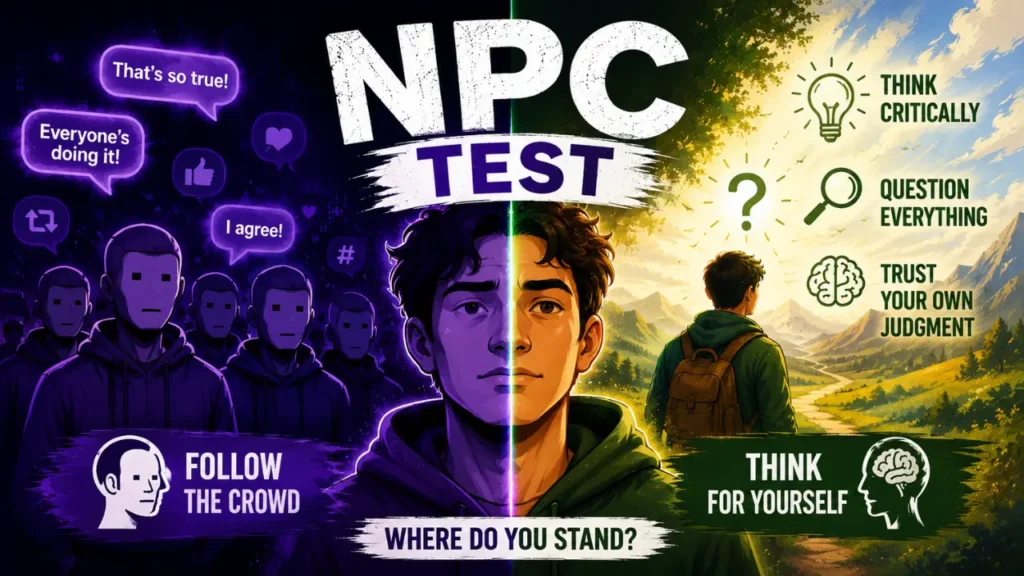
Free 15-Item NPC Test — Are You a Non-Playable Character?
Are you an independent thinker or do you follow the script? Take the free 7-Item NPC Test —inspired by the viral trend and grounded in conformity psychology.
Published Updated
In video games, NPCs — Non-Playable Characters — follow a predetermined script. They say the same lines, make the same decisions, and react the same way every time, regardless of what is actually happening around them. They are not bad characters. They are just not in control of their own story.
The internet borrowed this concept and applied it to real life: the “NPC” became shorthand for someone who seems to move through the world on autopilot — following whatever trend is current, echoing whatever opinion is loudest, and defaulting to the crowd’s choices without much independent reflection. The concept went viral on TikTok in 2023 and has remained a genuinely interesting lens for examining your own patterns of thinking and decision-making.
This free NPC Test explores the spectrum between the classic NPC (the default, scripted, crowd-following personality) and the independent thinker (the person who questions trends, forms their own opinions, and makes choices based on internal rather than external direction). Neither end of the spectrum is entirely good or bad — as you will see. 7 questions. Find out where you land.
What Is an NPC? The Psychology Behind the Meme
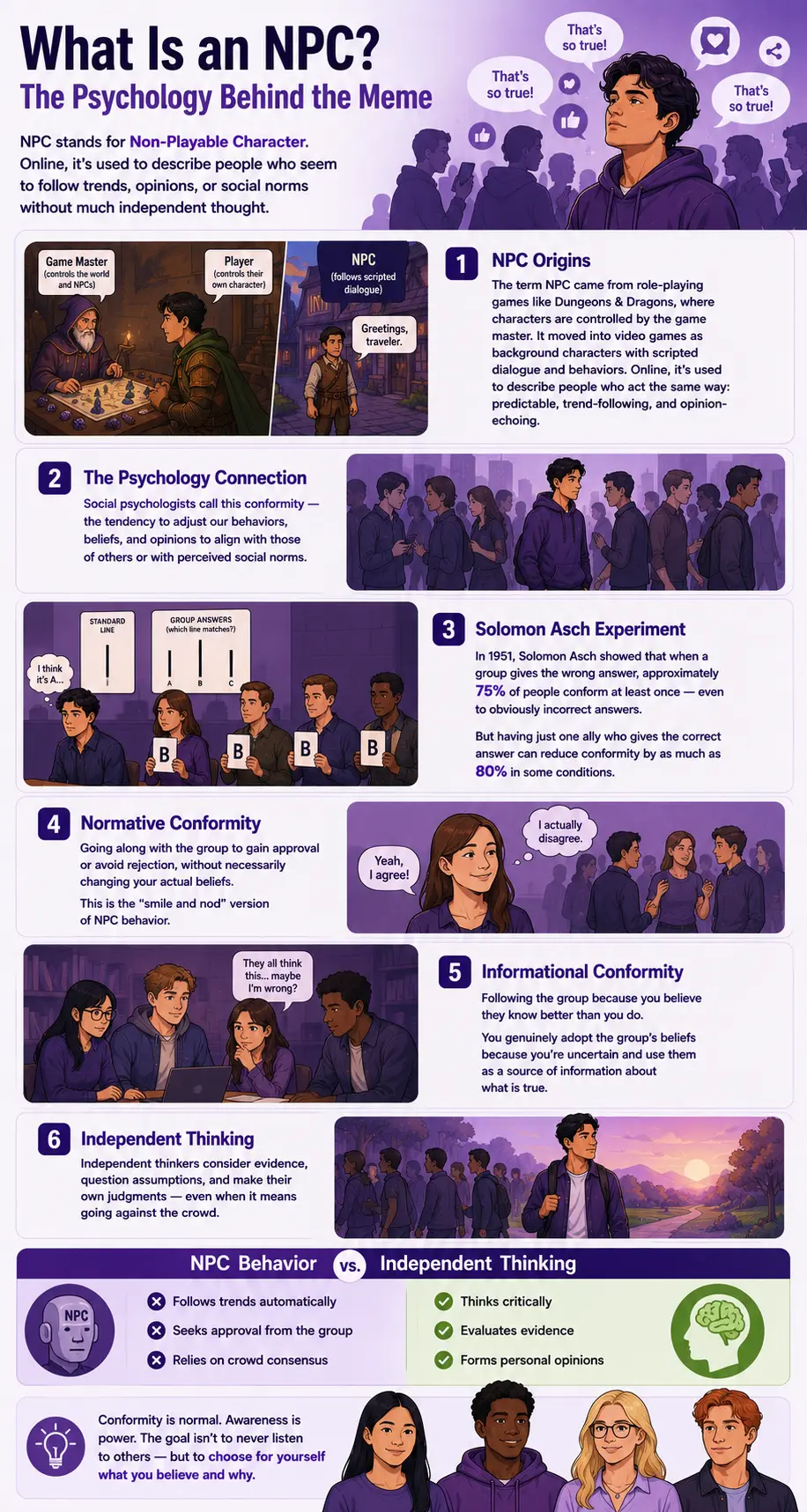
The term NPC (Non-Playable Character) originated in tabletop role-playing games like Dungeons & Dragons, where it referred to characters controlled by the game master rather than the players. It migrated into video game vocabulary — where NPCs are background characters with scripted dialogue and predetermined behaviors — and then into internet culture, where it became a way of describing people who exhibit the behavioral equivalent of a scripted character: predictable, trend-following, opinion-echoing, and seemingly lacking in independent thought. The internet produced a mirror-image term for the opposite posture — main character syndrome, where a person casts themselves as the protagonist and treats everyone else as the background characters. The two memes describe opposite ends of the same question: how much of your life feels authored by you.
The concept, whatever you think of its cultural politics, maps onto something that social psychologists have been studying rigorously for over 70 years: conformity — the tendency to adjust one’s behavior, beliefs, and opinions to align with those of others or with perceived social norms.
The foundational research on conformity was conducted by Solomon Asch in 1951 — his famous line experiments demonstrated that a significant proportion of people will give obviously incorrect answers to simple questions in order to conform to a group that is unanimously wrong. In Asch’s experiments, approximately 75% of participants conformed to the incorrect group answer at least once.
Having even a single ally who gave the correct answer reduced conformity dramatically — by as much as 80% in some conditions (Asch, 1951; Simply Psychology, 2025). This finding has direct relevance to the NPC concept: the scripted, crowd-following behavior the meme describes is not a personal failing — it is a documented feature of human social psychology operating in the absence of social support for independent judgment.
More recent research on social influence identifies two distinct mechanisms of conformity (Kelman, 1958; Wikipedia — Social Influence):
Normative conformity — going along with the group to gain approval or avoid rejection, without necessarily changing your actual beliefs. This is the “smile and nod” version of NPC behavior: the external compliance that doesn’t reflect internal agreement.
Informational conformity — genuinely adopting the group’s beliefs because you are uncertain and use the group as a source of information about what is true. This is the more complete NPC pattern: actually updating your views based on crowd consensus rather than independent evaluation.
Both mechanisms are normal human behaviors. The question the NPC Test explores is where your default setting tends to sit — toward automatic conformity, balanced adaptation, or genuine independent thinking.
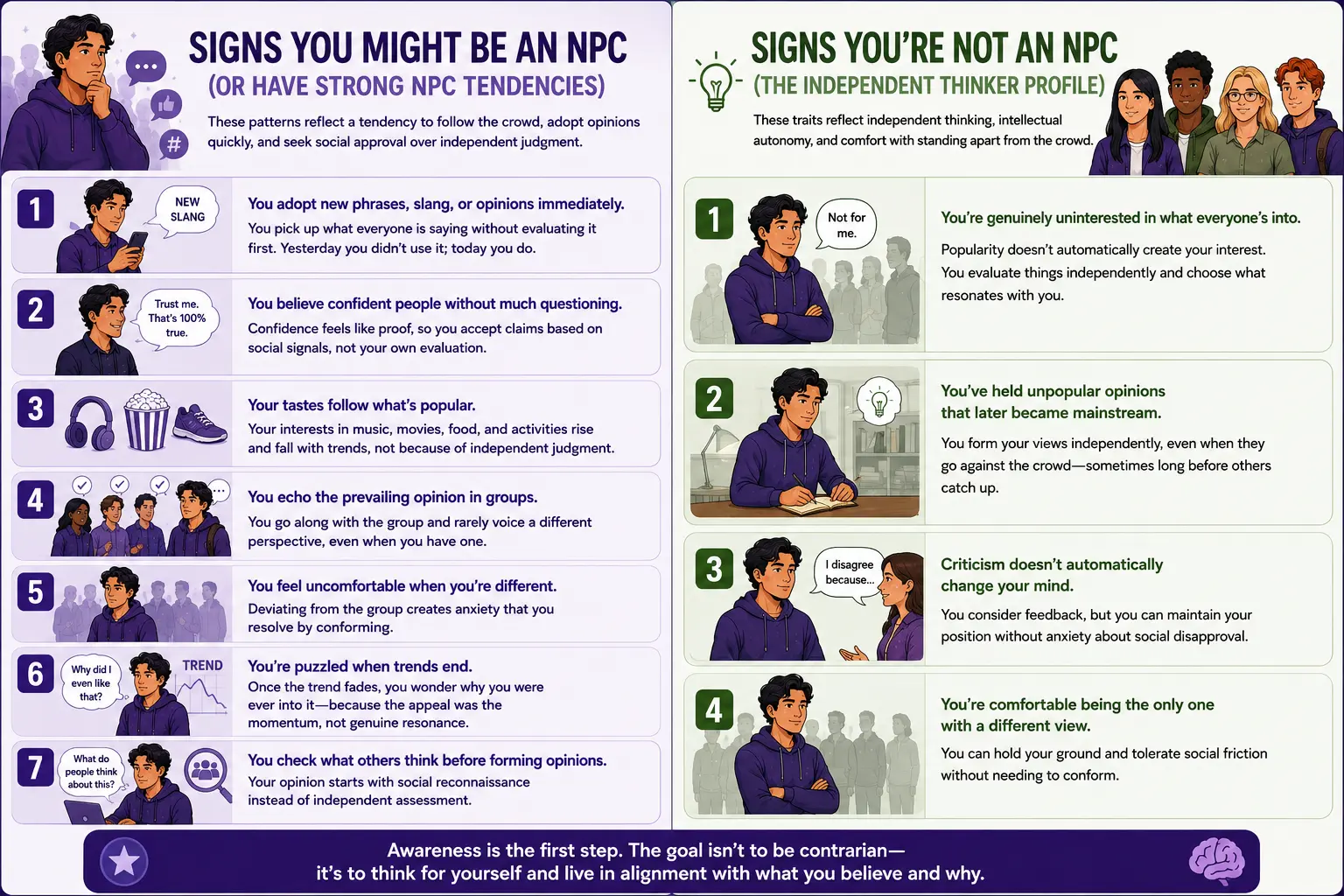
Signs You Might Be an NPC (Or Have Strong NPC Tendencies)
The following are behavioral patterns that — in the spirit of the original internet concept and grounded in conformity psychology — characterize the NPC end of the spectrum. None of these are pathological. They are simply patterns worth being aware of.
You adopt new phrases, slang, or opinions almost immediately after seeing them spread. Not because you’ve examined them and found them useful, but because they’re simply what everyone is saying now. The adoption happens reflexively, before evaluation. Yesterday, you didn’t use the phrase; today, it’s in your regular rotation. This mirrors what social influence researchers call a norm cascade — the rapid adoption of behaviors once a critical threshold of group adoption is reached.
When someone tells you something confidently, you tend to believe it without much questioning. The confidence of the speaker functions as evidence of the claim’s accuracy. You update your views based on social signal (this person seems sure) rather than epistemic evaluation (is this actually true?). This is informational conformity at work — using the group as a source of information in the absence of your own confident assessment.
Your taste in music, films, food, and activities tracks closely with what is currently popular. Not because you independently found these things appealing, but because the cultural momentum around them is what brought them to your attention and created the association with enjoyment. When something stops being popular, your interest fades — even if nothing about the thing itself has changed.
In group conversations, you tend to echo or amplify the prevailing opinion rather than introduce a different perspective. Even when you have a different perspective, the social cost of expressing it feels higher than the benefit. Going along feels easier, safer, and more comfortable. This is exactly the dynamic Asch’s experiments documented: the power of unanimous group opinion to suppress individual dissent even when the individual knows the group is wrong.
You feel distinctly uncomfortable when your views or choices deviate from the people around you. Not just the mild discomfort of being different, but a specific social anxiety that gets resolved by updating your position toward the group. The discomfort is the social conformity pressure doing its job — and the NPC pattern is consistently resolving that pressure by conforming rather than tolerating the discomfort.
When trends end, you look back at your participation in them with puzzlement — unsure why they appealed to you. The trend’s appeal was largely social momentum rather than genuine personal resonance. Without the momentum, there’s nothing there. This retrospective puzzlement is a reliable indicator of normative rather than intrinsic motivation.
You rarely form a strong opinion on something before checking what others think first. Your opinion-formation process begins with social reconnaissance — what are people saying? — rather than independent assessment. The group’s consensus shapes your position before you’ve had a chance to form one independently.
Signs You’re NOT an NPC (The Independent Thinker Profile)
You find yourself genuinely uninterested in things that “everyone” is talking about — not as a pose, but as a genuine response. The social momentum around something doesn’t automatically generate your interest. You notice what is popular and make a separate, independent assessment of whether it resonates with you.
You’ve held unpopular opinions that later became mainstream — and you held them before they were mainstream. Your opinion formation isn’t downstream of the crowd’s. You arrive at positions through independent evaluation and sometimes find, later, that the consensus catches up.
Criticism of your choices and opinions doesn’t automatically update your position. You can hear criticism, consider it, and decide it doesn’t change your view — without significant anxiety about the social cost of maintaining your position. This is what psychologists call resistance to social influence — the ability to maintain independent judgment despite external pressure to conform (Early Years Psychology, 2025).
You are comfortable being the only person in a group who holds a particular view. Not performatively contrarian — genuinely comfortable with the social friction of being different. Asch’s research found that this capacity — to maintain an independent position in the face of unanimous disagreement — was significantly rarer than most people assume. You are in the minority.
The NPC vs Independent Thinker — It’s a Spectrum, Not a Binary
| Feature | The NPC | The Balanced Adapter | The Independent Thinker |
|---|---|---|---|
| Opinion formation | Follows the crowd; adopts the prevailing consensus automatically | Considers others’ views and forms own position; influenced but not determined by group | Forms positions independently; the group’s consensus is data, not direction |
| Trend adoption | Immediate and reflexive; follows what’s popular without evaluation | Selective; evaluates trends before adopting; combines personal taste with current culture | Evaluated independently; trend popularity is irrelevant to personal adoption |
| Response to group pressure | High conformity; changes position to match the group even when privately disagreeing | Context-dependent; conforms in low-stakes situations, holds ground on important values | Low conformity; maintains position under group pressure; comfortable with social friction |
| Social comfort | Highest when fitting in; discomfort drives conformity behavior | Enjoys both belonging and individuality; navigates social contexts fluidly | Comfortable being different; tolerates the social cost of an independent position |
| Strengths | Socially smooth; group-compatible; easy to get along with; low social friction | Adaptable and authentic; connects socially while maintaining genuine individuality | Original: holds values under pressure; immune to manipulation through social proof |
| Watch-outs | Susceptible to manipulation; easy to mislead through crowd consensus; authentic identity may be underdeveloped | May face tension between social belonging and authentic self-expression in high-pressure contexts | Risk of unnecessary contrarianism; social friction can be costly; independent thinking can tip into isolation |
| Psychology framework | High normative + informational conformity (Asch 1951; Kelman 1958) | Selective conformity; context-sensitive social influence response | High resistance to social influence; strong internal locus of evaluation |
The NPC Test — How It Works
This NPC Test consists of 7 questions covering the core dimensions of the NPC concept: trend adoption, opinion formation under social pressure, response to group consensus, decision-making style, and comfort with independence. Each question has three answer options — choose the one that honestly describes how you typically think and behave, not how you wish you did.
Scoring:
- Option A = 3 points (most NPC-aligned — conformist, crowd-following)
- Option B = 2 points (balanced — adaptive, context-dependent)
- Option C = 1 point (most independent — internally directed, trend-resistant)
Total range: 7–21. Higher scores indicate stronger NPC tendencies. Lower scores indicate stronger independent thinking. Three result profiles below.
Understanding Your NPC Test Score
| Score Range | Profile | What It Suggests |
|---|---|---|
| 7 – 11 | Not an NPC — The Independent Thinker | You tend toward independent thinking, form your own opinions before consulting the crowd, and are comfortable with positions that differ from the group. Low conformity profile. |
| 12 – 16 | NPC Tendencies — The Balanced Adapter | A balanced profile — you adapt to social context while maintaining genuine personal preferences. Some conformity tendencies alongside authentic independent choices. |
| 17 – 21 | Might Be an NPC — The Social Script Follower | Strong NPC tendencies — you tend to follow trends, adopt group opinions, and default to social consensus over independent evaluation. You’re running on the social script. |
The Psychology Behind the NPC — Why We Conform
The NPC pattern is not a personality defect. It is the output of social psychological mechanisms that evolved for good reasons and serve important functions. Understanding why conformity happens is more useful than judging whether it makes someone an NPC.
Conformity is efficient. Independently evaluating every claim, trend, and social norm from scratch is cognitively expensive. Using social consensus as a shortcut — “if most people believe X, X is probably worth considering” — is a reasonable heuristic in most low-stakes situations. The problem arises when this heuristic is applied indiscriminately to high-stakes situations where independent evaluation matters.
Conformity is socially rewarding. Group belonging is a fundamental human need. Fitting in — sharing tastes, opinions, and behaviors with a group — produces genuine psychological rewards. The discomfort of non-conformity is not imaginary. The social exclusion warning system is activating and doing its job. The question is whether the benefits of social belonging in a given situation outweigh the costs of compromising independent judgment.
Conformity is more common than most people think. In Asch’s (1951) line experiments, 75% of participants conformed to an obviously incorrect answer at least once. Most people believe they would be in the non-conforming 25% — but most of those people also conformed. The NPC pattern is normal, not exceptional. Recognizing it in yourself is the beginning of having a choice about it.
Independent thinking has psychological prerequisites. Research on resistance to social influence (Early Years Psychology, 2025) identifies key factors that enable independent thinking: a stable sense of personal agency, the capacity to tolerate social discomfort without resolving it through conformity, and specific critical-thinking skills that allow you to distinguish your own evaluation from the group’s. These are learnable — they are not fixed traits.
How to Think More Independently — What Actually Works
Form your opinion before you look up what others think. On anything that matters to you — a film, a political question, a new product, a trend — form an initial, provisional assessment before consulting reviews, social media, or friends’ opinions. You don’t have to stick with it. But having one gives you something to compare rather than an empty vessel for whoever’s opinion you encounter first.
Notice the difference between enjoying something and enjoying that others enjoy it. These are different experiences that can feel identical. The film you love because it resonated with you is different from the film you love because everyone is talking about it. Paying attention to this distinction over time is one of the most useful exercises for NPC awareness.
Practice the single-dissenter position. Asch’s research found that a single ally dramatically reduced conformity. You can be that ally for yourself: in group discussions, practice being the person who articulates the alternative position — not to be contrarian, but to ensure space for independent thought exists.
Distinguish between informational and normative conformity in your own decisions. When you update a view based on someone else, ask: am I updating because they gave me new information or a better argument (informational — usually fine), or am I updating because of the social pressure their confidence created (normative — worth examining)?
Frequently Asked Questions
What does NPC mean?
NPC stands for Non-Playable Character — a term from video games describing characters controlled by the computer rather than by a human player. NPCs follow scripted, predetermined behaviors. The term was adopted by internet culture, particularly on TikTok in 2023, to describe people who appear to follow social scripts without independent thought — moving through life on autopilot, adopting trends reflexively, and echoing group opinions without forming their own. The concept maps onto well-established research in social psychology on conformity and social influence, making it genuinely interesting beyond its meme origins.
Is being an NPC bad?
Not inherently. The NPC profile — high social sensitivity, strong group adaptation, easy conformity — produces real social advantages: you are easy to get along with, socially smooth, and comfortable in group settings. The downsides are specific: you are more susceptible to manipulation through social proof, more likely to adopt positions and behaviors that don’t reflect your genuine values, and more vulnerable to norm cascades. Whether this is a problem depends entirely on the contexts you navigate and the stakes involved. In low-stakes social situations, NPC behavior is practically adaptive. In high-stakes evaluative situations — political decisions, financial choices, identity formation — the NPC default is worth interrogating.
What is the psychology behind the NPC concept?
The NPC concept maps onto the psychology of social conformity — one of the most heavily researched areas of social psychology. Solomon Asch’s conformity experiments (1951) demonstrated that a majority of people will conform to an obviously incorrect group answer rather than trust their own perception. Kelman (1958) identified two conformity mechanisms: normative conformity (going along outwardly to fit in) and informational conformity (genuinely adopting the group’s beliefs when uncertain). Both mechanisms produce NPC-like behavior. More recent research on resistance to social influence identifies the psychological factors — stable personal agency, tolerance of social discomfort, critical thinking skills — that enable independent thinking (Early Years Psychology, 2025).
Can I become less of an NPC?
Yes. Resistance to social influence is a learnable skill, not a fixed trait. The most effective interventions are behavioral: forming your opinion before consulting others’, practicing articulating minority positions in group discussions, and deliberately distinguishing between genuine resonance and social momentum in your choices. The Asch research found that having even one social ally supporting an independent position reduced conformity dramatically — building or finding communities where independent thinking is normalized and valued is one of the most effective environmental interventions.
Is this a real psychological test?
This is a fun personality quiz grounded in real conformity psychology — not a clinical diagnostic instrument. It is not measuring a diagnosable condition and does not replace professional assessment. What it does is provide a useful, evidence-grounded framework for reflecting on your own patterns of social conformity and independent thinking. The concepts it draws on — Asch’s conformity research, Kelman’s social influence framework, the psychology of independent thinking — are well-established and empirically supported.
Where did the NPC trend come from?
The term NPC has its roots in tabletop role-playing games like Dungeons & Dragons in the 1990s, where it described characters controlled by the game master. It migrated into video game vocabulary and then into internet culture. The political NPC meme emerged around 2016–2018 as a way to describe people who appeared to repeat talking points without independent thought — first aimed at one side of the political spectrum, then rapidly adopted across it.
The trend escalated on TikTok in 2023, when content creators began performing NPC-like behavior in live streams (repeating scripted phrases in response to viewer donations), which paradoxically turned the NPC into both a critique and a performance genre. The real-life NPC concept also circulated — a more extreme interpretation suggesting some people literally lack internal monologue or consciousness. This fringe idea is not scientifically supported; what the concept does usefully describe is the conformity patterns documented in social psychology research for decades.
What is the difference between conformity and being open-minded?
This is one of the most important distinctions to make when thinking about NPC vs independent thinker profiles. Being open-minded means being willing to update your views in light of new information, compelling arguments, and evidence that challenges your current position. Conformity means updating your views based on social pressure, group consensus, and the discomfort of dissenting — regardless of whether any new information or argument has actually been presented. The independent thinker can be highly open-minded — updating constantly based on evidence — while maintaining low conformity. The NPC can appear open-minded while actually just being compliant. The test is the mechanism of update: evidence or social pressure?
Related Tests
- Imposter Syndrome Test — both imposter syndrome and NPC patterns involve heavy reliance on external validation; worth exploring if the NPC profile resonated
- Anxiety Test — social conformity is frequently anxiety-driven; the discomfort of not fitting in is an anxiety signal that the NPC pattern relieves
- Dark Triad Test — the opposite end of the conformity spectrum; high Dark Triad individuals tend to be the ones driving norms rather than following them
- Social Anxiety Test — social anxiety and NPC tendencies are structurally related; both involve prioritizing social acceptance over authentic self-expression
- Alexithymia Test — difficulty identifying your own emotions can contribute to external orientation; when you can’t tell what you feel, others’ feelings fill the gap
- Avoidant Personality Disorder Test — AVPD and NPC patterns overlap; fear of rejection drives conformity in AVPD presentations
- Borderline Personality Disorder Test — identity instability in BPD can produce NPC-like behavior as the person mirrors others’ personalities and opinions
- Main Character Syndrome Test — the exact inverse of this test: instead of feeling like a background character, seeing everyone else as one
References
- Asch, S.E. (1951). Effects of group pressure upon the modification and distortion of judgments. In H. Guetzkow (ed.), Groups, Leadership and Men (pp. 177–190). Carnegie Press. [Conformity experiments; 75% conformed at least once; single ally reduces conformity ~80%]
- Kelman, H.C. (1958). Compliance, identification, and internalization: Three processes of attitude change. Journal of Conflict Resolution, 2(1), 51–60. [Normative vs informational conformity framework]
- McLeod, S.A. (2025). Asch Conformity Line Experiment. Simply Psychology. simplypsychology.org
- Cherry, K. (2024). What Is Conformity? Definition, Types, Psychology Research. Simply Psychology. simplypsychology.org
- Early Years Psychology. (2025). Resistance to Social Influence: The Psychology of Independent Thinking. earlyyears.tv
- Know Your Meme. (2025). NPC / Non-Playable Character. knowyourmeme.com
- Wikipedia. (2025). Social influence. en.wikipedia.org
- Wikipedia. (2025). Non-player character. en.wikipedia.org
Related Tests
See All Quiz →
Emotional and Trait Assessments
Are You a Psychopath? Take This Free Psychopath Test (PCL-R Based)
→
You may also like
See All Quiz →