
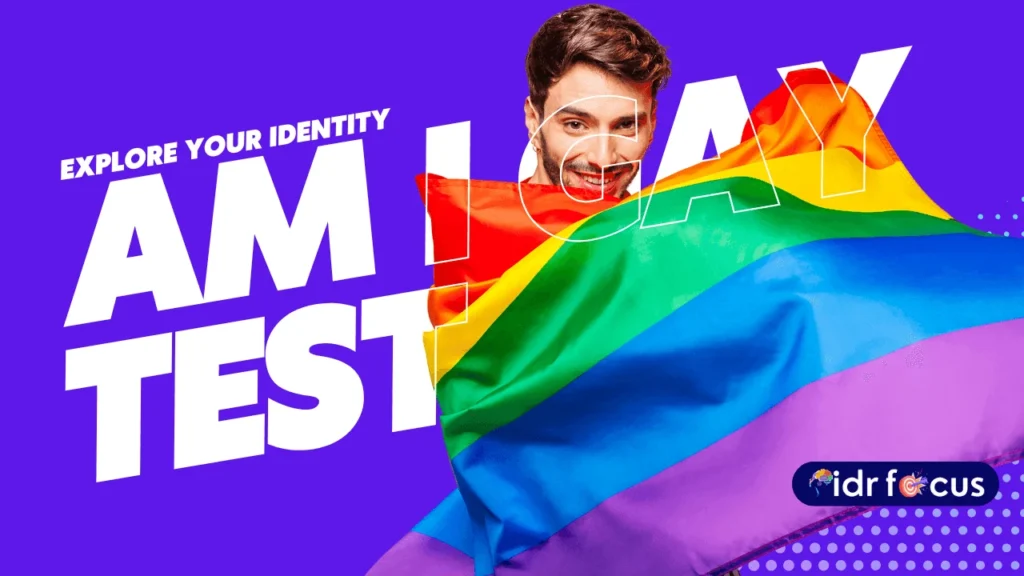
Gay Test: Am I Gay? Free 10-Question Sexual Orientation Quiz
Questioning your sexuality? This free gay test helps you explore your sexual orientation honestly. No judgment. 10 questions. Instant results.
Published Updated
Questioning is one of the most honest things a person can do. Whether you’ve been carrying a quiet curiosity for years or something recently made you stop and think, the question of sexual orientation deserves to be taken seriously and answered honestly. Not dismissed. Not rushed. Not judged.
This free gay test is a private, judgment-free space to explore your patterns of attraction. It won’t give you a label you have to keep. It won’t tell you who you are. What it will do is give you a starting point — a structured way to reflect on feelings that can be hard to put into words when you’re in the middle of them.
10 questions. Answer as honestly as you can. Results are instant and completely private — nothing is stored or shared. If you’d like a plain-language map of the terms first, our guide to LGBTQ+ identities explained covers them without jargon.
What Does It Mean to Be Gay?
Gay is a term used to describe people who experience romantic or sexual attraction primarily toward people of the same gender. While historically used most often to refer to men attracted to men, “gay” is now widely used as an umbrella term that includes both men and women, though many women prefer the term “lesbian.” In clinical and research contexts, same-sex attraction is studied within the broader framework of sexual orientation — a person’s enduring pattern of emotional, romantic, and sexual attraction to others.
Sexual orientation is widely understood by mainstream psychology and medicine to be a natural variation of human experience, not a disorder, not a phase, and not a choice. The American Psychological Association, the American Psychiatric Association, and every major health organization in the world affirm this clearly. Being gay is not something that needs to be fixed. It’s something that can be understood, accepted, and lived with authenticity.
The experience of realizing you might be gay — or questioning whether you are — varies enormously from person to person. Some people describe always knowing. Others describe a slow recognition that built over the years. Many describe a specific moment of clarity. And many more describe a long period of uncertainty that didn’t resolve cleanly in either direction. All of these experiences are valid. The process of figuring this out doesn’t have a required timeline.
Sexual Orientation Is a Spectrum
One of the most important things to understand before taking any test like this is that sexual orientation is not binary. You are not required to be either completely heterosexual or completely gay. The reality of human attraction is more nuanced than that — and this has been supported by research for over 75 years. A major scientific review commissioned by the Association for Psychological Science concluded that sexual orientation is best understood as a stable but non-binary trait, shaped by a mix of biological and developmental factors rather than by choice or upbringing (Bailey et al., 2016).
Alfred Kinsey’s landmark research in the 1940s and 1950s was among the first to document this formally. His Kinsey Scale — which runs from 0 (exclusively heterosexual) to 6 (exclusively homosexual) — demonstrated that most people fall somewhere on a continuum rather than at the extremes. Many people experience attraction toward both their own gender and other genders to varying degrees, at different times in their lives.
This means your result on this gay test isn’t a fixed identity you have to commit to. It’s a snapshot of where your patterns of attraction seem to cluster right now. Orientation can be fluid for many people — researchers use the term sexual fluidity for situation-dependent shifts in who someone is drawn to, and it is documented in men and women alike (Diamond, 2016). Whatever you feel is valid, whether it fits neatly into a label or not.
If you want a more detailed picture of where you fall on the full heterosexual-to-homosexual spectrum, the Kinsey Scale Test is worth taking alongside this one.
Am I Gay, Bisexual, or Something Else?
This is one of the most common questions people have when they start questioning, and it’s worth addressing directly. The difference between being gay and being bisexual comes down to the pattern of attraction — not to a single experience, feeling, or encounter.
Gay typically describes attraction that is directed primarily or exclusively toward people of the same gender. A gay man is predominantly or exclusively attracted to men. A gay woman (lesbian) is predominantly or exclusively attracted to women.
Bisexual describes attraction to more than one gender — not necessarily equally, not necessarily at the same time, and not necessarily in the same way. Bisexual people may lean more toward one gender than another, and that balance can shift across different periods of life. Our Bisexual Quiz explores this specifically, if you think this might describe your experience better.
Pansexual describes attraction to people regardless of gender, where gender is not a determining factor in attraction. Our Pansexual Quiz covers this in more depth.
Asexual describes little or no sexual attraction to anyone of any gender, though asexual people can still experience romantic attraction. The Asexuality Spectrum Test is worth exploring if sexual attraction feels largely absent for you, regardless of gender.
Straight (heterosexual) describes attraction directed primarily or exclusively toward people of a different gender. If your answers point that way and you want to examine that pattern on its own terms, the Am I Straight Quiz approaches the same question from the opposite direction.
None of these identities is more real, more valid, or more “enough” than any other. Labels are tools — use the ones that help you understand yourself, and set aside the ones that don’t fit.
Signs You Might Be Gay
There’s no checklist that definitively identifies someone as gay — attraction is internal and subjective, and only you have access to what you genuinely feel. But there are some patterns that people commonly describe when reflecting on early signs of same-sex attraction:
Your fantasies and daydreams involve people of the same gender. Not occasionally, as a curiosity, but consistently — the people you imagine being with romantically or sexually are predominantly or exclusively the same gender as you.
Attractions to people of the opposite gender feel performed or absent. You can appreciate that someone of the opposite gender is objectively attractive, but you don’t feel a personal draw toward them. Opposite-gender relationships may feel comfortable but not electric — like something you do because it’s expected, not because it’s what you want.
You feel a different quality of attention toward people of the same gender. Not just appreciation — a specific kind of noticing. A pull. An awareness that feels different from how you notice people of the opposite gender.
You have had feelings for a specific person of the same gender — not just admiration or friendship, but something that felt like more. Something that felt like what people describe as being attracted to someone.
Conversations about gay relationships or gay people feel personally relevant. Content about queer experiences — films, books, online communities — resonates in a way that feels like recognition rather than just interest.
You’ve found yourself avoiding the question — not because the answer is clearly no, but because the answer might be something you’re not ready to sit with yet.
None of these alone “proves” anything. But together, they form a pattern worth paying attention to, honestly.
How This Gay Test Works
This test uses 10 questions to assess your patterns of romantic and sexual attraction across both same-gender and opposite-gender experiences. The questions are designed to be honest, clear, and non-leading — they don’t push you toward any particular result.
Answer based on what you genuinely feel and have genuinely experienced — not what you think you should feel, not what you wish you felt, not what would make life simpler. The most useful result comes from the most honest answers.
Results are instant and private. Nothing is recorded or stored.
Understanding Your Gay Test Result
This test measures your orientation across seven dimensions — attraction, fantasy, emotional preference, behavior, social preference, self-identification, and ideal future attraction. Your total score reflects the combined pattern across all of them, not any single answer. A score near the lower end reflects consistent opposite-gender attraction; a score near the higher end reflects consistent same-gender attraction; and a score in the middle reflects attraction running in both directions.
| Score Range | Category | What It Suggests |
|---|---|---|
| 10 – 19 | Predominantly Heterosexual | Consistent opposite-gender attraction across most or all dimensions. The pattern is primarily heterosexual. |
| 20 – 28 | Mostly Heterosexual — Some Same-Gender Attraction | Primary attraction is opposite-gender, but meaningful same-gender attraction is present across at least some dimensions. Sometimes described as “mostly straight.” |
| 29 – 37 | Bisexual Range — Attracted to Both Genders | Attraction to both genders appears consistently across multiple dimensions. The pattern is consistent with bisexual, sexually fluid, or pansexual orientation. |
| 38 – 50 | Predominantly Homosexual — Gay / Lesbian | Consistent same-gender attraction across most or all dimensions. The pattern is primarily gay or lesbian. |
What to Do After the Test
A quiz result is a starting point, not an ending point. Whatever you scored, here are some thoughts on what comes next.
If the result confirms what you suspected. That confirmation — even from a quiz — can feel significant. Many people describe a sense of relief when something they’d been quietly carrying finally has a name. Give yourself time to sit with it. You don’t have to do anything with this information immediately. Identity takes time to integrate, and that’s not weakness — it’s honesty.
If the result surprised you. Results that surprise us are sometimes the most useful ones — not because the quiz is always right, but because surprise can reveal what we were hoping for, or what we were afraid of. Both are worth paying attention to. Take the test again if you want. Think about the specific questions that felt uncomfortable to answer. That discomfort often points to something important.
If you’re still uncertain. That’s completely valid. Uncertainty is not a problem to be solved — it’s a stage many people go through for extended periods. Sexual orientation doesn’t always resolve cleanly into a single clear answer, and that’s a normal human experience. The LGBTQ+ Test takes a broader look at orientation and identity if you want more to reflect on.
If you’d like to talk to someone. Speaking with an LGBTQ+-affirming therapist or counselor is one of the most useful things you can do if you’re in a period of questioning. You don’t have to be in crisis to deserve support — the process of figuring out your identity is genuinely significant, and working through it with a professional can make a real difference. The Coming Out Readiness Test is also there when you’re ready to start thinking about that next step.
Your Identity, Your Timeline
There is no correct age to figure this out. There is no correct sequence of experiences that must happen before you’re “allowed” to identify as gay. There is no threshold of certainty you need to reach before your orientation is real.
Some people know when they’re children. Some people come out in their 40s, 50s, or 60s after decades of living otherwise. Some people identify as gay for years before realizing they’re bisexual — or the other way around. Orientation can clarify, shift, and deepen across a lifetime. None of these paths is wrong.
What matters is that you give yourself permission to be honest about what you feel — and to take that honesty seriously, rather than explaining it away. You came here and took this test because something in you was asking a question. That question deserves a real answer, found at your own pace, on your own terms.
Support and Resources
Questioning your sexual orientation is a normal part of self-understanding, not a symptom of anything. The American Psychological Association is explicit that being gay, lesbian, or bisexual is a normal variation of human sexuality and not a mental disorder, and no credible professional body supports attempts to change a person’s orientation.
That said, questioning can be hard — particularly if you are somewhere that is not safe or affirming. If you want to talk to someone, these services are free, confidential, and staffed by people trained for exactly this conversation:
- The Trevor Project — crisis support and counselling for LGBTQ+ young people under 25, 24/7. Call 1-866-488-7386, text START to 678-678, or chat online.
- 988 Suicide & Crisis Lifeline — call or text 988 anywhere in the US, any time, for any kind of emotional crisis. You do not have to be suicidal to call.
- PFLAG — peer support groups for LGBTQ+ people and their families, with chapters across the US. Useful if the hard part is the people around you rather than the question itself.
If you are outside the US, the Trevor Project’s resource pages list international equivalents. And if you are looking for ongoing rather than crisis support, an LGBTQ+-affirming therapist is worth seeking out specifically — affirming practice means a therapist who treats your orientation as information about you, not as the problem to be solved.
Frequently Asked Questions
Am I gay if I sometimes think about people of the same gender?
Not necessarily — though it depends on the nature and pattern of those thoughts. Many people experience occasional same-gender attraction without identifying as gay. The relevant questions are: how consistent is this pattern? How strong is it relative to opposite-gender attraction? Does it feel like genuine attraction rather than just curiosity? Sexual orientation is defined by enduring patterns of attraction over time, not by isolated thoughts or experiences. If same-gender attraction is persistent, meaningful, and emotionally resonant for you, it’s worth exploring — which is why you’re here.
Can a test tell me if I’m gay?
No test can definitively tell you your sexual orientation — including this one. What a test can do is give you a structured framework for reflecting on your own patterns of attraction, and a starting point for a conversation with yourself. Only you have access to what you genuinely feel. Use this result as a mirror, not a verdict.
What if I don’t fit neatly into gay or straight?
Then you’re in the majority of people who take this test, and the majority of people generally. Sexual orientation exists on a spectrum, not a binary. Many people experience attraction in patterns that are fluid, mixed, or that don’t map cleanly onto any single label. Bisexual, pansexual, queer, and sexually fluid are all valid ways of describing experiences that don’t fit at either end of the spectrum. Our Bisexual Quiz and LGBTQ+ Test may give you more to work with.
Is it possible to be gay and not know it?
Yes — and more commonly than many people realize. Many people spend years or decades not recognizing their same-gender attraction as attraction because they lack the framework, language, or safety to identify it. Attractions that have been consistently suppressed, dismissed, or reframed can be genuinely difficult to access honestly. The questioning process itself — the act of asking “am I gay?” — is often the beginning of recognizing something that was already there.
Does being gay mean I have to come out?
No. Coming out is a personal decision that belongs entirely to you — when, to whom, and how. There is no obligation attached to knowing your orientation. Many people live privately with knowledge of their sexuality for years before choosing to share it, and that choice is always valid. If you’re thinking about what coming out might look like, the Coming Out Readiness Test explores this in depth and at a pace you control.
What’s the difference between sexual orientation and gender identity?
Sexual orientation refers to who you’re attracted to. Gender identity refers to your own internal sense of your gender — whether you identify as a man, a woman, non-binary, or another identity. These are separate dimensions of identity that operate independently. A person can be gay and cisgender (identifying with the gender they were assigned at birth), gay and transgender, or any other combination. Our Gender Dysphoria Test is there if gender identity is something you’re also exploring.
How accurate is an online gay test?
No online gay test can diagnose or determine your sexual orientation, and any test claiming to do so is overselling itself. What a well-built test can do is measure the consistency of your attraction patterns across several dimensions and show you where those patterns cluster. That is genuinely useful as a mirror. Its accuracy depends entirely on how honestly you answer — and on the fact that only you can verify the result against what you actually feel. Treat the score as a structured reflection, not a diagnosis.
Am I gay or just curious?
Curiosity and attraction can feel similar from the inside, and telling them apart usually comes down to three things: persistence, specificity, and emotional charge. Curiosity tends to be abstract, occasional, and intellectually interesting — you wonder what something would be like. Attraction tends to be persistent, directed at specific people, and accompanied by a physical or emotional pull you did not choose to generate. If your interest keeps returning, attaches to particular people, and carries feeling rather than just questions, that is usually attraction rather than curiosity. Either way, curiosity is a legitimate reason to explore, and it does not commit you to a label.
Can you be gay and still be attracted to the opposite gender?
Yes. Sexual orientation describes the overall pattern and direction of your attraction, not an absolute rule with no exceptions. Many people who identify as gay report occasional opposite-gender attraction, and that does not invalidate their identity. Orientation is about where your attraction consistently and predominantly points. If attraction to more than one gender is substantial and recurring rather than occasional, bisexual or pansexual may describe your experience more precisely — the Bisexual Quiz and Kinsey Scale Test can help you tell the difference.
At what age do people usually know they are gay?
There is no standard age. Research on sexual orientation development finds enormous variation: many people describe first noticing same-gender attraction around the onset of puberty, others recall it in early childhood, and a substantial number do not recognise it until their twenties, forties, or later — often because they lacked the language, framework, or safety to name it earlier. Coming to the realisation later does not make it less real or less valid. Awareness, self-acceptance, and disclosure are three separate steps, and they can happen years apart.
Related Tests
Sexual orientation and identity exist across a broad spectrum. These tests are the most relevant next steps depending on what you’re exploring:
- Kinsey Scale Test — the full 0–6 heterosexual-to-homosexual spectrum; gives you a more granular picture of where your attraction pattern sits
- LGBTQ+ Test — a broader exploration of sexual orientation and gender identity if you’re not sure where to start
- Bisexual Quiz — if attraction to both genders feels relevant to your experience, this explores that specifically
- Lesbian Test — for women exploring same-sex attraction specifically
- Asexuality Spectrum Test — if sexual attraction feels largely absent for you regardless of gender
- Pansexual Quiz — if gender isn’t a determining factor in your attraction
- Coming Out Readiness Test — when you’re starting to think about what coming out might look like for you
- Gender Dysphoria Test — if gender identity, not just orientation, is something you’re also exploring
- Is My Boyfriend Gay Quiz — if you’re a woman in a relationship with a man and questioning what you’re observing
- What Type of Lesbian Am I Quiz — for women who already identify as lesbian and want to explore their style, energy, and identity within the community
- Am I Straight Quiz — the same question approached from the other direction, if that framing fits better
- Am I Trans Quiz — if the question you are really circling is about your own gender rather than who you are attracted to
For more sexual orientation and gender identity quizzes, visit our Sexual Orientation & Gender Identity collection. For definitions of the terms used throughout this page, see LGBTQ+ identities explained.
References
- Bailey, J.M., Vasey, P.L., Diamond, L.M., Breedlove, S.M., Vilain, E., & Epprecht, M. (2016). Sexual Orientation, Controversy, and Science. Psychological Science in the Public Interest, 17(2), 45–101. [Major scientific review: orientation is a stable, non-binary trait not chosen or caused by upbringing] pubmed.ncbi.nlm.nih.gov
- Savin-Williams, R.C., & Vrangalova, Z. (2013). Mostly Heterosexual as a Distinct Sexual Orientation Group: A Systematic Review of the Empirical Evidence. Developmental Review, 33(1), 58–88. [Basis for the “mostly straight” band: a distinct orientation, not a transitional stage] doi.org
- Diamond, L.M. (2016). Sexual Fluidity in Male and Females. Current Sexual Health Reports, 8(4), 249–256. [Evidence that attraction can shift by situation and over time, in men as well as women] doi.org
- American Psychological Association. Sexual Orientation and Gender Diversity. [Being gay, lesbian, or bisexual is a normal variation of human sexuality, not a mental disorder] apa.org
- The Kinsey Institute, Indiana University. The Kinsey Scale. [Source for the 0–6 heterosexual-to-homosexual continuum referenced throughout this page] kinseyinstitute.org
- Williams Institute, UCLA School of Law. Adult LGBT Population in the United States. [Current US prevalence estimates for LGBT identification] williamsinstitute.law.ucla.edu
- The Trevor Project. Get Help. [Crisis line and chat for LGBTQ+ people under 25: 1-866-488-7386, text START to 678-678] thetrevorproject.org
Related Tests
See All Quiz →
Sexual Orientation & Gender Identity
What’s Your Sexual Orientation or Gender Identity? Take This Free LGBTQ+ Test
→
You may also like
See All Quiz →