
Is My Boyfriend Gay Quiz — Free, Honest & Compassionate
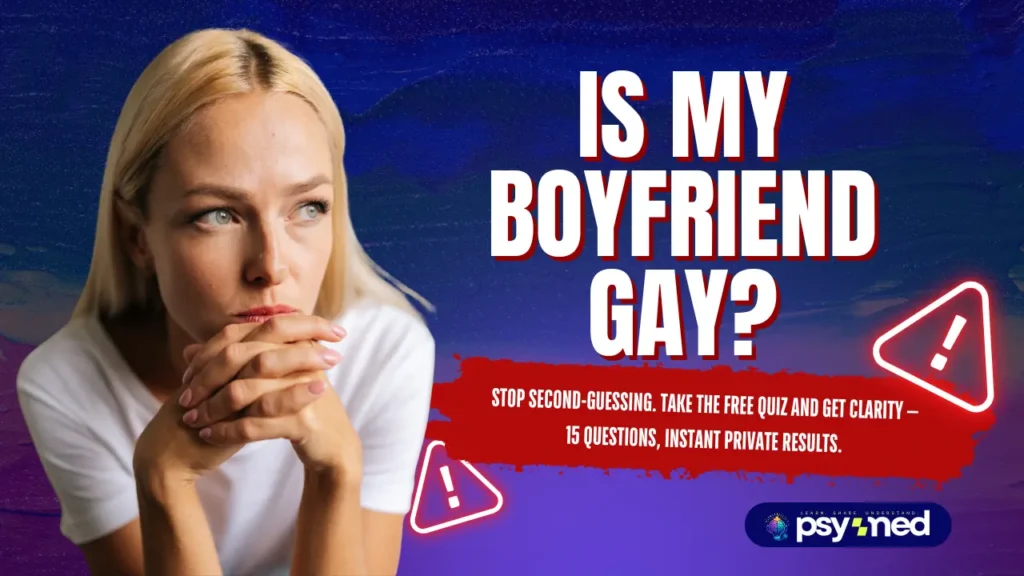
Something feels off but you can't name it. Our "Is my boyfriend gay" quiz helps you reflect on the signs that may suggest your boyfriend is gay or questioning
Published Updated
You didn’t come here because you’re naturally suspicious. You came here because something has shifted — in the way he responds to you, in the intimacy between you, in moments that felt off in ways you struggled to articulate. Maybe it’s been building for a while. Maybe it was one specific thing you can’t stop thinking about. Either way, the question is sitting with you, and you deserve a thoughtful place to explore it.
This isn’t a quiz that will tell you your boyfriend’s sexuality. No quiz can do that — only he can. What it can do is help you organize your observations, assess whether the patterns you’ve noticed carry meaningful weight, and provide language for a conversation that might be very important.
Our “Is My Boyfriend Gay Quiz” is designed to be honest without being alarmist, compassionate without being dismissive, and useful without pretending to be something it isn’t. 15 questions. Instant, private results. Please read the full results — not just the score.
Why Do Some Men Who Are Gay Enter Heterosexual Relationships?
Understanding why a man might be in a relationship with a woman while being gay or bisexual helps make sense of what you may be observing — and it’s important context for approaching the situation with empathy rather than judgment.
Societal pressure, family expectations, internalized fear, and genuine personal confusion are the most commonly cited reasons. Many men who are gay or bisexual grew up in environments — whether religious, cultural, or familial — where being anything other than heterosexual was not an acceptable identity. Entering a heterosexual relationship may have been a deliberate act of conformity, a genuine attempt to believe their own heterosexuality, or something that happened before they had the language or self-awareness to understand their own orientation.
Some men enter relationships genuinely believing themselves to be straight, and their orientation only becomes clear to them over time. Sexual identity can develop and shift throughout adulthood — the research on sexual fluidity, particularly in men who have sex with men (MSM), details that attraction, behavior, and identity don’t always align neatly or remain static (Herbenick et al., 2010). This doesn’t make what they’re doing less painful to experience from your side of the relationship — but it does mean the situation is often more complicated than simple deliberate deception.
Research on mixed-orientation relationships — relationships where one partner is heterosexual and the other is gay, bisexual, or questioning — suggests these situations are more common than most people realize. A national probability study found that 4.2% of men identified as gay and 2.6% as bisexual (Herbenick et al., 2010), and many of these men are or have been in heterosexual relationships. The Straight Spouse Network estimates that there are approximately 2 million gay people in the United States in mixed-orientation marriages.
Important Caveats Before You Take This Quiz
Please read these before proceeding — they matter.
No quiz can determine anyone’s sexuality.
Sexual orientation is a deeply personal, internal experience. The only person who can know whether your boyfriend is gay, bisexual, or questioning is your boyfriend. What this quiz assesses is the pattern of behavioral signals you have observed — signals that may or may not be related to sexual orientation. Many behaviors on this list have entirely innocent explanations.
Being gay is not a problem — but being in a relationship built on a hidden truth is.
Our “Is My Boyfriend Gay?” quiz is not designed to help you “catch” your boyfriend doing something wrong. It’s designed to help you understand whether what you’re experiencing in your relationship deserves a direct conversation. If the result is that your boyfriend is gay or bisexual, that is not a tragedy about him — it’s information that both of you deserve to have so you can make honest choices about your lives.
Stereotypes are not signs.
Fashion sense, emotional expressiveness, male friendships, grooming habits, and cultural interests tell you nothing reliable about a person’s sexual orientation. This quiz deliberately avoids these. The behavioral signals that actually carry weight are those related to intimacy, attraction patterns, secretive behavior, and direct interaction with same-sex content or contacts.
Bisexuality is a distinct possibility.
“Is he gay?” may be the question in your head, but “Is he bisexual?” is an equally valid possibility. Bisexual men are attracted to both men and women and can have a genuine, deep attraction to female partners while also being attracted to men. Many of the behavioral patterns described here may indicate bisexuality rather than exclusive homosexuality.
Signs Your Boyfriend Might Be Gay — What Actually Matters
Most lists of “signs” are filled with stereotypes that reflect cultural bias more than clinical reality. This section covers the behavioral patterns that relationship counselors, psychologists, and people with lived experience in mixed-orientation relationships consistently identify as meaningful.
Decreased physical and sexual intimacy — with a specific pattern.
Reduced intimacy on its own means almost nothing — stress, depression, health issues, and relationship dynamics all affect sex drive. What’s more meaningful is a specific pattern: consistent avoidance of initiation, discomfort with her touch specifically, or a disconnect between willingness to be physically close generally and willingness to engage in sexual intimacy with her in particular. If he’s affectionate in non-sexual ways but consistently disengaged sexually, that specific pattern is worth noting.
Strong, intense emotional connection to a specific male friend.
Close male friendships are healthy and normal. What’s different is when one particular male friendship takes on the emotional intensity, priority, and exclusivity that typically belongs to a romantic relationship — when he consistently chooses that friend over you for emotional disclosure, shares more with him than with you, and seems measurably happier and more himself in that person’s company.
Discovery of gay or bisexual content in his browsing, apps, or history.
This is the clearest behavioral signal — not his aesthetic preferences or cultural interests, but actual engagement with same-sex sexual or romantic content. Gay dating apps (Grindr, Scruff, Jackd), gay pornography, or gay social media activity that he keeps hidden from you are concrete behavioral indicators that deserve to be addressed directly. Many women who have discovered their partner’s homosexuality or bisexuality identify this as the moment their suspicion became knowledge.
Overcompensation — performing heterosexuality.
Some closeted gay men overcompensate with exaggerated heterosexual behavior: unprompted declarations of how attracted they are to women, performative interest in female celebrities, or conspicuous discomfort around gay people or LGBTQ+ topics that seems defensive rather than neutral. This is a psychological defense mechanism — it can signal that the person is working hard to manage internal conflict regarding their orientation.
Secretive phone and online behavior.
Hiding his phone, frequently clearing his history, having accounts you don’t know about, or reacting with disproportionate alarm when you’re near his device — these are secrecy behaviors that may indicate hidden activity of any kind. Combined with other signals, they carry more weight.
His past relationships and sexual history.
A pattern of short, emotionally shallow relationships with women, a history of same-sex experiences he has minimized or dismissed, or a coming-out history with any aspect of LGBTQ+ identity that he later “walked back” are all relevant contextual information.
Your own gut feeling.
This is nothing. Partners in mixed-orientation relationships frequently describe a persistent sense that something was wrong — that the connection was off in a way they couldn’t name. Your intuition draws on thousands of micro-observations your conscious mind hasn’t yet processed. It’s worth taking seriously as a signal that something deserves a conversation, even if you can’t yet articulate what.
How This “Is My Boyfriend Gay” Quiz Works
This quiz asks about behavioral observations across three domains: intimacy and attraction patterns, secretive or hidden behavior, and emotional and social patterns. Answer based on what you have actually observed — not what you fear, not what you hope, but what you have genuinely noticed over the course of your relationship.
Each question has three response options:
- No / Not That I’ve Noticed (0 points)
- Sometimes / Possibly (1 point)
- Yes / Definitely (2 points)
Total range: 0–30. Results are on a spectrum — not a verdict.
Understanding Your Results
| Score Range | Category | What It Suggests |
|---|---|---|
| 0 – 7 | Low — Few Signals Present | Your responses don’t suggest a strong pattern of signals associated with a closeted partner. Your concerns may stem from other relationship dynamics worth exploring. |
| 8 – 15 | Moderate — Some Patterns Worth Exploring | Some signals are present. They may reflect orientation-related concerns or other relationship issues like emotional unavailability or low libido. A direct, compassionate conversation is warranted. |
| 16 – 22 | Significant — Multiple Consistent Patterns | Multiple consistent behavioral signals are present across different domains. This pattern warrants a serious, honest conversation with your partner. Consider speaking with a therapist for support. |
| 23 – 30 | Strong — Most Signals Present | A strong and consistent pattern of signals is present across multiple domains. The behavioral picture is significant and deserves direct, honest communication. You deserve clarity. |
What If Your Suspicions Are Confirmed? What Comes Next
If your boyfriend tells you he’s gay, bisexual, or questioning — or if his behavior makes it clear — the experience can feel like the relationship ground disappearing beneath you. Even if some part of you knew, the confirmation still tends to be shocking, and the grief it produces is real. You are losing not just the relationship but the version of it you thought you had.
A few things worth knowing for that moment:
Your feelings are valid — all of them. Grief, rage, relief, love, humiliation, compassion — you may feel all of these in the same afternoon. None of them is wrong. You don’t have to choose between being hurt and being supportive. You can be both.
This is not a reflection of your worth or attractiveness. A man’s same-sex orientation has nothing to do with whether you are desirable, lovable, or enough. His orientation existed before you met — it is not something you caused or failed to prevent.
You don’t owe him your continued relationship. Some couples in this situation choose to restructure their relationship — remaining partners in some form while he lives openly as gay or bisexual. This is a valid choice if both partners want it freely. But you are under no obligation to remain in a relationship that does not meet your needs for intimacy, honesty, or mutual attraction. Leaving is also valid and not unkind.
Get support for yourself. The Straight Spouse Network (straightspouse.org) specifically serves people in your position. Individual therapy can help you process this in a private, supported space. You do not have to figure this out alone.
Scopophobia vs. Sexual Orientation Concern — A Note on Anxiety
Sometimes the worry that a partner is gay is not primarily about their behavior — it’s about an anxiety pattern in the person asking. If you find yourself frequently worried about your boyfriend’s sexuality despite limited concrete evidence, if the worry shifts from “is he gay” to “is he cheating” to “does he love me” without resolution, or if relationship anxiety is a recurring theme for you, it may be worth exploring that pattern separately from this specific question. Our Anxiety Test is a useful starting point.
Frequently Asked Questions
Can you tell if someone is gay from their behavior?
Not definitively — and anyone who claims otherwise is overstating what behavioral observation can tell you. Sexual orientation is an internal experience of attraction, not a set of observable behaviors. What behavioral signals can do is identify patterns that are inconsistent with what you’d expect in a genuinely attracted, honest relationship — and those patterns may warrant a direct conversation. No quiz, article, or list of signs can tell you with certainty whether someone is gay. Only they can.
What if he’s bisexual rather than gay?
Bisexuality is a distinct and valid orientation involving genuine attraction to more than one gender. Many of the behavioral signals described in this quiz could reflect bisexuality rather than exclusive homosexuality. Bisexual men can have genuine, deep attraction to female partners — but if he’s also attracted to men and hiding that, it’s still a hidden truth your relationship is being built around. The conversation about honesty and what you both need is the same, regardless of where on the spectrum he falls. Our Kinsey Scale Test and LGBTQ+ Test may provide useful context on the spectrum of sexual orientation.
Should I confront him directly?
“Confront” is probably not the right word — and not the right frame. If your observations have raised genuine concerns, a direct and compassionate conversation is warranted. The goal of that conversation is not to catch him or force a confession but to tell him what you’ve noticed, how you’ve been feeling, and to create space for honesty between you. Starting from a place of care — for him and for yourself — tends to produce more honest and productive conversations than starting from a place of accusation.
What if he denies it even though I’m sure?
This is one of the most painful aspects of this situation. A man who is not ready to come out — or who is not yet fully aware of his own orientation — may genuinely deny being gay even when asked directly. You cannot force someone’s readiness for self-disclosure. What you can do is be honest about what you’ve observed and how it has affected you, and make clear what you need from the relationship going forward. If the relationship does not provide the honesty and intimacy you need — regardless of the reason — that is a sufficient basis to make choices about whether to stay.
Can a gay man be in a happy relationship with a woman?
Some mixed-orientation couples do make their relationships work — typically through radical honesty, renegotiated boundaries, and mutual agreement on what the relationship will and won’t provide. These are not common outcomes, and they require both partners to freely and genuinely choose the arrangement. In most cases, mixed-orientation relationships produce significant distress for both partners — the straight partner from the lack of full intimacy and honesty, and the gay partner from suppression of identity. Both people generally do better when the truth is out, and they can build lives that genuinely fit them.
Where can I get support if my boyfriend turns out to be gay?
The Straight Spouse Network (straightspouse.org) is the primary organization specifically serving partners in mixed-orientation relationships — offering peer support, resources, and connection with others who have been through the same experience. Individual therapy with a therapist experienced in LGBTQ+ issues and relationship transitions is also strongly recommended. You don’t have to wait for confirmation to reach out — if you’re in distress now, support is available now.
Related Tests
These tests may provide additional context for what you’re exploring:
- Kinsey Scale Test — if you want to understand the full spectrum of sexual orientation and where different people might fall on it
- LGBTQ+ Test — a broader exploration of sexual orientation and identity across the full spectrum
- Gay Test — for those exploring their own sexual orientation
- Anxiety Test — if relationship anxiety and persistent worry are a recurring pattern for you beyond this specific concern
- Social Anxiety Test — sometimes fear of relationship loss drives persistent questioning, worth exploring separately
For more relationship and identity tests, visit our Sexual Orientation & Gender Identity collection.
References
- Herbenick, D., Reece, M., Schick, V., Sanders, S.A., Dodge, B., & Fortenberry, J.D. (2010). Sexual behavior in the United States: Results from a national probability sample of men and women ages 14–94. Journal of Sexual Medicine, 7(Suppl 5), 255–265. PMID: 20929272
- Buxton, A.P. (2004). Works in progress: How mixed-orientation couples maintain their marriages after the wives come out. Journal of Bisexuality, 4(1–2), 57–82. doi.org
- Kays, J.L., & Joanna Markman, K. (2009). Characteristics of Mixed Orientation Couples: An Empirical Study. Edification: The Transdisciplinary Journal of Christian Psychology, 3(1), 42–55. Wheaton College.
- Schrimshaw, E.W., et al. (2013). Disclosure and nondisclosure among nongay-identified, behaviorally bisexual men. Archives of Sexual Behavior, 42(3), 389–402. PMID: 22370936
- Straight Spouse Network. (2026). Resources for Straight Spouses and Partners. straightspouse.org
Related Tests
See All Quiz →
Sexual Orientation & Gender Identity
What’s Your Sexual Orientation or Gender Identity? Take This Free LGBTQ+ Test
→
You may also like
See All Quiz →
Addiction and Impulse Control
Is Gambling Becoming a Problem? Take This Free Gambling Addiction Test (PGSI)
→