

Free Alexithymia Test — Based on the TAS-20
Take this free Alexithymia Test based on the TAS-20 to measure difficulty identifying and describing emotions. Instant results across all three subscales.
Published Updated
You sense something inside but can’t name it. Before a tough talk, your chest tightens, and you call it “stress.” When asked how you feel, you may draw a blank. Watching someone cry in a movie, you wonder what they feel that you don’t.
This isn’t about being emotionally cold or indifferent. It’s called alexithymia, and it’s more common than most people think.
Take the free Toronto Alexithymia Scale (TAS-20) test. It takes 5–10 minutes, and the results are immediate. All answers are confidential.
What Is Alexithymia?
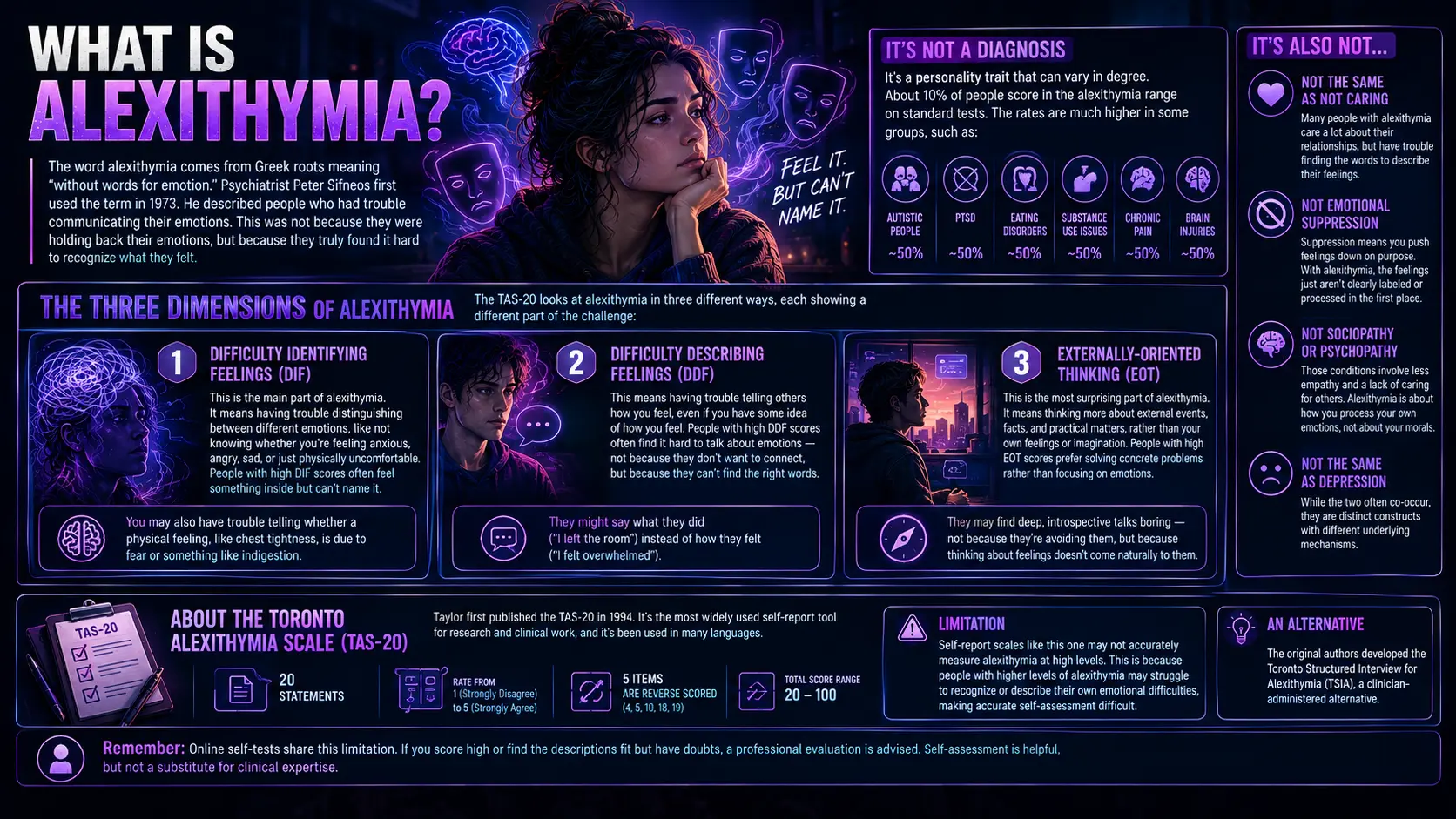
The word alexithymia comes from Greek roots meaning “without words for emotion.” Psychiatrist Peter Sifneos first used the term in 1973. He described people who had trouble communicating their emotions. This was not because they were holding back their emotions, but because they truly found it hard to recognize what they felt.
Alexithymia isn’t a diagnosis. It’s a personality trait that can vary in degree. About 10% of people score in the alexithymia range on standard tests. The rates are much higher in some groups. For example, about 50% of autistic people and those with PTSD, eating disorders, substance use issues, chronic pain, or brain injuries.
It’s also important to know what alexithymia is not:
- It’s not the same as not caring. Many people with alexithymia care a lot about their relationships, but have trouble finding the words to describe their feelings.
- It’s not emotional suppression. Suppression means you push feelings down on purpose. With alexithymia, the feelings just aren’t clearly labeled or processed in the first place.
- It’s not sociopathy or psychopathy. Those conditions involve less empathy and a lack of caring for others. Alexithymia is about how you process your own emotions, not about your morals.
- Not the same as depression. While the two often co-occur, they are distinct constructs with different underlying mechanisms.
The Three Dimensions of Alexithymia
The TAS-20 looks at alexithymia in three different ways, each showing a different part of the challenge:
Factor I: Difficulty Identifying Feelings (DIF)
This is the main part of alexithymia. It means having trouble distinguishing between different emotions, like not knowing whether you’re feeling anxious, angry, sad, or just physically uncomfortable. People with high DIF scores often feel something inside but can’t name it. They may also have trouble telling whether a physical feeling, like chest tightness, is due to fear or something like indigestion.
Factor II: Difficulty Describing Feelings (DDF)
This means having trouble telling others how you feel, even if you have some idea of how you feel. People with high DDF scores often find it hard to talk about emotions—not because they don’t want to connect, but because they can’t find the right words. They might say what they did (“I left the room”) instead of how they felt (“I felt overwhelmed”).
Factor III: Externally-Oriented Thinking (EOT)
This is the most surprising part of alexithymia. It means thinking more about external events, facts, and practical matters, rather than your own feelings or imagination. People with high EOT scores prefer solving concrete problems rather than focusing on emotions. They may find deep, introspective talks boring—not because they’re avoiding them, but because thinking about feelings doesn’t come naturally to them.
About the Toronto Alexithymia Scale (TAS-20)
Taylor first published the TAS-20 in 1994. It’s the most widely used self-report tool for research and clinical work, and it’s been used in many languages. Each TAS-20 contains 20 statements. You rate each one from 1 (Strongly Disagree) to 5 (Strongly Agree). Five of the items—numbers 4, 5, 10, 18, and 19—are scored in reverse, so agreeing with them means less alexithymia.
Your total score can range from 20 to 100. However, a limitation is that self-report scales like this one may not accurately measure alexithymia at high levels. This is because people with higher levels of alexithymia may struggle to recognize or describe their own emotional difficulties, making accurate self-assessment difficult.
Those who cannot access their emotional states may struggle to accurately rate their own difficulty. Because of this, the original authors developed the Toronto Structured Interview for Alexithymia (TSIA), a clinician-administered alternative. Remember, online self-tests share this limitation: if you score high or find descriptions fit but have doubts, a professional evaluation is advised. Self-assessment is helpful, but not a substitute for clinical expertise.
Signs of Alexithymia
Alexithymia shows up as a consistent difficulty connecting with, naming, and communicating your inner emotional world — not as an absence of feeling. The signs below are the everyday ways that difficulty tends to surface. Recognizing several of them, especially as long-standing patterns, may suggest alexithymic traits; the test above puts a number to it.
You feel something but can’t name it
You sense that you’re reacting to something — a tightness, an unease, an energy — but can’t tell whether it’s anxiety, anger, sadness, or excitement. The emotion is present, yet it arrives without a label. This is the core sign (Difficulty Identifying Feelings) and the one people notice most.
You struggle to put feelings into words
Even when you have some sense of what you feel, describing it to someone else is genuinely hard. You might default to describing the situation or what you did (“I just left”) rather than the emotion behind it (“I felt overwhelmed”). Conversations about feelings can leave you stuck for words.
You confuse emotions with physical sensations
Emotions register in your body before (or instead of) your mind — a racing heart, a tight chest, a knot in your stomach, fatigue — and it’s hard to tell whether a physical sensation is a feeling or a medical symptom. Many people with alexithymia see doctors for bodily complaints that turn out to be unrecognized emotions.
You prefer facts and practicalities over introspection
You’d rather focus on external events, tasks, and concrete problems than turn attention inward. Deep, feelings-focused conversations can feel boring or pointless — not because you’re avoiding them, but because reflecting on emotions doesn’t come naturally (Externally-Oriented Thinking).
Others see you as distant, even when you care
Partners, friends, or family may describe you as emotionally unavailable, hard to read, or uncaring — which can be painful and confusing, because you do care. The gap isn’t in your feelings for people; it’s in the ability to identify and express those feelings in the moment.
Your imagination and daydreaming feel limited
You may have a sparse fantasy life — few daydreams, little spontaneous imagining, and limited interest in reading hidden meaning into films, stories, or art. This constricted imaginative life is part of the broader alexithymia construct, historically described alongside the difficulty with feelings.
Anger is the emotion you reach most easily
When many feelings are hard to identify, anger and irritability — which are physically obvious and hard to miss — can become the default emotional channel that other, subtler emotions get funneled into. Feeling “just angry” a lot, without a clear why, is a common alexithymic pattern.
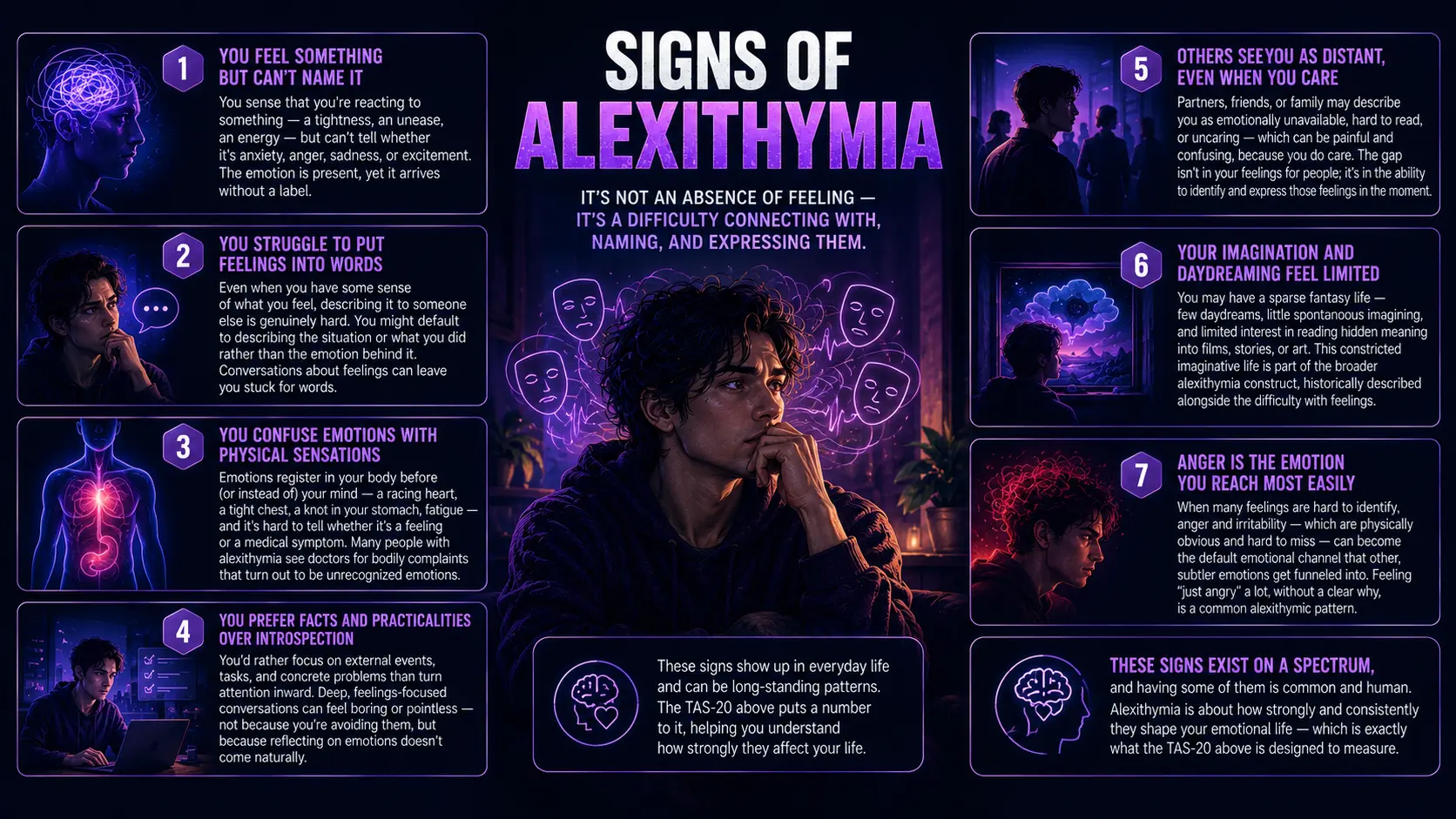
These signs exist on a spectrum, and having some of them is common and human. Alexithymia is about how strongly and consistently they shape your emotional life — which is exactly what the TAS-20 above is designed to measure.
How This Alexithymia Test Works
This Alexithymia test has 20 statements covering all three TAS-20 categories. Rate each based on your actual experience, not what you think you should be.
There are no right or wrong answers. A high score shows a pattern—it’s not a sign of a problem.
Understanding Your Results
The cutoff scores below are from the original 1994 study by Bagby, Parker, and Taylor. These are the standard clinical guidelines:
| Score | Interpretation |
|---|---|
| 20–51 | No alexithymia — emotional identification and description are generally not a significant difficulty. |
| 52–60 |
Possible alexithymia — some features are present; worth exploring further, especially if they affect relationships or daily life.
|
| 61–100 |
Alexithymia present — significant difficulty with emotional identification and/or description; professional support is worth considering
|
Your scores on each subscale matter just as much as your total score. For example, someone with high DIF but low EOT has a different profile and may need different support than someone with the opposite pattern. Notice which subscale had the biggest impact on your score.
A score of 61 isn’t a hard line. For example, 59 and 63 are more alike than different. These cutoffs are just general guidelines, not strict rules. If your score is close to the cutoff and the descriptions fit you, trust your own experience more than the number.
Alexithymia and Autism — An Important Connection
If you’re looking into autism or ADHD, please read this section closely.
Studies show that alexithymia is much more common in autistic people. About 50% score in the alexithymia range on the TAS-20. In contrast, about 10% of the general population do. This overlap has important clinical implications that experts have only recently started to take seriously.
In the past, trouble with recognizing and expressing emotions in autism was seen as a core part of autism itself. Newer research, including work by psychologist Dr. Geoffrey Bird, suggests that many of these challenges are actually due to alexithymia happening alongside autism, not just autism alone:
- Reduced affective empathy in autistic people appears to be driven by alexithymia, not autism
- Difficulty recognizing facial expressions correlates with alexithymia, not autism per se
- Reduced eye contact in alexithymia occurs in response to negative feelings. This differs from the sensory and social reasons for reduced eye contact in autism.
This difference matters in real life. If you’re autistic and working with a therapist on emotions or relationships, knowing if alexithymia is a big factor can change how therapy works. Treatments for alexithymia are different from those for autism alone.
Alexithymia is also more common in people with ADHD, PTSD, eating disorders, chronic pain, and those who experienced emotional neglect as children. In cases of emotional neglect, researchers talk about primary alexithymia (which is based in the brain and more stable) and secondary alexithymia (which develops from trauma or environment and may respond better to therapy).
What to Do If You Score High
A high score is just information, not a judgment. If alexithymia makes it hard to understand yourself, connect with others, or manage your health, there are helpful ways to address it.
- Cognitive Behavioral Therapy (CBT) for alexithymia helps you build words for your inner states, connect physical feelings to emotions, and slowly develop better emotional self-awareness. Progress is usually slow and steady, but you can see real changes over time.
- Mentalization-Based Therapy (MBT) helps people better understand their own and others’ thoughts and feelings, which fits well with the challenges of alexithymia. It’s especially helpful when alexithymia occurs alongside attachment issues.
- Somatic approaches start with the body. They use awareness of physical sensations to reach emotions. For people who struggle with emotional words, noticing and describing body feelings like tension, warmth, heaviness, or pressure can be an easier first step than naming emotions directly.
- Emotion-focused journaling means regularly checking in with your inner state, without forcing yourself to name emotions. Just noticing how your body reacts in different situations is good practice.
Just learning about alexithymia can help. Knowing it exists, seeing which subscale you struggle with, and realizing it’s a common, documented experience—not a personal flaw—can ease the shame that sometimes builds up over time.
Frequently Asked Questions
Is alexithymia the same as not having emotions?
No, and that’s a common misunderstanding. People with alexithymia do have emotions. The challenge is in noticing and naming them inside, and in explaining them to others. The feelings are there, but the way they’re processed is different. Some people feel emotionally flat, while others have strong physical reactions to things they can’t explain emotionally.
The experience is different for everyone. Improvement depends partly on whether alexithymia is primary (neurologically based) or secondary (developed in response to environmental or traumatic factors). Secondary alexithymia is generally more responsive to therapy. Primary alexithymia is more stable, but not unchangeable; individuals can develop compensatory strategies and a functional emotional vocabulary over time, even if the underlying difficulty does not fully resolve. Sustained, targeted effort is essential, rather than relying on awareness alone.
Is alexithymia the same as low emotional intelligence?
They’re related but not the same. Emotional intelligence (EQ) is a broader concept that encompasses noticing, using, understanding, and managing emotions in yourself and others. Alexithymia is mostly about noticing and understanding emotions, not the whole range of EQ. You can have low alexithymia but still struggle with emotional regulation, or the other way around.
Does alexithymia affect relationships?
Often, yes—and usually in ways the person with alexithymia doesn’t fully notice. Partners and family may see someone with high DIF and DDF as emotionally distant or uncaring, even if that’s not true. Trouble expressing feelings can lead to unresolved issues, unmet needs, and missed connections. Knowing about alexithymia, especially if you talk about it with your partner, can help you both see these patterns differently instead of assuming the worst.
What’s the difference between the TAS-20 and the Bermond-Vorst Alexithymia Questionnaire (BVAQ)?
The BVAQ looks at five areas: emotionalizing, fantasizing, identifying, verbalizing, and analyzing, while the TAS-20 focuses on three. The BVAQ covers both the cognitive and affective aspects of alexithymia, whereas the TAS-20 is more focused on cognition. The TAS-20 is more commonly used in research and clinics, but the BVAQ may better capture the fantasy side, which the TAS-20 can miss.
What is the TAS-20 online free version?
The TAS-20 is in the public domain, and this test is a free online version you can take yourself. The original questionnaire was published by Bagby, Parker, and Taylor in 1994 and has been used in thousands of studies. The TAS-20 has five reverse-scored items (4, 5, 10, 18, 19), which are important for accurate scoring. To compare your results to clinical data, use these cutoffs: 51 or below (no alexithymia), 52–60 (possible), and 61 or above (present).
Further reading
Alexithymia is specifically about identifying and describing emotions, which is narrower than personality as a whole. The free personality test covers the five broad dimensions if you want the fuller profile. Alexithymia sits at the low end of emotional self-awareness, which is the foundation the rest of emotional intelligence builds on. The EQ test looks at the positive side of the same territory — how well you recognise, manage and read emotions overall.
Related Tests
Alexithymia rarely occurs in isolation. The following related assessments may provide useful context for your results:
- Empathy Test — alexithymia affects affective empathy; your empathy profile, alongside your alexithymia score, gives a fuller picture
- Social Anxiety Test — difficulty describing feelings often worsens social anxiety; the two frequently co-occur
- PTSD Test — Secondary alexithymia is common following trauma; the two interact in clinically significant ways
- Multidimensional Anger Test — anger is often the most accessible emotion for people with alexithymia and can become a default response when other emotions can’t be identified
- Anhedonia Test — reduced pleasure and reduced emotional awareness are different things that overlap in ways worth distinguishing.
References
- Bagby, R. M., Parker, J. D. A., & Taylor, G. J. (1994). The twenty-item Toronto Alexithymia Scale — I. Item selection and cross-validation of the factor structure. Journal of Psychosomatic Research, 38(1), 23–32. doi:10.1016/0022-3999(94)90005-1
- Bagby, R. M., Parker, J. D. A., & Taylor, G. J. (2020). Twenty-five years with the 20-item Toronto Alexithymia Scale. Journal of Psychosomatic Research, 131. doi:10.1016/j.jpsychores.2020.109940
- Bird, G., & Cook, R. (2013). Mixed emotions: The contribution of alexithymia to the emotional symptoms of autism. Translational Psychiatry, 3, e285. doi:10.1038/tp.2013.62
- Taylor, G. J., Bagby, R. M., & Parker, J. D. A. (1997). Disorders of affect regulation: Alexithymia in medical and psychiatric illness. Cambridge University Press.
Related Tests
See All Quiz →
You may also like
See All Quiz →