

Insomnia Test
The Insomnia Severity Index: seven questions about your sleep over the last two weeks, scored 0 to 28, measuring how severe your insomnia is and how much it affects your days. A validated screening tool, not a diagnosis - and insomnia responds well to treatment.
Published Updated
Insomnia isn’t just “not sleeping well” — it’s persistent difficulty falling asleep, staying asleep, or waking too early, combined with real daytime consequences like fatigue, low mood, and trouble concentrating. The good news worth stating up front: insomnia is one of the most treatable sleep problems there is, and the most effective treatment isn’t medication but a structured approach called CBT-I. This insomnia test can’t diagnose you, but it can tell you how significant your insomnia is right now and whether it’s worth doing something about.
What Is Insomnia?
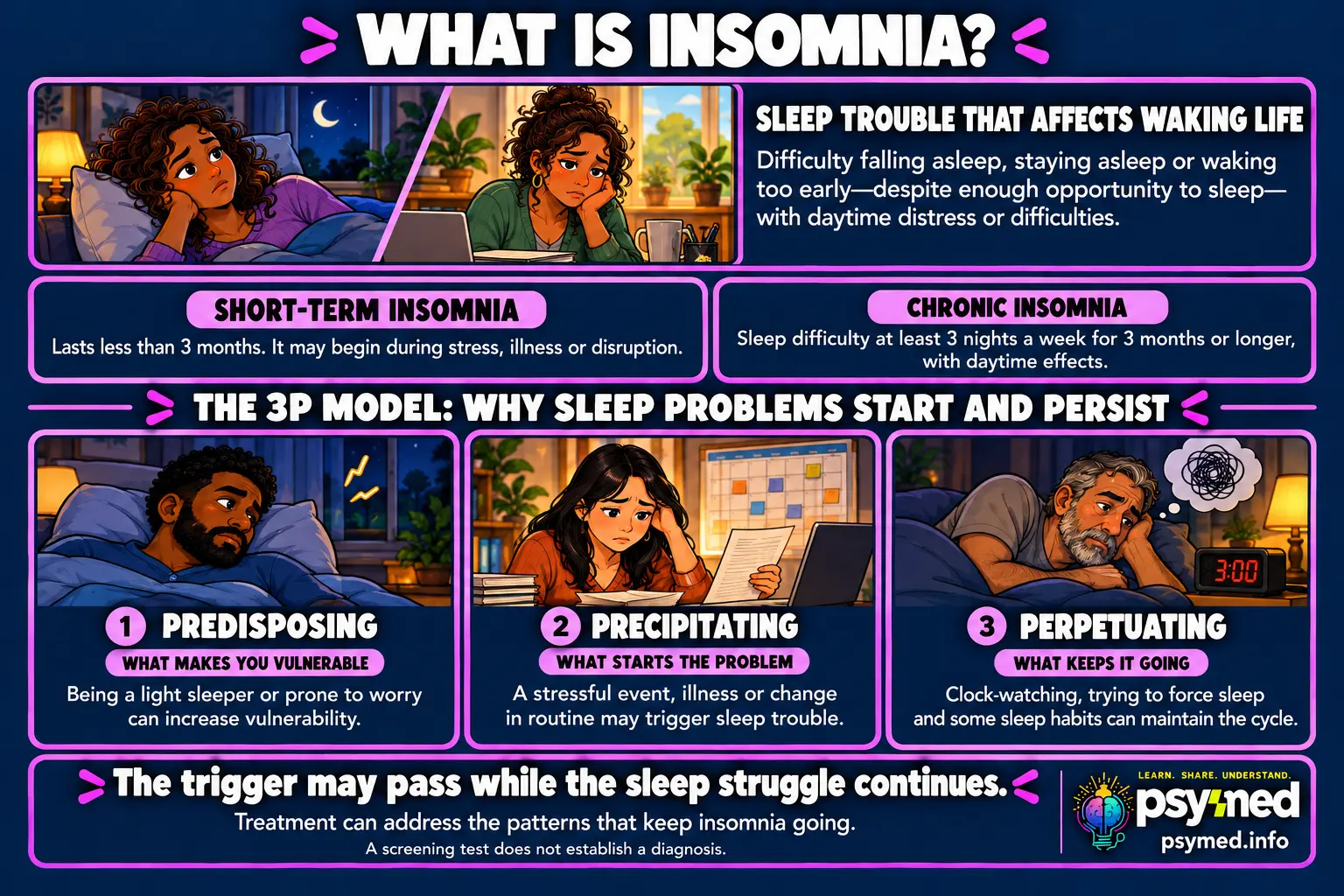
Insomnia is difficulty with sleep — trouble falling asleep, staying asleep, or waking earlier than you want — that happens despite adequate opportunity to sleep and causes distress or problems during the day. That daytime part matters: by the DSM-5 definition of insomnia disorder, it’s not insomnia unless the poor sleep is also affecting your waking life. Clinically, insomnia is considered chronic when it occurs at least three nights a week for three months or longer; shorter episodes, often triggered by stress, illness, or a disruption, are called acute or short-term insomnia.
It’s extremely common — roughly a third of adults have insomnia symptoms at any given time, and about 1 in 10 have chronic insomnia disorder. One useful way sleep specialists think about it is the “3P” model (developed by Arthur Spielman): predisposing factors (a naturally light sleeper, a tendency to worry), precipitating factors (a stressful event that starts the problem), and perpetuating factors (the habits and anxieties that keep it going long after the original trigger is gone). That last group — lying in bed trying to force sleep, clock-watching, napping, dreading bedtime — is exactly what good treatment targets.
Signs You Have Insomnia
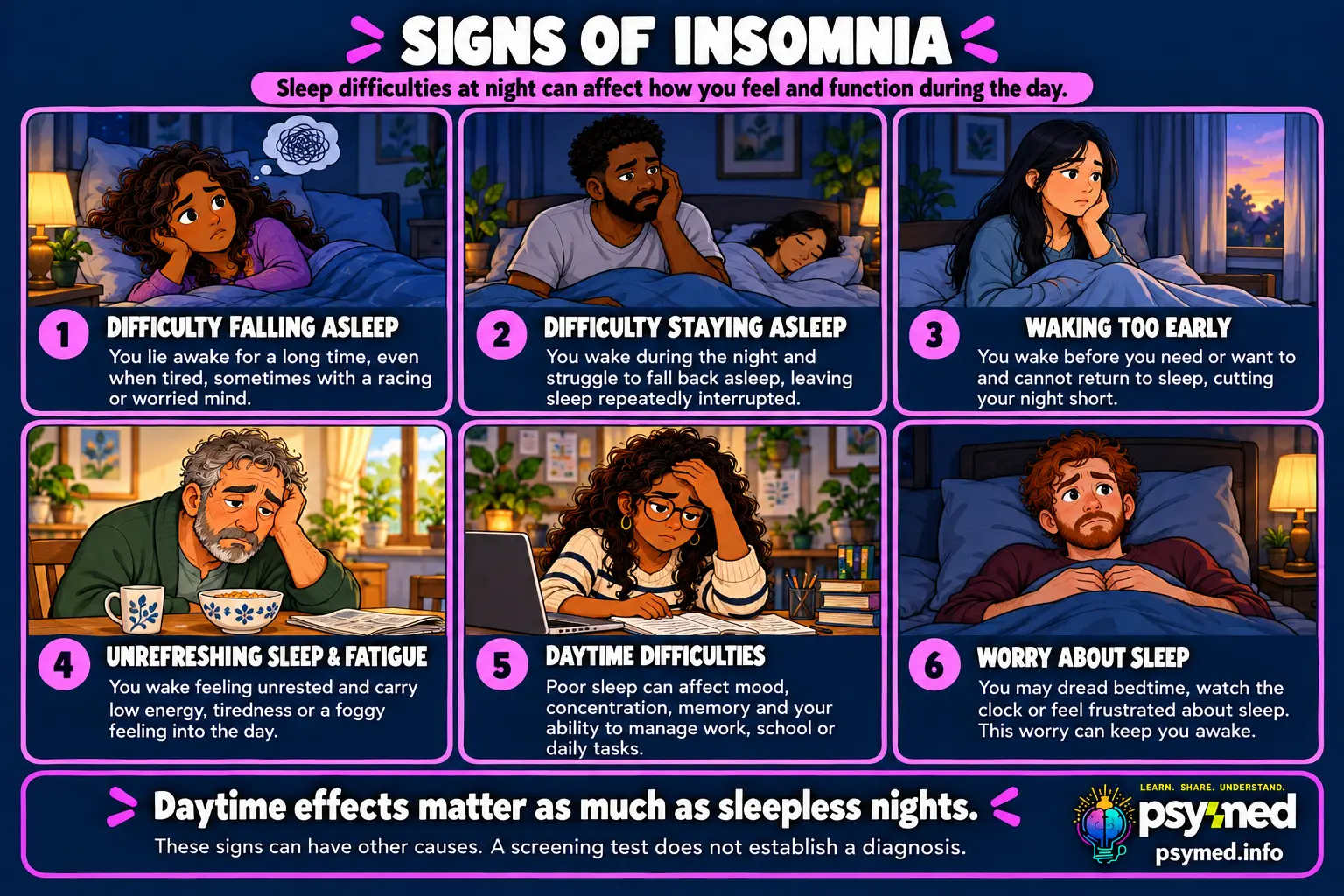
Insomnia shows up as a recognizable set of night-time and day-time signs. The daytime effects are just as much a part of it as the sleepless nights. These are the areas this insomnia test measures.
Difficulty falling asleep (sleep-onset insomnia)
Lying awake at the start of the night, unable to switch off — often with a racing or worried mind — and taking a long time to drift off, even when you’re tired.
Difficulty staying asleep (sleep-maintenance insomnia)
Waking repeatedly during the night and struggling to get back to sleep, so your sleep is broken and shallow rather than continuous and restorative.
Waking too early (early-morning insomnia)
Waking well before you need or want to — and being unable to fall back asleep — which leaves the night cut short. Early-morning waking is also commonly linked with depression.
Unrefreshing sleep and daytime fatigue
Waking up feeling as though you’ve barely slept, and carrying tiredness, low energy, or a foggy, drained feeling through the day regardless of how long you were in bed.
Daytime impairment
The knock-on effects that define insomnia as a disorder: irritability or low mood, trouble concentrating and remembering, reduced performance at work or school, and difficulty functioning the way you want to.
Worry and distress about sleep
Becoming anxious about sleep itself — dreading bedtime, watching the clock, feeling frustrated or hopeless about not sleeping. This sleep-related anxiety is one of the main things that keeps insomnia going.
About the Insomnia Severity Index (How This Insomnia Test Works)
This test is the Insomnia Severity Index (ISI), developed by sleep researcher Charles Morin. It has 7 questions, each scored from 0 to 4, asking about your sleep over the last two weeks. The first three rate the severity of specific sleep problems (falling asleep, staying asleep, waking too early); the rest ask how satisfied you are with your sleep, how noticeable the problem is, how worried you are about it, and how much it interferes with your daily life. Your answers are added up for a total score from 0 to 28, which maps onto a standard severity band. Answer for the last two weeks, and keep your responses private.
Understanding Your Results
Your total score (0–28) places you in one of the Insomnia Severity Index’s four standard categories. These are the same thresholds used in research and clinical practice. Read your result as a measure of severity and a guide to next steps — not a formal diagnosis, which only a clinician can make.
| Score | Range | What It Suggests |
|---|---|---|
| 0 – 7 | No Insomnia | No clinically significant insomnia. |
| 8 – 14 | Subthreshold | Subthreshold insomnia — some difficulty worth addressing early. |
| 15 – 21 | Clinical (Moderate) | Clinical insomnia of moderate severity; professional help is worthwhile. |
| 22 – 28 | Clinical (Severe) | Severe clinical insomnia; seeing a professional is strongly recommended. |
Why Sleeping Pills Aren’t the First Answer: CBT-I
It surprises many people, but the recommended first-line treatment for chronic insomnia isn’t medication — it’s Cognitive Behavioral Therapy for Insomnia (CBT-I), endorsed by the American Academy of Sleep Medicine and other major bodies. CBT-I targets the perpetuating factors that keep insomnia running: it resets your sleep schedule (stimulus control and sleep restriction), dismantles the anxious, effortful relationship with sleep that develops over time, and replaces unhelpful beliefs about sleep with accurate ones.
It typically takes only a few sessions, has lasting effects without side effects, and outperforms sleeping pills over the long term. Medications can have a short-term role in some situations, but they don’t address the underlying pattern and can create dependence. If your score points to clinical insomnia, asking about CBT-I is one of the most useful things you can do.
When to See a Doctor
Consider seeing a doctor if your insomnia has lasted more than a few weeks, is affecting your mood or daytime functioning, or isn’t responding to basic sleep changes. It’s especially worth a professional’s attention if you snore loudly, gasp or stop breathing in your sleep, or feel excessively sleepy during the day despite time in bed (possible sleep apnea), or if you have uncomfortable leg sensations that disrupt sleep (restless legs syndrome) — because treating insomnia won’t fix an underlying sleep disorder that’s driving it. A doctor can also check for medical and psychiatric contributors, since insomnia frequently travels with anxiety, depression, and chronic pain. Bringing your ISI score to the appointment gives them a useful, standardized starting point.
Methodology & Sources
This insomnia test is a faithful reproduction of the Insomnia Severity Index (ISI), developed by Charles M. Morin, Ph.D. (Université Laval). The ISI is a widely used, validated 7-item questionnaire that measures the nature, severity, and impact of insomnia over the previous two weeks; each item is rated 0–4 and summed for a total of 0–28, interpreted using the author’s established cutoffs. It is provided here for educational and self-screening purposes and is not a substitute for a clinical evaluation. Insomnia disorder, as defined in the DSM-5, can only be diagnosed by a qualified professional, who can also identify contributing conditions and recommend treatment such as CBT-I.
References
- Morin, C.M. (1993). Insomnia: Psychological Assessment and Management. Guilford Press. (Original Insomnia Severity Index.)
- Bastien, C.H., Vallières, A., & Morin, C.M. (2001). Validation of the Insomnia Severity Index as an outcome measure for insomnia research. Sleep Medicine, 2(4), 297–307. doi:10.1016/S1389-9457(00)00065-4
- Morin, C.M., Belleville, G., Bélanger, L., & Ivers, H. (2011). The Insomnia Severity Index: psychometric indicators to detect insomnia cases and evaluate treatment response. Sleep, 34(5), 601–608. doi:10.1093/sleep/34.5.601
- Edinger, J.D., et al.; American Academy of Sleep Medicine (2021). Behavioral and psychological treatments for chronic insomnia disorder in adults: clinical practice guideline. Journal of Clinical Sleep Medicine, 17(2), 255–262. doi:10.5664/jcsm.8986
Frequently Asked Questions
How do I know if I have insomnia or just a few bad nights?
The difference is persistence and daytime impact. Occasional poor sleep — after stress, travel, or too much caffeine — is normal and isn’t insomnia. Insomnia disorder involves difficulty falling asleep, staying asleep, or waking too early that happens regularly (clinically, at least three nights a week for three months or more) and causes daytime problems like fatigue, low mood, or poor concentration. The ISI captures exactly this by asking about both your sleep and its effect on your waking life over the past two weeks. A score of 15 or above suggests clinically significant insomnia worth addressing.
What is the most effective treatment for insomnia?
For chronic insomnia, the most effective treatment is Cognitive Behavioral Therapy for Insomnia (CBT-I), not medication. CBT-I is recommended as first-line treatment by the American Academy of Sleep Medicine. It works by resetting your sleep schedule, reducing the time you spend awake in bed, and defusing the anxiety and unhelpful habits that keep insomnia going. It usually takes only a few sessions, has no side effects, and produces results that last longer than sleeping pills. Medications may help briefly in certain circumstances, but they don’t fix the underlying pattern, which is why they aren’t the first choice for long-term insomnia.
Can anxiety or depression cause insomnia?
Yes, and the relationship runs both ways. Anxiety often makes it hard to fall asleep because a racing, worried mind resists switching off, while depression is classically linked with early-morning waking and unrefreshing sleep. At the same time, chronic insomnia is itself a risk factor for developing depression and anxiety, so the two can feed each other. This is one reason treating insomnia matters beyond the sleep itself. If you suspect anxiety or low mood is part of your picture, it’s worth screening for those too and mentioning them to a professional, because addressing them together tends to work better than tackling either alone.
Is the Insomnia Severity Index accurate?
The ISI is one of the most widely used and well-validated insomnia questionnaires in the world, used in both research and clinical care to measure insomnia severity and track response to treatment. It reliably distinguishes people with clinically significant insomnia from those without. That said, it’s a screening and severity tool, not a diagnostic test — it can’t confirm insomnia disorder or rule out other sleep conditions like sleep apnea on its own. Its real value is giving you, and a clinician, a clear, standardized measure of how severe your insomnia is and whether it warrants treatment.
Related Tests
- Anxiety Test — anxiety and insomnia frequently drive each other
- Clinical Depression Test — early-morning waking and poor sleep are common in depression
- Burnout Test — chronic stress and burnout often disrupt sleep
- Complex PTSD Test — trauma commonly affects sleep and causes nighttime waking
- ADHD Test — sleep problems and delayed sleep are very common in ADHD
This test is an educational screening tool, not a diagnosis. Insomnia disorder can only be diagnosed by a qualified professional, who can also check for other sleep disorders such as sleep apnea. If you are struggling with your mood or having thoughts of harming yourself, please call or text 988 (Suicide & Crisis Lifeline, US, 24/7). Outside the US, find helplines at findahelpline.com. The Insomnia Severity Index is © Charles M. Morin and is reproduced here for educational use.
Related Tests
See All Quiz →

Anxiety and Fear Disorders · Mental Health
Do I have Obsessive-Compulsive Disorder Test (Free OCD Quiz Online)
→
You may also like
See All Quiz →

Anxiety and Fear Disorders · Mental Health
Do I have Obsessive-Compulsive Disorder Test (Free OCD Quiz Online)
→