
Sexual orientation self-reflection · Identity
Kinsey Scale Test: Explore the 0–6 scale and your attractions.
What is the Kinsey scale, and where might your attractions sit on it? Answer 10 questions, then learn what Kinsey's 0–6 ratings and X mean, how they were assigned, and where the scale falls short.
For self-reflection only. A quiz can't tell you your sexual orientation; only you can decide how you identify. LGBTQ+ young people can reach The Trevor Project 24/7.
-
THE SELF-CHECK10 focused questionsReflect on attraction, fantasy, connection and experience.
-
PRIVACY FIRSTNo account neededFree to take, with no sign-up. Your result appears right away.
-
CLEAR BOUNDARIESA reflection, not a labelLearn what your answers can and cannot tell you.
The self-check
Take the Kinsey scale test
Explore where your attractions might sit on Kinsey’s 0–6 range. Answer for how things are for you now, across your feelings and experiences, not a single moment. There are no right answers. This quiz is an educational approximation for anyone who is curious. It is not Kinsey’s interview method, and it cannot give you a label.Your result
What the results mean
- Kinsey 0 Only toward a different gender
- Kinsey 1 Mostly toward a different gender, a little toward the same
- Kinsey 2 Mostly toward a different gender, more than a little toward the same
- Kinsey 3 Toward more than one gender, near the middle
- Kinsey 4 Mostly toward the same gender, more than a little toward others
- Kinsey 5 Mostly toward the same gender, a little toward others
- Kinsey 6 Only toward the same gender
- Some X One or two answers about little or no attraction or interest
- X Three or more answers about little or no attraction or interest
 Your result is the closest match to one of Kinsey’s ratings, based on the average of your answers. Answers about little or no attraction are counted separately, so they never pull your result toward any gender. Answers about not having had relationships or experiences yet are left out of the average. No points total is shown, and the order does not mean better or worse.
The short answer
What is the Kinsey scale?
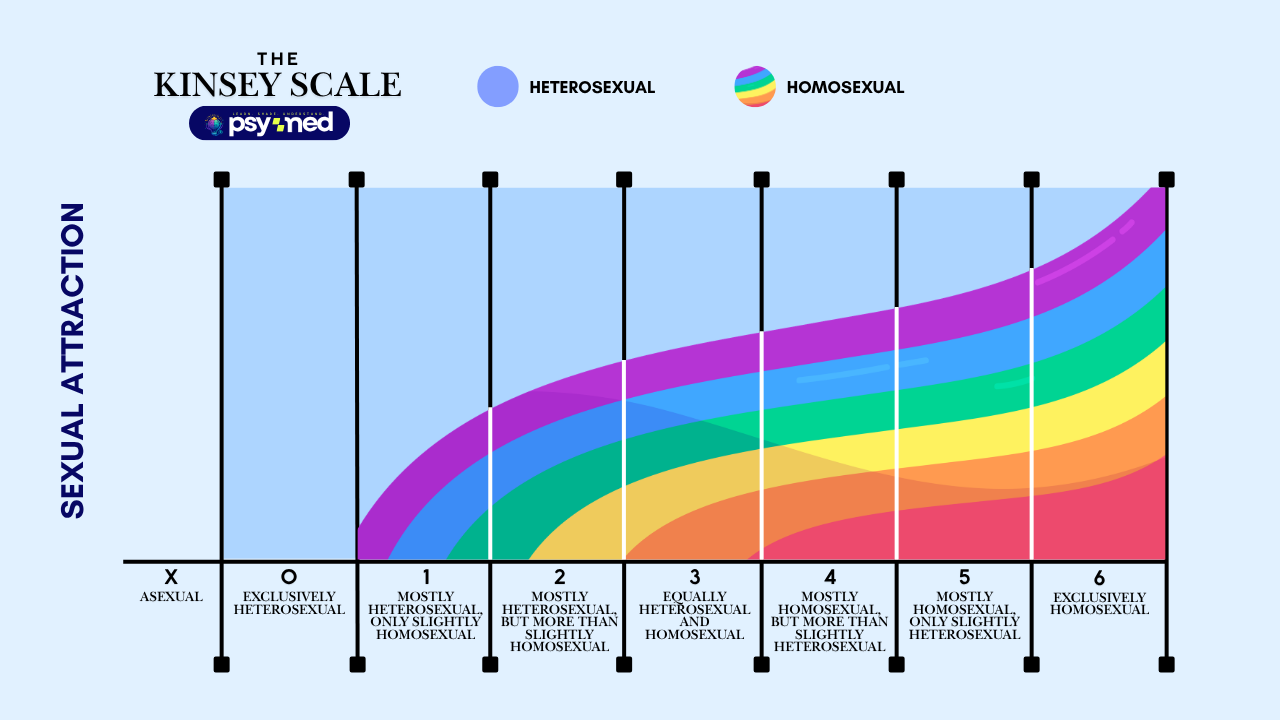
The Kinsey scale is a 0–6 rating of sexual behavior and attraction, from 0 (exclusively heterosexual) to 6 (exclusively homosexual), with an extra category, X, for people who reported no socio-sexual contacts or reactions. Its formal name is the Heterosexual-Homosexual Rating Scale. Alfred Kinsey’s research team first published it in Sexual Behavior in the Human Male (1948) and discussed it again in Sexual Behavior in the Human Female (1953). In the 1940s, Kinsey’s team interviewed thousands of people about their sexual histories. They found that sexual behavior, thoughts and feelings toward the same or opposite sex were not always consistent over time and often did not fit neat heterosexual or homosexual categories. So instead of sorting people into boxes, they placed them on a range. There is no official Kinsey scale test: the researchers assigned each rating from the interview, not from a questionnaire.Rating by rating
The 0–6 Kinsey scale explained
Here is each rating as the Kinsey Institute describes it, with a plain-language note. People at 0 reported exclusively opposite-sex behavior or attraction, and people at 6 exclusively same-sex. Ratings 1 to 5 cover varying levels of attraction or sexual activity with either sex. The original wording uses “heterosexual” and “homosexual” and compares only two sexes, which reflects research from the 1940s.-
Kinsey 0
Exclusively heterosexual. Attraction and experience only with the other sex. -
Kinsey 1 and 2
Predominantly heterosexual. At 1, only incidentally homosexual: mostly the other sex, with occasional same-sex attraction or experience. At 2, more than incidentally homosexual: mostly the other sex, with clear same-sex attraction or experience as well. -
Kinsey 3
Equally heterosexual and homosexual. About the same toward both. -
Kinsey 4 and 5
Predominantly homosexual. At 4, more than incidentally heterosexual: mostly the same sex, with clear other-sex attraction or experience as well. At 5, only incidentally heterosexual: mostly the same sex, with occasional other-sex attraction or experience. -
Kinsey 6
Exclusively homosexual. Attraction and experience only with the same sex. -
X
No socio-sexual contacts or reactions. No reported sexual activity or interest, so no number was given.
How the results line up with Kinsey’s ratings
A rough match based on the average of your answers. Kinsey assigned ratings from interviews, so this is an educational approximation, not his method.| Result | What your answers mostly described | Closest Kinsey rating |
|---|---|---|
| Kinsey 0 | Only toward a different gender | 0 |
| Kinsey 1 | Mostly toward a different gender, a little toward the same | 1 |
| Kinsey 2 | Mostly toward a different gender, more than a little toward the same | 2 |
| Kinsey 3 | Toward more than one gender, or answers that balance out near the middle | 3 |
| Kinsey 4 | Mostly toward the same gender, more than a little toward others | 4 |
| Kinsey 5 | Mostly toward the same gender, a little toward others | 5 |
| Kinsey 6 | Only toward the same gender | 6 |
| Some X | One or two answers about little or no attraction or interest; the rest about attraction or experience | Not placed on the 0–6 line |
| X | Three or more answers about little or no attraction or interest | Not placed on the 0–6 line (nearest: X) |
Beyond one number
What came after the Kinsey scale?
Later researchers built on Kinsey’s idea of a range. Their models rate attraction in more than one direction, split orientation into several parts, or add time frames. You don’t need to use them, but they show what a single Kinsey number can leave out; the limits are explained in the next section.-
01 Klein grid
Seven variables, three time frames
The Klein Sexual Orientation Grid, developed by Fritz Klein, rates seven variables of sexual orientation, including sexual attraction, behavior and fantasies, emotional and social preference, and sexual identity. Each is rated for the past, the present and the ideal. -
02 Storms scale
Two axes instead of one line
In 1980, Michael D. Storms published a model that plots eroticism on an X and Y axis. Measuring each direction separately allows a much greater range of descriptions than one line. -
03 Many measures
More than 200 scales
According to the Kinsey Institute, Kinsey’s, Storms’s and Klein’s are only three of more than 200 scales used to measure and describe sexual orientation. No single scale is the official one.
Then and now
History and limits of the Kinsey scale
Instead of sorting people into categories such as heterosexual, bisexual or homosexual, Kinsey’s team placed them on a range, and their ratings showed many people in between. Sexual Behavior in the Human Male (1948) and Sexual Behavior in the Human Female (1953) sold nearly a million copies together and were translated into 13 languages. The Kinsey Institute links them with a change in how the public thought about sexuality.
That influence came with real limits, which researchers have pointed out ever since. Knowing them helps you read any Kinsey number, including the result this quiz gives you.
One line, two sexes
On a single 0–6 line, more attraction to one sex means less to the other. The scale cannot show strong attraction to both, or little attraction to anyone, as positions on the line. That is why X sits outside it. The scale also compares only same-sex and opposite-sex attraction. The Kinsey Institute notes that it does not address all possible sexual identities, and it has no place for nonbinary people or for attraction that isn’t about gender.Attraction, behavior and identity blended
Researchers now describe sexual orientation as having three dimensions: behavior, attraction and identity. These do not always match. Someone can be attracted to a gender they have never dated, or identify as gay and be celibate. A single number blends them.A snapshot in time
Kinsey’s team assigned each rating from a face-to-face interview, so the number described a person’s history up to that point. Kinsey’s own data showed that behavior, thoughts and feelings were not always consistent over time. A rating describes one point in a life, not a permanent category.Reading your result
What your result can and can’t tell you
Your result summarizes the answers you gave today. Here is how to read it fairly, whatever it says.-
01 / WHAT IT CAN DO
A mirror for your answers
The quiz adds up 10 answers about attraction, fantasy, emotional connection, relationships and experience, and shows roughly where they sit on Kinsey’s range. That can give you words for patterns you have noticed in yourself. -
02 / WHAT IT CAN’T DO
Not a label or a diagnosis
Sexual orientation is not something a quiz or a doctor diagnoses. Your result doesn’t decide whether you are straight, gay, lesbian, bisexual, pansexual, asexual or anything else. Only you can decide how you identify, and some people choose no label at all. -
03 / OVER TIME
Answers can change
A 2022 National Academies report found that national data standards in several countries stress that identity, attraction and behavior can change over time. In a 10-year study of 79 lesbian, bisexual and unlabeled women, two-thirds changed the identity label they had used at the start. A different result later is not a mistake.
How the result works: each answer that describes attraction counts from 0 (only a different gender) to 6 (only the same gender), and your result is the Kinsey rating closest to their average. Answers about little or no attraction are counted separately, so they are never read as leaning toward any gender. If you haven’t had relationships or romantic or sexual experiences yet, those questions are left out and your result comes from the rest of your answers. Research background: the Kinsey Institute and the National Academies (2022).
Support and community
Where can you find support and community?
Questions about attraction and identity can feel exciting, confusing or both. You can explore them at your own pace.-
01
Take your time
There is no deadline for working out how you identify, and you don’t owe anyone a label. Notice what feels true for you, and come back to it whenever you like. -
02
Talk to someone you trust
A friend, family member, school counselor or LGBTQ+-affirming therapist can help you think things through. If you are deciding whether to tell people, the Coming Out Readiness Test can help you weigh your situation. -
03
Find community
LGBTQ+ centers, student groups and moderated online spaces can connect you with people who have asked the same questions. The Trevor Project’s peer support offers an affirming international community for LGBTQ+ young people.
Good questions to ask
Kinsey scale test FAQs
Short answers to the most common questions about the Kinsey scale and this test.
Editorial transparency
Sources and review information
Prepared by the PsyMed Editorial Team from the research sources listed here. We are writers and researchers, not clinicians or sexuality researchers, and no expert reviewer is claimed. The 10 questions are an original educational quiz, not Kinsey’s interview method or a validated scale. Read how we build our tests and who we are.Research and editorial references
- Kinsey Institute, Indiana University: The Kinsey Scale
- Kinsey AC, Pomeroy WB, Martin CE. Sexual Behavior in the Human Male. Philadelphia: W.B. Saunders; 1948.
- Kinsey AC, Pomeroy WB, Martin CE, Gebhard PH. Sexual Behavior in the Human Female. Philadelphia: W.B. Saunders; 1953.
- Klein F, Sepekoff B, Wolf TJ. Sexual orientation: a multi-variable dynamic process. J Homosex. 1985;11(1-2):35-49. doi:10.1300/J082v11n01_04
- American Institute of Bisexuality: The Klein Grid
- Storms MD. Theories of sexual orientation. J Pers Soc Psychol. 1980;38(5):783-792. doi:10.1037/0022-3514.38.5.783
- Diamond LM. Female bisexuality from adolescence to adulthood: results from a 10-year longitudinal study. Dev Psychol. 2008;44(1):5-14. doi:10.1037/0012-1649.44.1.5
- National Academies of Sciences, Engineering, and Medicine. Measuring Sex, Gender Identity, and Sexual Orientation (2022), chapter 5
- The Trevor Project: Get help
- The Trevor Project: Understanding asexuality
Your identity, your words
Your attractions are yours to explore.
Use the Kinsey scale test as a starting point for reflection. Whatever your result, only you decide what it means and what, if anything, to call it. Take the Kinsey scale test