
Identity self-reflection · Sexual orientation & gender identity
LGBTQ+ Test: Explore your sexuality and gender identity.
Questioning who you're attracted to, or how you feel about your gender? Answer 15 short questions, then learn what the terms mean and what a sexuality test can and can't tell you.
For self-reflection only, not a label. LGBTQ+ young people can reach The Trevor Project 24/7 at 1-866-488-7386 or by texting START to 678-678.
- THE SELF-CHECK15 short questionsAbout attraction, gender and where you are right now.
- PRIVACY FIRSTNo account neededFree to take, with no sign-up. Your result appears right away.
- CLEAR BOUNDARIESA reflection, not a labelOnly you can decide how you identify.
The self-check
Take the sexuality test
This free LGBTQ+ test asks 15 questions about who you are drawn to and how you feel about your gender. It is for anyone who is curious or questioning, teens and adults alike. There are no right answers, and the result is a starting point for reflection, not a verdict on who you are.
Your score
What the bands mean
- 0–10 Mostly straight and cisgender responses
- 11–18 Mixed responses or little attraction
- 19–29 Responses across the spectrum
- 30–38 Many LGBTQ+ responses
- 39–45 Mostly LGBTQ+ responses
Each answer scores 0 to 3, for a total of 0–45. The bands describe patterns in your answers. They are not identities, and no band is better or worse than another.
Who you are attracted to and your sense of your own gender are separate questions.
The short answer
What does LGBTQ+ mean?
LGBTQ+ stands for lesbian, gay, bisexual, transgender, queer and questioning, with the plus sign covering other sexual orientations and gender identities. Some of these words describe sexual orientation, which includes sexual, physical, romantic and emotional attraction, behavior and identity. Others describe gender identity, your inner experience of being a man, a woman, a nonbinary person or otherwise.
An LGBTQ+ test, or sexuality test, is a set of questions that helps you notice patterns in your own feelings. It cannot measure your identity from the outside. Questioning is common, and you do not have to figure everything out right now, or ever.
Being LGBTQ+ is not a condition or a problem to fix. It is one part of who a person is.
The World Health Organization moved gender incongruence out of the mental disorders chapter of its disease classification (ICD-11), reflecting current knowledge that trans and gender diverse identities are not conditions of mental ill-health. ICD-10 already stated that sexual orientation alone is not a disorder.
View sourceKnow the language
What the terms mean
Labels are tools, not boxes. People use them differently, and many people use more than one or none at all. For a longer guide, see LGBTQ+ identities explained.
Lesbian and gay
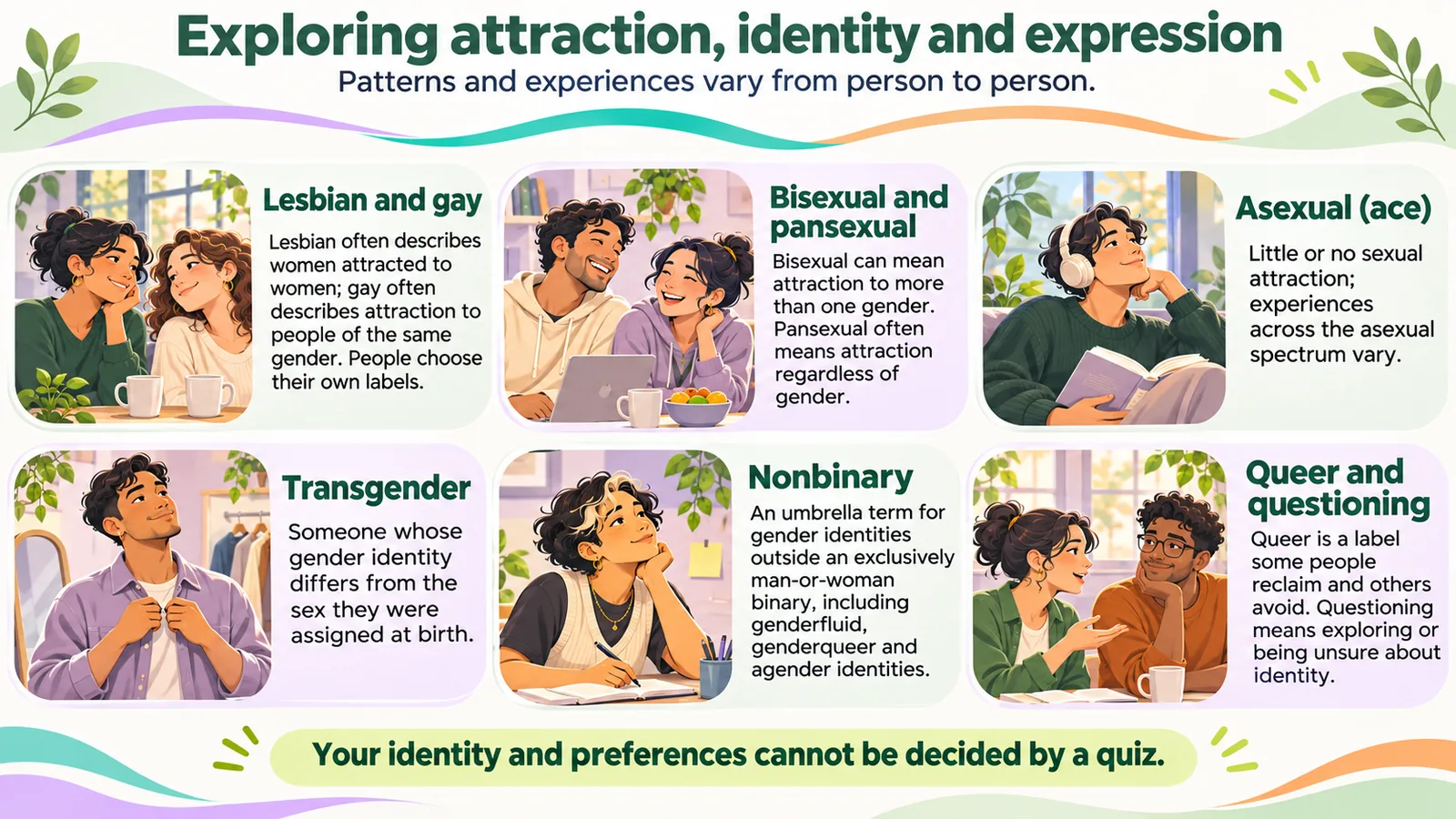
Lesbian commonly describes a woman attracted to other women; some nonbinary people also identify as lesbian. Gay commonly describes a man attracted to other men, and is sometimes used more broadly.
Bisexual and pansexual
Bisexual people can be attracted to more than one gender, not necessarily equally or at the same time. Pansexual means attraction to people of any gender, or regardless of gender.
Asexual (ace)
Little or no sexual attraction, or sexual attraction in a less typical way. It is a spectrum that includes demisexual people, who feel it only after a strong emotional connection.
Transgender
Someone whose gender identity differs from the sex they were assigned at birth. Cisgender describes someone whose gender identity matches it. Not every trans person transitions.
Nonbinary
An umbrella term for people whose gender identity or expression is outside the man/woman binary, including genderfluid, genderqueer and agender people. Some nonbinary people also identify as trans.
Queer and questioning
Queer is an umbrella term some people have reclaimed for not being straight and/or cisgender; others still find it hurtful. Questioning means you are still exploring, without a fixed label.
Sexual orientation vs. gender identity
Everyone has both. Knowing one does not tell you the other.
| Feature | Sexual orientation | Gender identity |
|---|---|---|
| The question it answers | Who am I drawn to, sexually, romantically or emotionally? | What is my inner sense of my own gender? |
| Examples | Straight, lesbian, gay, bisexual, pansexual, asexual. | Cisgender, transgender, nonbinary. |
| Kinds of attraction | Sexual and romantic attraction do not always line up. Some ace people describe romantic attraction with words like heteroromantic or biromantic. | Gender identity is about you, not about who you are attracted to. |
| Can both be part of LGBTQ+? | Yes. A trans person can be straight, gay, bisexual or any orientation, and a cisgender person can be any orientation too. | |
Inside the quiz
How this LGBTQ+ test works
Each question has four answers worth 0 to 3 points. The questions fall into three groups. The Kinsey Scale, which rates sexual feelings and behavior from 0 to 6, was created because Kinsey’s research found that people did not always fit into exclusively heterosexual or homosexual categories.
- 01 Attraction
Ten questions about attraction
Crushes, relationships, who catches your eye and the label that feels most honest. One answer in each question covers feeling little or no attraction.
- 02 Gender
Three questions about gender
How the gender you were assigned at birth fits, how you relate to the idea of gender as a spectrum, and how gender norms have felt to you.
- 03 Right now
Two questions about both
Whether you have questioned your orientation or gender, and which description feels most true for you today.
Because attraction and gender are added together, two people with the same score can have very different answers. An asexual cisgender person and a straight trans person can land in the same band. If one area matters more to you, the Am I Trans? Quiz looks at gender identity alone, and the Asexuality Spectrum Test looks at little or no attraction.
Reading your result
What your result can and can’t tell you
Your result reflects how you answered today. It can help you put words to something you have felt, but it cannot tell you who you are. Notice your own reaction to the result: relief, surprise or doubt can tell you as much as the band.
It can’t give you a label; only you decide
The bands describe patterns in your answers, not an identity. Your sexual orientation and gender identity are known from the inside. A quiz, a friend or a family member cannot decide them for you. You can use a label that fits, change it later, or use none.
Attraction can change for some people
Sexual orientation identity is not fixed for everyone. Some people are attracted to different genders at different times in their life, and that is not confusion.
A straight, cisgender result is a valid outcome
Questioning does not have to end in a new label. Honest reflection that brings you back to where you started is still worthwhile.
You are not alone
Support and community
Questioning can feel exciting, confusing or lonely, especially if the people around you are not supportive. These free services are run for LGBTQ+ people.
- 01 / LGBTQ+ YOUTH
The Trevor Project
Free, confidential crisis counseling for LGBTQ+ young people in the US, 24/7. Call 1-866-488-7386, text START to 678-678, or chat at thetrevorproject.org/get-help. Deaf and hard of hearing callers can use TTY at 1-866-803-3699.
- 02 / PEER SUPPORT
Trans Lifeline
A peer support hotline run by trans people for trans and questioning people, even if you are not in crisis or not sure you are trans. US (877) 565-8860, Canada (877) 330-6366. Check its website for current hours.
- 03 / YOUR OWN PACE
Coming out at your own pace
There is no one way to come out, and you may decide to be out only to yourself. If you are thinking about telling someone, the Coming Out Readiness Test can help you weigh safety, timing and support.
Check each service’s website for current hours and contact options. You don’t need a quiz result to reach out.
Practical next steps
What can you do after taking the test?
There is no required next step, and no result you need to act on.
- 01
Trust yourself over the score
The result reflects how you answered in one moment. Notice your reaction to it: a surprising result can also be a sign of recognition.
- 02
Look at one area at a time
If one area matters more to you, the Kinsey Scale Test looks only at attraction, and the Am I Trans? Quiz looks only at gender identity.
- 03
Take as long as you need
Questioning is common, and you do not have to figure everything out right now, or ever. Talking it through with someone you trust can help.
In the US, call or text 988 (Suicide & Crisis Lifeline, 24/7). Call 911 for an emergency. Elsewhere, contact local emergency services or find a helpline at findahelpline.com. A quiz is not the right tool for a crisis.
Good questions to ask
Sexuality test FAQs
Short, honest answers to common questions about LGBTQ+ tests, sexual orientation and gender identity.
Only you can answer that, and you do not have to answer it today. A sexuality quiz can help you notice patterns, such as who you have had crushes on, who you picture a relationship with, and whether you feel sexual attraction at all. Many people find a word that fits, some use more than one, and some use none. If you are still exploring, “questioning” is a valid place to be.
No. Sexual orientation and gender identity are known from the inside and cannot be measured from the outside. This test is an original self-reflection quiz, not a validated scale. It reflects your answers back to you and can give you words to explore, but the result is not a label and it is not a verdict.
This quiz is written in plain language for anyone who is questioning, including teens. Questioning your identity is really common, and exploring your gender identity is normal at any age. If you are a young LGBTQ+ person and want to talk, The Trevor Project offers free, confidential support 24/7 by phone, text and chat.
Sexual orientation is about who you are attracted to, sexually, romantically or emotionally. Gender identity is your inner sense of being a man, a woman, a nonbinary person or otherwise. They are separate: a transgender person can be straight, gay, bisexual or any other orientation. This test asks about both, so one score can come from either.
For some people, yes. Sexual orientation identity is not fixed for everyone, and some people are attracted to different genders at different times in their life. A change is not proof that you were confused before. Other people feel the same way their whole life, and that is just as valid.
Queer is an umbrella term for people who are not straight and/or cisgender. It was used as a slur against LGBTQ+ people and has been reclaimed by many, but some people are still not comfortable with it. Use it for yourself if it feels right, and mirror the words other people use for themselves.
Trust yourself over the score. The result reflects how you answered in one moment, and this quiz adds attraction and gender together, so a band can hide which area mattered. A surprising result can also be a sign of recognition. Notice your reaction, read the terms above, and take as long as you need.
No. Coming out is a personal decision, and there is no one way to do it. Some people come out to a few people, some to everyone, and some only to themselves. Your safety comes first. If you are thinking about it, the Coming Out Readiness Test can help you plan.
Editorial transparency
Sources and review information
Prepared by the PsyMed Editorial Team from the sources listed here. We are writers and researchers, not clinicians, and no licensed clinician is claimed as a reviewer. Read how we build our tests and who we are.
References
- The Trevor Project: The Coming Out Handbook
- The Trevor Project: Allyship in Action, LGBTQ+ Key Terms (2024)
- The Trevor Project: Understanding Bisexuality
- The Trevor Project: Pansexuality, What It Is, What It Isn’t
- The Trevor Project: Understanding Asexuality
- The Trevor Project: Get Help (crisis services)
- Trans Lifeline: Hotline
- 988 Suicide & Crisis Lifeline
- World Health Organization: Gender incongruence and transgender health in the ICD
- Cochran SD, Drescher J, Kismödi E, et al. Proposed declassification of disease categories related to sexual orientation in the International Statistical Classification of Diseases and Related Health Problems (ICD-11). Bull World Health Organ. 2014;92(9):672-679.
- Kinsey Institute: The Kinsey Scale
Take your time
However you identify, you deserve to feel at home in it.
Use this quiz to put your thoughts in order, explore the words that might fit, and reach out for support whenever you want it.
Take the sexuality test