
Free Burnout Test — Are You Burned Out?
Burnout isn’t just being tired after a hard week. It’s the deep, accumulated exhaustion that comes from chronic stress — most often work stress — that hasn’t been successfully managed. It shows up as physical and emotional depletion, growing cynicism or detachment from your work, and a sinking sense that you’re no longer effective at what you do. Left unaddressed, it doesn’t resolve on its own; it tends to deepen.
This free burnout test measures all three of those dimensions across 15 questions, based on the World Health Organization’s ICD-11 model of burnout. It takes a couple of minutes, and your results are private and instant.
One important framing point before you begin: the World Health Organization classifies burnout as an “occupational phenomenon,” not a medical condition (ICD-11). A high score means you’re reporting significant exhaustion and depletion — it doesn’t mean you have a clinical disorder. This is a self-reflection tool to help you see where you stand, not a diagnosis.
What Is Burnout?
Burnout is a syndrome resulting from chronic workplace stress that has not been successfully managed, as defined by the World Health Organization in the ICD-11 (2019). The WHO characterizes it by three dimensions: feelings of energy depletion or exhaustion; increased mental distance from one’s job, or feelings of negativism or cynicism related to one’s job; and reduced professional efficacy. Critically, the WHO places burnout in the ICD-11 chapter on “factors influencing health status” — meaning it is explicitly not classified as a medical condition or mental disorder, but as an occupational phenomenon that can affect health.
The concept originated in the 1970s — psychologist Herbert Freudenberger coined the clinical use of “burnout” in 1974 — and was developed into a measurable construct largely through the work of Christina Maslach, whose research established the influential three-dimensional model of exhaustion, cynicism, and reduced accomplishment. That model underlies both the WHO definition and the major burnout instruments used by researchers today, including the Maslach Burnout Inventory (MBI) and the Copenhagen Burnout Inventory (CBI).
Burnout is specifically an occupational phenomenon — the WHO notes it should not be applied to describe experiences in other areas of life. That said, the exhaustion at its core spills into and is worsened by everything else, which is why burnout so often bleeds into your energy for family, friends, and the things you used to enjoy.
The Three Dimensions of Burnout
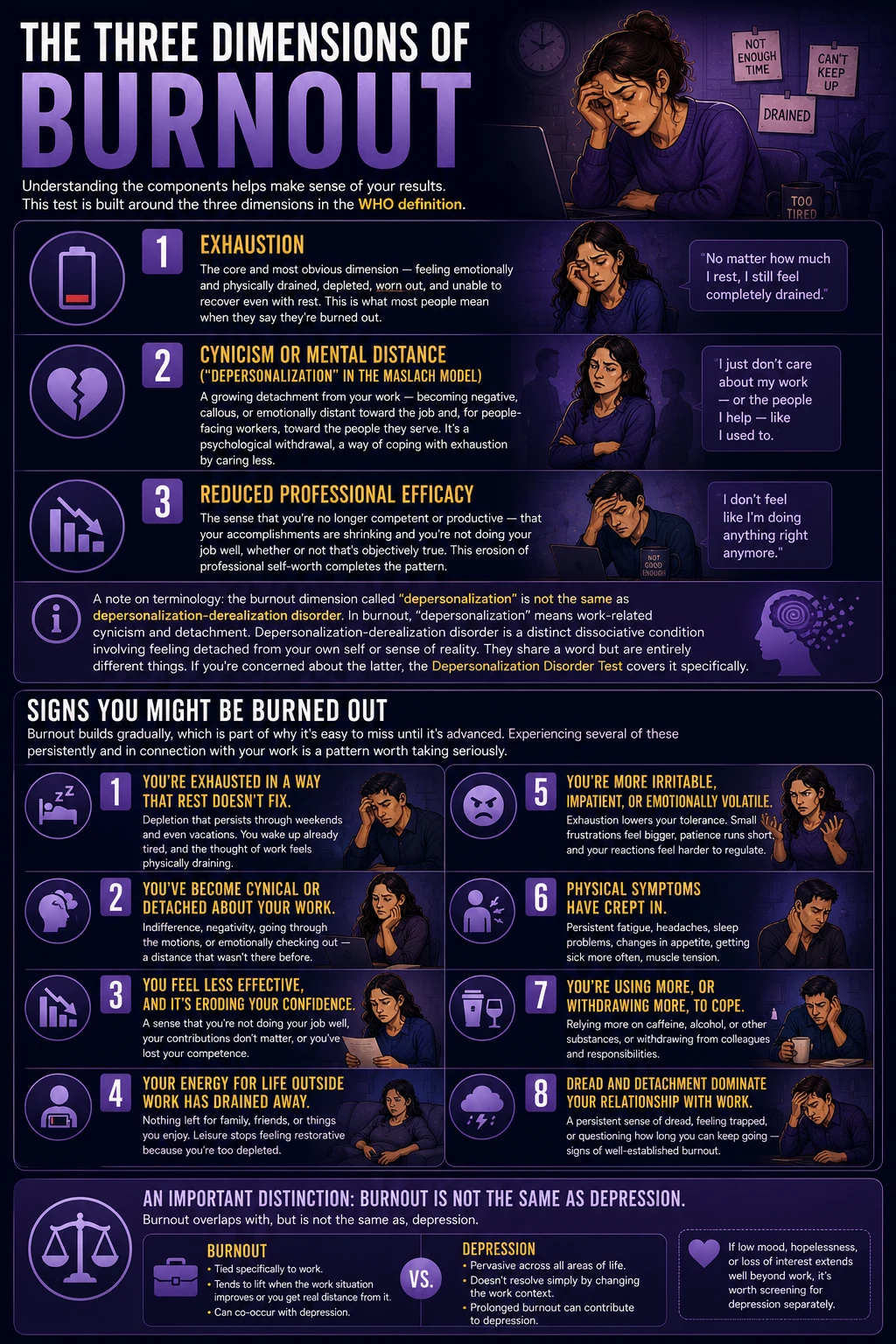
Understanding the components helps make sense of your results. This test is built around the three dimensions in the WHO definition:
Exhaustion is the core and most obvious dimension — feeling emotionally and physically drained, depleted, worn out, and unable to recover even with rest. This is what most people mean when they say they’re burned out.
Cynicism or mental distance (called “depersonalization” in the Maslach model) is a growing detachment from your work — becoming negative, callous, or emotionally distant toward the job and, for people-facing workers, toward the people they serve. It’s a psychological withdrawal, a way of coping with exhaustion by caring less.
Reduced professional efficacy is the sense that you’re no longer competent or productive — that your accomplishments are shrinking and you’re not doing your job well, whether or not that’s objectively true. This erosion of professional self-worth completes the pattern.
A note on terminology, because it causes real confusion: the burnout dimension called “depersonalization” is not the same as depersonalization-derealization disorder. In burnout, “depersonalization” means work-related cynicism and detachment. Depersonalization-derealization disorder is a distinct dissociative condition involving feeling detached from your own self or sense of reality. They share a word but are entirely different things. If you’re concerned about the latter, the Depersonalization Disorder Test covers it specifically.
Signs You Might Be Burned Out
Burnout builds gradually, which is part of why it’s easy to miss until it’s advanced. These are the signs most consistent with occupational burnout, spanning the exhaustion, cynicism, and efficacy dimensions. Experiencing several of them, persistently and in connection with your work, is a pattern worth taking seriously.
You’re exhausted in a way that rest doesn’t fix. The hallmark of burnout is depletion that persists through weekends and even vacations. You wake up already tired, and the thought of another day at work feels physically draining before it’s begun.
You’ve become cynical or detached about your work. Things you once cared about now provoke indifference or negativity. You may notice yourself becoming callous, going through the motions, or emotionally checking out — a psychological distance that wasn’t there before.
You feel less effective, and it’s eroding your confidence. A growing sense that you’re not doing your job well, that your contributions don’t matter, or that you’ve lost your competence — regardless of your actual performance. Accomplishments feel hollow or absent.
Your energy for life outside work has drained away. By the time work is done, there’s nothing left for family, friends, or the things you enjoy. Leisure stops feeling restorative because you’re too depleted to engage with it.
You’re more irritable, impatient, or emotionally volatile. Exhaustion lowers your tolerance. Small frustrations feel bigger, patience runs short, and your emotional reactions feel harder to regulate than they used to.
Physical symptoms have crept in. Burnout frequently shows up in the body — persistent fatigue, headaches, sleep problems, changes in appetite, getting sick more often, muscle tension. Chronic stress has physiological costs.
You’re using more, or withdrawing more, to cope. Increased reliance on caffeine, alcohol, or other substances to get through the day, or withdrawing from colleagues and responsibilities, can both be coping responses to burnout.
Dread and detachment dominate your relationship with work. A persistent sense of dread about work, a feeling of being trapped, or questioning how long you can keep going — these point to burnout that’s well established rather than passing stress.
An important distinction: burnout overlaps with, but is not the same as, depression. Burnout is tied specifically to work and tends to lift when the work situation genuinely improves, or you get real distance from it; depression is pervasive across all areas of life and doesn’t resolve simply by changing the work context. The two can co-occur, and prolonged burnout can contribute to depression. If low mood, hopelessness, or loss of interest extends well beyond work, it’s worth screening for depression separately.
How This Burnout Test Works
This test contains 15 questions covering the three dimensions of burnout: exhaustion, cynicism or mental distance from work, and reduced sense of effectiveness. For each question, choose how often the experience applies to you, based on how you’ve felt recently:
Never = 0 | Rarely = 1 | Sometimes = 2 | Often = 3 | Always = 4
Your answers are added to a total score from 0 to 60, which places you in one of four ranges from low to high burnout. Answer based on how you’ve felt recently — burnout is a state that changes over time, not a fixed trait, which is also the hopeful part: it can improve.
This is an educational self-reflection tool grounded in the WHO’s ICD-11 model of burnout and the wider burnout literature. It is not a validated clinical instrument, and it does not diagnose anything. For a formal assessment, researchers and clinicians use validated tools such as the Maslach Burnout Inventory or the Copenhagen Burnout Inventory, discussed below.
Understanding Your Burnout Test Score
| Score Range | Level | What It Suggests |
|---|---|---|
| 0 – 15 | Low Burnout | Burnout doesn’t appear to be a significant problem right now. Normal fatigue may be present without the sustained depletion of burnout. |
| 16 – 30 | Mild Burnout | Some early signs of burnout. A useful signal to address the sources of stress before they deepen. |
| 31 – 45 | Moderate Burnout | A meaningful level of burnout that’s likely affecting your wellbeing. Worth addressing the underlying causes and considering support. |
| 46 – 60 | High Burnout | Strong signs of burnout across multiple dimensions. Real changes and support are advised; this is worth treating as a priority. |
What Causes Burnout?
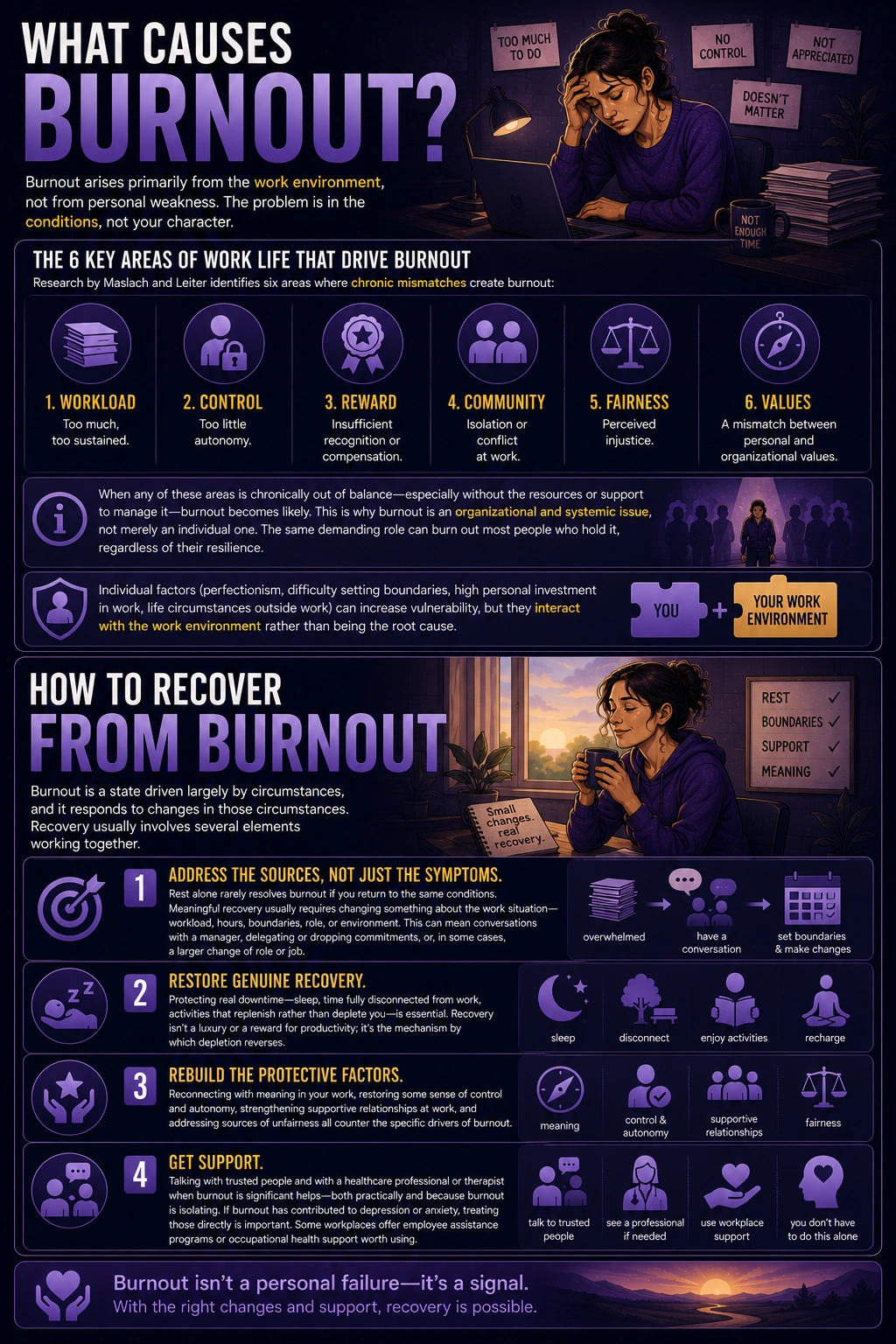
Burnout arises primarily from the work environment, not from personal weakness — a crucial point, because it locates the problem (and much of the solution) in conditions rather than character. Maslach and Leiter’s research identified six key areas of work life where chronic mismatches drive burnout: workload (too much, too sustained), control (too little autonomy), reward (insufficient recognition or compensation), community (isolation or conflict at work), fairness (perceived injustice), and values (a mismatch between personal and organizational values).
When any of these areas is chronically out of balance — especially without the resources or support to manage it — burnout becomes likely. This is why burnout is increasingly understood as an organizational and systemic issue, not merely an individual one: the same demanding role can burn out most people who hold it, regardless of their resilience. Individual factors (perfectionism, difficulty setting boundaries, high personal investment in work, life circumstances outside work) can increase vulnerability, but they interact with the work environment rather than being the root cause.
How to Recover From Burnout
Because burnout is a state driven largely by circumstances, it responds to changes in those circumstances — which is genuinely hopeful. Recovery generally involves several elements working together.
Address the sources, not just the symptoms. Rest alone rarely resolves burnout if you return to the same conditions. Meaningful recovery usually requires changing something about the work situation — workload, hours, boundaries, role, or environment. This can mean conversations with a manager, delegating or dropping commitments, or, in some cases, a larger change of role or job.
Restore genuine recovery. Protecting real downtime — sleep, time fully disconnected from work, activities that replenish rather than deplete you — is essential. Recovery isn’t a luxury or a reward for productivity; it’s the mechanism by which depletion reverses.
Rebuild the protective factors. Reconnecting with meaning in your work, restoring some sense of control and autonomy, strengthening supportive relationships at work, and addressing sources of unfairness all counter the specific drivers of burnout.
Get support. Talking with trusted people and with a healthcare professional or therapist when burnout is significant helps — both practically and because burnout is isolating. If burnout has contributed to depression or anxiety, treating those directly is important. Some workplaces offer employee assistance programs or occupational health support worth using.
Frequently Asked Questions
What is burnout?
Burnout is a syndrome resulting from chronic workplace stress that hasn’t been successfully managed, defined by the WHO in the ICD-11 (2019). It has three dimensions: exhaustion or energy depletion; increased mental distance from one’s job (cynicism or negativity); and reduced professional efficacy. Importantly, the WHO classifies burnout as an “occupational phenomenon,” not a medical condition or mental disorder — it can affect health, but it isn’t itself a diagnosis. Burnout is specifically tied to work, distinguishing it from general stress or depression, which are broader.
Is burnout the same as depression?
No, though they overlap and can co-occur. Burnout is specifically tied to work or occupational context, and it tends to improve when the work situation genuinely improves or you get real distance from it. Depression is pervasive across all areas of life, not just work, and it doesn’t resolve simply by changing the work context — it involves persistent low mood, loss of interest, and other symptoms that extend everywhere. Prolonged burnout can contribute to developing depression, and the exhaustion of burnout can look like depression’s fatigue. If your low mood, hopelessness, or loss of interest extends well beyond work, it’s worth screening for depression separately with the Depression Test.
Is burnout a mental illness or medical diagnosis?
No. The World Health Organization explicitly classifies burnout as an “occupational phenomenon” rather than a medical condition. In the ICD-11, it appears in the chapter on “factors influencing health status or contact with health services” — not among the mental or behavioral disorders. This means burnout is understood as a work-related syndrome that can affect your health and wellbeing, but it is not itself a diagnosable mental illness. A high burnout score indicates significant exhaustion and depletion; it doesn’t mean you have a clinical disorder. That said, burnout can coexist with or contribute to conditions like depression and anxiety, which are separate and diagnosable.
How accurate is this burnout test?
This test is an educational self-reflection tool, not a validated clinical instrument. It’s built around the WHO’s ICD-11 three-dimensional model of burnout and the established burnout literature, and it can help you recognize whether your experiences align with burnout and decide whether to take action. But it doesn’t diagnose anything, and it isn’t a substitute for validated research instruments (such as the Maslach Burnout Inventory or Copenhagen Burnout Inventory) used by professionals, or for a conversation with a healthcare provider. Treat your result as a meaningful starting point for reflection, not a definitive measurement.
What is the Maslach Burnout Inventory (MBI)?
The Maslach Burnout Inventory (MBI), developed by Christina Maslach and Susan Jackson, is the most historically influential burnout measure and established the three-dimensional model of burnout (exhaustion, depersonalization/cynicism, and reduced personal accomplishment). It’s widely used in research and organizational settings. The MBI is a proprietary, copyrighted instrument owned by Mind Garden, Inc., and using or reproducing it requires a paid license — which is why this free test is not the MBI itself, but an educational tool built on the same underlying WHO/Maslach model. If you need the official MBI (for research or organizational use), it’s available through Mind Garden.
What is the Copenhagen Burnout Inventory (CBI)?
The Copenhagen Burnout Inventory (CBI) is a validated, public-domain burnout assessment developed by Tage Kristensen and colleagues (2005). It measures burnout across three subscales — personal, work-related, and client-related burnout — each scored separately from 0 to 100. Unlike the proprietary MBI, the CBI is free to use, and its exhaustion scale correlates strongly with the MBI’s, indicating they measure the same core construct. The CBI is designed to report its three subscales separately rather than as a single combined score. This test draws on the same underlying model but uses its own questions and a single combined score for simplicity; if you want the full three-subscale CBI, it’s freely available in the research literature (Kristensen et al., 2005).
Who is most at risk of burnout?
Burnout was first studied in human-services and healthcare workers, who face high emotional demands, and these fields still show high rates. But burnout is now recognized across virtually all occupations. Risk is driven more by work conditions than by profession alone: chronic work overload, low control or autonomy, insufficient reward or recognition, workplace conflict or isolation, perceived unfairness, and a mismatch between personal and organizational values all raise risk. Individual factors — perfectionism, difficulty setting boundaries, high personal investment in work, and demanding life circumstances outside work — can increase vulnerability, but they interact with the work environment rather than being the primary cause.
Related Tests
- Clinical Depression Test — burnout overlaps with depression but is work-specific; if low mood extends beyond work, screen for depression separately
- Anxiety Test — chronic work stress and burnout frequently co-occur with anxiety; worth assessing alongside
- Generalized Anxiety Disorder Test — persistent worry about work and performance can overlap with and feed burnout
- Depersonalization Disorder Test — clarifies the distinction between burnout’s “depersonalization” (work cynicism) and the separate dissociative disorder that shares the name
- ADHD Test — undiagnosed ADHD can make work disproportionately depleting and raise burnout risk; worth considering if work exhaustion is longstanding
- Self-Esteem Test — the reduced sense of efficacy in burnout can erode self-worth; relevant if confidence has dropped
References
- World Health Organization. (2019). Burn-out an “occupational phenomenon”: International Classification of Diseases (ICD-11). [Three dimensions; occupational phenomenon, not a medical condition] who.int
- Maslach, C., & Leiter, M.P. (2016). Understanding the burnout experience: recent research and its implications for psychiatry. World Psychiatry, 15(2), 103–111. [Three-dimensional model; six areas of work life] pmc.ncbi.nlm.nih.gov
- Kristensen, T.S., Borritz, M., Villadsen, E., & Christensen, K.B. (2005). The Copenhagen Burnout Inventory: A new tool for the assessment of burnout. Work & Stress, 19(3), 192–207. [Public-domain 3-subscale burnout measure] tandfonline.com
- Maslach, C., & Jackson, S.E. (1981). The measurement of experienced burnout. Journal of Occupational Behavior, 2(2), 99–113. [Original MBI; three-dimensional model — proprietary, Mind Garden]
- Freudenberger, H.J. (1974). Staff burn-out. Journal of Social Issues, 30(1), 159–165. [Origin of the clinical concept of burnout]
- UCSF Stress Measurement Network. Burnout & the Maslach Burnout Inventory. [MBI is copyrighted; permission required from Mind Garden] stressmeasurement.org
Related Tests
See All Quiz →
You may also like
See All Quiz →
Emotional and Trait Assessments · Personality
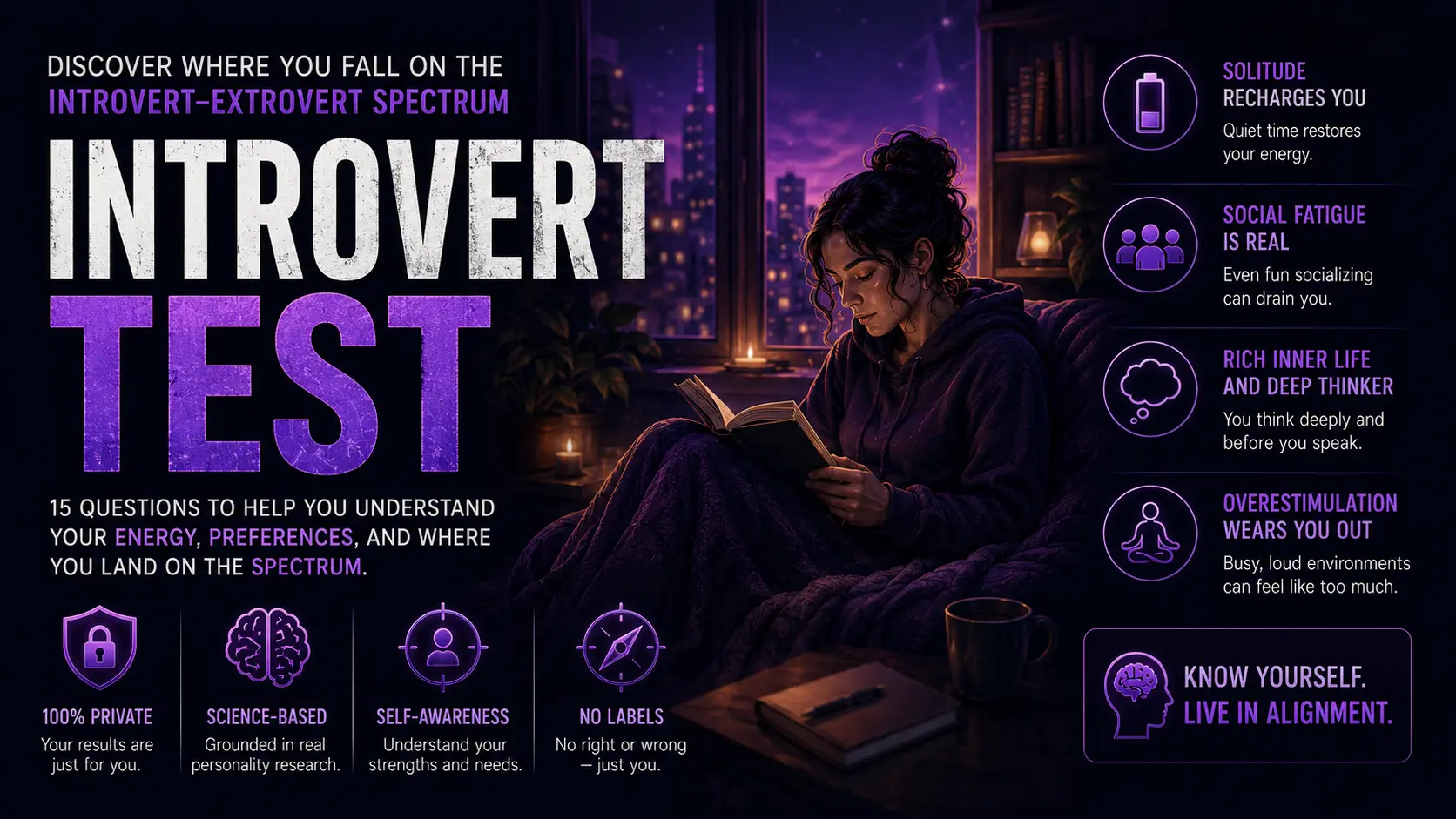
Introvert Test: Are You an Introvert, Extrovert, or Ambivert?
→