


Personality Complex Test: Which Complex Do You Have?
Take the free Personality Complex Test to discover your dominant complex — inferiority, superiority, savior, victim, or imposter. 15 questions, instant results.
Published Updated
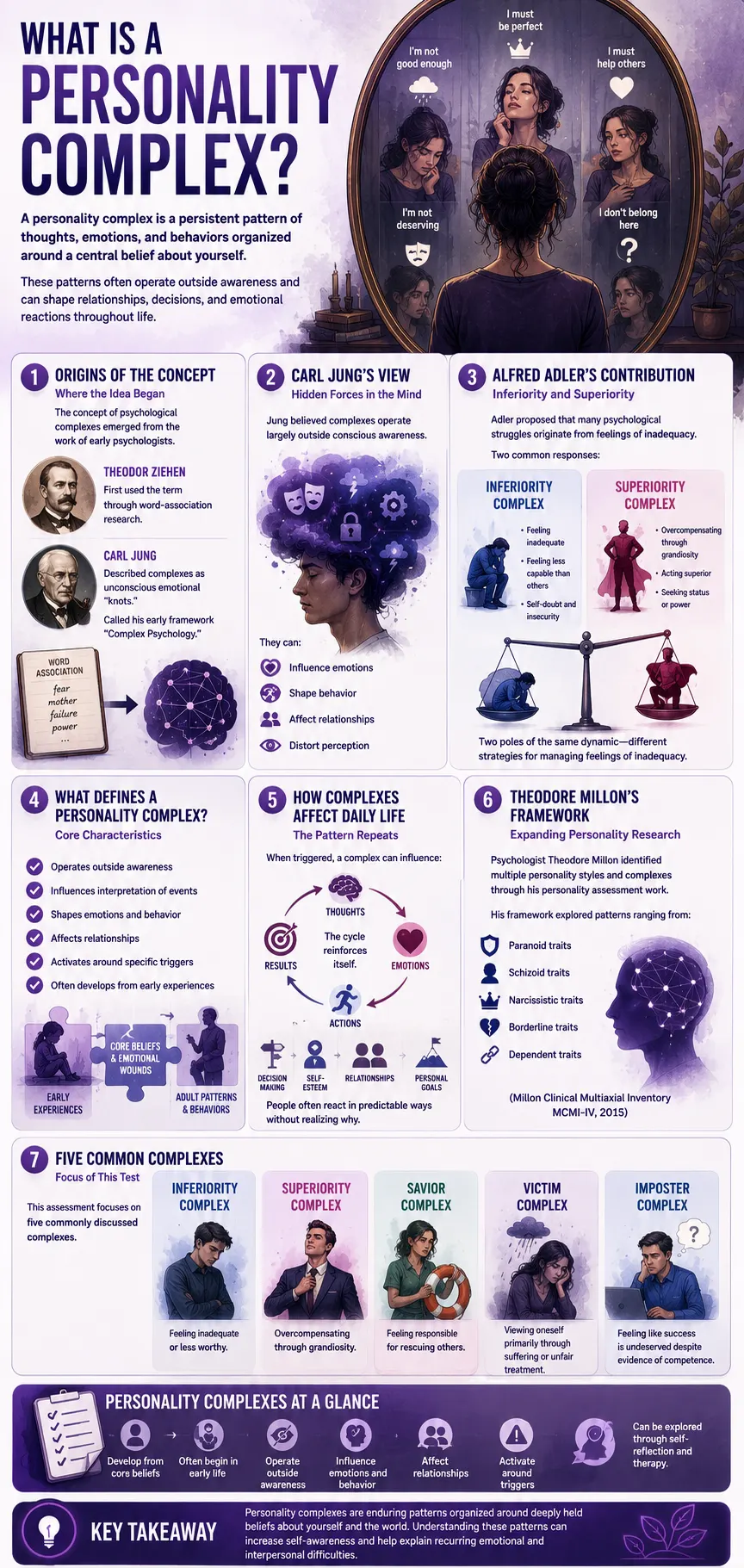
The word “complex” in psychology does not mean complicated. It means something more precise: a cluster of emotionally charged thoughts, memories, and perceptions organized around a central theme — a node in the unconscious, as Carl Jung described it — that operates as a persistent lens through which a person interprets themselves, other people, and the world (Wikipedia: Complex (psychology); Jung, 1921).
Everyone has complexes. The question is not whether you have them but which ones are most active in your psychology, how intensely they are driving your behavior, and whether you are running them or they are running you. The five complexes covered in this test — inferiority, superiority, savior, victim, and imposter — are among the most psychologically significant, most widely researched, and most commonly experienced in the general population.
This free Personality Complex Test screens all five simultaneously. 15 questions — three per complex. Instant results showing your profile across all five, with the most prominent complex identified.
What Is a Personality Complex?
A personality complex is a cluster of emotionally charged thoughts, memories, and beliefs organized around a central theme — such as inferiority, superiority, or feeling like an imposter — that operates largely outside conscious awareness and quietly shapes how you see yourself and react to the world. The word “complex” here doesn’t mean “complicated”; it’s a precise psychological term for a persistent inner lens that colors your interpretation of everyday experience.
The concept comes from two founding traditions. The German psychiatrist Theodor Ziehen first used the term, identifying it through word-association experiments. Carl Jung then developed the theoretical framework, describing a complex as a node in the unconscious — a knot of feelings and beliefs, detectable indirectly through behavior that’s puzzling or hard to account for (Jung, Psychological Types, 1921). Jung’s ideas became so central that he originally called his entire body of work “Complex Psychology.” The most clinically influential complex theory came from Alfred Adler — Jung’s contemporary and rival — whose Individual Psychology introduced the inferiority complex in 1907 and elaborated it in Understanding Human Nature (1927). Adler’s key insight was that the inferiority complex and its compensatory counterpart, the superiority complex, are two poles of a single dynamic — both rooted in feelings of inadequacy, and both strategies for managing them.
In practice, a personality complex is a persistent, theme-shaped pattern of thought and emotion that shapes how you read ambiguous situations, influences your relationships and decisions in recognizable ways, tends to activate around specific triggers, and usually traces back to an early emotional wound. This test screens for five of the most widely experienced complexes: the inferiority, superiority (god), savior/messiah, victim/martyr, and imposter complexes. If you want to know which theme runs strongest in you, you’re in the right place — take the test below.
A note on the two meanings of “personality complex.” The word is used in two slightly different ways, and knowing which you’re after points you to the right test. The sense above — an emotionally charged psychological theme in the Jungian and Adlerian tradition — is what this test measures. Some people, though, use “personality complex” more loosely to mean their broader personality style or the deeper, disorder-level personality patterns clinicians describe. (That’s the sense behind clinical models like Theodore Millon’s personality styles, which map closely to the recognized personality disorders.) If it’s those wider personality styles and disorder patterns you’re looking for — narcissistic, borderline, avoidant, and the rest — our Personality Disorder Tests hub covers them in depth. The rest of this page focuses on the five psychological complexes above.
The 5 Personality Complexes This Test Covers
1. The Inferiority Complex — introduced by Alfred Adler in 1907 and fully theorized in 1927 — is characterized by a pervasive, stable sense of being fundamentally less capable, less worthy, or less deserving than other people. Adler proposed that all humans begin life with inherent feelings of inferiority (as small, dependent children in a world of adults) and that psychological health involves overcoming these through productive striving. A complex develops when the inferiority feelings become fixed, generalized, and self-reinforcing — producing chronic avoidance, excessive self-criticism, hypersensitivity to judgment, and a persistent comparison of oneself to others that almost always produces an unfavorable result.
Research by Cekrlija and colleagues (2023, Personality and Individual Differences, N=1,046) found that inferiority complex is most strongly predicted by neuroticism among the Big Five personality traits and is also associated with narcissism — suggesting the two are not as distinct as they might appear, and that narcissism in some cases represents a response to inferiority rather than its absence.
2. The Superiority/God Complex — also introduced by Alfred Adler (1927) — is the compensatory response to inferiority feelings: an exaggerated overestimation of one’s own abilities, importance, and entitlement that functions as a psychological defense against the underlying inferiority. The person with a superiority complex presents as confident, dismissive, or contemptuous of others, and experiences a chronic need to assert dominance, expertise, or specialness — often in precisely the domains where the underlying inferiority wound is located. Adler distinguished this from genuine confidence: the superiority complex is driven and compulsive in a way that authentic self-assurance is not.
The research by Cekrlija et al. (2023) found superiority complex associated with narcissism and — uniquely, compared to inferiority — with psychopathy: the callousness and grandiosity of psychopathic personality independently predicted superiority feelings above and beyond narcissism and the Big Five.
3. The Savior/Messiah Complex (also called hero complex or white knight complex) describes a persistent compulsion to rescue, fix, or save others — driven not by genuine altruism but by an internal need that the helping fulfills. The savior complex person typically: feels uniquely positioned or called to help; has difficulty allowing others to solve their own problems; derives significant self-worth from being needed; becomes distressed when their help is rejected; and often sacrifices their own needs, relationships, or wellbeing in service of others. The underlying dynamic is typically a mix of identity organization around helping (the self is only valuable when helping), control needs (helping is a way of maintaining order and reducing anxiety), and sometimes narcissistic specialness (I am the one who can save this person when no one else can).
4. The Victim/Martyr Complex describes a stable orientation toward life in which the self is consistently perceived as wronged, disadvantaged, exploited, or singled out for unfair treatment — and in which this victimhood has become a central identity rather than a response to specific circumstances. The person with a victim complex: interprets ambiguous situations through a default lens of being wronged; derives social and interpersonal benefits from the victim position; has difficulty accepting responsibility for outcomes; and may resist improvement or resolution because the victim identity has become self-defining. This is distinct from genuine victimization — the complex describes a chronic orientation, not a response to actual harm.
5. The Imposter Complex (also called impostor syndrome or the impostor phenomenon) was first formally described by psychologists Dr. Pauline Clance and Dr. Suzanne Imes at Georgia State University in their landmark 1978 paper “The Impostor Phenomenon in High Achieving Women” (Psychotherapy: Theory, Research & Practice, 15(3), 241–247). It is characterized by a persistent inability to internalize genuine accomplishments — the private belief that one’s success has been achieved through luck, charm, timing, or deception rather than ability, and that eventual exposure as a fraud is inevitable. Research estimates that approximately 70% of people experience imposter feelings at some point in their lives (Sakulku & Alexander, 2011, International Journal of Behavioral Science). Unlike the other four complexes, the imposter complex typically co-occurs with genuine achievement and high performance.
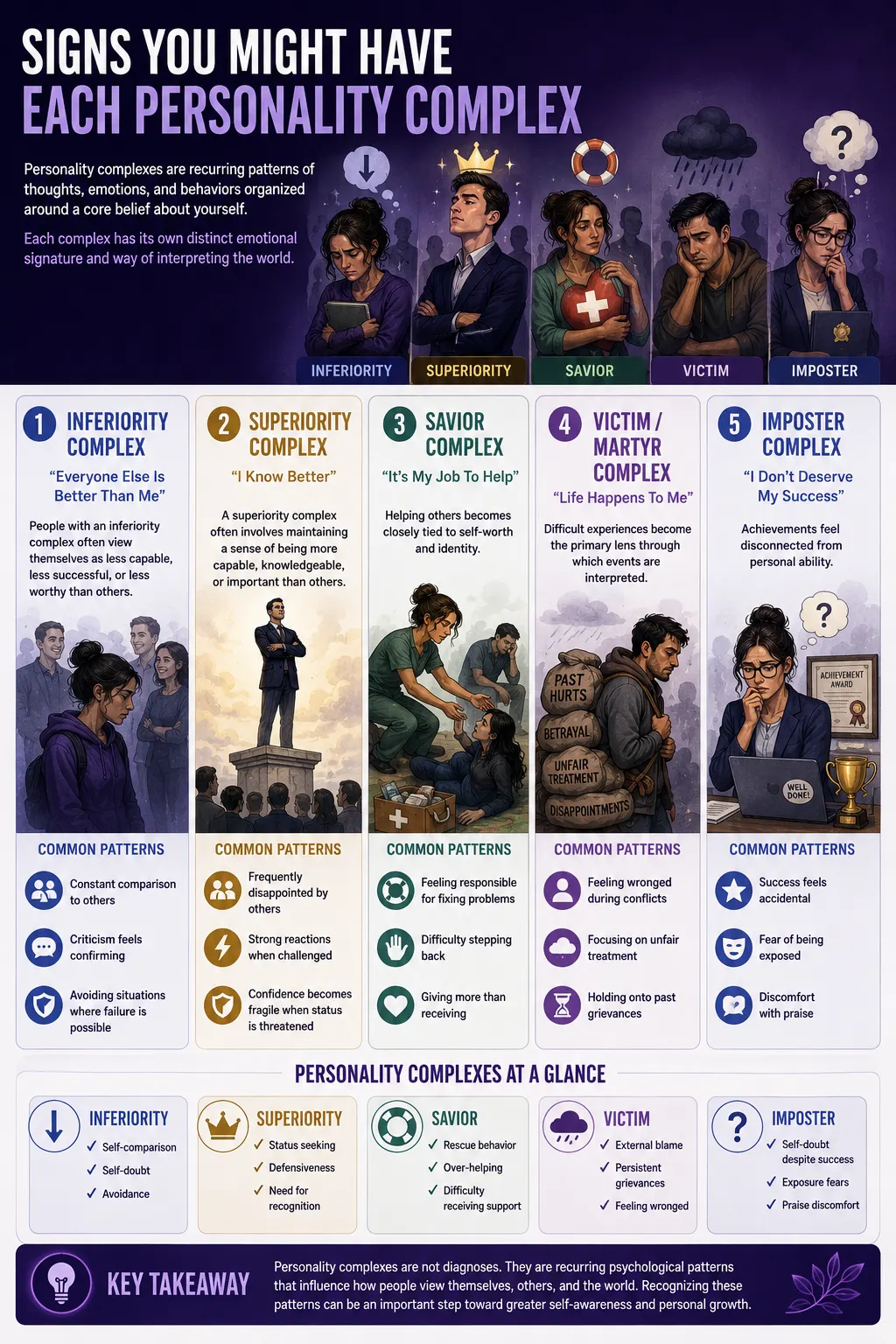
Signs You Might Have Each Personality Complex
Signs of an Inferiority Complex:
You compare yourself to others constantly — and almost always come out worse. The comparison is automatic, involuntary, and systematic. You notice others’ accomplishments with a specific quality of pain — not simple envy, but a confirmation of something you already believe about the gap between what they are and what you are.
Criticism, rejection, or failure confirms something you already believe about yourself rather than updating a belief. For most people, criticism is uncomfortable but surprising. For the person with an inferiority complex, it is confirming — it matches the underlying self-assessment that was already present. The criticism lands as evidence, not as an event to evaluate.
You avoid situations where you might be exposed as less capable, less successful, or less worthy than others. The avoidance is protective — you don’t enter arenas where the inferiority might become visible. This includes social contexts, professional opportunities, and relationships where the self-exposure that vulnerability requires feels too dangerous.
Signs of a Superiority/God Complex:
You find others consistently disappointing — most people fail to meet your standards of intelligence, competence, or insight. The disappointment feels accurate rather than excessive. The conviction that most people are operating below your level is stable, generalized, and has been present for as long as you can remember.
You experience a specific irritability or contempt when others don’t recognize your expertise or defer to your judgment. Being overruled, corrected, or dismissed by someone you consider your inferior produces a disproportionate response — not ordinary frustration but something closer to outrage or contempt at the world’s failure to properly recognize its hierarchy.
Your confidence depends on maintaining a position of superiority — it becomes fragile or aggressive when threatened. This is the key distinction from genuine confidence: the superiority complex requires ongoing reinforcement and responds to challenge with defensiveness or aggression rather than flexibility.
Signs of a Savior Complex:
You feel most yourself — most purposeful, most valuable — when you are helping, fixing, or rescuing someone. Helping is not simply something you enjoy; it is how you organize your sense of worth and identity. Without someone to help, something feels wrong or empty.
You find it very difficult to allow others to solve their own problems without your involvement. The urge to step in, offer solutions, or take over is driven by more than helpfulness — it involves a specific discomfort when others struggle that you can only resolve by intervening. Watching someone manage their own difficulty without your help feels like deprivation.
You give significantly more than you receive in most relationships — and find this more comfortable than being on the receiving end. Being helped, cared for, or receiving without giving creates discomfort or anxiety. The savior complex involves a fundamental asymmetry in how care flows.
Signs of a Victim/Martyr Complex:
You notice that most significant events in your life seem to happen to you rather than resulting from your choices. The locus of causation is consistently external. Bad outcomes reflect others’ actions or unfair circumstances; good outcomes may be minimized or attributed to luck. The story of your life is organized around what has been done to you.
When conflicts arise, you typically experience yourself as the wronged party — regardless of the specific circumstances. The victim position in interpersonal conflict is your default. Even in situations where your own actions contributed significantly to the outcome, the focus organizes around how you were wronged rather than on your role.
You find it difficult to move forward from past grievances — they remain active and painful for longer than most people find proportionate. The martyr dimension: suffering has meaning and identity value. Moving on from a grievance would require relinquishing the identity position the suffering provides.
Signs of an Imposter Complex:
Your success feels undeserved, lucky, or like a mistake that will eventually be corrected. The specific quality of imposter experience: the success is visible and real, but it doesn’t feel internally like your own. You know the accomplishment exists; you don’t believe you earned it in the way others would assume you did.
You fear that at some point, others will discover that you are not as capable as they believe. The exposure anxiety is the defining imposter feature. Not general performance anxiety — the specific fear that the gap between others’ perception of your competence and your own private self-assessment will eventually become visible.
Praise makes you uncomfortable rather than simply pleased — you notice the gap between what you are being credited for and what you believe you actually deserve credit for. Compliments can produce anxiety in the imposter complex because they increase the apparent expectation that your performance must match — raising the stakes of eventual exposure.
Signs a Personality Complex May Be Affecting You
A personality complex tends to reveal itself through recurring, theme-shaped patterns in how you think, feel, and relate — patterns that often feel like “just how I am” until they’re named. As you read these signs, notice which feel familiar; recognizing several may point to a complex worth exploring.
One theme colors how you see almost everything
A single emotional lens — feeling less-than, needing to be the best, needing to rescue others, feeling wronged, or feeling like a fraud — keeps showing up across very different situations, as if it’s always running in the background.
Your reactions feel bigger than the moment
Certain triggers produce emotional reactions that seem out of proportion to what actually happened — a sign that the moment touched a deeper, charged theme rather than just the surface event.
The same pattern repeats in your relationships
You find yourself in the same dynamic again and again — always the helper, always overlooked, always proving yourself — across different people, suggesting the pattern lives in you rather than only in them.
Your self-image resists contrary evidence
Facts that should change how you see yourself somehow don’t. You feel like an imposter despite clear success, or superior despite setbacks — the complex filters out what doesn’t fit.
Some of your own behavior puzzles you
You act in ways that don’t quite make sense even to you — self-sabotage, over-giving, needing to win — which is often the visible edge of a complex operating beneath conscious awareness.
Having a complex isn’t a disorder or a flaw — these themes are common and human. The value of naming yours is that a pattern you can see is a pattern you can begin to work with.
How These 5 Complexes Relate and Differ
| Feature | Inferiority | Superiority/God | Savior | Victim/Martyr | Imposter |
|---|---|---|---|---|---|
| Core belief about self | I am less than others — fundamentally inadequate | I am more than others — superior in ways they fail to recognize | My value comes from helping — I am uniquely positioned to save others | Bad things consistently happen to me — I am the wronged party | My success is undeserved — I will eventually be exposed as a fraud |
| Relationship to others | Others are above me; comparison is painful and automatic | Others are below me; disappointment and contempt are frequent | Others need me; fixing and rescuing organizes relationships | Others wrong me; grievance and unfairness are central experiences | Others overestimate me; praise creates anxiety about eventual exposure |
| Relationship dynamic | Submissive, self-effacing, deferential or avoiding | Dominant, dismissive, contemptuous of others’ judgment | Caretaking, over-involved, boundary-blurring with those they help | Dependent, grievance-anchored, may extract care through suffering | Performing, concealing, working harder than necessary to prevent exposure |
| Adlerian origin | Yes — foundational concept (Adler 1907/1927) | Yes — compensatory response to inferiority (Adler 1927) | Clinical extension — not Adler directly | Clinical extension — not Adler directly | Clance & Imes (1978) — independent research tradition |
| Research link | Neuroticism strongest predictor; also linked to narcissism (Cekrlija et al. 2023) | Narcissism + psychopathy both predictive (Cekrlija et al. 2023) | Narcissism, codependency, low self-worth organized around helping | Helplessness orientation; may overlap with trauma responses | 70% lifetime prevalence; higher in high achievers (Sakulku & Alexander 2011) |
| PsyMed companion test | Anxiety Test | NPD Test | Empathy Test | Depression Test | Imposter Syndrome Test |
How This Personality Complex Test Works
This Personality Complex Test screens for all five complexes simultaneously — 3 questions per complex, 15 questions total. The questions cover the core experiential features of each complex: the characteristic self-concept, the relational pattern, and the behavioral tendency most associated with each type.
Your result will show:
1. Your overall Personality Complex Index — a combined score reflecting the total level of complex activity across all five types.
2. Your dominant complex — which of the five scored highest, indicating the most active pattern in your psychology.
3. Your profile across all five — a breakdown showing the level (Low / Moderate / High) for each complex separately.
Answer based on your habitual patterns — how you consistently think, feel, and behave across different situations, not specific moments or your best/worst periods.
- Never = 0
- Rarely = 1
- Sometimes = 2
- Often = 3
- Always = 4
Combined range: 0–60. Per-complex range: 0–12 (3 questions × 4 max per complex).
Understanding Your Personality Complex Test Score
| Combined Score | Category | What It Suggests |
|---|---|---|
| 0 – 15 | Low — Few Active Complex Patterns | Complex patterns are not strongly active across the five types. Occasional inferiority, imposter, or savior feelings exist within the normal range without a pervasive, organizing pattern. |
| 16 – 30 | Mild — Some Complex Activity | One or more complexes are active at a meaningful level. The dominant complex is shaping your thinking and relationships in recognizable ways. Self-reflection and targeted individual tests are worthwhile. |
| 31 – 45 | Moderate — Significant Complex Pattern | Multiple complexes are active at significant levels. These patterns are likely shaping your relationships, decisions, and emotional experience in ongoing ways that therapeutic support can meaningfully address. |
| 46 – 60 | High — Strongly Active Complex Patterns | Multiple complexes are strongly and pervasively active. These patterns are very likely central to recurring difficulties in relationships and daily functioning. Professional support is recommended. |
Per-Complex Score Guide (0–12 per complex):
0–3 = Low — this complex pattern is not significantly active
4–7 = Moderate — this complex is present and influencing your experience
8–12 = High — this complex is a dominant, active feature of your psychology
The Psychology of Complexes — Why They Form and Persist
Understanding why complexes form is the first step toward working with them rather than simply being run by them.
Complexes form in response to experience
Jung’s insight was that a complex begins with an experience — typically in childhood or adolescence — that produces a strong emotional charge. The emotional charge creates an organized cluster of associations: memories, feelings, perceptions, and behavioral impulses that cohere around the central experience. The inferiority complex often traces to experiences of being compared unfavorably, humiliated, or consistently failing to meet expectations in a domain that mattered. The savior complex often traces to a family environment where earning love required caretaking. The imposter complex frequently traces to achievement in contexts where the person felt fundamentally different from those around them.
Complexes persist because they organize experience rather than simply responding to it
The critical mechanism that makes a complex rather than simply a memory or a belief: it actively organizes how incoming experience is perceived. The inferiority complex doesn’t just make you feel inferior in specific situations — it makes you more likely to perceive situations as inferiority-relevant and to interpret ambiguous signals as confirming the underlying belief. This organizing function is self-reinforcing: the complex creates the perceptions that confirm its existence.
Complexes are often invisible from inside them
This is Jung’s point about “more often the case that the complex has us than we have the complex.” When you are inside a complex, its interpretations feel like accurate perception rather than distortion. The inferiority feels like self-knowledge. The superiority feels like a clear-eyed assessment. The imposter feeling feels like a sober self-appraisal about undeserved success. This invisibility is why self-report tests and therapeutic reflection are both important — external perspectives (from the test, from a therapist, from trusted others) can make visible what is invisible from inside.
Frequently Asked Questions
What is a personality complex?
A personality complex, in psychological terms, is a cluster of emotionally charged thoughts, memories, beliefs, and behavioral tendencies organized around a central self-concept theme — operating largely outside conscious awareness and shaping the interpretation of experience in a consistent direction.
The concept was developed by Carl Jung, who described a complex as “a node in the unconscious” (Jung, Psychological Types, 1921). Alfred Adler developed the most clinically influential complex theory through his concept of the inferiority complex (1907/1927) and its compensatory counterpart, the superiority complex. In modern clinical psychology, a personality complex refers to a rigid, persistent pattern of self-experience and relational behavior that causes functional difficulty when activated.
What is the inferiority complex?
The inferiority complex was first described by Alfred Adler in 1907 (Studie über Minderwertigkeit von Organen) and fully theorized in Understanding Human Nature (1927). It describes a pervasive, stable sense of being fundamentally less capable, less worthy, or less deserving than others — a generalized feeling of inadequacy that organizes comparison, avoidance, and self-criticism.
Adler proposed that all humans begin with inherent inferiority feelings (as small, dependent children) and that psychological health involves overcoming these through productive striving. A complex develops when the inferiority feelings become fixed and self-reinforcing. Research by Cekrlija and colleagues (2023, N=1,046) found neuroticism is the strongest Big Five predictor of inferiority complex, with narcissism also significantly associated.
What is the superiority complex or god complex?
The superiority complex — also called the god complex or megalomaniacal complex — was described by Alfred Adler (1927) as the compensatory overestimation of one’s own abilities, importance, and entitlement that functions as a defense against underlying inferiority feelings. The person with a superiority complex presents as confident, dismissive, or contemptuous, and requires constant affirmation of their superior position.
Adler distinguished it from genuine confidence: the superiority complex is compulsive and brittle in a way authentic self-assurance is not. Research by Cekrlija et al. (2023) found superiority complex uniquely associated with both narcissism and psychopathy — the only complex in the study where psychopathy provided independent predictive variance beyond narcissism. The NPD Test and Dark Triad Test provide related clinical assessments.
What is the savior or messiah complex?
The savior complex (also called the messiah complex, hero complex, or white knight complex) describes a compulsive need to rescue, fix, or save others — driven not by genuine altruism but by an internal need that the helping fulfills. The person with a savior complex derives their primary sense of identity and worth from being needed, experiences significant discomfort when help is refused or unnecessary, and typically sacrifices their own needs chronically in service of others.
Psychologically, the savior complex often reflects identity organization around helping (value only comes from being useful), control needs (helping reduces anxiety about others’ welfare), and sometimes narcissistic specialness (I am uniquely positioned to save this person). When the savior pattern is significant, the Empathy Test and Burnout Test are worth completing — savior complex is a well-documented pathway to compassion fatigue.
What is the imposter complex?
The imposter complex (impostor phenomenon) was first formally described by Dr. Pauline Clance and Dr. Suzanne Imes in 1978 in “The Impostor Phenomenon in High Achieving Women” (Psychotherapy: Theory, Research & Practice, 15(3), 241–247). It is characterized by a persistent inability to internalize genuine accomplishments — the private belief that success has been achieved through luck, timing, or deception rather than competence, and that eventual exposure as a fraud is inevitable. An estimated 70% of people experience imposter feelings at some point in their lives (Sakulku & Alexander, 2011). Unlike the other four complexes, the imposter complex typically co-occurs with genuine high achievement. The dedicated Imposter Syndrome Test — based on the Clance Impostor Phenomenon Scale — provides a more detailed assessment.
Can you have more than one personality complex?
Yes — and co-occurring complexes are the norm rather than the exception. The inferiority and superiority complexes frequently co-exist as two poles of the same dynamic: the superiority presentation protecting against the underlying inferiority wound. The imposter complex frequently co-occurs with both inferiority (feeling less than others) and the savior pattern (earning value through achievement and service). The victim complex can co-occur with inferiority (I am less than others and the world confirms this through how it treats me). Understanding your profile across all five complexes is more informative than identifying a single dominant type, which is why this test produces a multi-complex profile rather than a single result.
What is the difference between a personality complex and a personality disorder?
Personality complexes and personality disorders describe different levels of analysis. A personality complex refers to a specific thematic pattern of self-concept, emotional experience, and relational behavior — organized around a central wound or belief — that may or may not reach clinical severity. A personality disorder (per DSM-5-TR) is a pervasive, enduring, clinically significant pattern that causes marked impairment, meets specific diagnostic criteria, and begins by early adulthood.
The complexes covered in this test can exist at subclinical levels (as personality patterns experienced by most people to varying degrees) or at clinical levels that contribute to a personality disorder diagnosis: inferiority and imposter patterns can contribute to Avoidant PD; superiority to NPD; victim to BPD or Dependent PD; savior to Dependent PD.
Further reading
A complex is one specific pattern. If you want the wider picture it sits inside, the free personality test profiles all five broad dimensions of personality — openness, conscientiousness, extraversion, agreeableness and neuroticism — in about 50 questions. Complexes describe recurring patterns in how you see yourself; emotional intelligence describes how well you work with emotions. They are different layers, and the EQ test covers the second.
Related Tests
- Imposter Syndrome Test — the most detailed assessment for the imposter complex, based on the Clance Impostor Phenomenon Scale (CIPS); 20 questions covering the full imposter phenomenon spectrum
- Narcissistic Personality Disorder Test — the superiority/god complex at clinical levels; NPD shares the entitlement and grandiosity of the superiority complex with added criteria
- Covert Narcissism Test — covert narcissism shares features with both inferiority complex (private inadequacy) and superiority complex (hidden grandiosity); an important companion
- Avoidant Personality Disorder Test — AVPD represents the clinical extreme of inferiority-complex-driven avoidance; fear of rejection and inadequacy organized into a personality disorder
- Anxiety Test — inferiority complex is strongly associated with anxiety; neuroticism is its strongest Big Five predictor (Cekrlija et al. 2023)
- Clinical Depression Test — victim/martyr complex and inferiority complex are both associated with depressive presentations; depression and complex patterns frequently co-occur
- Borderline Personality Disorder Test — BPD shares features with victim/martyr complex (abandonment-driven grievance orientation) and with savior complex reversal (needing to be saved)
- Dark Triad Test — the superiority complex overlaps with Dark Triad narcissism; psychopathy is uniquely associated with superiority among the complexes (Cekrlija et al. 2023)
- Burnout Test — savior complex is a well-documented pathway to burnout through chronic over-giving and self-neglect
- Empathy Test — savior complex involves empathy organized around compulsive helping rather than genuine other-orientation; worth assessing
References
-
- Adler, A. (1907). Studie über Minderwertigkeit von Organen [Study of Organ Inferiority and Its Psychical Compensation]. Berlin: Urban & Schwarzenberg. [First formal description of inferiority complex]
- Adler, A. (1927). Understanding Human Nature. New York: Greenberg. [Inferiority and superiority complex; Individual Psychology framework]
- Jung, C.G. (1921). Psychological Types. Collected Works Vol. 6. [Complex as “node in the unconscious”; Complex Psychology]
- Clance, P.R., & Imes, S.A. (1978). The impostor phenomenon in high achieving women: Dynamics and therapeutic intervention. Psychotherapy: Theory, Research & Practice, 15(3), 241–247. [Original imposter phenomenon paper] doi.org/10.1037/h0086006
- Cekrlija, D., et al. (2023). Relationship between the inferiority and superiority complex and the Big Five and Dark Triad traits. Personality and Individual Differences, 204, 111849. [N=1,046; neuroticism → inferiority; narcissism + psychopathy → superiority] sciencedirect.com
- Sakulku, J., & Alexander, J. (2011). The Impostor Phenomenon. International Journal of Behavioral Science, 6(1), 73–92. [70% lifetime prevalence estimate] doi.org
- IDRlabs International. (2025). Personality Complex Test. [Based on Theodore Millon’s 15 personality complexes; pays homage to Millon, Grossman, Beck, Freeman, McWilliams] idrlabs.com
- EBSCO Research Starters. (2025). Theodore Millon. [MCMI-IV 15 personality scales; DSM-5 alignment; contributed to DSM-III/IV] ebsco.com
- Wikipedia. (2025). Complex (psychology). [Jung’s complex theory; Theodor Ziehen origin; word association; node in unconscious] en.wikipedia.org
- PsyPost. (2023). Study links inferiority and superiority complexes to specific personality traits. [Cekrlija study summary; Dark Triad link] psypost.org
Related Tests
See All Quiz →
You may also like
See All Quiz →


Sexual Orientation & Gender Identity
What’s Your Sexual Orientation or Gender Identity? Take This Free LGBTQ+ Test
→