


Sexual Orientation & Gender Identity
Free Kinsey Scale Test — Where Do You Fall on the Sexual Spectrum?
→
Am I polyamorous? This free 15-question Polyamorous Quiz places you on the spectrum from monogamy-leaning to polyamory-leaning. Instant results, no sign-up.
Published Updated
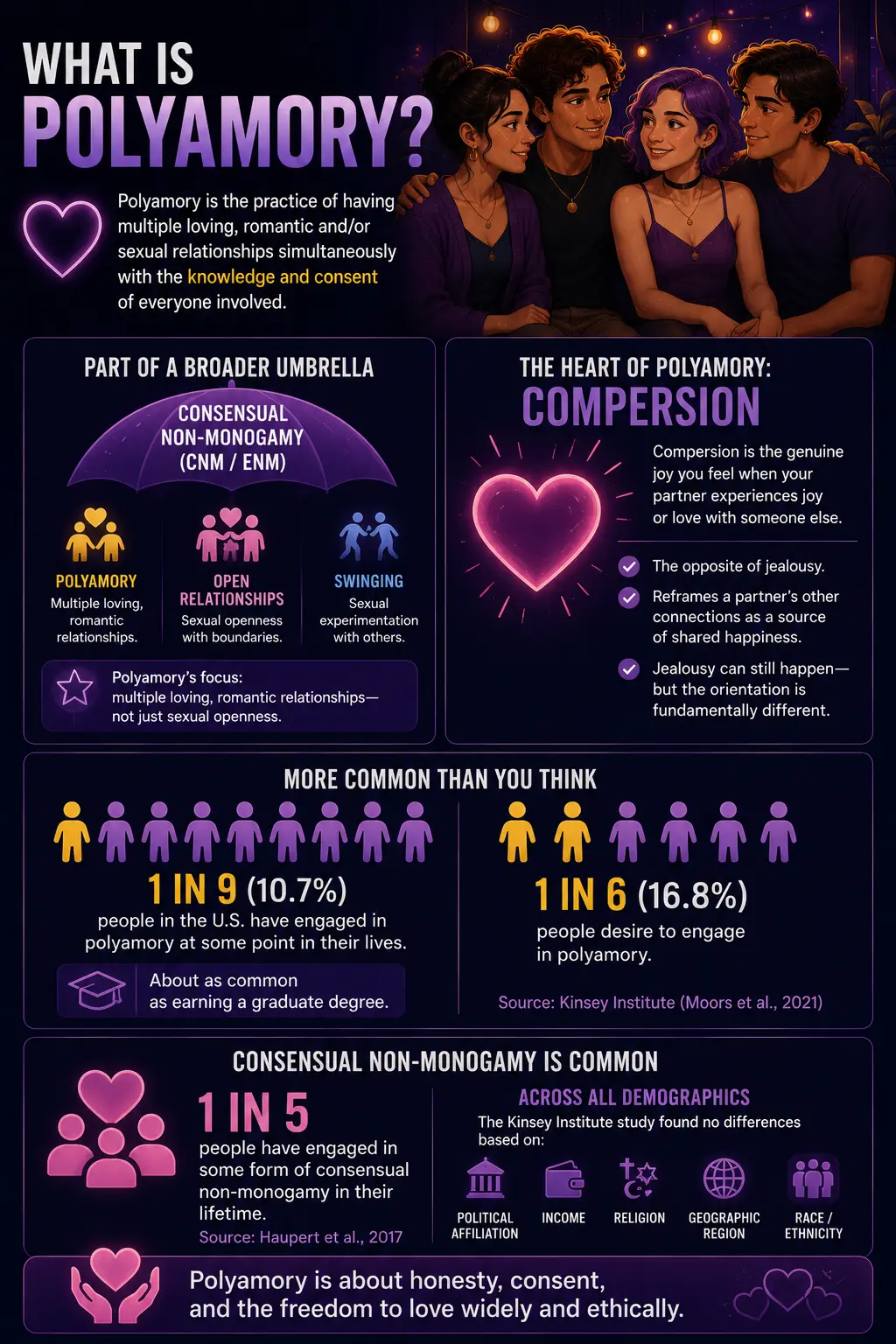
Polyamory is the practice of having more than one romantic relationship at the same time, with the full knowledge and consent of everyone involved. The word combines the Greek poly (many) and the Latin amor (love) — many loves. It is one form of ethical non-monogamy, and the word that matters most in defining it is ethical: polyamory is built on honesty, communication, and the informed consent of all partners. That is exactly what separates it from cheating, which is built on secrecy and betrayal.
Polyamory is not a disorder, a phase, or a sign that something is wrong. It is a relationship orientation — and research consistently finds that for the people it fits, consensually non-monogamous relationships are as satisfying and as stable as monogamous ones, with no higher rates of jealousy and, in several studies, lower (Conley et al., 2017). Roughly 1 in 9 Americans have engaged in polyamory at some point in their lives, and about 1 in 6 say they’d like to (Moors et al., 2021, Kinsey Institute).
This free Polyamorous Quiz is a reflection tool, not a verdict. It explores where your romantic orientation currently leans on the spectrum from monogamous to polyamorous — but only you can decide what fits your life. Both monogamy and polyamory are equally valid. 15 questions. Private, instant results.
Polyamory is a relationship orientation and practice in which a person has — or is open to having — multiple romantic and/or sexual relationships simultaneously, with the knowledge and consent of everyone involved. It sits within the broader umbrella of consensual non-monogamy (CNM) (also called ethical non-monogamy, or ENM), which includes other structures such as open relationships and swinging. What distinguishes polyamory specifically is its emphasis on multiple loving, romantic relationships — not just sexual openness.
The defining concept that sets polyamory apart from the cultural assumptions of monogamy is compersion — sometimes described as the opposite of jealousy. Compersion is the genuine joy or happiness a person feels when their partner experiences joy or love with someone else. Where monogamous culture often treats a partner’s connection with another person as inherently threatening, polyamory reframes it as something that can be a source of shared happiness. Not everyone feels compersion all the time, and jealousy still exists in polyamorous relationships — but the orientation toward a partner’s other connections is fundamentally different.
Polyamory is more common than many people assume. Drawing on a U.S. Census-based sample of 3,438 single adults, researchers at the Kinsey Institute (Moors et al., 2021) found that 1 in 9 people (10.7%) have engaged in polyamory at some point in their lives — about as common as earning a graduate degree — and 1 in 6 (16.8%) desire to.
A separate widely-cited study (Haupert et al., 2017) found that roughly 1 in 5 people have engaged in some form of consensual non-monogamy in their lifetime, though researchers note this figure draws on samples that may overrepresent the preference. Notably, the Kinsey Institute study found no differences in prevalence based on political affiliation, income, religion, geographic region, or race/ethnicity — polyamory cuts across all demographics.
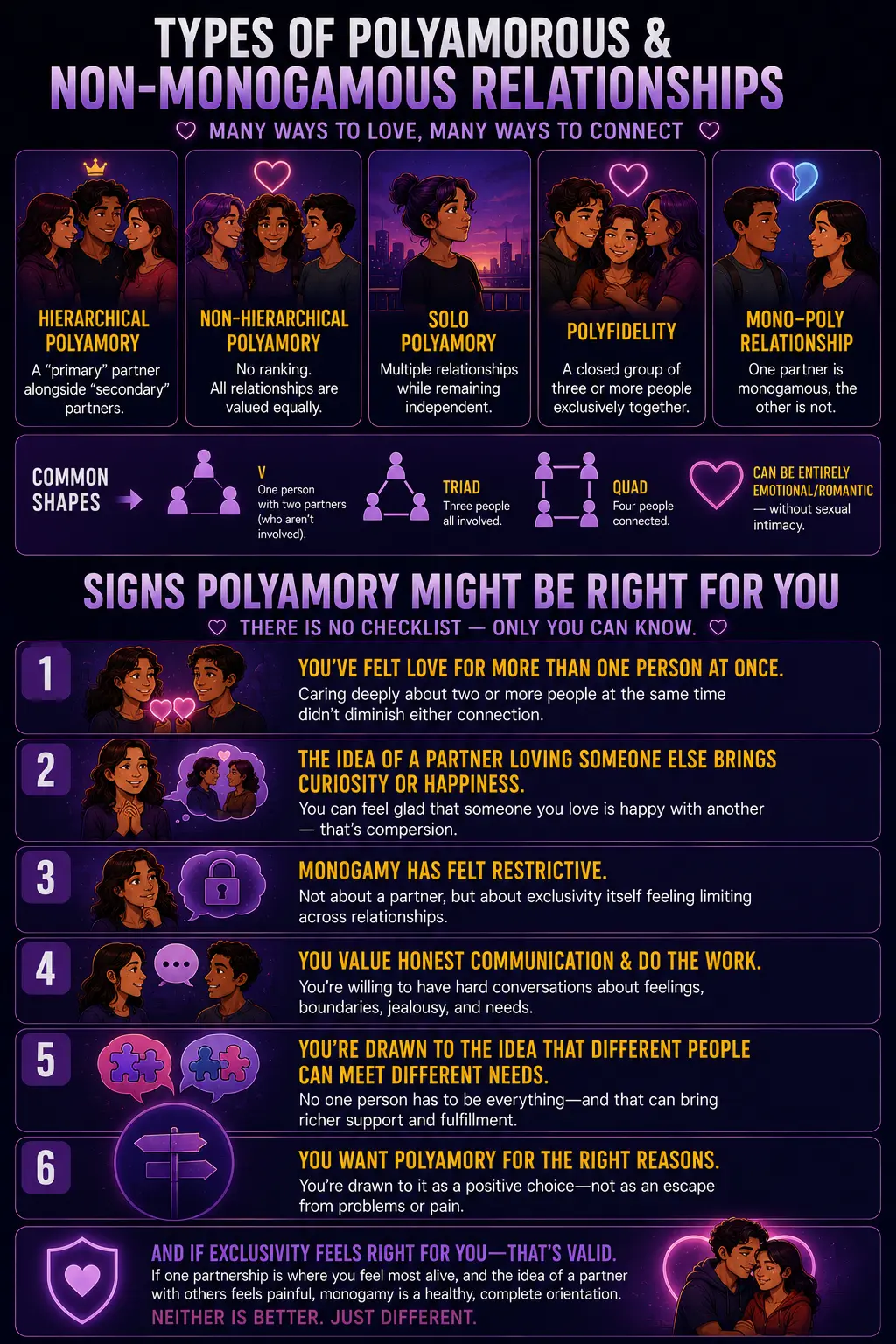
Polyamory is not one single structure — it encompasses many configurations, and part of understanding your own orientation is recognizing which (if any) resonate:
Hierarchical polyamory involves a “primary” partner (often a live-in or long-term partner with whom life is most entwined) alongside “secondary” relationships. Non-hierarchical polyamory rejects ranking — all relationships are valued on their own terms without one being designated more important. Solo polyamory describes people who maintain multiple relationships while remaining independent, without a “primary” merged-life partnership.
Polyfidelity is a closed group of three or more people who are romantically and sexually exclusive to one another. Mono-poly relationships involve one partner who is monogamous and another who has multiple relationships. Common shapes include the “V” (one person with two partners who aren’t involved with each other), the triad (three people all involved), and the quad (four people). Polyamory can also be entirely emotional/romantic without sexual intimacy — relevant for people on the asexual spectrum.
There is no checklist that determines whether you’re polyamorous — only you can know that, and it often becomes clear over time rather than all at once. But many people who find that polyamory fits them describe recognizing some of the following experiences. None is required, and recognizing them doesn’t obligate you to anything. Equally, not recognizing them is completely valid — a strong preference for monogamy is its own healthy orientation, not a limitation.
You’ve felt genuine romantic love for more than one person at the same time. Not just attraction or a wandering eye, but the experience of caring deeply, romantically, about two or more people simultaneously — and feeling that this didn’t diminish either connection. For many polyamorous people, this is the foundational recognition: love doesn’t feel like a finite resource that runs out when shared.
The idea of a partner loving someone else brings curiosity or even happiness, rather than only a threat. If you can imagine — or have experienced — feeling genuinely glad that someone you love is happy with another person, that capacity for compersion is one of the clearest signals of a polyamorous orientation. This doesn’t mean feeling jealousy; it means jealousy isn’t the only or dominant response.
Monogamy has felt restrictive in a way that wasn’t about your specific partner. Not dissatisfaction with a particular relationship, but a recurring sense that the structure of exclusivity itself feels limiting — a feeling that persisted across different relationships with people you genuinely loved. This is distinct from simply being unhappy with one partner.
You value transparency and communication and are willing to do the emotional work. Polyamory requires a great deal of honest, sometimes uncomfortable communication — about feelings, boundaries, jealousy, scheduling, and needs. People for whom polyamory works tend to find this work meaningful rather than purely burdensome, even when it’s hard.
You’re drawn to the idea that different people can meet different needs. A sense that no single person can or should be everything to you — and that having multiple connections could mean richer support, variety, and fulfillment rather than divided attention.
You can distinguish wanting polyamory from wanting an escape. An important sign of readiness, rather than orientation: people for whom polyamory genuinely fits are drawn to it as a positive structure, not primarily as a way to avoid problems in a current relationship or to soften a breakup. Wanting “more” because something is wrong is different from wanting polyamory because it fits who you are.
And the equally valid counter-signal: if exclusivity feels like security rather than restriction, if the depth of one partnership is where connection feels most alive for you, and if a partner’s involvement with someone else feels genuinely painful rather than potentially joyful — that points toward a monogamous orientation, which is no less valid, mature, or open-minded than polyamory. Neither orientation is better; they’re simply different.
| Feature | Polyamory | Open Relationship | Swinging | Monogamy |
|---|---|---|---|---|
| Core focus | Multiple loving, romantic relationships | A primary couple open to outside sexual connections | Recreational sexual activity with others, often as a couple | One exclusive romantic and sexual partner |
| Emotional connection with others | Central — romantic love with multiple partners is the point | Usually kept limited, emotional exclusivity is often retained | Typically discouraged; focus is sexual, not romantic | Reserved for the one partner |
| Consensual & ethical? | Yes — all partners know and consent | Yes — all partners know and consent | Yes — all partners know and consent | Yes — exclusivity is the agreement |
| Umbrella category | Consensual/ethical non-monogamy (CNM/ENM) | Consensual/ethical non-monogamy (CNM/ENM) | Consensual/ethical non-monogamy (CNM/ENM) | Monogamy |
| Distinct from cheating? | Yes — cheating is non-consensual; polyamory is fully consensual | Yes — agreed boundaries, not secrecy | Yes — mutual, agreed activity | Cheating violates the monogamous agreement |
A related term worth knowing is relationship anarchy — an approach that rejects predefined rules and hierarchies for relationships altogether, treating each connection (romantic, sexual, or platonic) as unique and self-defined without ranking. It overlaps with non-hierarchical polyamory but extends the philosophy more broadly. All of these fall under consensual non-monogamy, and the boundaries between them are flexible — many people blend elements or move between them over time. The LGBTQ+ Test may also be relevant if you’re exploring your wider identity, since orientation and relationship style are distinct but sometimes intertwined dimensions.
This Polyamorous Quiz contains 15 questions about your feelings, comfort, and preferences around multiple romantic and sexual connections. For each, you’ll choose how often or how strongly the statement applies: Never, Rarely, Sometimes, Often, or Always.
Answer based on your genuine, typical feelings — not what you think you should feel, and not based on a single relationship or moment. There are no right or wrong answers, and the goal is clarity, not a particular result.
Your total score places your current orientation on a spectrum from a more monogamous leaning to a more polyamorous leaning. Importantly, this measures orientation, not a fixed identity or a recommendation — many people find their understanding evolves with experience and reflection, and the result is a starting point for thinking, never a verdict.
A reminder before reading your result: this reflects where your romantic orientation currently leans — not a fixed label, and not a judgment. Monogamy and polyamory are equally valid, healthy orientations. Wherever you land, the most useful outcome isn’t a category but greater clarity about what you actually want and why.
| Score Range | Orientation Leaning | What It Suggests |
|---|---|---|
| 15 – 35 | Monogamy-Leaning | Your answers lean toward monogamy — comfort and fulfillment in an exclusive relationship. This is a valid, healthy orientation, not a limitation. |
| 36 – 55 | Flexible / Open-Curious | Your answers suggest openness or curiosity about non-monogamy while still valuing some structure. Many people sit here, and exploration may bring clarity. |
| 56 – 75 | Polyamory-Leaning | Your answers lean strongly toward polyamory — comfort with and attraction to multiple simultaneous loving relationships. A valid, healthy orientation. |
Polyamory is the practice of engaging in multiple romantic and/or sexual relationships at the same time, with the knowledge and consent of everyone involved. The term combines Greek (poly, many) and Latin (amor, love). It is one form of consensual or ethical non-monogamy (CNM/ENM), distinguished by its emphasis on multiple loving relationships rather than purely sexual openness. What separates polyamory from cheating is consent and honesty: in polyamory, all partners know about and agree to the arrangement. Polyamory is a relationship orientation, not a mental health condition, and research finds polyamorous relationships can be as satisfying and stable as monogamous ones.
This is genuinely debated. Many polyamorous people describe polyamory as an orientation — something that feels intrinsic, stable over time, and present across their lives. Others experience it as a deliberate philosophical and practical choice about how to structure relationships. Both experiences are real and valid. It’s also distinct from sexual orientation in the sense of who you’re attracted to (gay, straight, bisexual, etc.) — polyamory is about relationship structure and the capacity for multiple simultaneous loves, not about gender of attraction. A person of any sexual orientation can be monogamous or polyamorous; the two dimensions are separate.
More common than many assume. Research from the Kinsey Institute (Moors et al., 2021), drawing on a U.S. Census-based sample of 3,438 single adults, found that 1 in 9 people (10.7%) have engaged in polyamory at some point in their lives, and 1 in 6 (16.8%) desire to. A separate study (Haupert et al., 2017) found that roughly 1 in 5 people have engaged in some form of consensual non-monogamy in their lifetime, though some researchers note this figure may draw on samples that overrepresent the preference. Among people currently in relationships, about 4-5% identify as consensually non-monogamous. Polyamory cuts across all demographics, with no meaningful differences by political affiliation, income, religion, region, or race.
Compersion is the feeling of genuine joy or happiness when a partner experiences love, joy, or connection with someone else. It’s often described as the opposite of jealousy, and it’s a central concept in polyamorous communities. Where monogamous culture typically frames a partner’s connection with another person as a threat, compersion reframes it as something that can bring shared happiness — feeling glad that someone you love is happy. Not every polyamorous person feels compersion constantly, and jealousy still exists in polyamorous relationships, but the capacity for compersion is one of the experiences that distinguishes a polyamorous orientation.
No — they are opposites in the most important respect. Cheating is built on secrecy, deception, and the violation of an agreed boundary. Polyamory is built on honesty, transparency, and the informed consent of everyone involved. In a polyamorous relationship, all partners know about each other and agree to the arrangement. It’s entirely possible to cheat within a polyamorous relationship — by violating the specific agreements that the partners have made. The defining ethical line isn’t the number of partners; it’s whether everyone involved knows and consents.
Research consistently indicates that consensually non-monogamous relationships can be just as healthy, satisfying, and stable as monogamous ones for the people they fit. A major review by Conley and colleagues (2017) found that relationship satisfaction in CNM is on par with or exceeds that in monogamy, and several studies have found lower jealousy among consensually non-monogamous people than among monogamous people. Longitudinal research by Dr. Elisabeth Sheff found no adverse developmental outcomes for children raised in polyamorous families, given support and stable communication. As with any relationship structure, health depends on honesty, communication, consent, and mutual care — not on the number of partners.
Relationship orientation can be stable for some people and more fluid for others. Some people feel they have always been polyamorous or always monogamous; others find their orientation shifts with experience, self-understanding, or life circumstances. Neither pattern is more valid. It’s also possible to be monogamous in practice while polyamorous in orientation (or vice versa) — orientation describes your underlying inclination, while your actual relationships reflect choices made within your specific life. Exploring this Polyamorous quiz, reflecting honestly, and (if helpful) talking with an affirming therapist can support clarity, but only you can determine what fits you.
About three minutes. It is 15 statements rated on a five-point scale from Never to Always, there is no sign-up and no email required, and your result appears immediately when you finish. Scores run from 15 to 75 and place you in one of three bands — monogamy-leaning, flexible or open-curious, and polyamory-leaning. You can retake it whenever you like: the quiz measures where your orientation sits now, not a fixed label.
Sexual Orientation & Gender Identity
Free Kinsey Scale Test — Where Do You Fall on the Sexual Spectrum?
Sexual Orientation & Gender Identity
What Type of Lesbian Am I Quiz – Discover Your Lesbian Identity
Sexual Orientation & Gender Identity
What’s Your Sexual Orientation or Gender Identity? Take This Free LGBTQ+ Test
Here you'll find all collections you've created before.