



Should I Quit My Job? A Mental-Health Check-In
Torn about quitting? This free quiz helps you see how much your job is affecting your mental health — and whether the causes are fixable or reasons to leave.
Published Updated
Almost everyone asks it at some point: should I quit my job? Sometimes it’s a passing bad week. Sometimes it’s a quieter, heavier question — the kind that shows up on Sunday nights, or that you carry around for months without saying out loud. This quiz won’t make the decision for you (no honest quiz can), but it can help you see something that often gets tangled up in the “should I stay or go” spiral: how much your job is actually affecting your mental health, and whether the reasons are things that could be fixed or reasons that genuinely point toward leaving.
That distinction matters more than the raw question of quitting. Two people can feel equally miserable at work for completely different reasons — one because of a workload or a manager who could change, the other because the job fundamentally conflicts with who they are. The first situation often has a path that isn’t quitting. The second often doesn’t. This 15-question check-in is built around the most established research on why jobs harm well-being to help you identify which situation applies to you.
It’s a reflection tool, not a diagnosis or career advice. Based on how you’ve been feeling about work recently. Private, instant results.
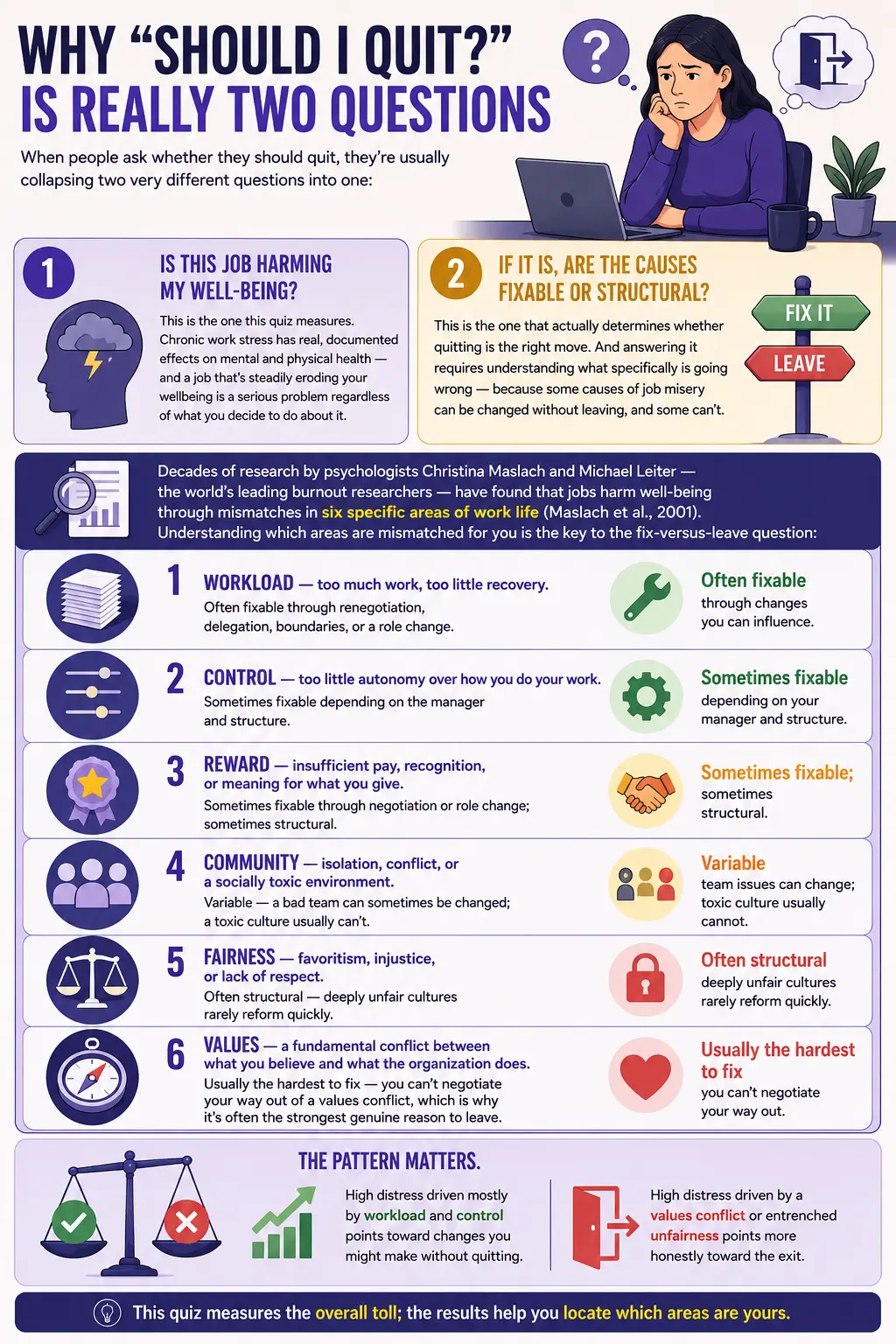
Why “Should I Quit?” Is Really Two Questions
When people ask whether they should quit, they’re usually collapsing two very different questions into one:
Question 1: Is this job harming my well-being?
This is the one this quiz measures. Chronic work stress has real, documented effects on mental and physical health — and a job that’s steadily eroding your wellbeing is a serious problem regardless of what you decide to do about it.
Question 2: If it is, are the causes fixable or structural?
This is the one that actually determines whether quitting is the right move. And answering it requires understanding what specifically is going wrong — because some causes of job misery can be changed without leaving, and some can’t.
Decades of research by psychologists Christina Maslach and Michael Leiter — the world’s leading burnout researchers — have found that jobs harm well-being through mismatches in six specific areas of work life (Maslach et al., 2001). Understanding which areas are mismatched for you is the key to the fix-versus-leave question:
- Workload — too much work, too little recovery. Often fixable through renegotiation, delegation, boundaries, or a role change.
- Control — too little autonomy over how you do your work. Sometimes fixable depending on the manager and structure.
- Reward — insufficient pay, recognition, or meaning for what you give. Sometimes fixable through negotiation or role change; sometimes structural.
- Community — isolation, conflict, or a socially toxic environment. Variable — a bad team can sometimes be changed; a toxic culture usually can’t.
- Fairness — favoritism, injustice, or lack of respect. Often structural — deeply unfair cultures rarely reform quickly.
- Values — a fundamental conflict between what you believe and what the organization does. Usually the hardest to fix — you can’t negotiate your way out of a values conflict, which is why it’s often the strongest genuine reason to leave.
The pattern matters. High distress driven mostly by workload and control points toward changes you might make without quitting. High distress driven by a values conflict or entrenched unfairness points more honestly toward the exit. This quiz measures the overall toll; the results help you locate which areas are yours.
Signs Your Job Might Be Affecting Your Mental Health
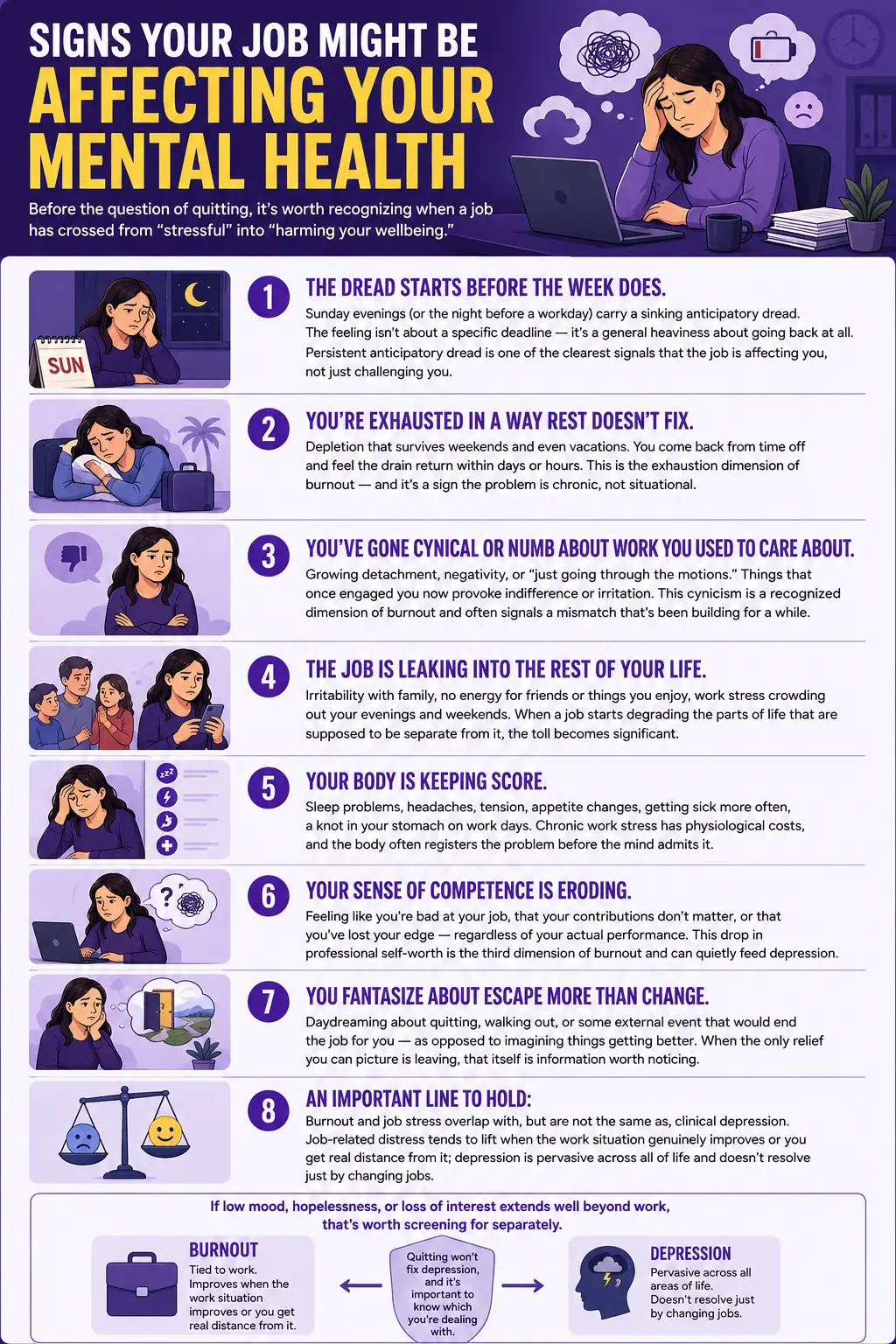
Before the question of quitting, it’s worth recognizing when a job has crossed from “stressful” into “harming your wellbeing.” These are the signs that most consistently indicate the job is taking a real mental-health toll — the thing worth taking seriously regardless of what you decide.
The dread starts before the week does. Sunday evenings (or the night before a workday) carry a sinking anticipatory dread. The feeling isn’t about a specific deadline — it’s a general heaviness about going back at all. Persistent anticipatory dread is one of the clearest signals that the job is affecting you, not just challenging you.
You’re exhausted in a way rest doesn’t fix. Depletion that survives weekends and even vacations. You come back from time off and feel the drain return within days or hours. This is the exhaustion dimension of burnout — and it’s a sign the problem is chronic, not situational.
You’ve gone cynical or numb about work you used to care about. Growing detachment, negativity, or “just going through the motions.” Things that once engaged you now provoke indifference or irritation. This cynicism is a recognized dimension of burnout and often signals a mismatch that’s been building for a while.
The job is leaking into the rest of your life. Irritability with family, no energy for friends or things you enjoy, work stress crowding out your evenings and weekends. When a job starts degrading the parts of life that are supposed to be separate from it, the toll becomes significant.
Your body is keeping score. Sleep problems, headaches, tension, appetite changes, getting sick more often, a knot in your stomach on work days. Chronic work stress has physiological costs, and the body often registers the problem before the mind admits it.
Your sense of competence is eroding. Feeling like you’re bad at your job, that your contributions don’t matter, or that you’ve lost your edge — regardless of your actual performance. This drop in professional self-worth is the third dimension of burnout and can quietly feed depression.
You fantasize about escape more than change. Daydreaming about quitting, walking out, or some external event that would end the job for you — as opposed to imagining things getting better. When the only relief you can picture is leaving, that itself is information worth noticing.
An important line to hold: burnout and job stress overlap with, but are not the same as, clinical depression. Job-related distress tends to lift when the work situation genuinely improves, or you get real distance from it; depression is pervasive across all of life and doesn’t resolve just by changing jobs. If low mood, hopelessness, or loss of interest extends well beyond work, that’s worth screening for separately — because quitting won’t fix depression, and it’s important to know which you’re dealing with.
How This Quiz Works
This quiz contains 15 questions covering the six areas of work life where mismatches drive job distress (workload, control, reward, community, fairness, and values), plus the toll the job is taking on your wellbeing. For each, choose how often it applies based on how you’ve felt about work recently:
Never = 0 | Rarely = 1 | Sometimes = 2 | Often = 3 | Always = 4
Your answers add up to a score from 0 to 60, placing you in one of four ranges. Higher scores mean the job is taking a greater toll on your wellbeing — not automatically that you should quit. What you do about it depends on which areas are driving the score, and the results will help you think through that.
This is a self-reflection tool grounded in established burnout research. It is not a clinical assessment, not a diagnosis, and not career advice — the decision to leave a job depends on financial, practical, and personal factors no quiz can weigh. Treat your result as a starting point for honest thinking, not a verdict.
Understanding Your Result
| Score Range | Level | What It Suggests |
|---|---|---|
| 0 – 15 | Low — Job Toll Is Manageable | Your job doesn’t appear to be significantly harming your wellbeing right now. Normal ups and downs may be present without a serious toll. |
| 16 – 30 | Mild — Some Real Strain | Some genuine strain is showing. Worth identifying which areas are driving it before it deepens — often addressable without leaving. |
| 31 – 45 | Moderate — A Meaningful Toll | The job is taking a meaningful toll on your well-being. Time to look honestly at whether the causes are fixable or structural. |
| 46 – 60 | High — A Serious Toll | The job appears to be seriously affecting your wellbeing. This warrants real attention — and, if the causes are structural, leaving may be the healthy choice. |
Fixable vs Structural: How to Tell the Difference
Since the whole decision hinges on this, here’s a more detailed guide to sorting out your situation.
More often fixable (change may not require quitting): An overwhelming but potentially negotiable workload. A specific bad manager in an otherwise decent organization. Lack of recognition that a direct conversation could address. A skills or role mismatch that a transfer could solve. Boundary problems that clearer limits could improve. Under-market pay in a company that can, in principle, pay more. These are worth attempting to fix before quitting — not because quitting is wrong, but because leaving a fixable situation can mean carrying the same problem into the next job.
More often, structural (change usually requires leaving): A fundamental values conflict — the organization does things you find wrong, and that won’t change. An entrenched culture of unfairness, favoritism, or disrespect. A genuinely toxic environment that leadership tolerates or creates. A job whose core demands are incompatible with your health or your life. A field or role that no longer fits who you’ve become. These rarely improve no matter how well you advocate, and continuing to absorb them has a compounding cost to your well-being.
The reason this distinction matters so much: quitting a fixable problem can be a mistake you repeat, while staying in a structural one can be a slow harm you normalize. Most people err in one direction or the other. Knowing which way you tend to lean — toward escaping too fast or enduring too long — is as useful as the score itself.
Frequently Asked Questions
Should I quit my job if it’s affecting my mental health?
A job seriously harming your mental health is a genuine problem that needs to change — but “change” doesn’t automatically mean quitting. The right move depends on why the job is affecting you. If the causes are fixable (workload, a specific manager, lack of recognition, boundary problems), it may be possible to improve the situation without leaving — through renegotiation, a role change, or clearer limits. If the causes are structural (a values conflict, an entrenched unfair or toxic culture, or a job fundamentally incompatible with your health), leaving is often the healthiest choice. What’s rarely wise is staying in an unchanged situation that’s producing a serious toll, since that reliably gets worse. It’s also worth checking whether what you’re experiencing is job-specific burnout or broader depression, because if it’s depression, changing jobs alone won’t resolve it.
How do I know if I’m burned out or just having a bad stretch?
A bad stretch is tied to something specific and lifts when it passes — a crunch project ends, a conflict resolves, you take a break and come back restored. Burnout is chronic: the exhaustion survives weekends and vacations, the cynicism about work has become your default rather than a mood, and your sense of effectiveness has eroded over time. If rest genuinely restores you, it’s probably a rough patch. If you come back from time off and the depletion returns almost immediately, that points more toward burnout. The Burnout Test screens for this specifically across the exhaustion, cynicism, and effectiveness dimensions.
Is it normal to want to quit my job?
Yes — wanting to quit at times is extremely common and doesn’t by itself mean anything is wrong. Most people have periods of frustration, boredom, or “grass is greener” thinking. What’s worth paying attention to is the pattern: an occasional fleeting wish to quit is normal; a persistent, heavy dread about work that shows up on Sunday nights and doesn’t lift is a stronger signal that the job is genuinely affecting you. The difference between a passing wish and a sustained toll is what this quiz is designed to help you see.
Will quitting my job actually make me happier?
It depends entirely on why you’re unhappy. If your distress is driven by structural problems specific to this job — a values conflict, a toxic culture, an incompatible role — then leaving genuinely can lift it, because you’re removing the actual cause. But if the distress is driven by burnout you’d carry into the next role, by boundary or workload patterns you haven’t changed, or by an underlying depression or anxiety that isn’t really about the job, then quitting may bring only temporary relief before the same feelings return. This is why sorting fixable from structural causes — and screening for burnout or depression separately — matters before making the leap. Quitting solves job-specific problems; it doesn’t solve problems you carry with you.
What are the signs of a toxic workplace?
Common signs include an entrenched culture of unfairness or favoritism, chronic disrespect, leadership that tolerates or creates hostility, pervasive politics where who you know matters more than how well you do, and a “community” mismatch where — as burnout researchers describe it — people say “I love the work and I’m good at it, but I can’t stand being around these people.” A key marker of genuine toxicity is that the problems are systemic and leadership-tolerated rather than isolated. Toxic environments fall into the “structural” category — they rarely improve no matter how well an individual advocates, which is why they’re often a legitimate reason to leave.
Is this quiz a career test or a mental health test?
Both and neither in a formal sense. It’s a self-reflection tool that sits at the intersection: it measures how much your job is affecting your wellbeing (the mental-health dimension) to help inform a career decision (whether to stay or leave). It is not a validated psychological instrument, can’t diagnose anything, and isn’t professional career advice — the real decision involves financial, practical, and personal factors no quiz can weigh. What it’s built to do is cut through the “should I stay or go” spiral by clarifying how serious the toll is and whether the causes are fixable or structural.
Should I quit without another job lined up?
This is a genuinely personal decision that depends on your financial situation, your health, and your options — and it’s outside the scope of what any quiz can advise. What’s worth saying is that the two dimensions are separate: how much the job is harming you (which this quiz measures) and whether you can afford to leave (which it can’t). In some situations, the toll is severe enough that leaving without a plan is the healthy choice; in most, some runway or a next step matters. If the toll is high and the causes are structural, that’s a strong reason to start actively planning an exit — but “planning an exit” and “quitting tomorrow” aren’t the same thing. A career counselor or financial advisor can help you weigh the practical side that sits alongside the well-being side.
Related Tests
- Burnout Test — the most directly relevant screen; measures work exhaustion, cynicism, and reduced effectiveness across the three burnout dimensions
- Clinical Depression Test — job stress overlaps with depression, but depression won’t resolve by changing jobs alone; important to distinguish before a big decision
- Anxiety Test — chronic work stress frequently co-occurs with anxiety; worth screening if worry about work dominates your thinking
- Generalized Anxiety Disorder Test — persistent, uncontrollable worry about work and the future can overlap with and amplify job distress
- Self-Esteem Test — the erosion of professional self-worth in burnout can spill into general self-esteem; worth checking if confidence has dropped
- Imposter Syndrome Test — sometimes the urge to quit is driven by feeling like a fraud rather than by the job itself; worth distinguishing
References
- Maslach, C., Schaufeli, W.B., & Leiter, M.P. (2001). Job burnout. Annual Review of Psychology, 52, 397–422. [Six areas of work life: workload, control, reward, community, fairness, values] annualreviews.org
- Maslach, C., & Leiter, M.P. (2016). Understanding the burnout experience: recent research and its implications for psychiatry. World Psychiatry, 15(2), 103–111. pmc.ncbi.nlm.nih.gov
- Maslach, C., & Leiter, M.P. (2022). The Burnout Challenge: Managing People’s Relationships with Their Jobs. Harvard University Press. [Six areas framework; fixing workplace mismatches]
- World Health Organization. (2019). Burn-out an “occupational phenomenon”: International Classification of Diseases (ICD-11). who.int
- Greater Good Science Center, UC Berkeley. Six Causes of Burnout at Work. [Values mismatch and job satisfaction] greatergood.berkeley.edu
Related Tests
See All Quiz →You may also like
See All Quiz →