


Free Depersonalization Disorder Test (DPDR) – Do I Have Depersonalization-Derealization Disorder?
Feel detached from yourself or like the world isn't real? This free 15-item depersonalization disorder test screens for DPDR using DSM-5-TR criteria.
Published Updated
Feeling detached from yourself — as though you’re watching your own life from behind glass, or moving through a world that has quietly stopped feeling real — is one of the strangest and most frightening experiences a person can have. It’s also far more common than most people realize, and it is very often misunderstood by the person going through it.
Here is the most important thing to know before you take this test: having experienced depersonalization or derealization does not mean you have a disorder. Somewhere between a quarter and three-quarters of people have at least one such episode in their lifetime — during exhaustion, grief, extreme stress, or after using certain substances. Only about 1 to 2% of people meet the criteria for depersonalization/derealization disorder (DPDR). The difference isn’t whether it has happened to you. It’s whether it is persistent or recurrent, and whether it is causing you real distress or getting in the way of your life.
This free, confidential depersonalization disorder test screens for both halves of the condition — depersonalization (detachment from yourself) and derealization (detachment from your surroundings) — using the DSM-5-TR diagnostic criteria (APA, 2022). 15 questions, private results. It is a screening tool, not a diagnosis.
What Is Depersonalization/Derealization Disorder?
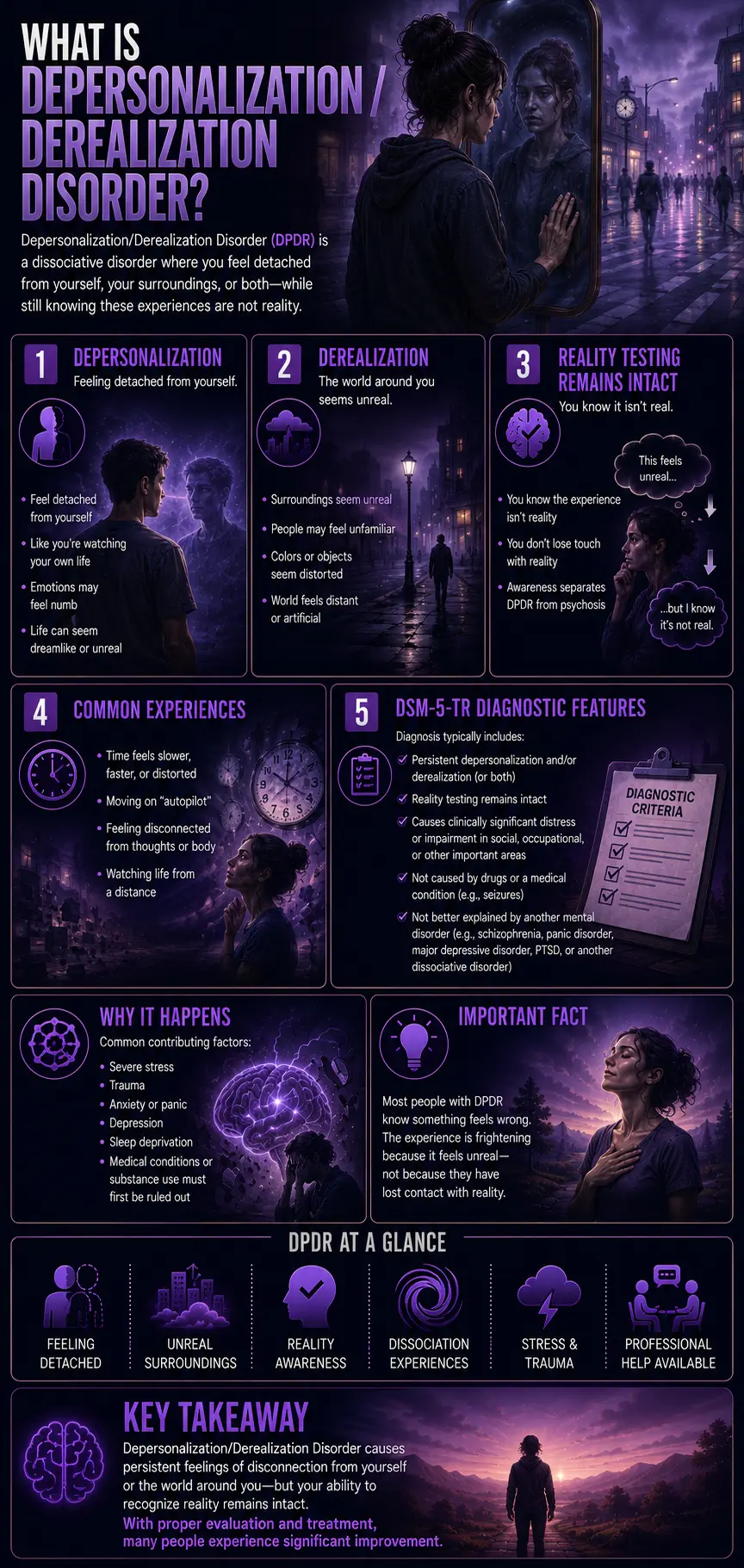
Depersonalization/derealization disorder (DSM-5-TR code 300.6 / F48.1) is a dissociative disorder defined by persistent or recurrent experiences of unreality — of yourself, of the world around you, or both — while your grasp on what is actually real remains intact. In the DSM-5, depersonalization and derealization were combined into a single diagnosis because the two experiences frequently occur together and there was no good evidence for treating them as separate conditions.
Depersonalization is the experience of being detached from, or an outside observer of, your own mental processes or body. People describe feeling as though they are in a dream, watching themselves from a distance, moving on autopilot, or that their thoughts, emotions, or limbs somehow don’t belong to them. Time may feel distorted — stretched, sped up, or strangely flat.
Derealization is the same quality of unreality applied to your surroundings. The world may seem dreamlike, distant, artificial, or stage-set. Visually, things can look foggy, flat, colorless, oddly two-dimensional, too bright, or subtly distorted in size or shape. Familiar places can feel unfamiliar; familiar people can seem lifeless, robotic, or somehow not quite themselves.
The full DSM-5-TR criteria require: persistent or recurrent depersonalization, derealization, or both (Criterion A); reality testing remaining intact during these experiences (Criterion B); clinically significant distress or impairment in social, occupational, or other important areas of functioning (Criterion C); the disturbance not being attributable to a substance or another medical condition such as seizures (Criterion D); and the disturbance not being better explained by another mental disorder such as schizophrenia, panic disorder, major depressive disorder, acute stress disorder, PTSD, or another dissociative disorder (Criterion E).
“Am I Going Crazy?” — Why the Answer Is Almost Certainly No
This deserves its own section, because it is the fear that brings most people to a page like this one, and because the accurate answer is genuinely reassuring.
People experiencing depersonalization and derealization very commonly fear that these sensations mean they are losing their minds, developing psychosis, or suffering brain damage. The experience is so alien and so hard to put into words that catastrophic explanations feel like the only ones that fit. But the clinical picture points the other way.
Criterion B of the diagnosis is that reality testing remains intact. That means the person knows their experiences are subjective — they understand that the world has not actually become unreal, that they have not actually left their body, and that their limbs are, in fact, their own. As the Merck Manual puts it, this preserved awareness is precisely what differentiates depersonalization/derealization disorder from a psychotic disorder, in which such insight is always lacking.
So the very thing that frightens you — the fact that you can tell something is off, that you’re aware the unreality is a feeling rather than a fact — is the clinical feature that distinguishes this condition from psychosis. If you are reading this and thinking, “I know it isn’t really real, that’s what’s so disturbing about it,” that awareness is not a small detail. It is the diagnostic line itself.
This does not mean the experience is trivial or that you don’t need help — DPDR can be profoundly distressing and disabling, and it deserves proper support. But the specific fear that you are going insane is, in the great majority of cases, not what is happening. If you’d like to understand where the line to psychosis actually sits, our Schizophrenia Test screens for those symptoms specifically.
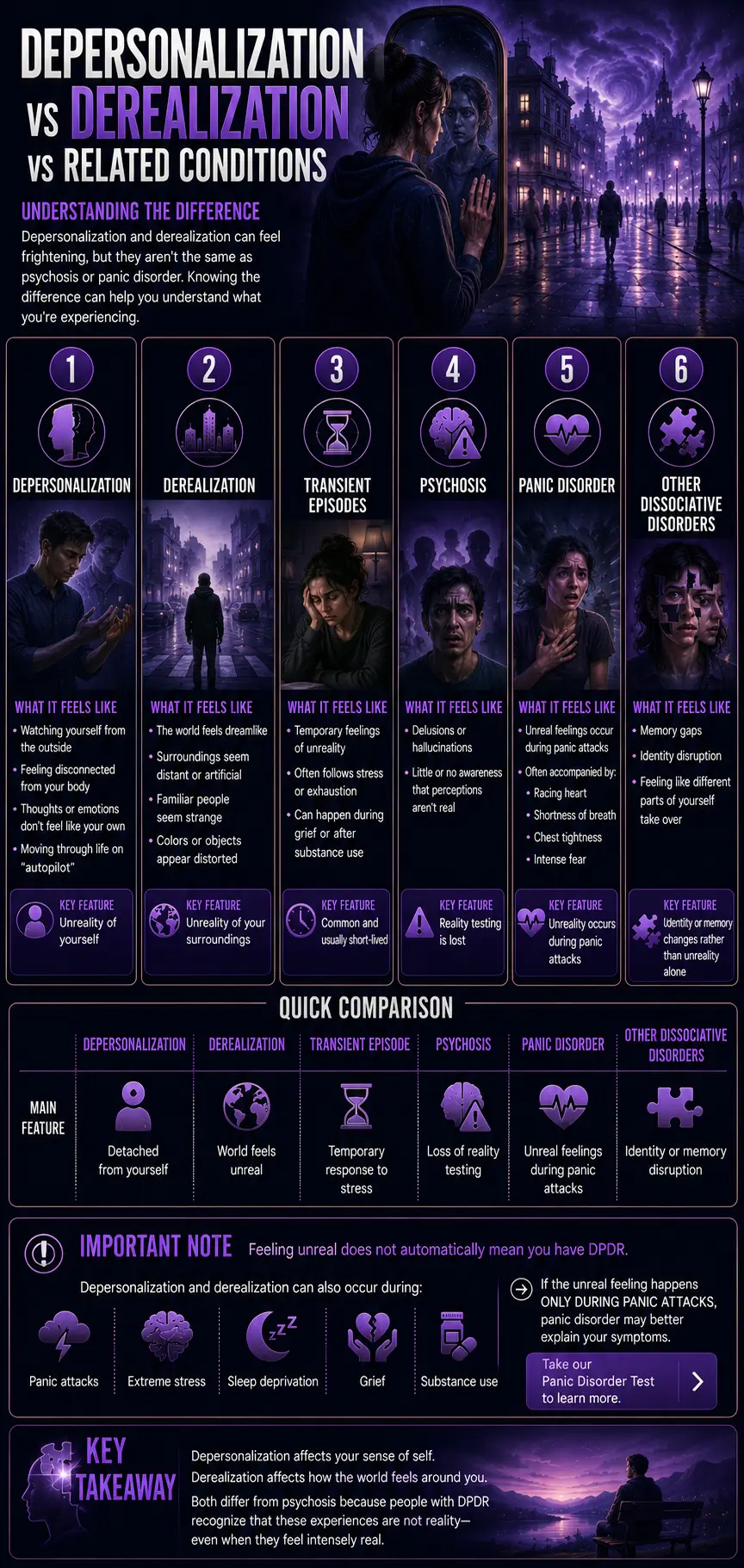
Depersonalization vs Derealization vs Related Conditions
| Experience | What It Feels Like | Key Feature |
|---|---|---|
| Depersonalization | Detached from your own self — watching yourself, on autopilot, body or thoughts don’t feel like yours, emotions muted | Unreality of the self |
| Derealization | The world seems dreamlike, foggy, flat, artificial; familiar places feel strange; people seem lifeless | Unreality of the surroundings |
| Transient episode | The same sensations, but occasional and tied to stress, exhaustion, grief, or substance use | Common (25–75% lifetime); not a disorder |
| Psychosis | Beliefs or perceptions experienced as literally true, without insight | Reality testing is lost — the opposite of DPDR |
| Panic disorder | Unreality arrives as one symptom during discrete panic attacks | Tied to attacks — see our Panic Disorder Test |
| Other dissociative disorders | Identity disruption or memory gaps rather than unreality alone | See our Dissociative Identity Disorder Test |
An important overlap worth naming: depersonalization and derealization are themselves listed among the symptoms of a panic attack. If your experiences of unreality arrive only during episodes of intense fear with a racing heart and breathlessness, panic disorder may be the better fit than DPDR — Criterion E specifically excludes unreality that’s better explained by panic disorder. Our Panic Disorder Test can help you tell the difference.
Signs You Might Have Depersonalization/Derealization Disorder
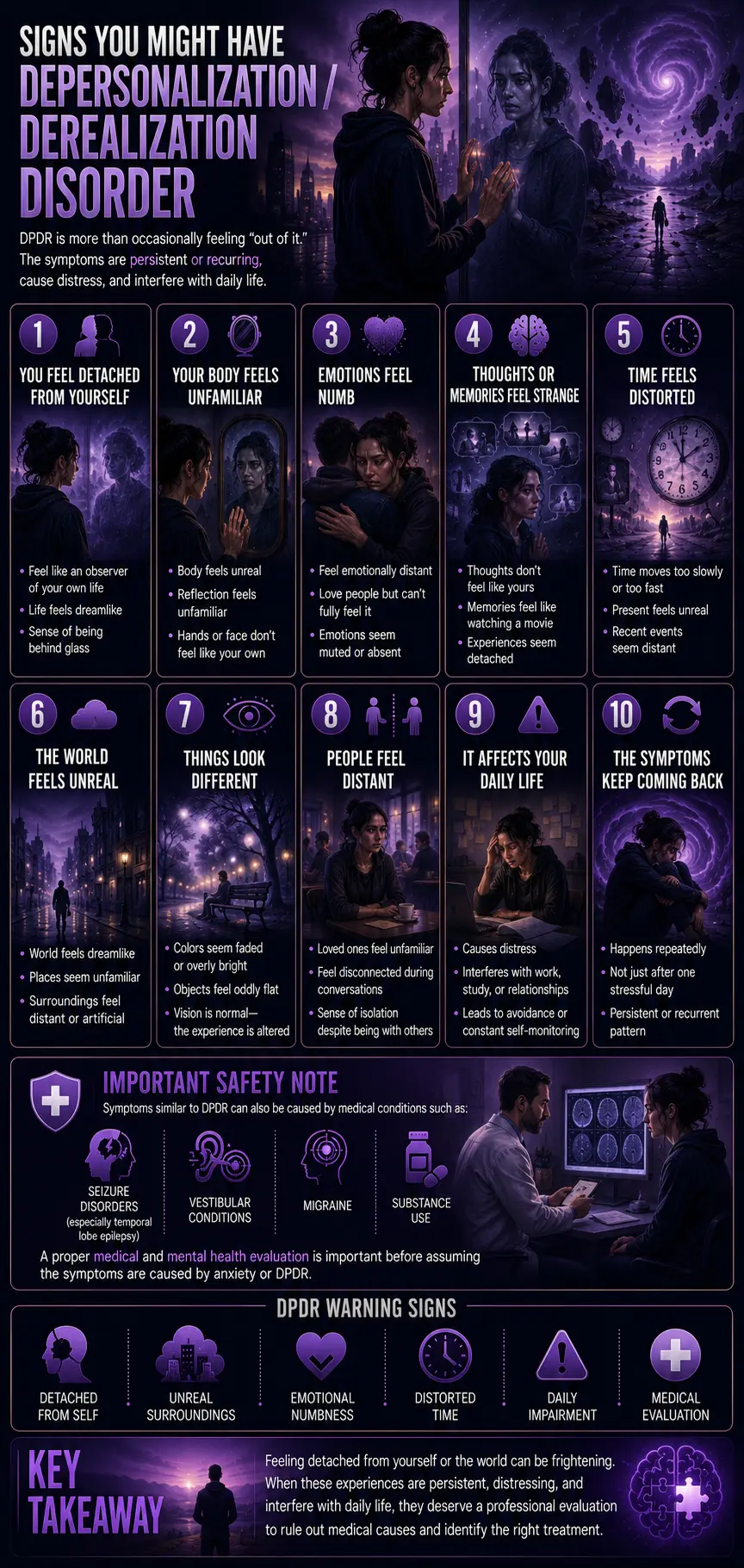
These are the experiences most consistently associated with DPDR. Remember as you read: the question is not whether any of these has ever happened, but whether they are persistent or recurrent and whether they are causing you distress or interfering with your life.
You feel detached from yourself, as if observing your own life. A sense of watching yourself from outside, or of being a spectator to your own actions and thoughts. Many people describe it as being behind glass, or as though a pane of something were between them and their own experience.
Your body doesn’t feel like yours. Your hands, face, voice, or body as a whole can feel unfamiliar, unreal, mechanical, or somehow not belonging to you. Catching your own reflection can be a particularly unsettling moment.
Your emotions feel muted, distant, or absent. An emotional numbing in which feelings seem flattened, far away, or as though they belong to someone else. People often describe knowing intellectually that they love someone, or that something is sad, without being able to feel it.
Your thoughts or memories feel foreign. Thoughts can seem as if they aren’t quite yours, and memories can feel like things that happened to someone else, or like scenes from a film rather than lived experience.
Time feels distorted. A sense that time is moving too slowly or too quickly, that recent events feel impossibly distant, or that the present moment has an odd, stretched, unanchored quality.
The world around you seems unreal or dreamlike. This is derealization: surroundings feeling artificial, stage-set, distant, or as though you’re moving through a dream. It’s the same quality of unreality, turned outward.
Your surroundings look visually altered. Things may appear foggy, flat, colorless or oddly over-bright, two-dimensional, or subtly wrong in size, shape, or distance. Vision itself is not damaged — the alteration is in how the world is being processed and experienced.
Familiar places and people feel strange. Somewhere you know well can feel unfamiliar, and people close to you can seem lifeless, robotic, unfamiliar, or somehow not quite real — which is often especially distressing precisely because you love them.
You feel cut off from the people around you. A sense of separation or invisible barrier between you and others, even in company, even mid-conversation.
It distresses you, and it’s affecting your life. The experiences frighten or exhaust you, they intrude on work, study, or relationships, and you may find yourself avoiding situations that seem to trigger them or constantly monitoring yourself for their return. This distress and interference is Criterion C — and it is what separates a disorder from an odd but harmless experience.
It has persisted or kept coming back. Not a single strange hour after a sleepless night, but something ongoing or recurrent. Persistence is what turns a common human experience into a clinical condition.
One safety note worth taking seriously: because Criterion D requires excluding medical causes, symptoms like these warrant both a medical and a psychological evaluation. Conditions including seizure disorders (particularly temporal lobe epilepsy), vestibular problems, and migraine can produce similar experiences, and assessment sometimes includes brain imaging or an EEG. Please do not assume it is “just anxiety” without a doctor confirming that.
How This DPDR Test Works
This Depersonalization Disorder test contains 15 questions covering both halves of the condition — six on depersonalization (detachment from yourself), five on derealization (unreality of your surroundings), three on distress and impairment, and a final question on how persistent the pattern has been. For each, choose how often it has applied to you over the past month:
Never = 0 | Rarely = 1 | Sometimes = 2 | Often = 3 | Always = 4
Your answers add up to a score from 0 to 60. Because transient experiences of unreality are common and the disorder is not, the Depersonalization Disorder test weighs persistence and distress rather than simply whether these sensations have ever occurred. This is a screening tool, not a diagnosis — and a proper diagnosis also requires ruling out medical and substance-related causes, which only a clinician can do.
Understanding Your Depersonalization Disorder Test Score
| Score Range | Level | What It Suggests |
|---|---|---|
| 0 – 15 | Minimal Indicators | Little sign of persistent depersonalization or derealization. Occasional experiences are common and not a disorder. |
| 16 – 30 | Mild Indicators | Some experiences of unreality present. Worth monitoring, and worth support if they’re distressing you. |
| 31 – 45 | Moderate Indicators | A pattern consistent with DPDR. A professional evaluation, including medical review, is recommended. |
| 46 – 60 | Significant Indicators | Strong, persistent indicators of DPDR with real distress. A professional evaluation is strongly recommended. |
What Causes Depersonalization and Derealization?
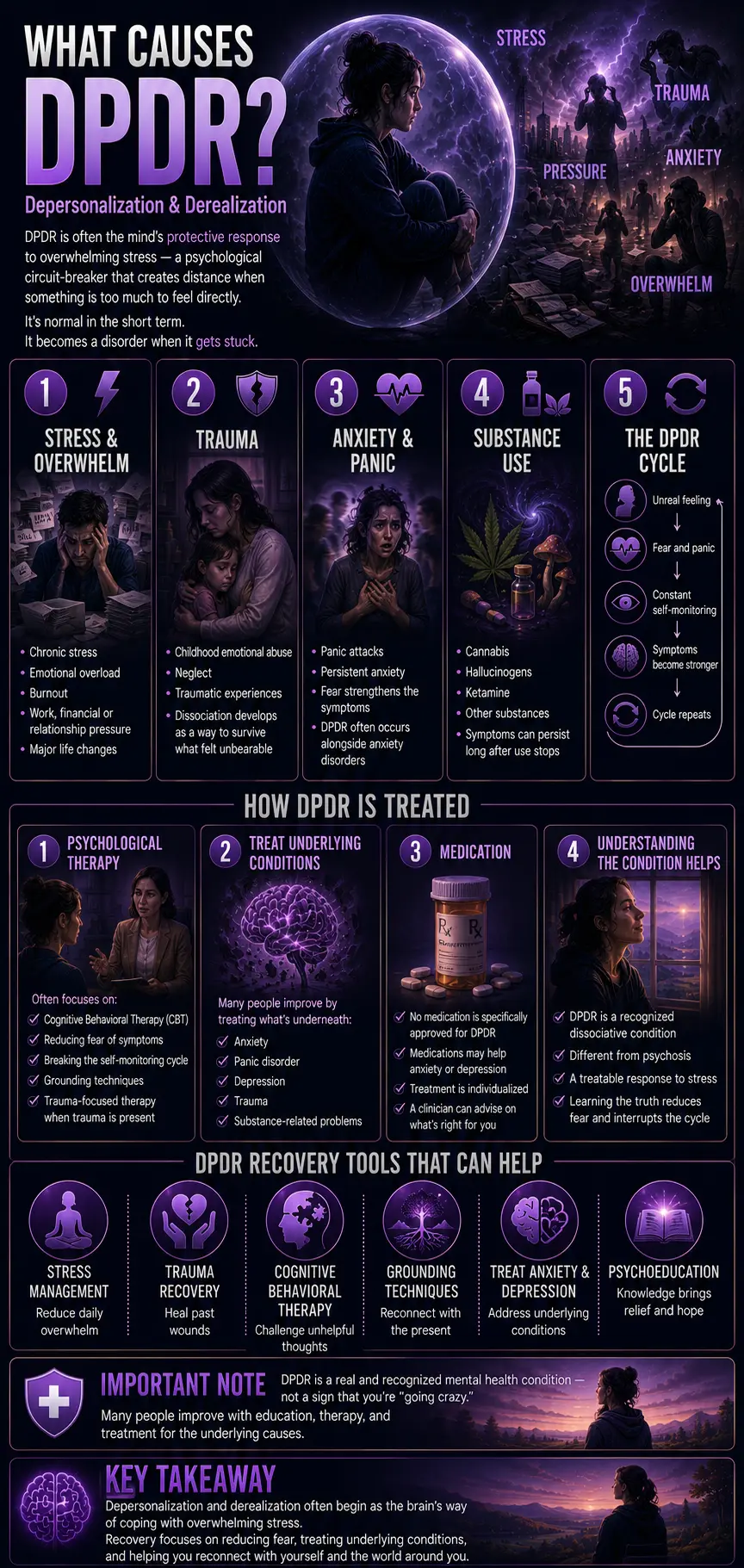
Depersonalization and derealization are widely understood as the mind’s protective response to overwhelming experience — a kind of psychological circuit-breaker that creates distance when something is too much to feel directly. That mechanism is normal and even adaptive in the short term; it becomes a disorder when it gets stuck.
The most common contributors are severe stress — interpersonal, financial, or occupational — along with anxiety and panic attacks, depression, and substance use. Trauma is a particularly strong thread: DPDR is frequently linked to traumatic experience, and especially to emotional abuse and neglect in childhood, where dissociation may have begun as a way to survive circumstances a child had no other way to escape.
Substances deserve a specific mention. Cannabis, hallucinogens, ketamine, and other drugs can trigger episodes of depersonalization and derealization. Importantly, while symptoms occurring during intoxication are excluded from the diagnosis, some substances can trigger a DPDR pattern that persists for a long time after use has stopped entirely — so a drug-triggered onset does not mean the condition isn’t real or won’t need treatment.
A vicious cycle then tends to maintain the problem: the experience of unreality is frightening, the fear drives hypervigilant self-monitoring (“am I still feeling detached?”), And that constant self-scrutiny both intensifies and sustains the detachment. This cycle is exactly what psychological treatment targets — which is part of why understanding the condition often begins to loosen it.
How Depersonalization/Derealization Disorder Is Treated
Treatment for DPDR is less established than for some conditions, and it’s honest to say the evidence base is more modest — but people do improve, and several approaches genuinely help.
Psychological therapy is the mainstay. Cognitive Behavioral Therapy adapted specifically for depersonalization has the best support; the approach developed at the Depersonalization Research Unit at King’s College London by Dr. Elaine Hunter and colleagues targets the catastrophic interpretations (“I’m going insane,” “my brain is damaged”) and the hypervigilant self-monitoring that keep the cycle turning. Reducing fear of the symptom reliably reduces its grip. Grounding techniques help many people manage acute episodes, and trauma-focused therapy is important where trauma is part of the picture.
Treating what’s underneath often matters more than treating the unreality directly. Because DPDR so commonly accompanies anxiety, panic, depression, and trauma, addressing those conditions frequently improves the dissociation substantially. Where substance use is involved, stopping is an essential part of recovery.
Medication is a more limited story, and it’s worth being straightforward about it: there is no medication specifically approved for DPDR, and results with medication have been mixed. Medications are mainly used to treat co-occurring anxiety or depression, which can indirectly help. A clinician can advise on whether that’s appropriate for you.
Psychoeducation — simply understanding what this is — is more powerful here than in almost any other condition, because so much of DPDR’s distress comes from the terrifying explanations people reach for in the absence of a real one. Learning that this is a recognized dissociative response to stress, that reality testing being intact rules out psychosis, and that other people experience the same bewildering thing, often produces genuine relief on its own.
Frequently Asked Questions
What is the difference between depersonalization and derealization?
They are two sides of the same experience of unreality, distinguished by what feels unreal. Depersonalization is detachment from yourself — feeling like an outside observer of your own thoughts, emotions, or body, as if watching yourself from a distance, on autopilot, or as though your body isn’t quite yours. Derealization is detachment from your surroundings — the world seeming dreamlike, foggy, flat, artificial, or distorted, with familiar places feeling strange and familiar people seeming lifeless. The two very often occur together, which is why the DSM-5 combined them into a single diagnosis rather than treating them as separate conditions. This test screens for both.
Does having depersonalization mean I have a disorder?
No, and this is one of the most important things to understand. Transient episodes of depersonalization or derealization are common — somewhere between 25% and 75% of people have at least one in their lifetime, typically during extreme stress, exhaustion, grief, or after substance use. Only around 1 to 2% of people ever meet the criteria for depersonalization/derealization disorder. What makes it a disorder is not that the experience has occurred, but that it is persistent or recurrent and causes clinically significant distress or impairment. An unsettling hour after a sleepless night is a human experience; months of ongoing unreality that frightens you and disrupts your life is a clinical condition worth getting help for.
Does depersonalization mean I’m going crazy or becoming psychotic?
Almost certainly not — and the reasoning here is genuinely reassuring rather than merely comforting. A diagnostic criterion for DPDR is that reality testing remains intact: the person knows their experiences are subjective, that the world hasn’t really become unreal and they haven’t really left their body.
The Merck Manual notes that this preserved awareness is exactly what differentiates DPDR from a psychotic disorder, in which insight is always lacking. So the fact that you can tell something is wrong, that you recognize the unreality as a feeling rather than a fact, is precisely the feature that points away from psychosis. Fearing you’re going crazy is one of the most characteristic features of DPDR — and it’s a symptom of the condition, not evidence for the fear.
Can depersonalization be caused by weed or other drugs?
Yes. Cannabis, hallucinogens, ketamine, and other substances are well-recognized triggers for episodes of depersonalization and derealization. There’s an important nuance in how this relates to diagnosis: symptoms occurring only during intoxication or withdrawal are excluded from a DPDR diagnosis (Criterion D). However, some substances can trigger a depersonalization pattern that persists for a long time after use has completely stopped. So if your symptoms began after a drug experience but have continued long since, that does not mean they aren’t real or don’t warrant treatment — it’s a recognized route into the condition. Stopping substance use is an essential part of recovery in these cases, and a clinician can help you sort out what’s driving what.
Is depersonalization a symptom of anxiety or panic attacks?
It can be. Depersonalization and derealization are listed among the recognized symptoms of a panic attack, and they commonly occur with anxiety, depression, and stress. This matters diagnostically: DPDR is only diagnosed when the unreality is not better explained by another condition (Criterion E). If your experiences of unreality happen mainly during discrete attacks of intense fear with a racing heart, breathlessness, and dizziness, panic disorder is likely the better explanation — see our Panic Disorder Test. If the unreality is more constant, present between and outside such episodes, DPDR becomes more likely. In practice they often coexist, and a clinician can untangle which is primary.
Can depersonalization/derealization disorder be cured?
People do get better, though it’s honest to say the evidence base for DPDR treatment is more modest than for conditions like panic or depression. The most effective approach is psychological therapy — particularly CBT adapted for depersonalization, which targets the catastrophic interpretations and the constant self-monitoring that keep the cycle going. Treating underlying anxiety, depression, or trauma often improves the unreality substantially, and stopping any contributing substance use matters. There is no medication approved specifically for DPDR. Recovery is frequently gradual rather than sudden, and it often begins in an unexpected place: simply understanding what the condition is tends to reduce the fear, and reducing the fear tends to reduce the symptom’s grip.
Can this test diagnose depersonalization disorder?
No. This is a screening and self-reflection tool, not a diagnostic instrument. It can help you recognize whether your experiences align with the patterns of depersonalization/derealization disorder and whether it’s worth seeking a professional assessment — but only a qualified clinician can diagnose DPDR. That’s especially true here, because the diagnosis specifically requires ruling out medical causes such as seizure disorders, substance effects, and other conditions that can produce similar experiences, sometimes with brain imaging or an EEG. Treat your result as useful information and a starting point for a conversation, not a conclusion.
Related Tests
- Dissociative Identity Disorder Test — the other major dissociative condition, centered on identity disruption and memory gaps rather than unreality alone
- Panic Disorder Test — depersonalization is a recognized panic attack symptom; essential for distinguishing panic-driven unreality from DPDR
- Anxiety Test — anxiety is among the most common drivers of depersonalization and derealization experiences
- PTSD Test — DPDR is strongly associated with trauma, particularly childhood emotional abuse and neglect
- Schizophrenia Test — screens for psychosis, where reality testing is lost; the key contrast with DPDR’s intact insight
- Clinical Depression Test — depression commonly accompanies DPDR and the emotional numbing the two share can overlap
- Schizotypal Personality Disorder Test — another condition in the dissociation and psychosis category involving unusual perceptual experiences
- Agoraphobia Test — avoidance of situations that trigger unreality or panic can develop alongside DPDR
References
- American Psychiatric Association. (2022). Diagnostic and Statistical Manual of Mental Disorders, Fifth Edition, Text Revision (DSM-5-TR). Depersonalization/Derealization Disorder 300.6 (F48.1), Dissociative Disorders. psychiatry.org
- Merck Manual / MSD Manual Professional Edition. (2026). Depersonalization/Derealization Disorder. [25–75% lifetime transient experiences vs ~1–2% disorder prevalence; intact reality testing differentiates DPDR from psychosis; assessment may include MRI, EEG, toxicology] merckmanuals.com
- Sierra, M., & Berrios, G.E. (2000). The Cambridge Depersonalization Scale: a new instrument for the measurement of depersonalization.Psychiatry Research, 93(2), 153–164. [The standard research measure for depersonalization severity] pubmed.ncbi.nlm.nih.gov
- Hunter, E.C.M., Baker, D., Phillips, M.L., Sierra, M., & David, A.S. (2005). Cognitive-behavior therapy for depersonalization disorder: an open study. Behavior Research and Therapy, 43(9), 1121–1130. [CBT model targeting catastrophic appraisals and symptom monitoring; Depersonalization Research Unit, King’s College London] pubmed.ncbi.nlm.nih.gov
- Simeon, D. (2004). Depersonalization disorder: a contemporary overview. CNS Drugs, 18(6), 343–354. [Clinical overview, course, and treatment evidence] pubmed.ncbi.nlm.nih.gov
Related Tests
See All Quiz →
You may also like
See All Quiz →



Addiction and Impulse Control
Are You Addicted to the Internet? Take the Ultimate Digital Dependency Test
→