
Rejection Sensitive Dysphoria Test
A free, private screen for rejection sensitive dysphoria - the sudden, outsized emotional pain that can hit when you feel rejected, criticised or like you have fallen short. Fifteen questions, scored 0 to 60. RSD is not a formal diagnosis, and this screen does not diagnose anything.
Published Updated
This free rejection sensitive dysphoria test screens for RSD — the intense, almost physical emotional pain that can hit when you feel rejected, criticized, or like you’ve fallen short, even when the trigger is small or imagined. In 15 questions, it looks at how strongly rejection and criticism affect you, how you respond, and how much it’s shaped your life. You’ll get an instant, private result.
A quick, honest note up front: rejection sensitive dysphoria is a real and often deeply painful experience, but it is not an official diagnosis. The term comes mainly from clinical work in the ADHD field — especially psychiatrist William Dodson — rather than from a large body of research under that name. What is well established is that people with ADHD often experience intense emotional reactions, and that sensitivity to rejection is a genuine, studied phenomenon. This test can’t diagnose you, but it can help you recognize a pattern that, for many people, finally explains a lifetime of reactions they never had a word for.
What Is Rejection Sensitive Dysphoria?
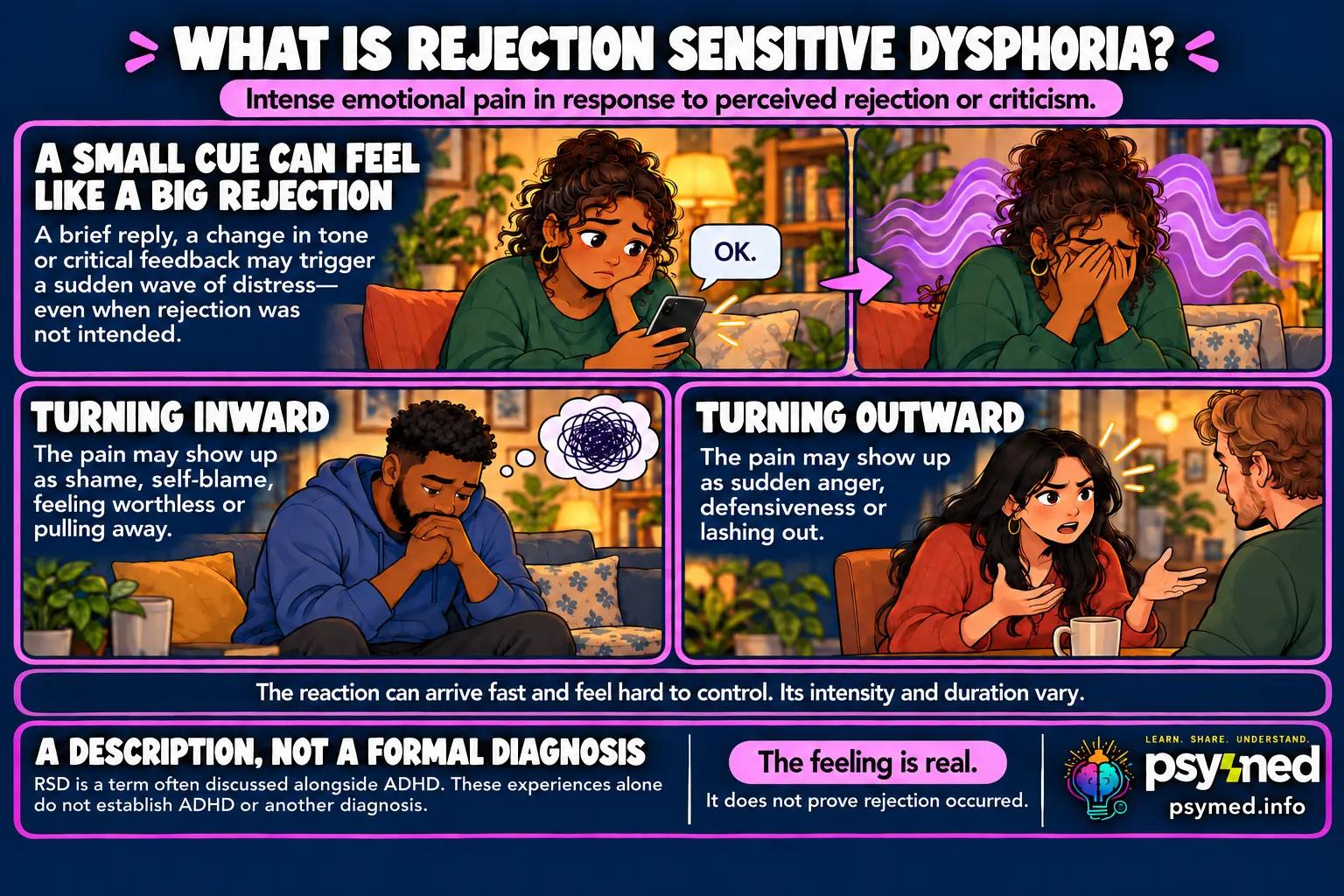
Rejection sensitive dysphoria describes an extreme emotional reaction to the perception of being rejected, criticized, or disappointing someone — whether or not that rejection is real. The word “dysphoria” comes from the Greek for “hard to bear,” and that captures it: people with RSD often describe the feeling as a sudden, overwhelming wave of pain that’s more physical than ordinary disappointment. A curt reply, a change in someone’s tone, or a single piece of criticism can set it off, and the reaction feels wildly out of proportion to the trigger — something sufferers are often painfully aware of but unable to switch off.
Psychiatrist William Dodson, who popularized the term in the context of ADHD, describes RSD taking one of two forms. It can be internalized — turning inward as a sudden crash into shame, worthlessness, and despair that can look, briefly, like a major depressive episode. Or it can be externalized — erupting outward as a flash of intense anger or lashing out. Either way, the emotion arrives fast, hits hard, and often passes relatively quickly, leaving confusion and self-criticism behind.
Signs You Have Rejection Sensitive Dysphoria
RSD shows up as a recognizable cluster of reactions and coping patterns. You don’t need all of them, and some are things you may have built your whole personality around without realizing why. These are the signs this test screens for.
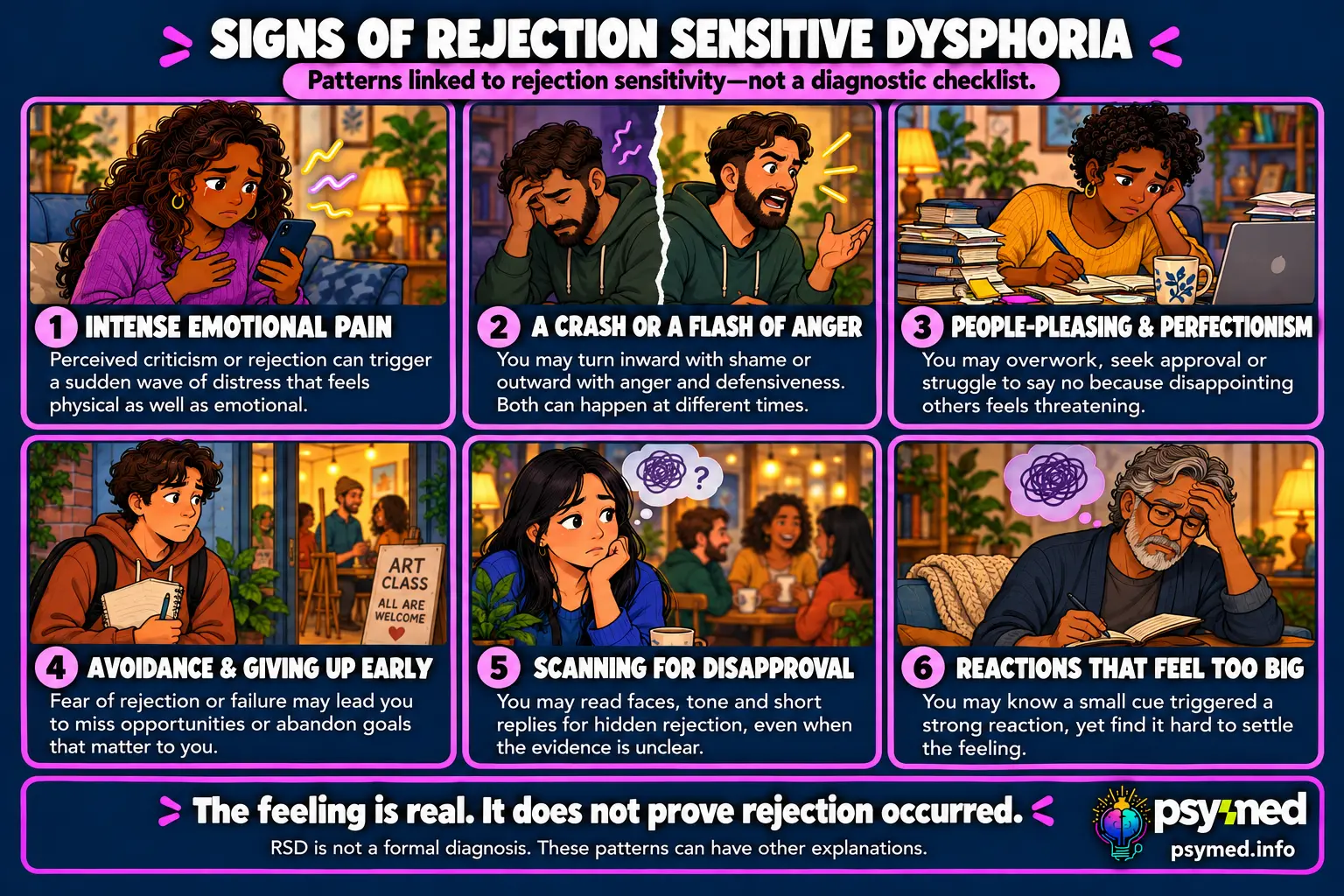
Emotional pain that’s intense and physical
Perceived rejection or criticism doesn’t just sting — it produces a sudden, overwhelming wave of pain that can feel physical, like being winded or punched. The intensity is the hallmark, and it’s often far bigger than the situation seems to warrant.
The two faces: a sudden crash, or a flash of anger
For some people RSD turns inward, dropping them into instant shame, worthlessness, or despair that resembles a brief depression. For others it turns outward as a surge of anger or defensiveness. Many people experience both at different times. Either way, the shift is abrupt and feels outside your control.
People-pleasing and perfectionism
To avoid ever triggering that pain, many people with RSD become intense people-pleasers or perfectionists — working relentlessly to meet everyone’s expectations, because anything less than approval feels like rejection. It can look like being conscientious or driven, but underneath it’s fear.
Avoidance and giving up early
Because failure and rejection hurt so much, you may avoid situations, opportunities, or relationships where either is possible — or abandon goals the moment there’s a risk of not succeeding. It can quietly shrink a life, keeping you from things you actually want.
Scanning for disapproval
A constant, often exhausting vigilance for any sign that someone is annoyed, pulling away, or judging you — reading tone, facial expressions, and short replies for hidden rejection, and frequently assuming the worst even without real evidence.
Reactions that feel out of proportion
Perhaps the defining experience: knowing, even in the moment, that your reaction is bigger than other people’s would be — and being unable to simply “let it go.” The gap between how much it hurts and how small the trigger was is itself a clue.
How This Rejection Sensitive Dysphoria Test Works
This test has 15 statements about how you experience and respond to rejection and criticism. For each, choose how true it is for you, thinking about how you generally are rather than on a single day:
Not at all = 0 | A little = 1 | Somewhat = 2 | Mostly = 3 | Completely = 4
Your answers add up to a score from 0 to 60 reflecting how strongly you identify with the experience of rejection sensitive dysphoria. A higher score suggests the pattern is a significant part of your emotional life and may be worth exploring, especially alongside ADHD; it doesn’t label you with a disorder. Your responses are private.
Understanding Your Results
Your score reflects how strongly you relate to the experience of rejection sensitive dysphoria. Read it as a guide, not a verdict. RSD isn’t a formal diagnosis, so no score here can confirm or rule it out — but a high total often points to something real and worth understanding, particularly if you have or suspect ADHD.
| Score | Range | What It Suggests |
|---|---|---|
| 0 – 15 | Low | Rejection and criticism affect you within a typical range. |
| 16 – 30 | Moderate | Noticeable sensitivity to rejection worth understanding and managing. |
| 31 – 45 | High | Strong rejection sensitivity consistent with RSD; exploring it (and ADHD) may help. |
| 46 – 60 | Very High | Very strong, life-shaping rejection sensitivity; support is worthwhile. |
RSD and ADHD: The Close Connection
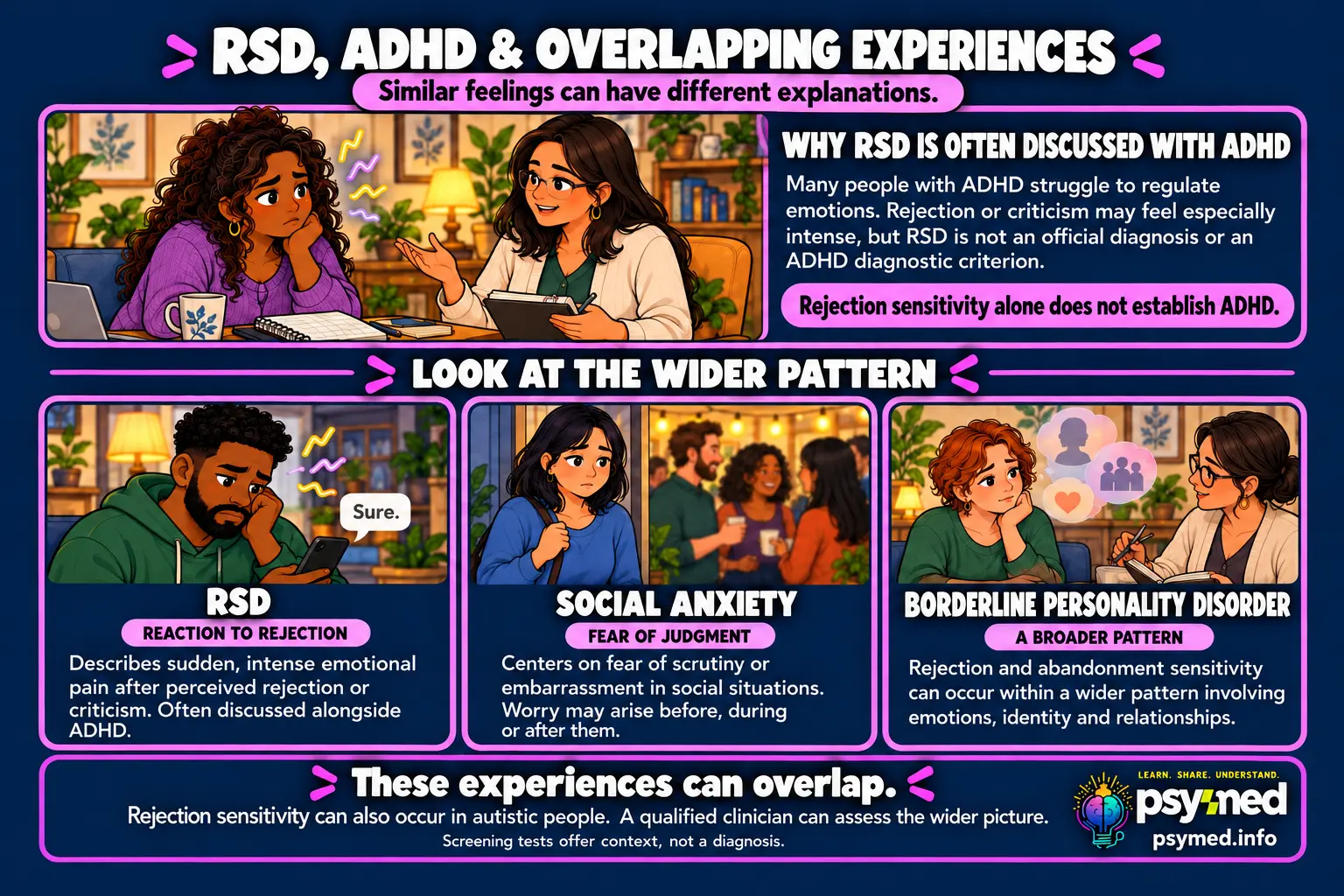
Rejection sensitive dysphoria is discussed most often in the context of ADHD, and that’s no accident. Emotional dysregulation — difficulty controlling the intensity and speed of emotional reactions — is increasingly recognized as a core part of the ADHD experience for many people, even though it isn’t one of the official diagnostic criteria. William Dodson, who brought the term RSD into wide use, has described it as one of the most impairing and least talked-about aspects of ADHD for the adults he worked with. The theory is that the same differences in the ADHD brain that affect attention and impulse control also make emotions hit harder and faster, including the emotions around rejection. If the pattern in this test resonates with you, it can be well worth exploring whether ADHD fits, because understanding the root often makes the sensitivity far easier to manage. Our ADHD Test is a natural next step, and RSD-type sensitivity also shows up in autism.
RSD vs. Social Anxiety vs. Borderline Personality
Intense sensitivity to rejection appears in several conditions, which is part of why RSD can be confusing. The feelings overlap; the surrounding picture differs.
- Social anxiety centers on anticipating scrutiny and embarrassment in social situations — a fear of being judged that often builds beforehand. RSD is more about the sudden, intense reaction to perceived rejection once it seems to happen.
- Borderline personality disorder also involves strong sensitivity to rejection and abandonment, but as part of a broader pattern of unstable identity, relationships, and emotions. RSD, as usually described, is narrower — the rejection-triggered reaction specifically, typically in the context of ADHD.
- RSD is the rapid, disproportionate emotional response to perceived rejection or criticism, most often discussed alongside ADHD and emotional dysregulation.
These aren’t mutually exclusive, and only a professional can tease them apart. If the broader emotional-instability picture fits better, our Anxiety Test and other screens may add useful context.
Methodology & Sources
This test is an educational screening tool informed by the clinical description of rejection sensitive dysphoria (notably by psychiatrist William Dodson in the ADHD field) and by the broader research tradition on rejection sensitivity, originating with Karen Horney and operationalized by Geraldine Downey and colleagues (the Rejection Sensitivity Questionnaire). Its 15 items are original statements reflecting the internalized, externalized, and anticipatory patterns associated with RSD. It is a screen for self-reflection, not a diagnostic instrument. Importantly, rejection sensitive dysphoria is not a formal diagnosis in the DSM-5 or ICD-11; what is well established is emotional dysregulation in ADHD and the studied phenomenon of rejection sensitivity. Only a qualified professional can assess conditions such as ADHD.
References
- Downey, G., & Feldman, S.I. (1996). Implications of rejection sensitivity for intimate relationships. Journal of Personality and Social Psychology, 70(6), 1327–1343. doi:10.1037/0022-3514.70.6.1327
- Dodson, W. (2021). Emotional Regulation and Rejection Sensitivity in ADHD. ADDitude Magazine / clinical commentary.
- Beheshti, A., Chavanon, M.L., & Christiansen, H. (2020). Emotion dysregulation in adults with attention deficit hyperactivity disorder: a meta-analysis. BMC Psychiatry, 20, 120. doi:10.1186/s12888-020-2442-7
Frequently Asked Questions
Is rejection sensitive dysphoria a real condition?
The experience is real; the label is informal. Rejection sensitive dysphoria is not a diagnosis in the DSM-5 or ICD-11. The term was popularized by psychiatrist William Dodson through clinical work with ADHD patients, rather than emerging from a large body of research under that specific name. What is well established is that people with ADHD frequently struggle with emotional dysregulation, and that sensitivity to rejection is a genuine, studied phenomenon (the “rejection sensitivity” research tradition). So while “RSD” isn’t official, the intense pain it describes is real and worth taking seriously.
Is RSD part of ADHD?
It’s very closely associated with ADHD, though not listed as an official symptom. Emotional dysregulation — emotions that come on fast and hit hard — is increasingly recognized as a central part of ADHD for many people, and rejection sensitive dysphoria is often described as the rejection-focused version of that. Many adults only make sense of their lifelong rejection sensitivity once they understand their ADHD. If the pattern in this test resonates, exploring whether ADHD fits can be genuinely clarifying, because treating the underlying emotional regulation often eases the rejection sensitivity too.
What’s the difference between RSD and just being sensitive?
Mostly intensity, speed, and impact. Lots of people dislike criticism and feel hurt by rejection — that’s normal. RSD describes something more extreme: a reaction that arrives suddenly, feels almost physically painful, is clearly out of proportion to the trigger, and can’t simply be shaken off. It often drives significant coping behaviors too, like intense people-pleasing, perfectionism, or avoiding opportunities altogether. When sensitivity to rejection is strong enough to shape your mood, your choices, and your sense of self, it’s worth understanding rather than dismissing as “just being sensitive.”
Can rejection sensitive dysphoria be treated?
Yes, the underlying patterns can be worked with, even if “RSD” itself isn’t a formal diagnosis. Because it’s so tied to ADHD and emotional regulation, approaches often include therapy (to build skills for riding out intense emotions and challenging automatic assumptions of rejection) and, where ADHD is present, ADHD treatment, which for some people reduces the emotional intensity as well. Self-understanding helps too: simply recognizing an RSD wave for what it is — a fast, disproportionate, passing reaction — can loosen its grip on your decisions. A professional who understands ADHD and emotional regulation is the best guide.
Related Tests
- ADHD Test — RSD is most closely associated with ADHD; the key related screen
- Autism Test — rejection sensitivity and emotional intensity also appear in autism
- Anxiety Test — for the social-anxiety side of fearing judgment and rejection
- Emotional Neglect Test — early experiences can deepen sensitivity to rejection
- Childhood Trauma Test — another root of adult rejection sensitivity
- Borderline Personality Disorder Test — when rejection sensitivity sits inside a wider pattern of unstable identity and relationships
This test is an educational screening tool, not a diagnosis. Rejection sensitive dysphoria is not a formal diagnosis, and conditions like ADHD can only be assessed by a qualified professional. If you are struggling and having thoughts of harming yourself, please call or text 988 (Suicide & Crisis Lifeline, US, 24/7). Outside the US, find helplines at findahelpline.com.
Related Tests
See All Quiz →
You may also like
See All Quiz →