


Emotional Neglect Test (Childhood Emotional Neglect)
A free, private screen for childhood emotional neglect (CEN), the pattern Dr. Jonice Webb described in Running on Empty: growing up with emotional needs that went unnoticed or unmet. Fifteen statements, scored 0 to 60. A reflection, not a diagnosis.
Published Updated
This free emotional neglect test is a gentle, private way to explore whether you experienced childhood emotional neglect (CEN) — and whether it may still be shaping how you feel today. Childhood emotional neglect happens when a child’s emotional needs go unnoticed or unmet, and because it’s about what didn’t happen rather than what did, it often leaves no clear memory — just a quiet sense that something is missing. These 15 questions can help you put words to it.
Before you begin, one thing that matters deeply with this particular topic: emotional neglect is real and valid even when it was invisible. Many people who experienced CEN had their physical needs met, were never abused, and had parents who loved them — which is exactly why they so often minimize it and blame themselves (“my childhood was fine, so what’s wrong with me?”). If that’s you, please hear this: your struggles are not a character flaw, and what you didn’t receive as a child was not your fault. This test can’t diagnose anything — it’s simply a compassionate place to start understanding yourself.
What Is Childhood Emotional Neglect (CEN)?
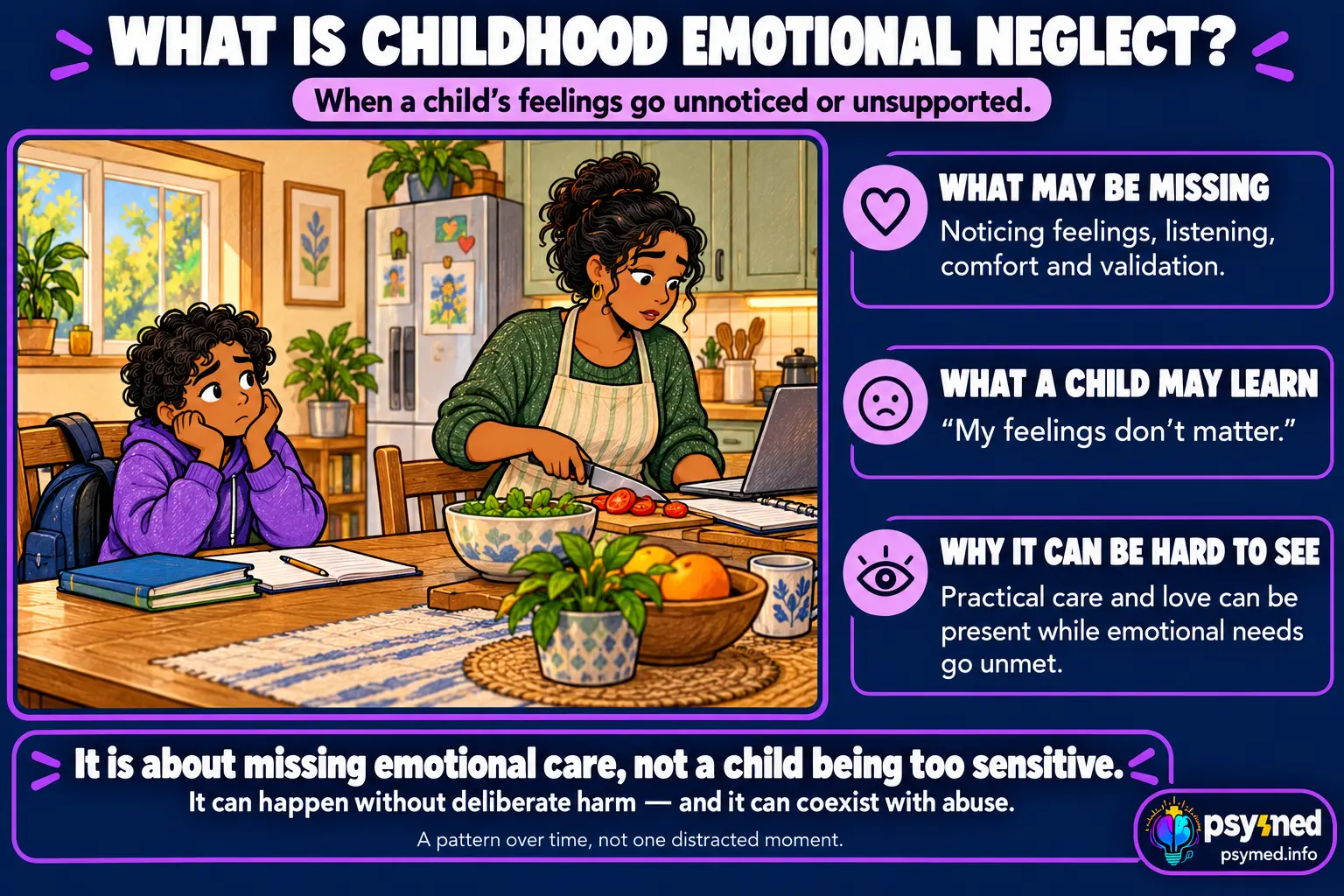
Childhood emotional neglect (CEN) is a parent’s failure to notice, attend to, or respond adequately to a child’s emotional needs. It was defined and popularized by psychologist Dr. Jonice Webb in her 2012 book Running on Empty, and it describes something subtle but profound: a childhood in which feelings were rarely asked about, named, validated, or responded to — so the child quietly learned that their emotions didn’t matter, and, by extension, that they didn’t matter.
What makes CEN so distinctive is that it’s an act of omission — it’s defined by what was missing, not by anything harmful that was done. That’s the opposite of abuse, which is an act of commission (something harmful that happened). Because nothing dramatic occurred, emotional neglect is almost invisible: there’s usually no memory to point to, no single event, often no bad intent at all.
It frequently comes from well-meaning, loving parents who were simply emotionally unaware themselves, overwhelmed, or raised the same way. A child can have food, shelter, activities, and genuine love, and still grow up emotionally alone. This is why so many people with CEN insist their childhood was “fine” while carrying a lifelong sense of emptiness they can’t explain.
Signs of Childhood Emotional Neglect in Adults
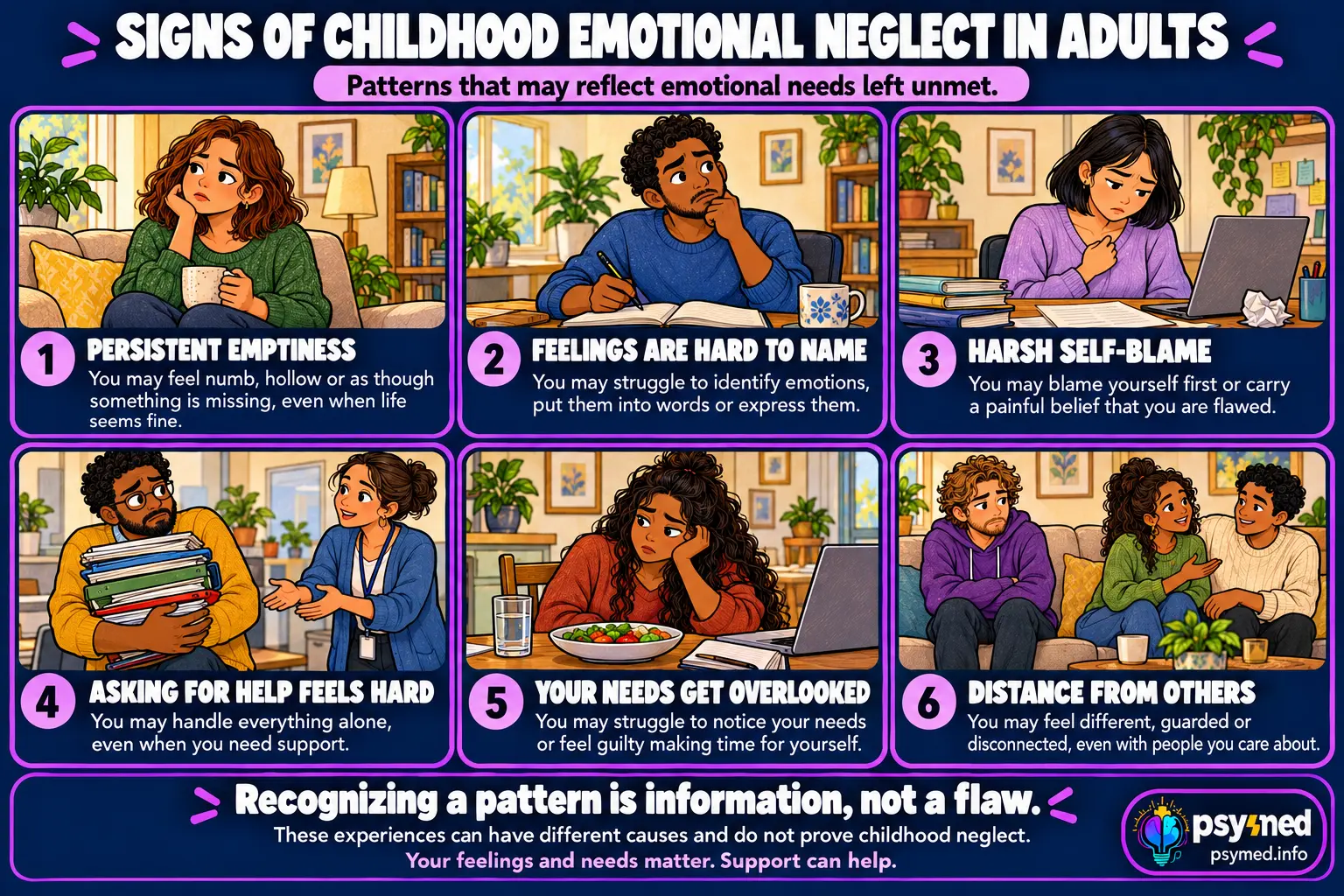
Childhood emotional neglect tends to show up later as a recognizable set of patterns — not as memories of what happened, but as ways of being that can feel like “just who I am.” You don’t need all of them, and recognizing yourself here isn’t a flaw; it’s information. Read these gently, as the signs this test screens for.
A persistent sense of emptiness
A background feeling of emptiness, numbness, or something missing that’s hard to name — as if you’re running on empty, even when life looks fine on paper. This quiet, hard-to-explain hollowness is one of the most common signs of CEN.
Difficulty knowing or expressing your feelings
Struggling to identify what you’re feeling, put emotions into words, or feel comfortable with strong feelings — because, growing up, no one helped you notice, name, or make sense of your inner world. Emotions can feel confusing, overwhelming, or like something to push aside.
Harsh self-blame and a feeling of being flawed
Being hard on yourself, blaming yourself first when things go wrong, and carrying a quiet belief that something is fundamentally wrong or defective about you. This “fatal flaw” feeling is common in CEN — and it is not the truth about you.
Difficulty asking for help (counter-dependence)
Finding it very hard to ask for help, rely on others, or lean on people emotionally — preferring to handle everything alone. When your needs weren’t met as a child, hyper-self-reliance often became the safest option, even though it leaves you isolated.
Not knowing your own needs or neglecting self-care
Struggling to know what you want or need, difficulty prioritizing yourself, or feeling guilty when you do — and often being far kinder to others than to yourself. If your feelings and needs were overlooked early on, it can be genuinely hard to tune into them now.
Feeling different, distant, or disconnected
A sense of not quite belonging or being different from others, and feeling guarded or hard to reach even in close relationships. The emotional distance that once protected you can quietly keep you from the closeness you long for.
Emotional Neglect vs Abuse: Why CEN Is So Easy to Miss
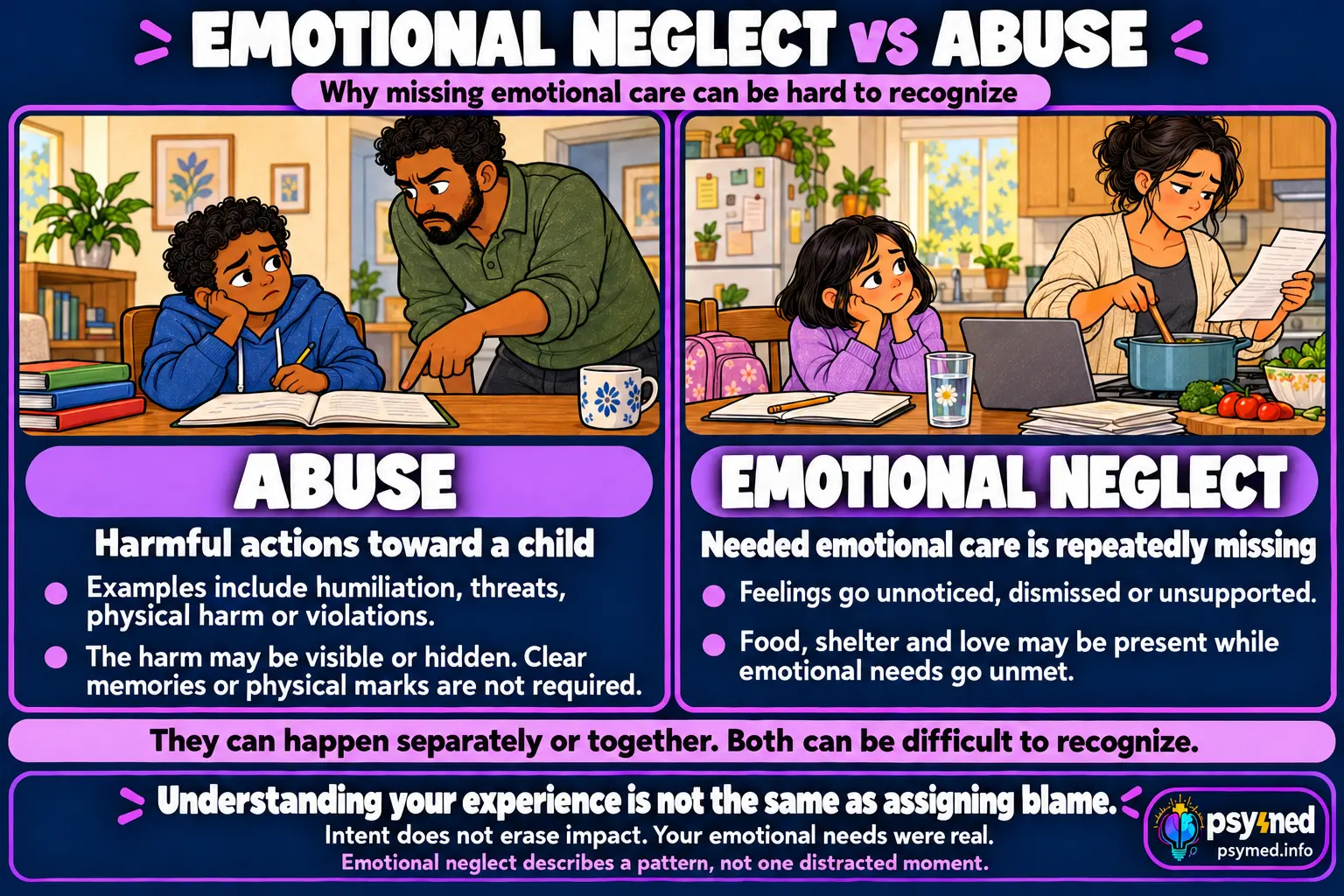
Understanding how emotional neglect differs from abuse is what helps so many people finally recognize their own experience. Abuse is an act of commission — something harmful that was done to a child (hitting, shaming, violating). Emotional neglect is an act of omission — something essential that was not done: a child’s feelings not being noticed, responded to, or valued. Abuse leaves marks and memories; neglect leaves an absence, which is far harder to see or name.
This is why CEN is so commonly overlooked, and why people who experienced it tend to minimize it or assume the problem is them. There was no villain, often no clear event, and frequently parents who loved their child and did their best. But a child’s emotional needs are real needs, and when they go consistently unmet — however unintentionally — the effects are real too. Recognizing this isn’t about blaming your parents; it’s about understanding yourself with compassion instead of judgment. (Note: this test is about childhood emotional neglect. If you’re experiencing emotional neglect in a current relationship — a partner who is emotionally unavailable or dismissive — our Emotional Availability Test and Toxic Relationship Quiz may fit better.)
How This Emotional Neglect Test Works
This test has 15 statements about the feelings and patterns associated with childhood emotional neglect. For each, choose how much it’s true for you, thinking about how you generally feel and your experience growing up:
Not at all = 0 | A little = 1 | Somewhat = 2 | Quite a bit = 3 | Very much = 4
Your answers add up to a score from 0 to 60, placing you in one of four ranges from minimal to strong signs of CEN. A higher score means more of these patterns resonate — it’s a reflection, not a diagnosis, and it doesn’t measure how “bad” your childhood was. Answer honestly and gently; your results are private.
Understanding Your Results
Your score reflects how strongly the patterns of childhood emotional neglect resonate with your experience. Please read it gently, and as a starting point for understanding — not as a diagnosis or a judgment of your parents. Only you can know your full story, and a therapist can help you explore it.
| Score | Range | What It Suggests |
|---|---|---|
| 0 – 15 | Minimal | Few signs of childhood emotional neglect. |
| 16 – 30 | Mild | Some signs worth gentle reflection. |
| 31 – 45 | Moderate | A meaningful pattern consistent with childhood emotional neglect. |
| 46 – 60 | Strong | Strong signs of CEN that may be significantly affecting you; support can help. |
Healing From Childhood Emotional Neglect
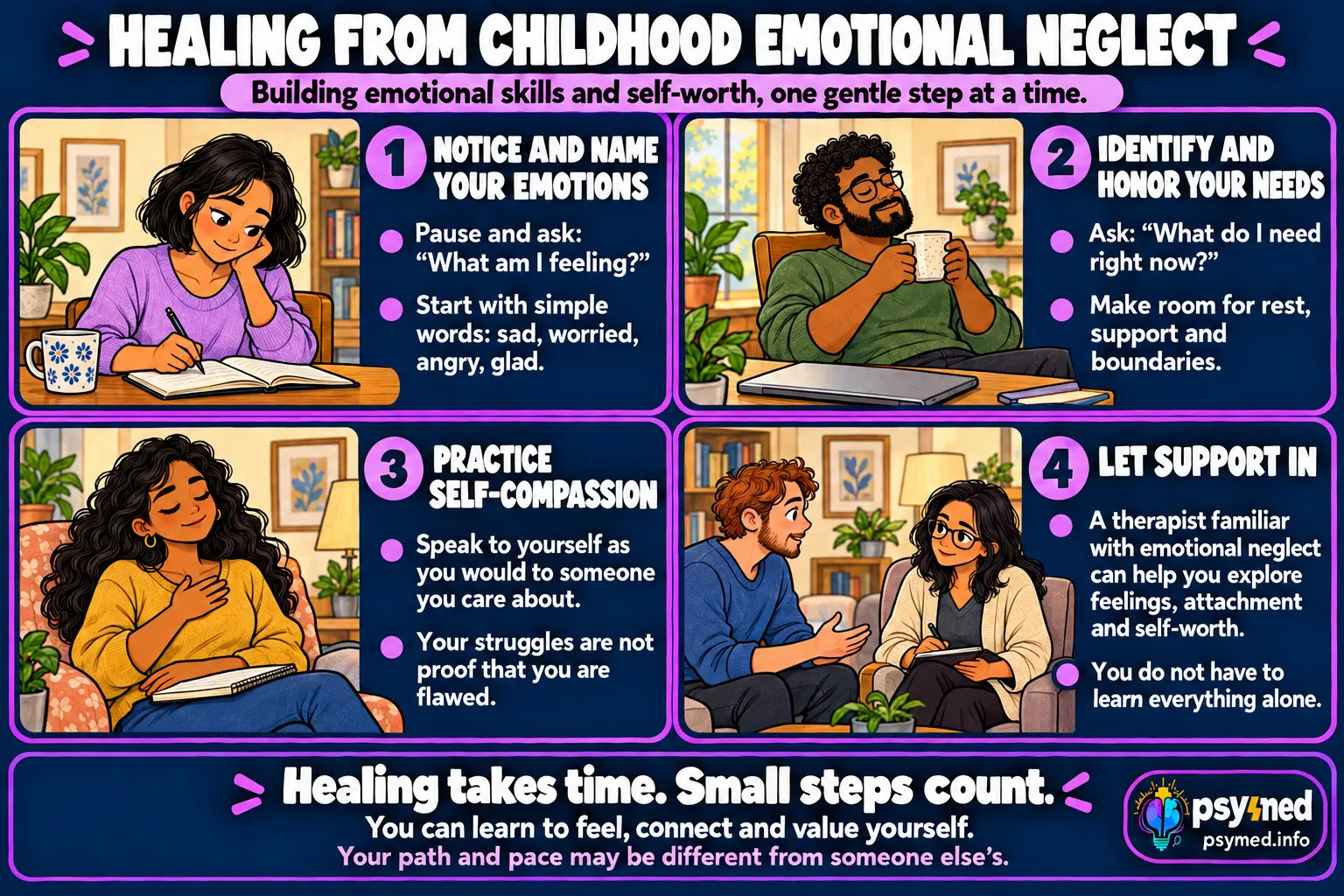
Childhood emotional neglect is very workable, and healing often feels less like fixing something broken and more like finally learning something you were never taught. Because CEN is about emotional skills and self-worth that didn’t get built in childhood, recovery centers on building them now: learning to notice and name your emotions (the very thing that was missing), to identify and honor your own needs, and to treat yourself with the compassion you may reserve only for others. Many people are surprised by how much changes once they stop seeing their struggles as personal failings and start seeing them as the logical result of what they didn’t receive.
Therapy can be especially helpful — approaches that work with emotions, attachment, and self-compassion, and therapists familiar with emotional neglect, can help you reconnect with an inner life that may have gone quiet long ago. Because CEN is closely tied to how we learned to bond and to see ourselves, our Attachment Style Test and Self-Esteem Test can add useful context, and if naming your emotions is particularly hard, our Alexithymia Test looks at that specific difficulty. Healing takes time and gentleness — but the capacity to feel, to connect, and to value yourself is still there, waiting to be grown.
Methodology & Sources
This test is an educational screening tool informed by the concept of Childhood Emotional Neglect (CEN) as defined by Dr. Jonice Webb in Running on Empty (2012), and by the broader clinical understanding of emotional neglect as a failure to meet a child’s emotional needs. Its 15 items are original statements reflecting the characteristics commonly seen in adults who experienced CEN — emptiness, difficulty with emotions, self-blame, counter-dependence, and a sense of disconnection. It is a screen for self-reflection, not a diagnostic instrument, and emotional neglect is not itself a formal diagnosis. A qualified professional can help you understand your experience fully.
References
- Webb, J. (2012). Running on Empty: Overcome Your Childhood Emotional Neglect. Morgan James Publishing. [The concept of Childhood Emotional Neglect]
- Webb, J. — Childhood Emotional Neglect resources. drjonicewebb.com
- Music, G. (2011). Nurturing Natures: Attachment and Children’s Emotional, Sociocultural and Brain Development. [On the developmental role of emotional attunement]
Frequently Asked Questions
What is childhood emotional neglect?
Childhood emotional neglect (CEN) is a pattern in which a child’s emotional needs are consistently not noticed, responded to, or validated by their caregivers. Defined by Dr. Jonice Webb, it’s an act of omission — it’s about what was missing (emotional attunement and responsiveness), not about anything harmful that was done. Because of that, it’s often invisible and unremembered, and can happen even in homes with loving, well-meaning parents. Its effects can last into adulthood as feelings of emptiness, difficulty with emotions, self-blame, and a sense of disconnection — but it is very treatable.
How is emotional neglect different from abuse?
The core difference is omission versus commission. Abuse is an act of commission — something harmful that is done to a child, such as physical, emotional, or sexual abuse. Emotional neglect is an act of omission — the absence of something essential, namely having your feelings noticed and responded to. Abuse tends to leave memories and clear harm; neglect leaves an absence that’s much harder to see or name. Both can have serious lasting effects, but neglect is far more commonly overlooked, which is why so many people who experienced it minimize it or assume the problem is them.
Can you have emotional neglect even if your parents loved you?
Yes — and this is one of the most important and freeing things to understand about CEN. Emotional neglect isn’t about whether your parents loved you; it’s about whether your emotional needs were consistently met. Loving, well-intentioned parents can still emotionally neglect a child if they were emotionally unaware themselves, overwhelmed, distracted, or simply never taught how to attune to feelings (often because they were raised the same way). You can have had a childhood that looked good on the outside, with caring parents, and still have experienced emotional neglect. Recognizing this isn’t about blame — it’s about finally understanding yourself.
Can you heal from childhood emotional neglect?
Yes. Childhood emotional neglect is very workable, and because it’s largely about emotional skills and self-worth that didn’t develop in childhood, healing is about building them now — learning to notice and name your feelings, to identify and honor your needs, and to offer yourself compassion. Therapy, particularly approaches that work with emotions, attachment, and self-compassion, can be very effective. Many people find that simply naming their experience brings relief and that, with time and gentleness, the emptiness lifts and genuine connection — with themselves and others — becomes possible. It’s never too late.
Related Tests
- Childhood Trauma Test — the ACE questionnaire, covering neglect and other adversity
- Complex PTSD Test — how prolonged childhood adversity can affect you now
- Attachment Style Test — how early experiences shaped the way you bond
- Alexithymia Test — difficulty identifying and describing emotions, common in CEN
- Self-Esteem Test — the sense of worth emotional neglect often wounds
This test is an educational screening tool, not a diagnosis or a substitute for professional care. If you are in crisis or having thoughts of harming yourself, please call or text 988 (Suicide & Crisis Lifeline, US, 24/7). Outside the US, find helplines at findahelpline.com. Be gentle with yourself — your feelings have always mattered.
Related Tests
See All Quiz →


You may also like
See All Quiz →



Addiction and Impulse Control
Is Gambling Becoming a Problem? Take This Free Gambling Addiction Test (PGSI)
→