

Free Passive-Aggressive Test — How Passive-Aggressive Am I?
Do you express frustration indirectly — through silence, sarcasm, or subtle resistance? This free Passive-Aggressive Test reveals your communication patterns.
Published Updated
Passive-aggressive behavior is one of the most common — and most misunderstood — patterns in human communication. It’s not dramatic. It’s not loud. It doesn’t announce itself. It looks like withdrawing when you’re upset rather than saying so. Like saying “fine” when nothing is fine. Like forgetting to do something that you quietly resented being asked to do. Like holding a grudge that never gets addressed, but never quite dissolves either.
Most people who rely on passive-aggressive patterns don’t experience themselves as being indirect or resistant. They experience themselves as avoiding unnecessary conflict — keeping the peace, not causing scenes, being the reasonable one. The indirectness feels like self-control. The resentment feels like a realistic assessment of the situation. The subtle retaliations feel proportionate.
That gap between how passive-aggressive behavior feels from the inside and how it affects relationships from the outside is what makes it worth examining honestly. This free passive-aggressive test maps your patterns across 20 situations — how you handle conflict, frustration, disappointment, and unmet needs — and shows you where indirect communication is shaping your relationships in ways you may not have fully recognized.
What Is Passive-Aggressive Behavior?
Passive aggression is a pattern of indirectly expressing negative feelings — frustration, resentment, anger, or resistance — rather than addressing them openly. The “passive” element refers to the indirect form of expression: withdrawal, silence, procrastination, subtle sabotage, or the cold shoulder. The “aggressive” element refers to the underlying hostility or resistance that drives those behaviors, even when it is never stated directly.
The term originated after World War II and was initially used to describe soldiers’ indirect insubordination. It was formally included in clinical psychology in the first edition of the DSM in 1952, where it was listed alongside passive-dependent and aggressive types under “Passive-Aggressive Personality.” The construct was refined in subsequent DSM editions but was eventually removed from DSM-5 as a formal personality disorder category, partly because passive aggression is now understood as a behavioral pattern and communication style that can appear across many contexts and conditions rather than a discrete diagnosable disorder (PMC, 2022).
Today, passive-aggressive behavior is understood as one of the most commonly identified interpersonal patterns in clinical and everyday contexts — present across relationships, workplaces, and family systems — and one that responds meaningfully to self-awareness and assertiveness-focused intervention.
What Does Passive-Aggressive Behavior Look Like?
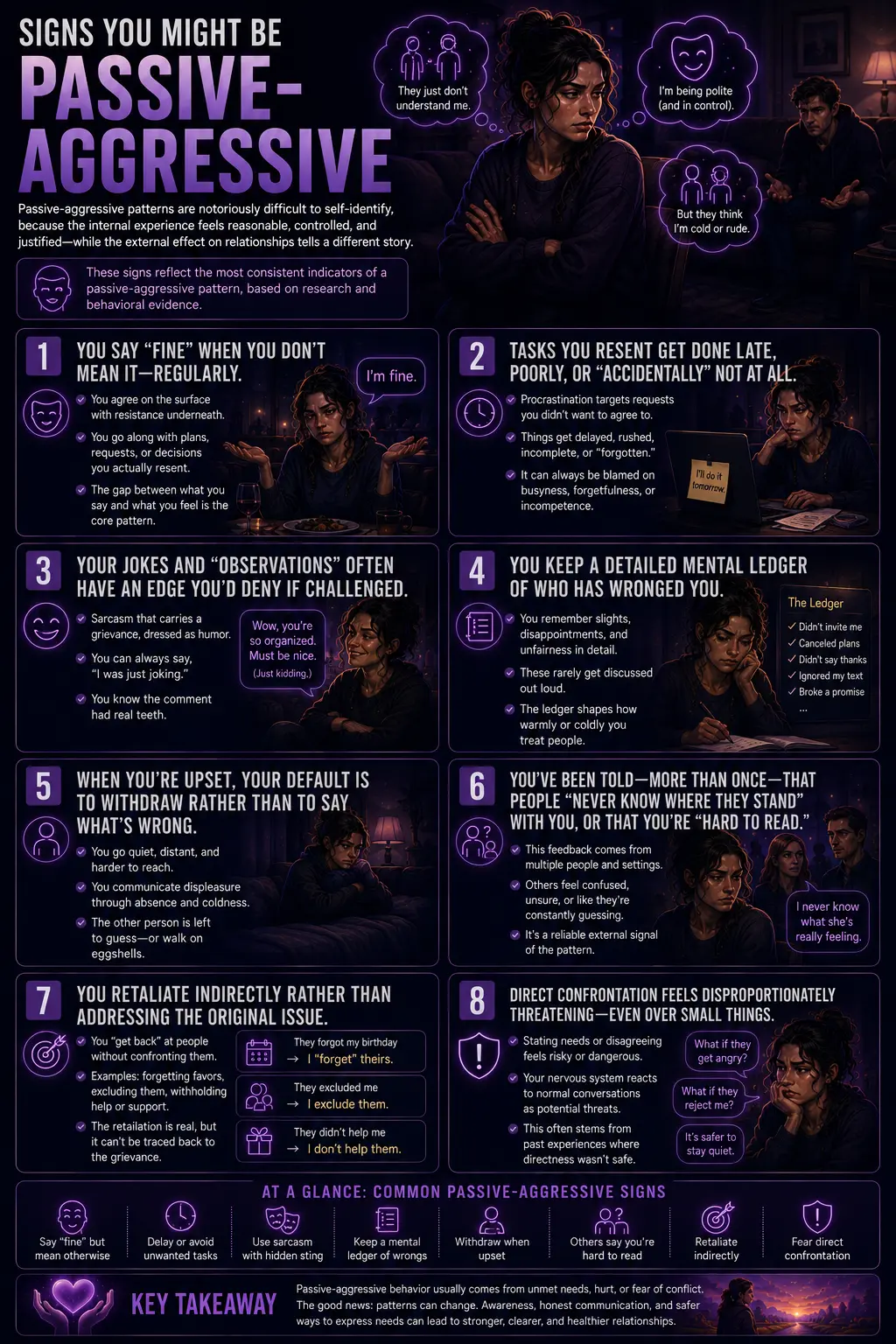
Passive-aggressive patterns are often invisible to the person exhibiting them and highly visible to everyone else. Here are the most common forms it takes — described from the inside, as people experiencing them typically describe them:
Withdrawal and silence. When you’re upset or feel unheard, the response is to become quiet, cold, or distant rather than to say what’s wrong. You’re communicating your displeasure — but indirectly, in a way that requires the other person to notice and ask rather than directly stating what you need. From the inside, this feels like not causing unnecessary drama. From the outside, it reads as stonewalling.
Saying “fine” when things aren’t fine. Agreeing to things you resent, going along with decisions you oppose, saying “it’s okay” when it isn’t — and then harboring resentment that builds invisibly. The compliance is real, but the internal experience is resistant. This is the core mechanism of passive aggression: surface compliance with underlying resistance.
Procrastination as protest. Delaying tasks you’ve been asked to do — not because you can’t, but because doing them promptly feels like compliance with something you resent. Forgetting things selectively. Doing tasks slowly, incompletely, or poorly in ways that can always be attributed to accident rather than intention. This form is particularly common in workplace and family contexts where direct refusal feels unsafe or socially unacceptable.
Sarcasm and subtle commentary. Expressing frustration through remarks that are technically deniable — jokes that carry an edge, offhand comments that contain a point, “observations” that function as criticism. These are distinguishable from ordinary humor by the fact that they communicate something the person is unwilling to state directly.
Indirect retaliation. Responding to perceived slights or injuries not by addressing them but by doing something that creates a cost for the other person, without the retaliation being traceable to the original grievance. Forgetting someone’s birthday after they forgot yours. Making plans without someone who canceled on you. Withholding warmth, attention, or effort from someone who disappointed you without explaining why.
Sulking and the grudge economy. Nursing resentments that never get resolved because they’re never addressed. Building a comprehensive internal record of others’ failings. Behaving coldly in ways that others can see but can’t easily address because no complaint has been made. The person experiencing this often feels they are simply reacting appropriately to patterns of behavior. The person on the receiving end often experiences it as confusing, exhausting, and relationship-eroding.
Signs You Might Be Passive-Aggressive
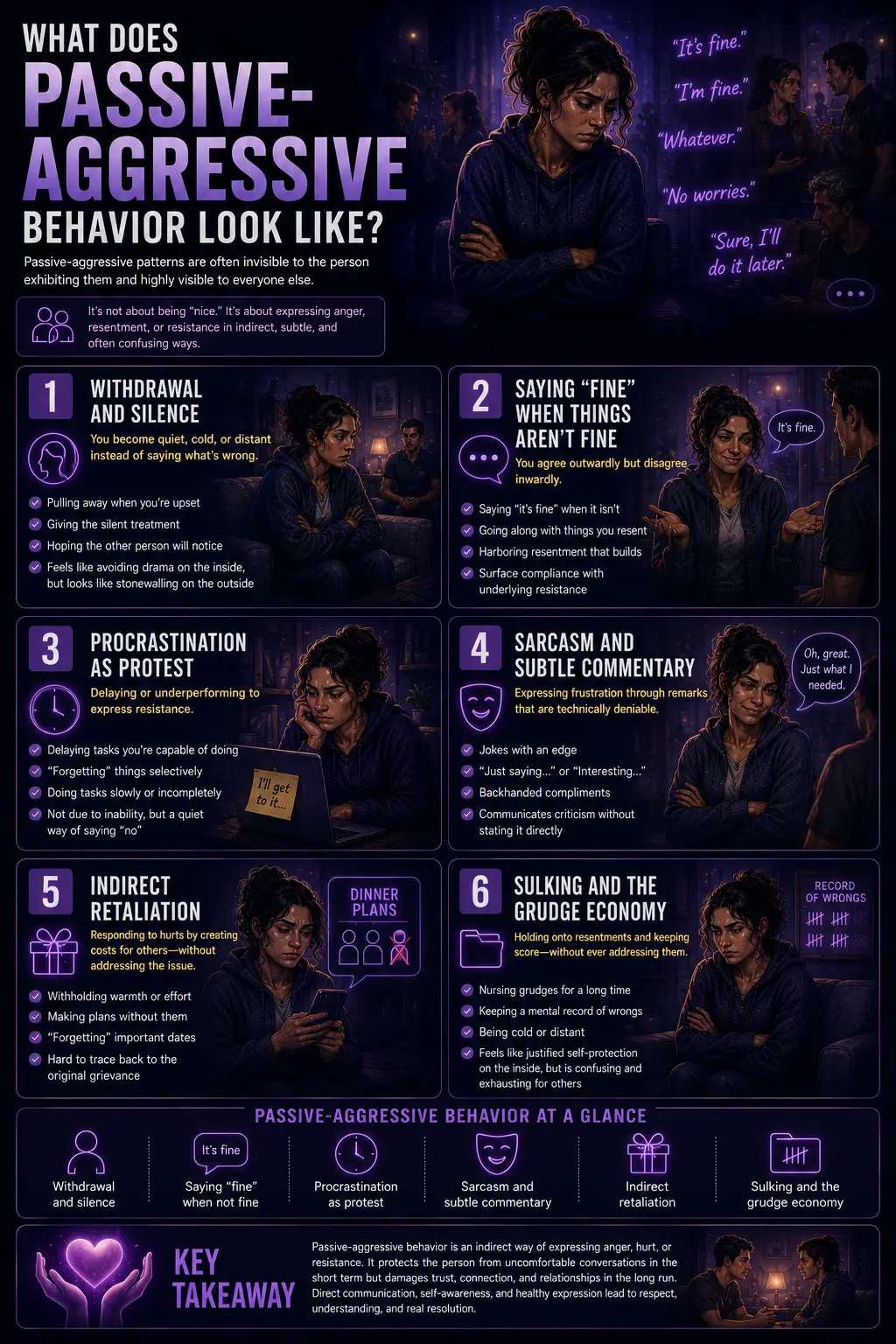
Passive-aggressive patterns are notoriously difficult to self-identify, precisely because the internal experience feels reasonable, controlled, and justified — while the external effect on relationships tells a different story. These are the signs that most consistently indicate a passive-aggressive pattern is operating, drawn from the behavioral domains researchers have most consistently linked to the construct (Hopwood & Wright, 2012; Frontiers in Psychology, 2021).
You say “fine” when you don’t mean it — regularly. Agreement on the surface with resistance underneath is the single most diagnostic feature of passive aggression. If you notice a recurring pattern of verbally agreeing to plans, requests, or decisions you actually resent — and then privately building a case against them — that gap between stated and felt position is the core mechanism, not an occasional white lie.
Tasks you resent get done late, poorly, or “accidentally” not at all. Procrastination that specifically targets requests you didn’t want to agree to in the first place — as opposed to general disorganization — is a behavioral signature of passive aggression. The deniability matters: it can always be attributed to forgetfulness, busyness, or incompetence rather than to the underlying resentment that is actually driving it.
Your jokes and “observations” often have an edge that you’d deny if challenged. Sarcasm that contains a genuine grievance, dressed as humor specifically so it can’t be directly addressed. If someone says “hey, that felt a little pointed” and your instinct is “I was just joking,” while privately knowing the comment had real teeth — that gap between the public framing and the private intent is characteristic.
You keep a detailed mental ledger of who has wronged you — and it rarely gets discussed out loud. The “grudge economy”: specific memories of disappointments, slights, and unfairness that accumulate without ever being raised directly with the person involved. The ledger shapes how warmly or coldly you treat people, without them necessarily knowing why.
When you’re upset, your default is to withdraw rather than to say what’s wrong. Going quiet, becoming distant, giving shorter answers — communicating displeasure through absence and coldness rather than through a direct statement of what’s bothering you. The other person is left to guess, ask, or simply absorb the changed atmosphere.
You’ve been told — more than once — that people “never know where they stand” with you, or that you’re “hard to read.” This external feedback is one of the most reliable indicators, because passive-aggressive patterns are often more visible to others than to the person enacting them. If multiple people across different relationships have independently made this observation, it is worth taking seriously rather than attributing to their misunderstanding.
You retaliate indirectly rather than addressing the original issue. Forgetting a favor for someone who forgot one for you. Excluding someone who excluded you. Letting someone fail at something you could have helped with, because they didn’t show up for you previously. The retaliation is real, but it’s structured so it can’t be traced back to the original grievance — preserving the appearance of having no issue at all.
Direct confrontation feels disproportionately threatening — even over small things. A felt sense that simply stating “I disagree” or “that bothered me” carries a risk that seems much larger than the actual situation warrants. This disproportionate threat response to ordinary assertiveness is often the clearest signal of the learned-safety origins of passive-aggressive patterns: somewhere, directness once carried real risk, and the nervous system has not fully updated since.
Why People Develop Passive-Aggressive Patterns
Passive aggression is not a character flaw — it is a learned communication strategy. Specifically, it tends to develop in environments where direct expression of anger, frustration, or disagreement was unsafe, prohibited, or reliably punished.
Childhood environments where anger was forbidden. Families in which the honest expression of feelings is forbidden tend to teach children to repress and deny their feelings and to use other channels to express their frustration (Wikipedia, 2025). When direct expression of negative emotion consistently results in punishment, rejection, or family destabilization, indirect expression becomes the safer option. The child learns: “I cannot say I’m angry. But I can stop cooperating. I can go quiet. I can forget.” These adaptations were functional in that environment. The problem is that they persist into adult relationships and contexts where direct expression is actually safe — and where the indirect patterns create costs that the original environment’s dangers justified.
Learned helplessness and conflict avoidance. Some passive-aggressive patterns develop not from punishment specifically but from a more diffuse experience of having feelings dismissed, minimized, or invalidated. If expressing needs directly has consistently not worked — if the response has been to be told you’re too sensitive, too demanding, or making things difficult — the implicit lesson is that direct expression is futile. Indirect expression becomes the way of influencing situations without putting oneself in the position of a direct request that can be denied.
Ambivalence about dependence and autonomy. Research on passive-aggressive patterns identifies a core conflict between dependence on others and the desire for self-assertion (Social Sci LibreTexts, 2024). People with strong passive-aggressive tendencies often want connection and approval while also resisting the perceived control that comes with close relationships. This ambivalence produces the characteristic pattern: surface compliance that doesn’t reflect genuine agreement, and covert resistance that allows self-assertion without direct confrontation.
Modeling and cultural context. Passive-aggressive communication patterns are frequently modeled within families and cultural contexts. When indirect communication is the norm — when everyone expresses displeasure through silence, commentary, and withdrawal rather than direct conversation — it becomes the acquired default rather than a conscious choice.
Passive-Aggressive Behavior vs. Assertive Communication
Understanding what passive aggression is requires understanding what it is not — and the most clinically important contrast is with assertive communication.
| Feature | Passive-Aggressive | Passive | Assertive | Aggressive |
|---|---|---|---|---|
| How needs are expressed | Indirectly — through hints, silence, withdrawal, sarcasm | Not expressed — suppressed entirely | Directly and clearly — “I feel X when Y happens” | Forcefully — with blame, criticism, or demands |
| Conflict approach | Avoided openly, resisted covertly | Avoided — capitulates to others’ needs | Engaged directly with respect for both parties | Escalated — others’ needs dismissed |
| Anger expression | Expressed indirectly — sarcasm, cold shoulder, subtle retaliation | Suppressed — may become resentment over time | Acknowledged and expressed proportionately | Expressed directly, often disproportionately |
| Effect on relationships | Confusing, gradually corrosive — creates distance and unresolved tension | One-sided — others may take advantage; resentment builds | Mutually respectful — builds trust and clarity | Damaging — creates fear, resentment, avoidance |
| Internal experience | Feels like self-control and conflict avoidance | Feels like accommodation; often feels powerless | Feels honest and clear; takes practice | Feels powerful in the moment; often regretted |
The key insight is that passive aggression is not the absence of aggression — it is its redirection. The frustration, resentment, or hostility is present; what changes is the channel through which it is expressed. This makes it distinctly different from genuinely passive communication (which involves suppression rather than indirect expression) and from assertive communication (which involves direct, respectful expression).
How This Passive-Aggressive Test Works
This Passive-Aggressive Test presents 20 real-world situations drawn from the most common contexts where passive-aggressive patterns appear: conflict at work, interpersonal friction with friends and partners, receiving criticism, handling disappointment, and managing disagreements. For each situation, four response options are provided — ranging from direct, assertive communication to increasingly indirect and passive-aggressive responses.
Answer based on what you would actually do — not what you think you should do. The most useful result comes from the most honest answer.
Scoring: 0 points for the first option (most direct/assertive), 1 for the second, 2 for the third, 3 for the fourth (most passive-aggressive). Total range: 0–60.
Understanding Your Passive-Aggressive Test Result
| Score Range | Category | What It Suggests |
|---|---|---|
| 0 – 12 | Minimal Indicators | Little to no passive-aggressive communication patterns. Responses suggest a predominantly direct and assertive communication style. |
| 13 – 24 | Mild Indicators | Occasional passive-aggressive patterns in specific contexts. Generally communicates directly but holds back in some situations. |
| 25 – 36 | Moderate Indicators | Meaningful passive-aggressive patterns across multiple contexts. Indirect communication and conflict avoidance are regular features of how frustration is expressed. |
| 37 – 48 | Significant Indicators | Passive-aggressive communication patterns are a consistent feature of relationships and conflict management. Very likely affecting close relationships and work dynamics. |
| 49 – 60 | Strong Indicators | Pervasive passive-aggressive communication patterns across most contexts. Indirect expression of frustration is the dominant response to conflict. |
How to Change Passive-Aggressive Patterns
The evidence base for changing passive-aggressive communication patterns is consistent and encouraging — these patterns are among the most responsive to targeted intervention, precisely because they are learned behaviors rather than fixed traits.
Recognizing the pattern in real time. The first step is developing the ability to notice passive-aggressive impulses as they arise — the impulse to go quiet rather than speak, to comply outwardly while resisting internally, to respond to disappointment indirectly. Without this awareness, the patterns operate automatically and invisibly. Journaling, mindfulness practices, and deliberate reflection on specific interpersonal incidents are the most accessible tools for developing this awareness.
Assertiveness training. The most directly evidence-supported intervention for passive-aggressive patterns. Assertiveness training teaches the skills of direct, respectful, non-aggressive expression of needs, feelings, and disagreements — the middle ground between passive-aggressive (indirect) and aggressive (forceful) communication. The core technique is the “I feel” statement: naming your internal experience directly without blaming, criticizing, or withdrawing. This sounds simple; it typically requires significant practice because direct expression activates the anxiety or discomfort that passive-aggressive behavior was originally developed to avoid.
Understanding the roots. Dr. Lorna Smith Benjamin’s Interpersonal Reconstructive Therapy (IRT) for passive-aggressive patterns is specifically built around the insight that these behaviors developed adaptively in specific relational contexts — typically family environments — and that lasting change requires understanding why the behaviors were originally useful rather than simply trying to stop them. This deeper approach is particularly relevant at higher levels of severity, where surface-level assertiveness training alone tends not to produce lasting change.
Cognitive Behavioral Therapy (CBT). CBT for passive-aggressive patterns addresses the underlying beliefs that maintain the behavior — beliefs about the safety of direct expression, about others’ likely responses to direct communication, and about the relative costs and benefits of confrontation versus avoidance. Changing behavior requires changing the beliefs that make it feel necessary.
Interpersonal Therapy (IPT). Focuses on the relational patterns themselves — how passive-aggressive communication develops within specific relationship dynamics and how changing the dynamic changes the behavior. Particularly useful when passive-aggressive patterns are concentrated in specific close relationships (partner, family, specific colleague) rather than diffuse across all contexts.
Frequently Asked Questions
What is passive-aggressive behavior?
Passive-aggressive behavior is a pattern of indirectly expressing negative feelings — frustration, resentment, anger, or resistance — rather than addressing them openly. It combines outward compliance or avoidance (the “passive” element) with underlying hostility or resistance that is never stated directly (the “aggressive” element). Common forms include withdrawal and silence, saying “fine” while feeling resentful, procrastination on resented tasks, sarcasm that carries a real grievance, and indirect retaliation. The term originated after World War II to describe soldiers’ indirect insubordination and was first formally included in the DSM-I (1952).
Is passive-aggressive behavior a personality disorder?
Passive-Aggressive Personality Disorder (PAPD) was included as a formal diagnosis in the DSM-I (1952) through DSM-III-R, but was removed from the main text of the DSM-IV in 1994 — relegated to an appendix for further study due to concerns about diagnostic reliability, validity, and overlap with other personality disorders (Wikipedia, 2025; PMC, construct validity review). It has not been reinstated as a standalone diagnosis in the DSM-IV-TR, DSM-5, or DSM-5-TR. Today, passive-aggressive behavior is understood as a learned communication pattern and behavioral tendency that can appear across many contexts and conditions — including as a feature of other personality presentations like covert narcissism — rather than as a discrete diagnosable disorder on its own. Research interest in the construct has continued despite its removal, including newer psychometric instruments like the Test of Passive Aggression (Frontiers in Psychology, 2021).
What causes someone to become passive-aggressive?
Passive-aggressive patterns typically develop in childhood environments where direct expression of anger, frustration, or disagreement was unsafe, prohibited, or reliably punished (Wikipedia, 2025). When a child learns that openly stating “I’m angry” leads to punishment, rejection, or family instability, indirect channels — withdrawal, forgetting, subtle resistance — become the safer alternative. Other contributing factors include learned helplessness from having needs repeatedly dismissed or minimized, an underlying ambivalence about dependence versus self-assertion in close relationships (Social Sci LibreTexts, 2024), and modeling — growing up in a family or culture where indirect communication was the norm rather than a conscious choice.
How is passive-aggressive behavior different from being assertive, passive, or aggressive?
These four communication styles differ in how needs and frustration are expressed. Assertive communication states needs and feelings directly and respectfully (“I feel frustrated when this happens”). Passive communication suppresses needs and feelings entirely, often producing resentment that builds silently over time. Aggressive communication expresses frustration forcefully, often with blame or criticism, disregarding the other person’s needs. Passive-aggressive communication expresses real underlying hostility or resistance, but does so indirectly — through sarcasm, withdrawal, procrastination, or subtle sabotage — rather than stating it openly. The key distinction from passive communication is that passive-aggressive behavior is not simple suppression; the resistance is actively expressed, just through indirect channels that allow deniability.
Can passive-aggressive behavior be changed?
Yes — passive-aggressive patterns are among the most responsive personality patterns to targeted intervention, precisely because they are learned communication strategies rather than fixed traits. Assertiveness training, which teaches direct, respectful, non-aggressive expression of needs and feelings, is the most directly evidence-supported intervention for milder patterns. For more entrenched patterns, approaches that address the underlying developmental origins — such as Dr. Lorna Smith Benjamin’s Interpersonal Reconstructive Therapy (IRT), which works from the premise that passive-aggressive behavior developed as an adaptive response within a specific family context — tend to produce more lasting change. Cognitive Behavioral Therapy (CBT) targeting the beliefs that maintain the pattern (about the safety of direct expression and others’ likely responses to it) is also well-supported.
How does passive-aggressive behavior affect relationships?
Passive-aggressive patterns tend to produce a specific kind of relational damage: not dramatic ruptures, but gradual, confusing erosion. The person on the receiving end often experiences a recurring sense of not knowing where they stand, of unresolved tension that’s never quite named, and of having to guess what’s wrong rather than being told directly. Over time, this confusion is exhausting and corrosive to trust — partners, friends, family members, and coworkers may describe feeling like they’re “walking on eggshells” without a clear sense of what they’re avoiding. Because passive-aggressive behavior is often invisible to the person enacting it (it feels like reasonable self-control, not avoidance), the relational cost frequently goes unaddressed for a long time before either person names the pattern directly.
Is passive-aggressive behavior the same as covert narcissism?
No, though the two frequently overlap. Passive aggression is a communication style — a way of expressing frustration or resistance indirectly — that can appear in people with many different underlying personality profiles, including people with no personality disorder at all. Covert narcissism is a specific personality presentation involving concealed grandiosity, hypersensitivity to criticism, and chronic feelings of being underappreciated — and passive aggression is one of its characteristic behavioral expressions (sulking, wounded withdrawal, indirect retaliation after perceived slights). Someone can be highly passive-aggressive without being narcissistic at all, and someone with covert narcissistic traits will very often express their hypersensitivity and resentment through passive-aggressive channels specifically.
Related Tests
- Covert Narcissism Test — passive aggression (sulking, wounded withdrawal, indirect retaliation) is one of the most characteristic behavioral expressions of covert narcissism
- Anger Management Test — passive aggression is one of three core anger expression patterns covered, alongside explosive and suppressed anger
- Borderline Personality Disorder Test — BPD’s idealization-devaluation pattern and abandonment-driven withdrawal can present with passive-aggressive features, though through a different underlying mechanism
- Dependent Personality Disorder Test — the ambivalence about dependence and self-assertion that underlies passive aggression overlaps with dependent personality patterns
- Avoidant Personality Disorder Test — both patterns involve conflict avoidance and indirect handling of relational friction, rooted in fear of negative consequences from direct expression
- Social Anxiety Test — fear of negative evaluation can drive both social anxiety and passive-aggressive conflict avoidance; the two frequently co-occur
- Intermittent Explosive Disorder Test — some people alternate between passive-aggressive suppression and explosive outbursts; worth assessing both patterns together
- Gaslighting Test — passive-aggressive denial and indirect retaliation can shade into gaslighting tactics when combined with reality distortion; an important adjacent pattern to assess
- Clinical Depression Test — chronic unexpressed resentment and conflict avoidance are associated with depressive symptoms over time
- Cluster B Personality Disorder Test — passive aggression can appear as a feature across several Cluster B presentations; this broader screening provides additional context
References
- Wikipedia. (2025). Passive–aggressive personality disorder. [DSM-I 1952 origin; DSM-IV 1994 removal to appendix; childhood origins; Millon subtypes] en.wikipedia.org
- Hopwood, C.J., & Wright, A.G.C. (2012), cited in: Construct Validity research on Passive-Aggressive Personality Disorder. PMC. [DSM-IV removal controversy; Millon negativistic syndrome; Benjamin 1993 interpersonal theory] pmc.ncbi.nlm.nih.gov
- Benjamin, L.S. (1993). Interpersonal Diagnosis and Treatment of Personality Disorders. Guilford Press. [Interpersonal Reconstructive Therapy foundational text; ambivalence about dependence and autonomy]
- Benjamin, L.S. (2003). Interpersonal Reconstructive Therapy: Promoting Change in Nonresponders. Guilford Press. [IRT for treatment-resistant passive-aggressive patterns]
- Frontiers in Psychology. (2021). Development and Psychometric Properties of the Test of Passive Aggression. [Passive aggression as stable behavioral tendency activated by stressors; dysfunctional monitoring processes from childhood experience] frontiersin.org
- Millon, T. (1981). Disorders of Personality: DSM-III, Axis II. Wiley. [Negativistic personality syndrome; passive-aggressive behavior as embedded symptom]
- Social Sci LibreTexts. (2024). Passive-Aggressive Behavior. [Core conflict between dependence and self-assertion] socialsci.libretexts.org
- American Psychological Association. (1997). Interpersonal Reconstructive Therapy for Passive-Aggressive Personality Disorder [Video]. Dr. Lorna Smith Benjamin. apa.org
Related Tests
See All Quiz →

You may also like
See All Quiz →

Sexual Orientation & Gender Identity
What’s Your Sexual Orientation or Gender Identity? Take This Free LGBTQ+ Test
→