
Light Triad Test: Are You an Everyday Saint?
A 15-item adult self-reflection scale measuring the three light triad traits described by Kaufman and colleagues: Kantianism, Humanism and Faith in Humanity. A low score does not mean you are a dark person.
Published Updated
This free Light Triad Test measures the bright side of your personality — the three prosocial traits that make someone genuinely good to others. Developed as the deliberate opposite of the “Dark Triad,” the light triad captures your warmth, honesty, and belief in people. In 15 quick questions, you’ll get an honest, private read on where you fall, along with a breakdown of the three traits that make up your light triad profile.
The test is grounded in real personality science. The three traits — Kantianism, Humanism, and Faith in Humanity — come from the Light Triad Scale developed by psychologist Scott Barry Kaufman and colleagues in 2019. Kaufman called people who score high “everyday saints.” One honest note before you start: this isn’t about being perfect or a pushover, and a low score doesn’t make you a bad or “dark” person — the two are more separate than they sound. It’s simply a mirror for how you tend to orient toward other people.
What Is the Light Triad?
The light triad is a set of three personality traits that reflect a caring, benevolent orientation toward other people — the bright counterpart to the well-known “Dark Triad” of narcissism, Machiavellianism, and psychopathy. It was introduced in 2019 by Scott Barry Kaufman, David Yaden, Elizabeth Hyde, and Eli Tsukayama in the journal Frontiers in Psychology, who built the Light Triad Scale to capture “a loving and beneficent orientation toward others” that the dark traits had long overshadowed.
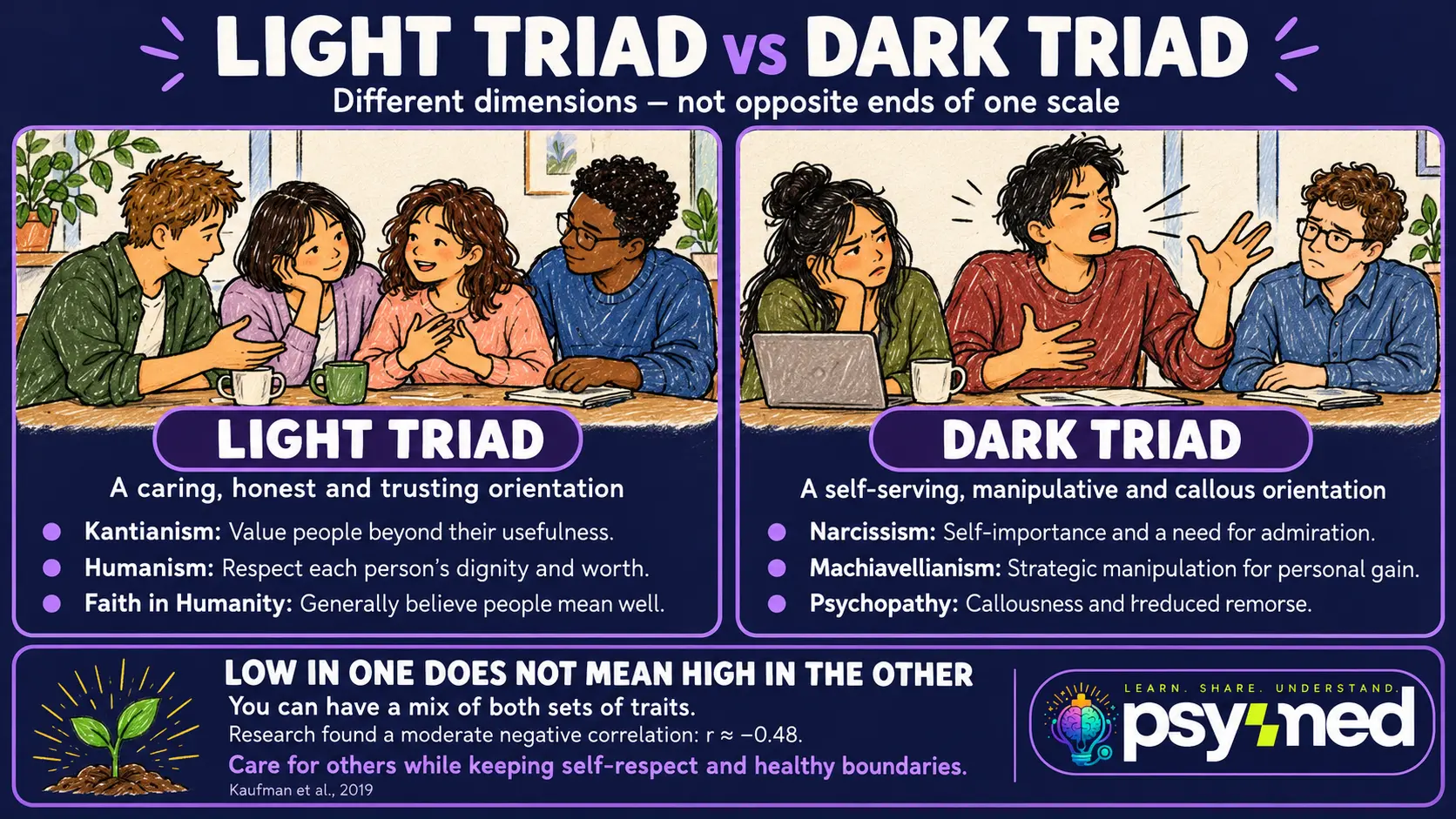
The three traits are Kantianism (treating people as ends in themselves rather than as means to an end), Humanism (valuing the dignity and worth of each individual), and Faith in Humanity (believing that people are fundamentally good). Importantly, the research found that the light and dark triads are not simple opposites — they correlate only moderately negatively (around r = −0.48), which means you can be high in both, low in both, or anywhere in between. Most people are a blend. Scoring high on the light triad is associated with greater life satisfaction, wellbeing, and a sense of flourishing — not with being naive or a pushover.
The 3 Traits of the Light Triad
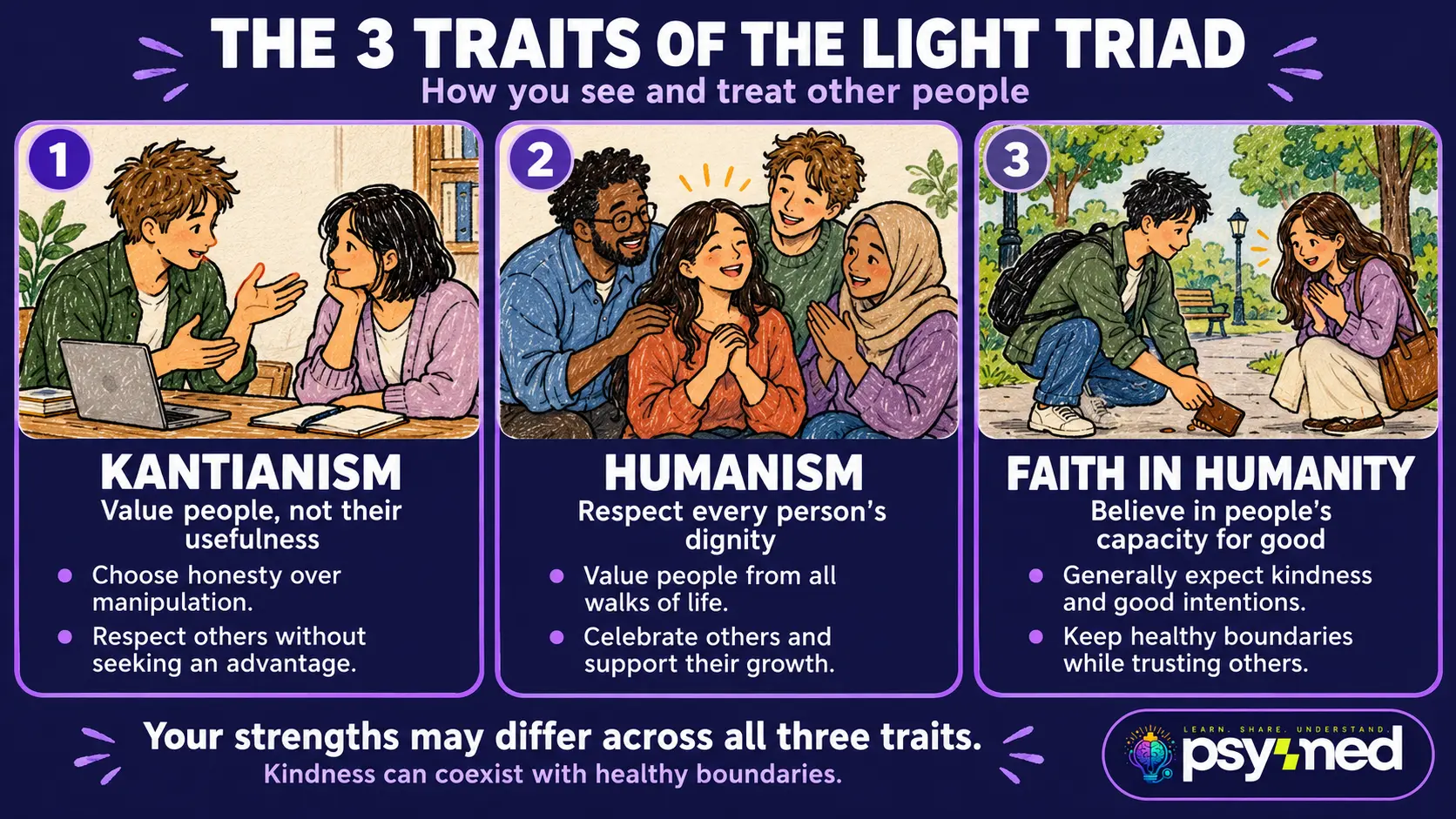
The light triad is made up of three distinct traits, and most people are stronger in some than others. Together they describe how you fundamentally see and treat other people. Here’s what each one looks like — read them as the “signs” of a light triad personality, and notice which feel most like you.
Kantianism: Treating People as Ends, Not Means
Kantianism is the tendency to treat people as valuable in themselves, rather than as tools to get something you want. The name comes from the philosopher Immanuel Kant, who argued we should never use people merely as a means to an end. In everyday life, it looks like preferring honesty over manipulation, not befriending people for what they can do for you, and being uncomfortable with the idea of using charm or pressure to get your way. If you’d rather lose an advantage than manipulate someone to keep it, this trait runs strong in you. It’s the direct opposite of the Machiavellian streak measured in our Machiavellian Test.
Humanism: Valuing Each Person’s Dignity and Worth
Humanism is the tendency to value the inherent dignity and worth of every person, whoever they are. It shows up as enjoying people from all walks of life, treating others as worthwhile regardless of their status or usefulness to you, celebrating other people’s successes rather than envying them, and wanting to bring out the best in those around you. Humanism is warmth turned outward — a genuine interest in other people’s flourishing, not just your own.
Faith in Humanity: Believing People Are Fundamentally Good
Faith in humanity is the tendency to believe that people are, at their core, basically good. It looks like seeing the best in people, trusting that others generally have good intentions, and expecting kindness more than cruelty — even after being let down. This isn’t the same as being gullible: people high in faith in humanity aren’t blind to bad behavior, they simply don’t start from a place of suspicion. This trait is the direct opposite of the cynical distrust that marks several darker personality patterns.
How This Light Triad Test Works
This test contains 15 statements that tap the three light triad traits. For each, choose how much you agree, thinking about how you generally are rather than how you’d like to be:
- Strongly Disagree = 0
- Disagree = 1
- Neutral = 2
- Agree = 3
- Strongly Agree = 4
Your answers add up to an overall light triad score from 0 to 60, placing you in one of four ranges from “low” to “predominantly light.” Answer honestly — the value of this test is entirely in how truthful you’re willing to be with yourself, and your results are completely private. There are no right answers, and no score here makes you a good or bad person.
Understanding Your Results
Your score places you in one of four ranges. Read it as a mirror, not a grade — and look at which of the three traits your answers were strongest in, because that’s where the real insight is. There’s no “perfect” score here, and crucially, a low score doesn’t make you a dark or bad person.
| Score | Range | What It Suggests |
|---|---|---|
| 46 – 60 | Predominantly Light | High on all three traits — an “everyday saint” orientation toward others. |
| 31 – 45 | Light-Leaning | Clearly prosocial and warm, with a generally benevolent view of people. |
| 16 – 30 | Balanced | A realistic mix of warmth toward others and healthy self-interest. |
| 0 – 15 | Lower Light | More guarded or self-focused — which is not the same as being “dark.” |
Light Triad vs Dark Triad: What’s the Difference?
The light triad and dark triad are companion frameworks, but they are not simply mirror images of each other. The dark triad — narcissism, Machiavellianism, and psychopathy — describes a self-serving, manipulative, callous orientation toward others. The light triad — Kantianism, Humanism, and Faith in Humanity — describes a caring, honest, trusting one. The intuitive assumption is that they’re opposite ends of a single scale, but Kaufman’s research showed they only correlate moderately (around r = −0.48).
In practical terms, that means being low in dark traits doesn’t automatically make you high in light ones, and vice versa — the absence of cruelty isn’t the same as the presence of warmth. Most people carry some of both, and the healthiest profiles tend to combine genuine care for others with enough self-respect and realism to not be exploited. If you’ve taken this test, taking our Dark Triad Test as well gives you the complete picture of both sides.
Frequently Asked Questions
What are the three light triad traits?
The three light triad traits are Kantianism, Humanism, and Faith in Humanity. Kantianism is treating people as ends in themselves rather than as means to an end — preferring honesty over manipulation. Humanism is valuing the dignity and worth of each individual person. Faith in Humanity is believing that people are fundamentally good.
Together they describe a caring, benevolent orientation toward others. They come from the Light Triad Scale developed by Scott Barry Kaufman and colleagues in 2019, who designed the framework as the positive counterpart to the Dark Triad of narcissism, Machiavellianism, and psychopathy.
Is a high light triad score a good thing?
Generally, yes — a high light triad score is associated with greater life satisfaction, stronger relationships, and a sense of flourishing, and it reflects genuinely admirable ways of treating other people. But it’s worth a small caveat: being high in the light triad isn’t about being perfect or self-sacrificing, and the research is clear that light people are not naive pushovers.
The healthiest version of a light personality pairs real warmth toward others with self-respect and boundaries — caring for people without letting yourself be exploited. So a high score is a strength, as long as your kindness toward others is matched by kindness toward yourself.
Does a low light triad score mean I’m a bad person?
No. This is the most important thing to understand about the light triad: a low score does not make you a bad or “dark” person. The light and dark triads are separate dimensions that only correlate moderately, which means the absence of light traits is not the same as the presence of dark ones. A lower light score usually reflects guardedness, self-protectiveness, past hurt, or simply a more cautious and pragmatic view of people — not cruelty or manipulation.
Plenty of decent, kind people score in the middle or lower ranges because they’re careful about trust. If you want to know specifically whether you have darker traits, that’s a separate question measured by our Dark Triad Test.
Is the Light Triad Test scientifically valid?
The light triad framework itself comes from peer-reviewed research — Kaufman and colleagues’ 2019 study in Frontiers in Psychology — so the three traits it measures are scientifically grounded. The scale showed excellent reliability and validity across four samples of 1,518 people, though it is worth knowing that the authors describe it as a “first draft” measure and their study as exploratory.
This particular test is a self-reflection tool built on that framework, designed to give you an accessible read on your three light triad traits; like any brief online self-report, it reflects how you see yourself rather than an objective clinical measurement. It isn’t a diagnosis of anything (the light triad describes healthy personality, not a condition), so treat your result as a meaningful mirror for self-understanding rather than a formal assessment.
Related Tests
- Dark Triad Test — the darker counterpart: narcissism, Machiavellianism, and psychopathy
- Machiavellian Test — the direct opposite of the Kantianism trait
- Emotional Intelligence (EQ) Test — the skills behind warm, attuned relationships
- Self-Esteem Test — healthy self-regard, the companion to caring for others
- Attachment Style Test — how early experiences shape the way you trust and relate
References
- Kaufman, S.B., Yaden, D.B., Hyde, E., & Tsukayama, E. (2019). The Light vs. Dark Triad of personality: Contrasting two very different profiles of human nature. Frontiers in Psychology, 10, 467. doi.org/10.3389/fpsyg.2019.00467
- Kaufman, S.B. (2019). The light triad vs. dark triad of personality. Scientific American / Beautiful Minds. [Accessible overview and the “everyday saints” framing]
- Paulhus, D.L., & Williams, K.M. (2002). The Dark Triad of personality: Narcissism, Machiavellianism, and psychopathy. Journal of Research in Personality, 36(6), 556–563. [The dark counterpart the light triad was built to contrast] doi.org
Related Tests
See All Quiz →
You may also like
See All Quiz →