

Narcissistic Abuse Test
A free, private screen for the recognized patterns of narcissistic abuse - gaslighting, control, contempt and the idealize-devalue cycle - and how they have affected you. Fifteen questions, scored 0 to 60. It measures what is being done to you, and it does not diagnose anyone, including the other person.
Published Updated
This free narcissistic abuse test helps you recognize whether what you’re living through — the confusion, the walking on eggshells, the sense that you’re always the problem — matches the known patterns of narcissistic abuse. In 15 private questions, it looks at how someone close to you (a partner, parent, or family member) treats you, and how it’s affected you. You’ll get an instant, confidential result.
Read this first, because it reframes everything below: this test is not about whether you are a narcissist. It’s about whether someone is treating you in ways that are controlling, manipulative, and harmful. And here’s the part most people need to hear — you do not need the other person to have a diagnosis for the abuse to be real. “Narcissistic abuse” isn’t a formal medical diagnosis, and you’ll likely never get them assessed. That doesn’t matter. What matters is the pattern of behavior and what it’s doing to you. If your gut has been whispering that something is wrong, this test can help you put words to it.
If you’re in immediate danger, call 911. For confidential support any time, the National Domestic Violence Hotline is 1-800-799-7233 (or text START to 88788). Abuse isn’t only physical — emotional and psychological abuse are real abuse, and these advocates understand that.
What Is Narcissistic Abuse?
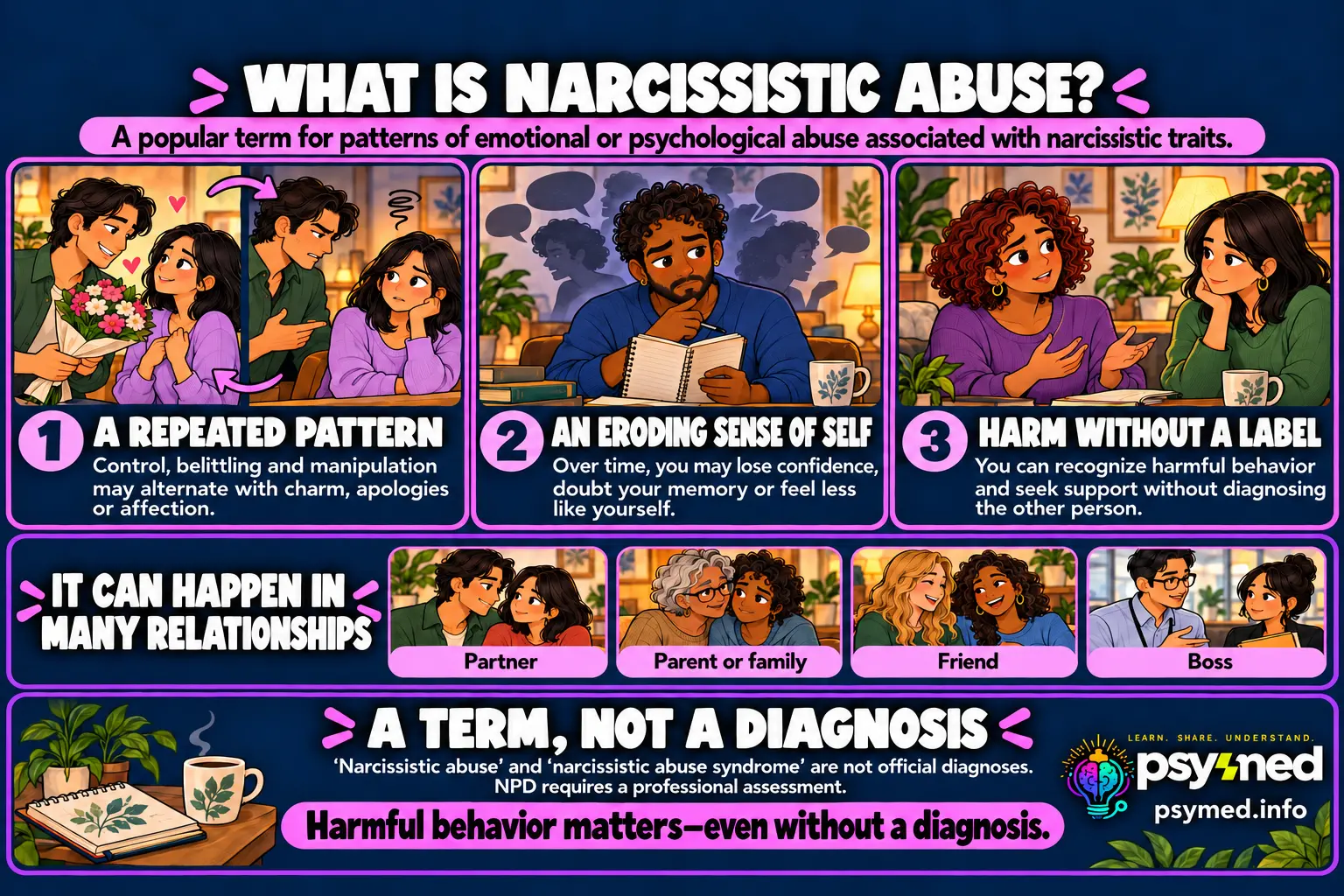
Narcissistic abuse is a pattern of emotional and psychological abuse carried out by someone with strong narcissistic traits — an intense need for control, admiration, and being right, combined with little genuine empathy for how their behavior lands on you. It can happen in a romantic relationship, with a parent, within a family, or with a friend or boss. The hallmark isn’t a single cruel act; it’s a cycle that slowly rewires how you see yourself. Many survivors describe gradually losing confidence, trust in their own memory, and even a clear sense of who they are.
It’s worth being precise about the language: “narcissistic abuse” and “narcissistic abuse syndrome” are popular terms, not official diagnoses, and narcissistic personality disorder (NPD) is a clinical diagnosis that only a professional can make — and only for someone they’ve actually assessed. So this page won’t tell you the other person “is a narcissist.” It doesn’t need to. The behaviors below are harmful whether or not anyone ever gets a label, and recognizing them is what helps you.
Signs You’re Experiencing Narcissistic Abuse
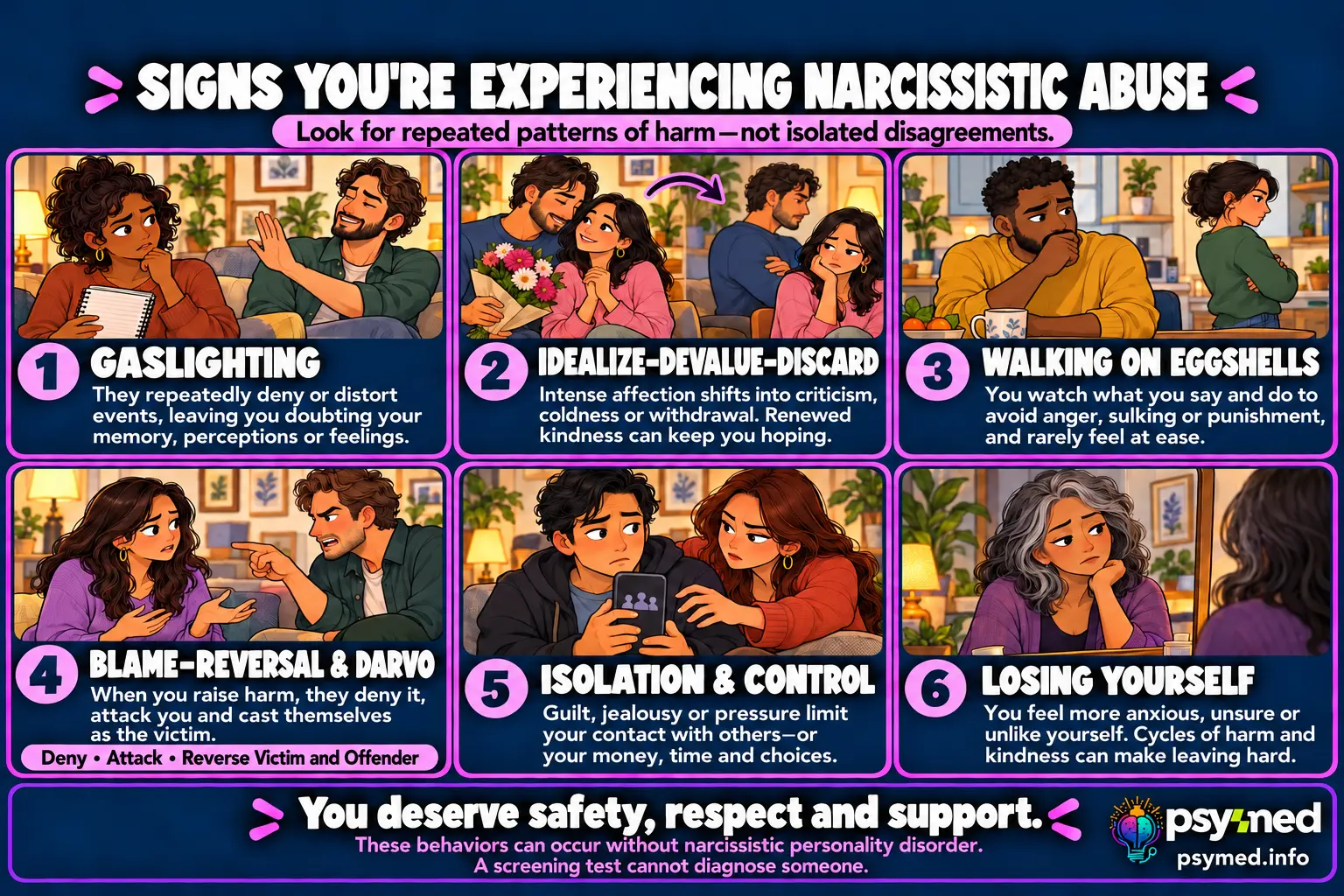
Narcissistic abuse shows up as a recognizable set of tactics. You won’t necessarily see all of them, and they often hide behind charm, apologies, and good moments — which is part of what makes them so disorienting. These are the patterns this test screens for.
Gaslighting — being made to doubt your own reality
They deny things you clearly remember, insist conversations didn’t happen, or tell you that what you saw or felt is wrong — until you start questioning your own memory, perception, and sanity. The term comes from the 1944 film Gaslight, and it’s one of the most destabilizing forms of psychological abuse because it attacks your ability to trust yourself.
The idealize–devalue–discard cycle
Early on you may have been showered with attention and affection (“love bombing”), only for it to curdle into criticism, coldness, and contempt — then sometimes swing back again. This push–pull cycle keeps you chasing the good version of them and blaming yourself for the bad, and it’s central to how the bond becomes so hard to break.
Walking on eggshells
You monitor everything you say and do to avoid triggering their anger, sulking, or punishment. Your nervous system stays braced. Over time this hypervigilance becomes exhausting and starts to feel normal, even though it isn’t.
Blame-reversal and DARVO
When you raise a problem, it gets turned around until you’re apologizing. Researcher Jennifer Freyd named this pattern DARVO — Deny, Attack, and Reverse Victim and Offender — where the person who caused harm recasts themselves as the real victim, and you as the aggressor. You end up defending yourself for having a feeling.
Isolation and control
Through disapproval, guilt, jealousy, or manufactured conflict, they chip away at your relationships with friends and family, and try to control your time, money, appearance, or choices. Researcher Evan Stark calls this coercive control — a web of domination that can be more entrapping than any single incident.
Losing yourself
Perhaps the clearest sign is what’s happened to you: more anxious, smaller, more self-doubting, less like the person you used to be. Survivors often describe a trauma bond — a powerful attachment formed through cycles of abuse and intermittent kindness — which is why “just leave” is never as simple as it sounds.
How This Narcissistic Abuse Test Works
This test has 15 statements about how someone close to you behaves and how it affects you. For each, choose how often it’s true, thinking about this relationship as it generally is rather than on a single day:
Never = 0 | Rarely = 1 | Sometimes = 2 | Often = 3 | Very often = 4
Your answers add up to a score from 0 to 60 reflecting how many patterns of narcissistic abuse are present. One thing to hold onto: abuse isn’t a number. Even if your total is low, a single pattern that keeps happening — or a steady feeling that something is wrong — is worth taking seriously. Trust that alongside the score. Your responses are private.
Understanding Your Results
Your score reflects how many patterns of narcissistic abuse are present in this relationship. Please read it as a mirror, not a verdict — and remember that only you know the full reality of what you’re living. These results can’t diagnose anyone, but they can help you see a pattern clearly, sometimes for the first time.
| Score | Range | What It Suggests |
|---|---|---|
| 0 – 15 | Few Signs | Few of these patterns — but trust your gut over the number if something feels wrong. |
| 16 – 30 | Some Signs | Some concerning patterns worth taking seriously and learning more about. |
| 31 – 45 | Strong Signs | Strong signs consistent with narcissistic abuse; support and safety planning matter. |
| 46 – 60 | Severe Signs | Severe, pervasive patterns of abuse; please reach out for confidential support. |
Why “Just Leave” Isn’t Simple: The Trauma Bond
If you’ve wondered why you can’t just walk away — or why part of you still loves or defends someone who hurts you — you’re not weak or foolish. You may be caught in what addiction researcher Patrick Carnes called a trauma bond: a powerful attachment formed through repeated cycles of abuse followed by affection or relief. The unpredictability is the point; intermittent kindness is one of the most powerful forms of reinforcement there is, and it binds people to their abusers in ways that are chemical and neurological, not just emotional.
Add the cognitive dissonance of loving someone who hurts you, the isolation, and the slow erosion of your confidence, and leaving becomes genuinely hard — not a matter of willpower. Understanding the bond for what it is often the first step toward loosening it.
You Don’t Need Their Diagnosis
Many people delay getting help because they’re stuck on a question they can’t answer: “But are they actually a narcissist?” Let that question go. You will almost certainly never get them clinically assessed, and you don’t need to. Narcissistic personality disorder is a specific diagnosis a professional can only make for someone in their care — and abuse is defined by behavior and its impact, not by the other person’s diagnosis.
Whether they meet the criteria for NPD, have strong narcissistic traits, or no diagnosis at all, the gaslighting, control, and contempt are just as harmful and just as worth leaving behind. Focus on the pattern and its effect on you. That’s what’s real, and that’s what you can act on.
Methodology & Sources
This test is an educational screening tool informed by the recognized patterns of narcissistic and coercive abuse, including gaslighting, the idealize–devalue–discard cycle, DARVO (Jennifer Freyd), coercive control (Evan Stark), and trauma bonding (Patrick Carnes). Its 15 items are original statements describing abusive behaviors and their effects from the perspective of the person experiencing them. It measures the presence of harmful patterns in a relationship — it does not diagnose anyone, including the other person. “Narcissistic abuse” is not a formal diagnosis, and narcissistic personality disorder can only be assessed by a qualified professional. If you are experiencing abuse, support is available regardless of whether anyone involved has a diagnosis.
References
- Freyd, J.J. (1997). Violations of power, adaptive blindness, and betrayal trauma theory. Feminism & Psychology, 7(1), 22–32. doi:10.1177/0959353597071004 (DARVO.)
- Stark, E. (2007). Coercive Control: How Men Entrap Women in Personal Life. Oxford University Press.
- Carnes, P. (1997). The Betrayal Bond: Breaking Free of Exploitive Relationships. Health Communications.
- Sweet, P.L. (2019). The sociology of gaslighting. American Sociological Review, 84(5), 851–875. doi:10.1177/0003122419874843
Frequently Asked Questions
What is narcissistic abuse?
Narcissistic abuse is a pattern of emotional and psychological abuse carried out by someone with strong narcissistic traits — typically involving gaslighting, control, contempt, and a cycle of idealizing you and then devaluing you. It can occur with a partner, parent, family member, friend, or boss. The defining feature is a repeating cycle that gradually erodes your confidence, your trust in your own perceptions, and your sense of self. It’s important to know that “narcissistic abuse” is a widely used term rather than a formal clinical diagnosis — but the behaviors it describes are real and harmful.
Can I take this test if I’m not sure the other person is a narcissist?
Yes — and that’s exactly who this test is for. You don’t need to know whether the other person has narcissistic personality disorder, and you almost certainly never will, because that’s a diagnosis only a professional can make about someone in their care. Abuse is defined by behavior and its impact on you, not by the other person’s diagnosis. This test looks at what’s being done to you and how it affects you, which is what actually matters and what you can act on.
Is narcissistic abuse a real diagnosis?
“Narcissistic abuse” and “narcissistic abuse syndrome” are popular, widely understood terms, but they are not official diagnoses in the DSM-5 or ICD-11. Narcissistic personality disorder is a formal diagnosis, but it applies to the person doing the harming, not the person experiencing it — and it can only be assessed by a qualified clinician. The effects of sustained abuse, however, are very real and can include anxiety, depression, and post-traumatic stress, including complex PTSD. The lack of a tidy diagnostic label doesn’t make what you’re going through any less real or any less deserving of support.
Why do I find it so hard to leave?
Because the difficulty is built into the dynamic, not a flaw in you. Abusive relationships typically alternate abuse with affection and relief, and that unpredictable, intermittent reinforcement creates a powerful attachment known as a trauma bond. On top of that, abuse erodes your confidence, isolates you from support, and floods you with cognitive dissonance — loving someone who also hurts you. Leaving is also, practically, the most dangerous time in an abusive relationship. All of this is why “just leave” is unhelpful advice, and why support from a domestic violence advocate or a trauma-informed therapist — who can help you plan safely — makes such a difference.
Related Tests
- Narcissism Test — understand narcissistic traits (useful context, though the test above doesn’t require it)
- Complex PTSD Test — long-term abuse is a leading cause of CPTSD
- Childhood Trauma Test — for those raised by a narcissistic or abusive parent
- Emotional Neglect Test — the quieter harm of needs going unmet
- Anxiety Test — anxiety and hypervigilance are common after narcissistic abuse
This test is an educational screening tool, not a diagnosis of you or anyone else. If you are experiencing abuse, you deserve support. In the US, the National Domestic Violence Hotline is 1-800-799-7233 (text START to 88788), available free and confidentially 24/7; if you’re having thoughts of harming yourself, call or text 988. If you are in immediate danger, call 911. Outside the US, find helplines at findahelpline.com.
Related Tests
See All Quiz →

You may also like
See All Quiz →