Anxiety Test – Take This Free Online Anxiety Assessment
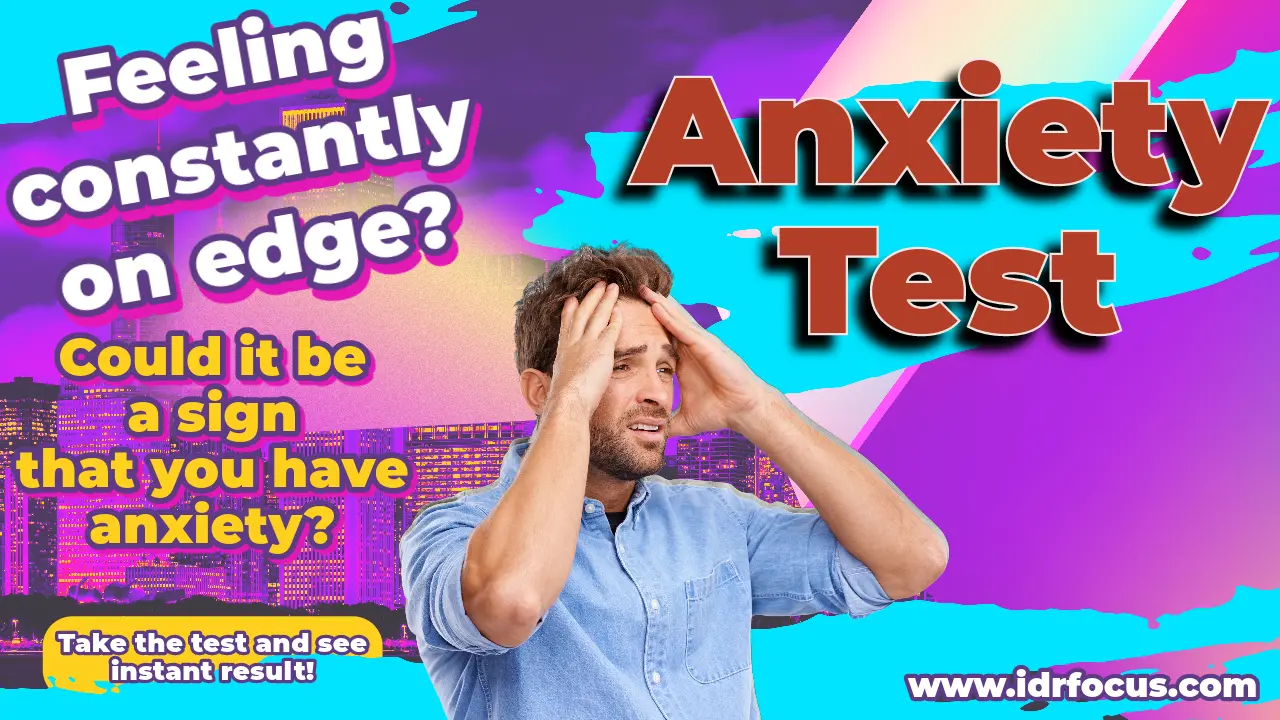
Anxiety is one of the most ordinary human experiences there is. Everyone feels it — before a job interview, during a difficult conversation, in the small hours when tomorrow feels too big. Anxiety only becomes a disorder when it stops being proportionate and starts running your life: when the worry won’t switch off, when your body stays braced for danger that never comes, and when you begin shrinking your world to avoid the things that set it off.
Anxiety disorders are the most common mental health conditions there are — about 19% of US adults have one in any given year, and roughly 31% will experience one at some point in life. They’re also among the most treatable. The complication is that “anxiety” isn’t one condition: it’s a family of related but genuinely different disorders, and they need different approaches.
That’s what this free anxiety test is designed for. It screens broadly across the anxiety family — generalized worry, panic, social anxiety, and situational fear — and then points you toward the specific condition your answers most resemble, so you can take a more focused test or bring something concrete to a professional. 15 questions, private results. It’s a screening tool, not a diagnosis.
What Are Anxiety Disorders?
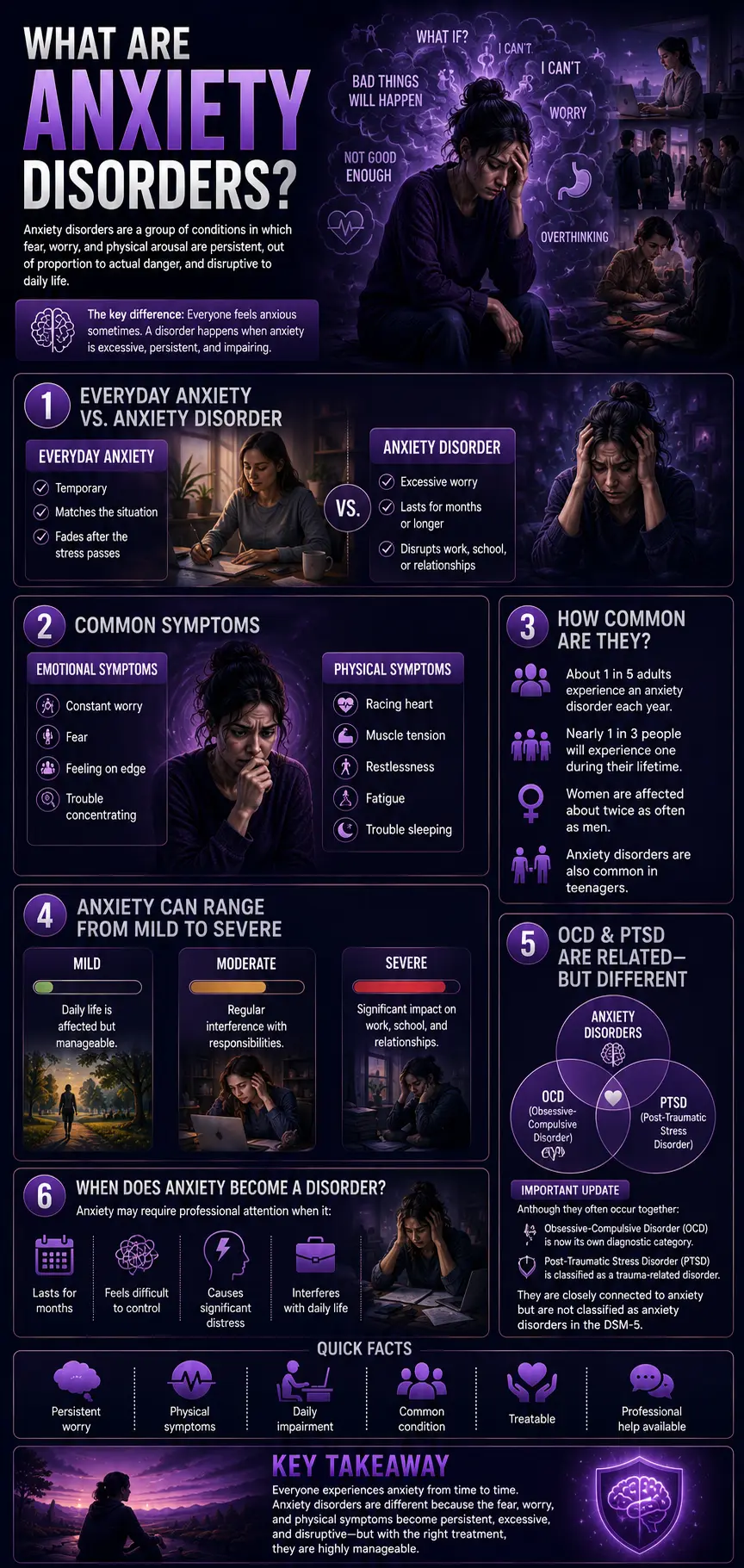
Anxiety disorders are a group of conditions in which fear, worry, and physical arousal are persistent, out of proportion to actual danger, and disruptive to daily life. The distinction that matters clinically isn’t whether you feel anxious — everyone does — but whether the anxiety is excessive, persistent, and impairing.
They are strikingly common. Around 19.1% of US adults meet criteria for an anxiety disorder in a given year and 31.1% over a lifetime, with women affected roughly twice as often as men (23.4% versus 14.3% in the past year). Among adolescents aged 13 to 18, the figure reaches about 31.9%. Severity varies widely: among adults with an anxiety disorder, impairment is mild for roughly 43.5%, moderate for 33.7%, and serious for 22.8% — which is to say a substantial minority are significantly disabled by it, while many others carry it at a lower but still wearing level.
One point of genuine confusion worth clearing up: in the DSM-5, obsessive-compulsive disorder and post-traumatic stress disorder were moved out of the anxiety disorders chapter into their own separate categories — OCD into “Obsessive-Compulsive and Related Disorders,” PTSD into “Trauma- and Stressor-Related Disorders.” They remain closely related to anxiety and frequently co-occur with it, but they are no longer classified as anxiety disorders. This is why prevalence figures differ between sources: older surveys bundled OCD and PTSD into “any anxiety disorder,” while newer DSM-5-based ones count them separately.
The Types of Anxiety Disorder
Knowing which kind of anxiety you’re dealing with genuinely changes what helps. These are the main conditions in the family.
| Condition | Core Feature | What It Looks Like |
|---|---|---|
| Generalized Anxiety Disorder | Persistent, uncontrollable worry across many areas of life | Worrying about work, health, money, family — the topic changes, the worry doesn’t. GAD Test |
| Panic Disorder | Recurrent unexpected panic attacks plus fear of the next one | Sudden surges of intense fear with physical symptoms, then living in dread of recurrence. Panic Disorder Test |
| Social Anxiety Disorder | Intense fear of being judged, scrutinized, or humiliated | Dread of social or performance situations; avoidance or enduring them with distress. Social Anxiety Test |
| Agoraphobia | Fear of situations where escape or help would be difficult | Avoiding crowds, transport, open spaces, or being far from home. Agoraphobia Test |
| Specific Phobias | Intense, disproportionate fear of a particular object or situation | The most common anxiety disorders, affecting about 9.1% of people. See our Hemophobia and Scopophobia tests |
| OCD (related, not an anxiety disorder in DSM-5) | Intrusive obsessions and compulsive rituals performed to relieve them | Reclassified in DSM-5 but closely related and often co-occurring. OCD Test |
| PTSD (related, not an anxiety disorder in DSM-5) | Anxiety arising specifically from traumatic experience | Also reclassified in DSM-5; anxiety symptoms are trauma-driven. PTSD Test |
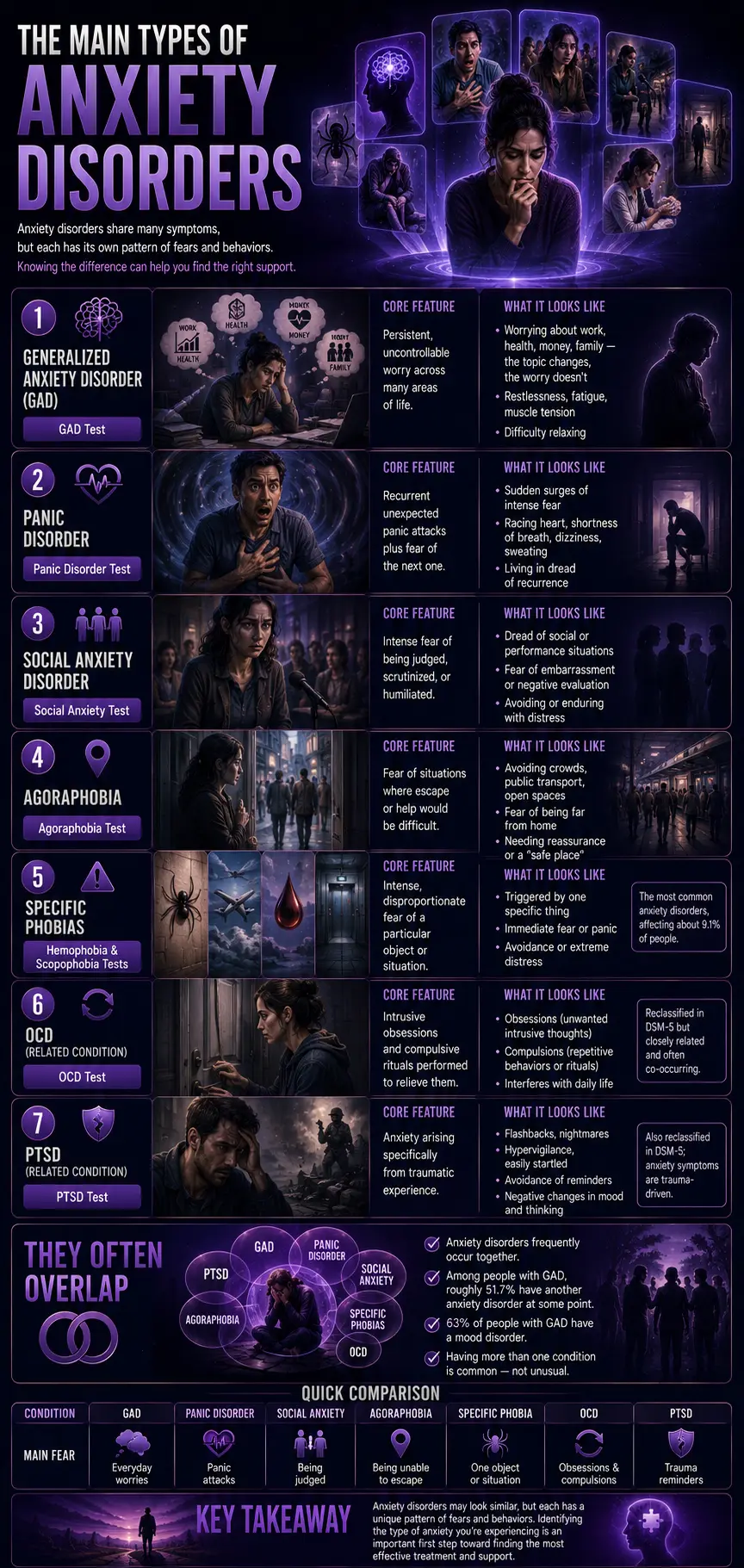
These conditions overlap heavily and frequently occur together — among people with generalized anxiety disorder, roughly 51.7% have another anxiety disorder at some point, and 63% have a mood disorder. Having more than one is the norm rather than the exception, which is another reason a broad screen like this one is a sensible starting point.
Signs You Might Have an Anxiety Disorder
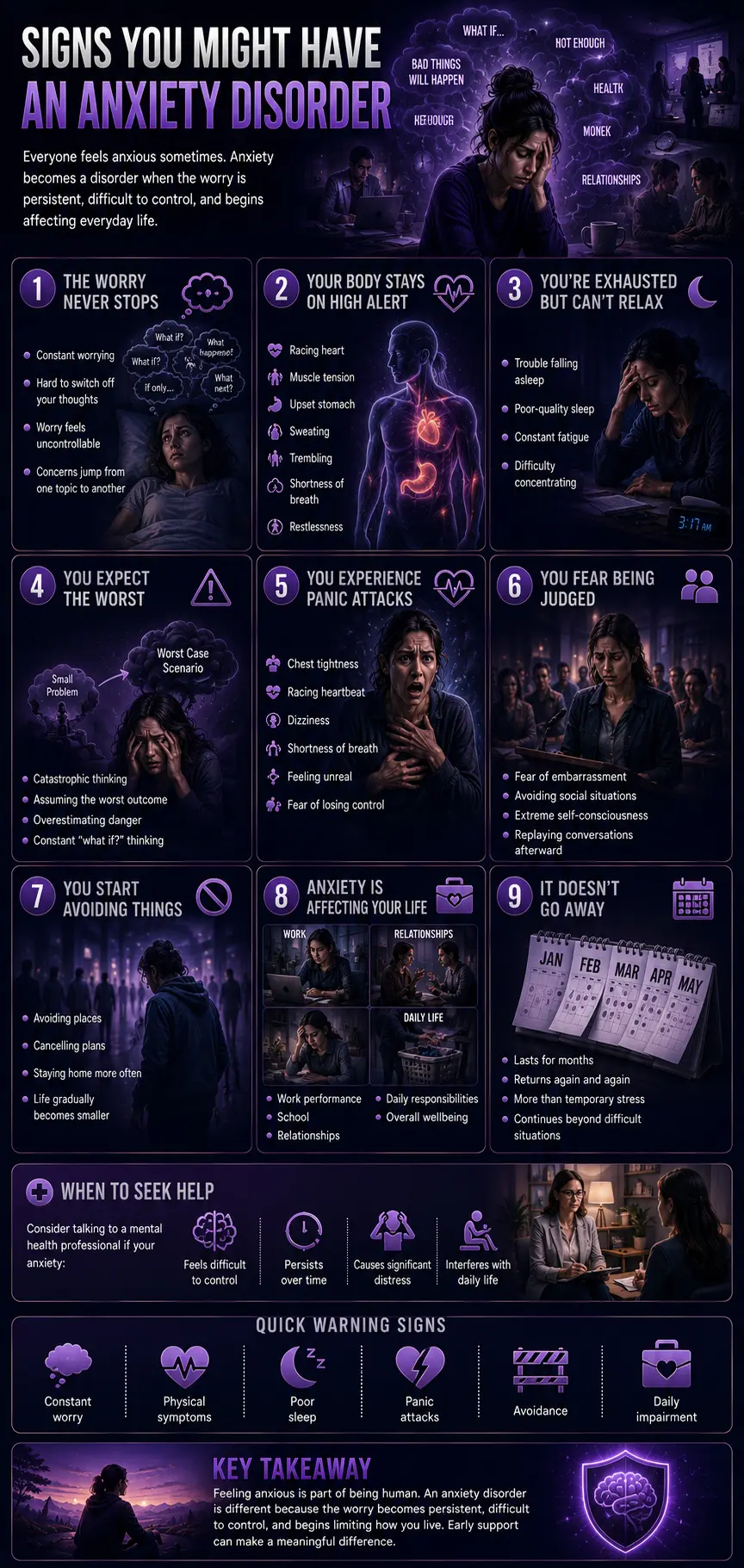
These are the features most consistently associated with anxiety disorders. The question isn’t whether you recognize any of them — most people will — but whether they’re persistent, out of proportion, and getting in the way of your life.
-
The worry doesn’t switch off
Anxiety that runs in the background regardless of what’s actually happening, and that you struggle to control or reason your way out of even when you can see it’s disproportionate. The uncontrollability is often more telling than the content.
-
Your body is braced for danger
Anxiety lives in the body as much as the mind: muscle tension, a churning stomach, a racing or pounding heart, breathlessness, sweating, trembling, dizziness, or a persistent restless, keyed-up feeling. Many people seek help for the physical symptoms long before they connect them to anxiety.
-
You’re exhausted but wired
Trouble falling or staying asleep because your mind won’t quiet, waking unrefreshed, and a fatigue that coexists with feeling constantly on edge. Concentration and memory often suffer.
-
You anticipate the worst
Your mind reaches automatically for the catastrophic version — the unexplained symptom is something serious, the unanswered message means something is wrong, the presentation will be a disaster. Anxiety systematically overestimates both the likelihood and the severity of bad outcomes.
-
You experience sudden surges of intense fear
Episodes that come on quickly, peak within minutes, and bring intense physical symptoms — pounding heart, breathlessness, chest tightness, dizziness, a feeling of unreality or of losing control. These are panic attacks, and they point toward panic disorder specifically.
-
You fear being judged or watched
Intense self-consciousness in social or performance situations, dread of embarrassing yourself, replaying interactions afterward looking for mistakes. This points toward social anxiety rather than generalized worry.
-
Your world is getting smaller
Avoiding places, situations, activities, or people because of anxiety — and finding that the list grows over time. Avoidance is the mechanism by which anxiety disorders entrench themselves: each avoidance brings short-term relief and long-term reinforcement.
-
It’s interfering with your life
Work, study, relationships, health, or day-to-day functioning are being affected. This is the line most diagnostic criteria turn on: anxiety becomes a disorder when it causes clinically significant distress or impairment.
-
It has persisted
Not a stressful fortnight before a deadline, but something ongoing. Most anxiety disorders carry a duration requirement precisely because temporary anxiety during a hard period is a normal human response, not an illness.
Worth knowing: anxiety and depression travel together closely — around 61% of people with generalized anxiety disorder also experience major depression at some point. If low mood is part of your picture, our Clinical Depression Test is worth taking alongside this one.
How This Anxiety Test Works
This test has 15 questions. Five cover the core features shared across anxiety disorders, and the rest sample the markers that distinguish the specific conditions — generalized worry, panic, social fear, and situational avoidance — so your result can point you toward the right next step. For each question, choose how often it has applied over the past few weeks:
Never = 0 | Rarely = 1 | Sometimes = 2 | Often = 3 | Always = 4
Your answers add up to a score from 0 to 60. Your result will also show you which group of questions drove your score, which is often more useful than the number itself — the pattern is what indicates which type of anxiety you may be dealing with. This is a screening tool, not a diagnosis; only a qualified professional can diagnose an anxiety disorder.
Understanding Your Anxiety Test Score
| Score Range | Level | What It Suggests |
|---|---|---|
| 0 – 15 | Minimal Anxiety | Anxiety levels within the normal range. Everyday anxiety without the persistence or impairment of a disorder. |
| 16 – 30 | Mild Anxiety | Noticeable anxiety that may be affecting you. Worth attention, especially if it’s been growing. |
| 31 – 45 | Moderate Anxiety | A level of anxiety consistent with an anxiety disorder. A professional assessment is recommended. |
| 46 – 60 | Severe Anxiety | Severe, pervasive anxiety very likely affecting most areas of life. Professional support is strongly recommended. |
Which Type of Anxiety Do Your Answers Point To?
Your total score tells you how much anxiety you’re carrying. Which questions you scored highest on tells you what kind — and that’s what determines which test and which treatment fit. The questions map like this:
- Questions 1–5 — core anxiety. Shared across all anxiety disorders: worry, uncontrollability, physical tension, restlessness, sleep and concentration. High scores here alone suggest general anxiety without a clear specific pattern.
- Questions 6–7 — generalized worry. Worry spanning many different areas of life. If your score concentrated here, see our Generalized Anxiety Disorder Test.
- Questions 8–9 — panic. Sudden attacks and fear of their recurrence. If these were your highest, see our Panic Disorder Test.
- Questions 10–11 — social anxiety. Fear of judgment and avoidance of social situations. If these stood out, see our Social Anxiety Test.
- Question 12 — situational avoidance. Avoiding specific places or situations. Consider our Agoraphobia Test or, for a specific feared object or situation, a phobia test such as Hemophobia or Scopophobia.
Questions 13–15 — impact and persistence. How much it’s interfering and how long it’s been going on. These don’t indicate a type, but they’re what turns anxiety into a disorder.
What Causes Anxiety Disorders?
Anxiety disorders develop from a combination of factors rather than one cause. Genetics contribute meaningfully — anxiety disorders run in families, and heritable temperamental traits like behavioral inhibition and neuroticism raise risk. Neurobiologically, they involve the brain’s threat-detection circuitry, particularly the amygdala and its regulation by prefrontal regions, along with the neurotransmitter systems that treatment targets.
Life experience matters too: early adversity, trauma, chronic stress, overprotective or unpredictable parenting, and significant life transitions all increase vulnerability. Physical health plays a role — thyroid disorders, cardiac and respiratory conditions, chronic pain, and certain medications can cause or amplify anxiety, which is one reason a medical check-up is a reasonable part of assessment. Substances are a common and underappreciated contributor: caffeine, alcohol (particularly in withdrawal), nicotine, and stimulants all worsen anxiety, sometimes dramatically.
What turns manageable anxiety into a persistent disorder is usually a maintenance cycle rather than the original cause. Anxiety prompts avoidance; avoidance brings immediate relief; the relief teaches the brain that the feared situation really was dangerous and that avoidance was what saved you. The fear grows, the world shrinks, and the cycle tightens. Understanding this is genuinely useful, because breaking that cycle — gradually, with support — is precisely what effective treatment does.
How Anxiety Disorders Are Treated
Anxiety disorders are among the most treatable mental health conditions, and it’s worth stating that clearly, because anxiety itself tends to generate pessimism about whether anything will help.
Cognitive Behavioral Therapy (CBT) is the best-established treatment across the anxiety disorders. It works by identifying and testing the catastrophic predictions anxiety generates, and — critically — by gradual exposure to feared situations, which reverses the avoidance cycle that maintains the disorder. Exposure is the active ingredient in most effective anxiety treatment, and it’s why “just avoiding what makes you anxious” reliably makes anxiety worse over time. Specific adaptations exist for each condition: interoceptive exposure for panic, social exposure for social anxiety, and so on.
Medication helps many people. SSRIs and SNRIs are the usual first-line choices, with good evidence across the anxiety disorders. They take several weeks to work fully and are often combined with therapy. Benzodiazepines, while fast-acting, carry dependence risks and are generally used sparingly and short-term. A prescriber can advise on what fits your situation.
Lifestyle and self-management support treatment meaningfully: consistent sleep, regular exercise (which has genuine evidence for anxiety), reducing caffeine and alcohol, and mindfulness-based approaches. These help, but for a disorder-level problem they work best alongside proper treatment rather than instead of it.
Because different anxiety disorders respond best to different adaptations of these approaches, identifying which type you’re dealing with is genuinely worth doing — which is what the question map in your results is for.
Frequently Asked Questions
How do I know if my anxiety is normal or a disorder?
The distinction isn’t whether you feel anxious — everyone does, and anxiety is a normal and often useful response to genuine challenge. Three things separate an anxiety disorder from ordinary anxiety. First, proportion: the anxiety is excessive relative to the actual situation. Second, persistence: it continues over time rather than resolving once the stressful period passes; most anxiety disorders carry a duration requirement for exactly this reason. Third, and most importantly, impairment: it causes significant distress or interferes with your work, relationships, or daily functioning. A stressful month before a deadline is normal. Months of uncontrollable worry that’s disrupting your sleep, your work, and the range of things you feel able to do is worth getting assessed.
What are the different types of anxiety disorders?
The main DSM-5-TR anxiety disorders are generalized anxiety disorder (persistent uncontrollable worry across many life areas), panic disorder (recurrent unexpected panic attacks plus ongoing fear of more), social anxiety disorder (intense fear of judgment or scrutiny), agoraphobia (fear of situations where escape or help would be difficult), specific phobias (intense fear of a particular object or situation — the most common anxiety disorders, affecting around 9.1% of people), plus separation anxiety disorder and selective mutism. Obsessive-compulsive disorder and PTSD are closely related and often co-occur, but the DSM-5 moved both out of the anxiety disorders chapter into their own categories. This test screens across the family and points you toward the specific pattern your answers most resemble.
Is OCD an anxiety disorder?
Not anymore, technically — and this is one of the most common misconceptions about anxiety. In the DSM-IV, OCD was classified as an anxiety disorder. The DSM-5 moved it into a new chapter called “Obsessive-Compulsive and Related Disorders,” alongside conditions like body dysmorphic disorder and hoarding disorder, reflecting evidence that these conditions share distinctive features that set them apart. PTSD was similarly moved into “Trauma- and Stressor-Related Disorders.”
Both remain closely related to anxiety, involve substantial anxiety, and frequently co-occur with anxiety disorders — so the reclassification is a matter of taxonomy rather than a claim that they’re unrelated. It does explain why prevalence statistics vary between sources: older surveys counted OCD and PTSD within “any anxiety disorder,” and newer DSM-5-based ones don’t. If OCD fits your experience, see our OCD Test.
How common are anxiety disorders?
Very. They’re the most prevalent mental health conditions there are. About 19.1% of US adults meet criteria for an anxiety disorder in any given year, and 31.1% will experience one at some point in their lifetime — roughly one in three people. Women are affected about twice as often as men (23.4% versus 14.3% in the past year), and rates among adolescents aged 13 to 18 reach around 31.9%. Severity varies considerably: among adults with an anxiety disorder, impairment is mild for about 43.5%, moderate for 33.7%, and serious for 22.8%. If you’re dealing with this, the one genuinely comforting statistic is how much company you have — and how well these conditions respond to treatment.
Can anxiety cause physical symptoms?
Yes, extensively — and this is one of the most misunderstood aspects of anxiety. Anxiety activates the body’s threat response, producing a racing or pounding heart, breathlessness, chest tightness, muscle tension, trembling, sweating, dizziness, nausea and digestive problems, headaches, and fatigue. These symptoms are real, not imagined, and many people first seek help for the physical experience without connecting it to anxiety. An important caveat: because anxiety symptoms overlap with genuine medical conditions — cardiac problems, thyroid disorders, respiratory conditions — new, severe, or changing physical symptoms should be medically evaluated rather than assumed to be anxiety. A proper anxiety diagnosis includes ruling out physical causes.
What is the GAD-7 and is this test the same thing?
The GAD-7 is a validated seven-item questionnaire widely used by clinicians to screen for generalized anxiety disorder and gauge its severity; at its conventional cutoff score of 10, it has a sensitivity of around 0.74. It’s a genuinely validated instrument, but it’s specific to generalized anxiety — it isn’t designed to detect panic disorder, social anxiety, or phobias. This test is different by design: it’s a broader house screener covering the whole anxiety family, built to help you identify which type of anxiety fits your experience so you can take a more focused test. If generalized worry is clearly your pattern, our Generalized Anxiety Disorder Test is the more targeted screen.
Can anxiety disorders be cured?
Anxiety disorders are among the most treatable mental health conditions, and many people experience substantial, lasting improvement — often to the point where anxiety stops meaningfully limiting their lives. Cognitive Behavioral Therapy has strong evidence across the anxiety disorders, particularly through gradual exposure, which reverses the avoidance cycle that keeps anxiety going. Medication (usually SSRIs or SNRIs) helps many people, alone or with therapy. “Cure” is a slightly awkward word for any mental health condition, since some tendency toward anxiety may remain part of your temperament — but that’s quite different from having a disorder. The realistic and well-supported expectation is that with proper treatment, anxiety becomes something you manage rather than something that manages you.
Further reading
Needing to control things is often anxiety wearing a different coat: when uncertainty is the intolerable part, control becomes the strategy. Our control freak quiz rates how strongly that pattern shows up for you.
Related Tests
- Generalized Anxiety Disorder Test — for persistent, uncontrollable worry spanning many areas of life
- Panic Disorder Test — for recurrent panic attacks and the fear of the next one
- Social Anxiety Test — for fear of judgment, scrutiny, and social or performance situations
- Agoraphobia Test — for fear and avoidance of situations where escape or help would be difficult
- Hemophobia Test — specific phobias are the most common anxiety disorders; this screens fear of blood
- Scopophobia Test — for fear of being watched or stared at, often mistaken for general social anxiety
- OCD Test — closely related to anxiety though reclassified in DSM-5; screens obsessions and compulsions
- PTSD Test — for anxiety arising specifically from traumatic experience
- Clinical Depression Test — around 61% of people with GAD also experience major depression; worth screening together
- Avoidant Personality Disorder Test — for pervasive social inhibition and fear of rejection beyond situational social anxiety
References
- American Psychiatric Association. (2022). Diagnostic and Statistical Manual of Mental Disorders, Fifth Edition, Text Revision (DSM-5-TR). Anxiety Disorders. [Diagnostic criteria; reclassification of OCD and PTSD into separate chapters] psychiatry.org
- National Institute of Mental Health. Any Anxiety Disorder — Statistics. [19.1% past-year and 31.1% lifetime prevalence in US adults; sex differences; impairment distribution] nimh.nih.gov
- Anxiety & Depression Association of America. Anxiety Disorders — Facts & Statistics. [Specific phobia 9.1% prevalence; adolescent rates; GAD-depression comorbidity] adaa.org
- Ruscio, A.M., Hallion, L.S., Lim, C.C.W., et al. (2017). Cross-sectional Comparison of the Epidemiology of DSM-5 Generalized Anxiety Disorder Across the Globe. JAMA Psychiatry, 74(5), 465–475. [WHO World Mental Health Surveys, 26 countries, n=147,261; lifetime 3.7%, 12-month 1.8%; comorbidity 81.9%] pubmed.ncbi.nlm.nih.gov
- Plummer, F., Manea, L., Trepel, D., & McMillan, D. (2016). Screening for anxiety disorders with the GAD-7 and GAD-2: a systematic review and diagnostic meta-analysis. General Hospital Psychiatry, 39, 24–31. [GAD-7 sensitivity 0.74 at cutoff 10] pubmed.ncbi.nlm.nih.gov
Related Tests
See All Quiz →
Anxiety and Fear Disorders
15-Item Scopophobia Test – Fear of being stared at, watched, or observed
→
You may also like
See All Quiz →