

Am I Being Manipulated? Manipulation Detection Quiz
If you feel unsafe, or manipulation has turned into control or abuse, support is available 24/7.
📞 National Domestic Violence Hotline — 1-800-799-7233, or text START to 88788
Emotional manipulation can be a part of abuse. If you’re in crisis or having thoughts of harming yourself, call or text 988 any time. If you’re in immediate danger, call 911. If someone might be monitoring your devices, consider using a private or trusted one.
If you’ve found yourself wondering “am I being manipulated?”, that question deserves to be taken seriously — and here’s the most important thing to know before you go any further: the fact that you’re asking is meaningful. Manipulation works by quietly eroding your trust in your own perception, so that you end up doubting yourself instead of questioning the other person’s behavior. If a relationship consistently leaves you confused, guilty, anxious, or feeling “off,” that feeling is not something to dismiss. It’s information.
This quiz is designed to help you step back and look at the pattern clearly, using the recognized signs of psychological manipulation. It’s a reflection tool, not a diagnosis of another person — but it can help you name what you may already be sensing, and decide what to do next. 15 questions, completely private. And whatever your result: if something feels wrong to you, that instinct is worth honoring.
What Is Psychological Manipulation?
Psychological manipulation is influencing someone through indirect, deceptive, or coercive tactics rather than honest, direct communication. Instead of openly asking for what they want, a manipulative person works on your emotions — your guilt, your fear, your empathy, your self-doubt — to get you to think, feel, or do what serves them, often at your own expense.
It’s worth being fair here: almost everyone uses a bit of influence or persuasion sometimes, and an isolated bad moment doesn’t make someone a manipulator. What defines genuine manipulation is a pattern — a consistent way of relating in which one person controls the narrative, dismisses your feelings, avoids accountability, and leaves you carrying confusion and self-blame. Manipulation can happen anywhere: romantic relationships, families, friendships, and workplaces. And it’s often hardest to see when it matters most, because a skilled manipulator makes you question yourself rather than them.
One thing the research is clear about: manipulators frequently target empathetic, conscientious people — precisely because a strong desire to understand, to help, and to give second chances can be turned into leverage. If you’re the kind of person who assumes good intentions and blames yourself first, that’s a good-hearted trait being used against you, not a flaw in you.
Manipulation vs. Normal Conflict: How to Tell the Difference
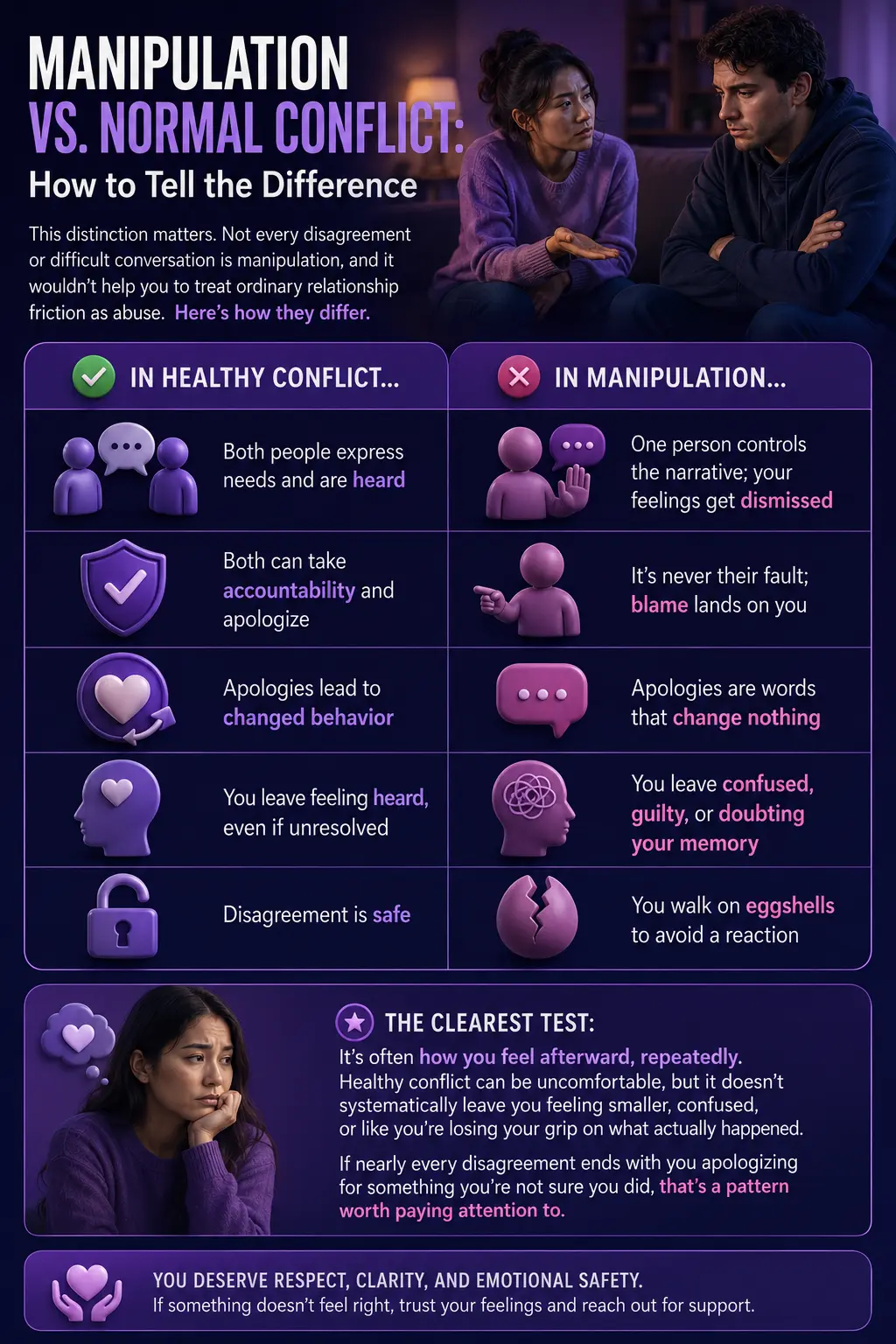
This distinction matters, because not every disagreement or difficult conversation is manipulation, and it wouldn’t help you to treat ordinary relationship friction as abuse. Here’s how they differ.
| In healthy conflict… | In manipulation… |
|---|---|
| Both people express needs and are heard | One person controls the narrative; your feelings get dismissed |
| Both can take accountability and apologize | It’s never their fault; blame lands on you |
| Apologies lead to changed behavior | Apologies are words that change nothing |
| You leave feeling heard, even if unresolved | You leave confused, guilty, or doubting your memory |
| Disagreement is safe | You walk on eggshells to avoid a reaction |
The single clearest test is often how you feel afterward, repeatedly. Healthy conflict can be uncomfortable, but it doesn’t systematically leave you feeling smaller, confused, or like you’re losing your grip on what actually happened. If nearly every disagreement ends with you apologizing for something you’re not sure you did, that’s a pattern worth paying attention to.
Signs You’re Being Manipulated
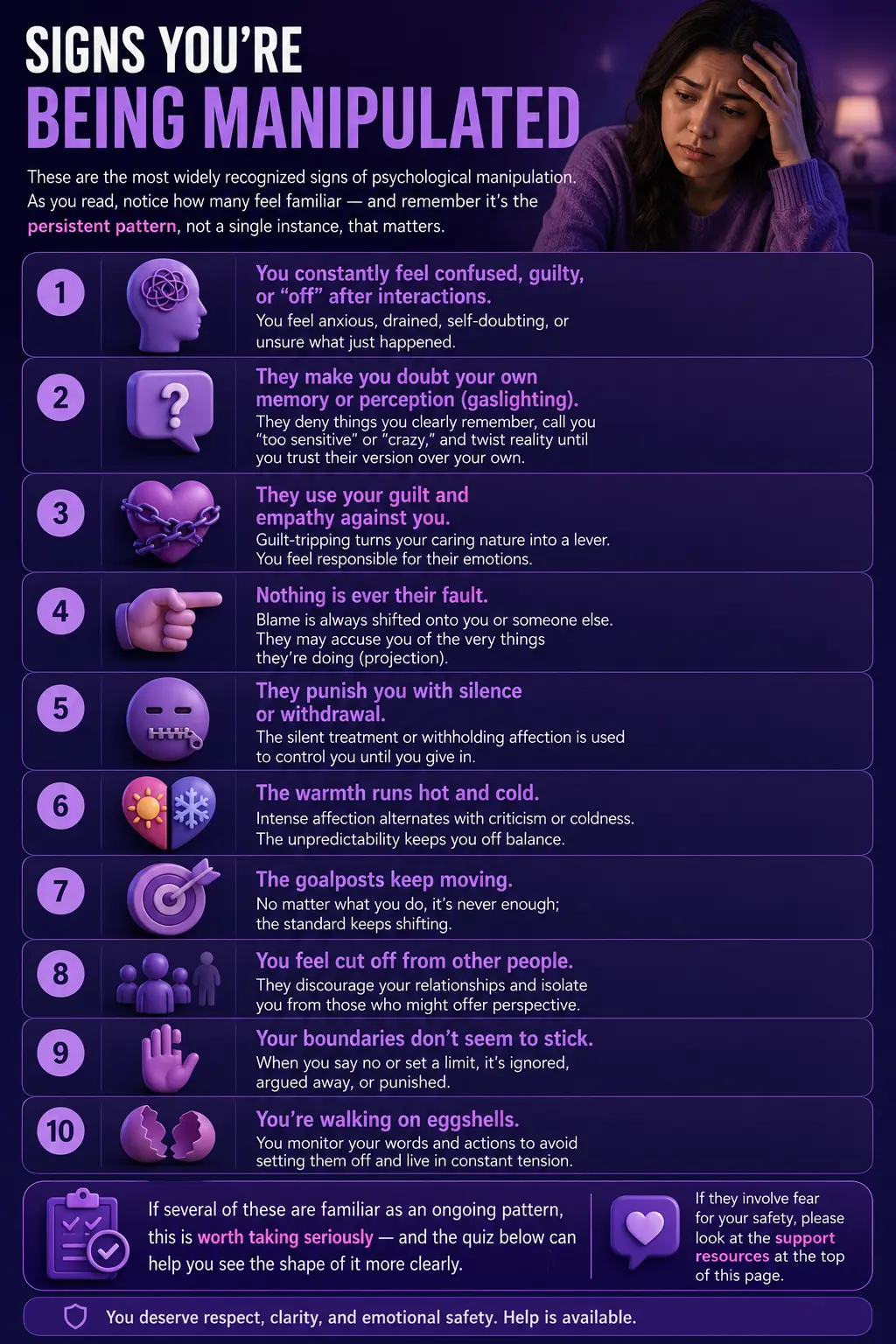
These are the most widely recognized signs of psychological manipulation. As you read, notice how many feel familiar — and remember it’s the persistent pattern, not a single instance, that matters.
-
You constantly feel confused, guilty, or “off” after interactions.
This is often the first and most reliable signal. If time with a particular person regularly leaves you anxious, drained, self-doubting, or unsure what just happened, your emotional response is telling you something.
-
They make you doubt your own memory or perception (gaslighting).
They deny things you clearly remember, insist events didn’t happen the way you know they did, or tell you you’re “too sensitive,” “imagining things,” or “crazy.” Over time you start trusting their version of reality over your own.
-
They use your guilt and empathy against you.
Guilt-tripping — “after everything I’ve done for you,” “if you really loved me, you would” — turns your caring nature into a lever. You end up prioritizing their needs and feeling responsible for their emotions.
-
Nothing is ever their fault.
Blame consistently gets shifted onto you or someone else. They may accuse you of the very things they’re doing (projection), so you’re left defending yourself instead of addressing their behavior.
-
They punish you with silence or withdrawal.
The silent treatment, stonewalling, or withholding affection is used to control you — creating anxiety until you give in, apologize, or comply just to restore the connection.
-
The warmth runs hot and cold
Intense affection, flattery, or generosity (sometimes called love bombing) alternates with criticism, coldness, or withdrawal. The unpredictability keeps you off balance and working to “earn back” the good version of them.
-
The goalposts keep moving
No matter what you do, it’s never quite enough; the standard shifts so you’re perpetually falling short and trying harder.
-
You feel cut off from other people
They subtly (or openly) discourage your other relationships, create conflict with friends or family, or make you feel you can only rely on them — isolating you from the people who might offer perspective.
-
Your boundaries don’t seem to stick
When you say no or set a limit, it’s ignored, argued away, or punished, until saying no feels more trouble than it’s worth.
-
You’re walking on eggshells
You monitor your words and actions to avoid setting them off, and you feel a low-level tension around them much of the time.
If several of these are familiar as an ongoing pattern, this is worth taking seriously — and the quiz below can help you see the shape of it more clearly. If they involve fear for your safety, please look at the support resources at the top of this page.
How This Am I Being Manipulated Quiz Works
Answer these 15 questions about one specific person or relationship — the one you had in mind when you found this page. For each, choose how often it’s true:
- Never = 0
- Rarely = 1
- Sometimes = 2
- Often = 3
- Always = 4
Your answers add up to a score from 0 to 60. A higher score means more signs of manipulation are present. But please read this clearly: a lower score does not mean your feelings are wrong. Manipulation is sometimes subtle, and no quiz can capture your full situation. If your instinct says something is off, that instinct matters more than any number here. Answer honestly about the overall pattern, and treat the result as a starting point for your own clarity — not a verdict on whether you’re “allowed” to feel the way you do.
Your Results
Before your result, one thing to hold onto no matter your score: you took this quiz because something prompted you to, and that’s worth respecting. These bands describe the pattern your answers show — they don’t overrule what you know and feel about your own life.
| Score Range | What It Suggests | Reading |
|---|---|---|
| 0 – 15 | Few Clear Signs | Few classic signs in your answers — but if your gut still says something’s off, trust it. |
| 16 – 30 | Some Concerning Signs | Some manipulation tactics appear present. Worth watching closely and naming. |
| 31 – 45 | Strong Pattern | A clear pattern consistent with manipulation. Worth taking seriously and getting support. |
| 46 – 60 | Severe — Possible Abuse | Pervasive manipulation that may amount to emotional abuse. Please reach out for support. |
What to Do If You’re Being Manipulated
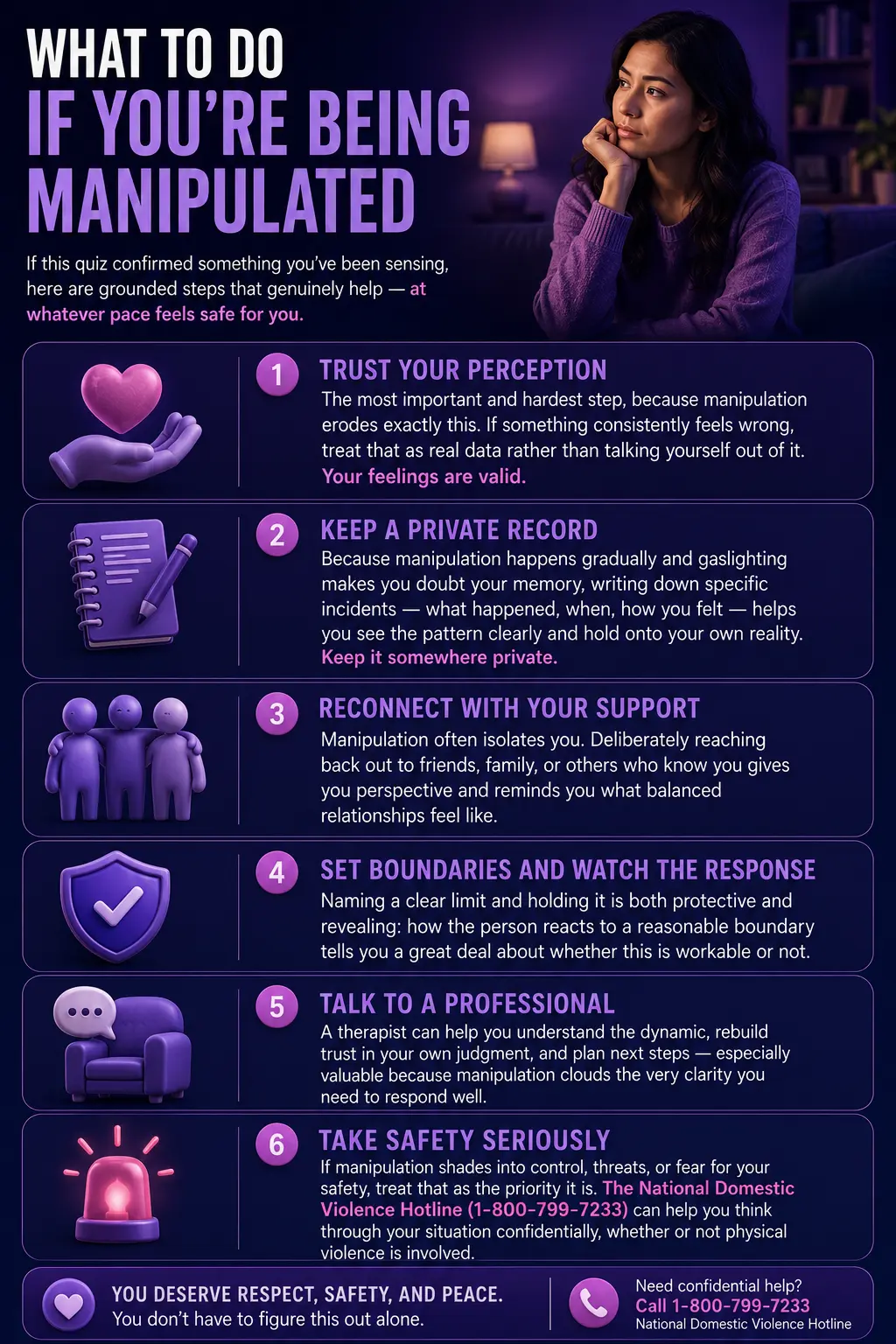
If this quiz confirmed something you’ve been sensing, here are grounded steps that genuinely help — at whatever pace feels safe for you.
-
Trust your perception
The most important and hardest step, because manipulation erodes exactly this. If something consistently feels wrong, treat that as real data rather than talking yourself out of it. Your feelings are valid.
-
Keep a private record
Because manipulation happens gradually and gaslighting makes you doubt your memory, writing down specific incidents — what happened, when, how you felt — helps you see the pattern clearly and hold onto your own reality. Keep it somewhere private.
-
Reconnect with your support
Manipulation often isolates you. Deliberately reaching back out to friends, family, or others who know you gives you perspective and reminds you what balanced relationships feel like.
-
Set boundaries and watch the response
Naming a clear limit and holding it is both protective and revealing: how the person reacts to a reasonable boundary tells you a great deal about whether this is workable or not.
-
Talk to a professional
A therapist can help you understand the dynamic, rebuild trust in your own judgment, and plan next steps — especially valuable because manipulation clouds the very clarity you need to respond well.
-
Take safety seriously
If manipulation shades into control, threats, or fear for your safety, treat that as the priority it is. The National Domestic Violence Hotline (1-800-799-7233) can help you think through your situation confidentially, whether or not physical violence is involved.
Frequently Asked Questions
How do I know if I’m being manipulated or just being too sensitive?
This exact worry — “maybe I’m just being too sensitive” — is worth noticing, because it’s frequently something a manipulator has actively planted. “You’re too sensitive” is one of the most common gaslighting phrases, designed to make you dismiss your own valid reactions. Here’s a clearer way to tell: manipulation is about a persistent pattern and its effect on you, not a single incident.
If interactions with someone repeatedly leave you confused, guilty, anxious, or doubting your memory; if it’s never their fault; if apologies never lead to changed behavior; and if you feel like you’re walking on eggshells — that’s a pattern, not oversensitivity. Genuine oversensitivity doesn’t systematically leave you feeling like you’re losing your grip on reality. Trust the pattern, and trust how you consistently feel.
What are the most common manipulation tactics?
The most widely recognized tactics include gaslighting (making you doubt your reality or memory), guilt-tripping (using your empathy and guilt to control you), love bombing followed by devaluation (intense affection that later turns cold), the silent treatment (withdrawal used as punishment), blame-shifting and projection (nothing is ever their fault, and they may accuse you of what they’re doing), moving the goalposts (nothing you do is ever enough), isolation (cutting you off from your support network), and emotional blackmail (using threats, guilt, or fear to force compliance).
Most manipulation combines several of these over time. The common thread is that they replace honest, direct communication with indirect pressure on your emotions — and they tend to leave you feeling confused and responsible rather than clear and respected.
Can someone manipulate you without realizing it?
Yes, sometimes. Not all manipulation is calculated. Some people learned these patterns in childhood or from their own experiences of trauma, and they repeat them without full awareness of what they’re doing or its effect. That said — and this is important — the impact on you is the same whether or not it’s intentional, and a person’s lack of awareness doesn’t obligate you to keep absorbing the harm.
Whether someone manipulates deliberately or unconsciously, you’re still allowed to name the behavior, set boundaries, and protect your wellbeing. Understanding that it might be unintentional can help you have compassion and decide how to approach a conversation, but it doesn’t mean the pattern is acceptable or that you have to tolerate it.
Is manipulation a form of abuse?
It can be. Occasional, low-level manipulation exists on a spectrum and isn’t automatically abuse — but persistent psychological manipulation, especially when it involves gaslighting, control, isolation, and the systematic erosion of someone’s confidence and reality, is recognized as a form of emotional or psychological abuse. It’s telling that a large majority of domestic violence survivors report experiencing gaslighting; manipulation is often part of a broader pattern of coercive control.
Emotional abuse is real abuse, even without any physical violence, and it can be just as damaging. If manipulation in your life has become pervasive or involves fear, please know that resources like the National Domestic Violence Hotline (1-800-799-7233) are there for psychological and emotional abuse, not only physical.
Why do I keep doubting myself even when I know something is wrong?
Because that self-doubt is often the direct result of the manipulation, not a flaw in your judgment. Tactics like gaslighting are specifically designed to make you distrust your own perception and rely on the manipulator’s version of reality instead.
Over time, being repeatedly told you’re wrong, too sensitive, or misremembering trains you to second-guess yourself — which is exactly what keeps the dynamic working. So if you find yourself knowing something is wrong and then talking yourself out of it, that’s not you being irrational; it’s the predictable effect of a pattern engineered to produce that confusion. Rebuilding trust in your own perception — through journaling, outside perspective, and often therapy — is one of the most important parts of recovering from manipulation.
Should I confront a manipulator?
It depends on your safety and the situation, so there’s no one-size answer. Naming the behavior can be worthwhile and clarifying — and how the person responds is revealing: someone acting in good faith will take your concern seriously, while a manipulator typically denies, deflects, minimizes, or turns it back on you. But direct confrontation isn’t always safe or productive, particularly if the person is volatile or the dynamic has features of control or potential abuse.
In those cases, your safety and support come first, and it’s wiser to talk with a therapist or a resource like the National Domestic Violence Hotline before confronting anyone. You’re allowed to protect yourself without staging a confrontation, including by setting quiet boundaries or stepping back from the relationship. Trust your read on what’s safe.
Further reading
Love Bombing to Devaluation: The Cycle Behind Manipulative Relationships — the full arc this quiz screens for — how the warmth arrives first, how it turns conditional, and why the alternation is what makes it hard to leave. This quiz looks at being on the receiving end. The mirror of it looks inward: the Machiavellian Test measures how far you use strategy, charm and selective honesty on other people. It is a subclinical trait everyone has some of, so a higher score is information rather than a verdict.
Related Tests
- Gaslighting Test — gaslighting is a specific, powerful manipulation tactic; this looks closely at reality-distortion
- Toxic Relationship Quiz — for the bigger picture when manipulation is part of a harmful relationship
- Codependency Test — if you tend to over-give and absorb blame, this looks at the pattern that manipulators exploit
- Self-Esteem Test — manipulation erodes self-worth; the Rosenberg scale checks where yours stands
- Narcissistic Personality Disorder Test — for when manipulation fits a broader pattern of self-focus and low empathy
- Fake Friend Test — if the manipulation is coming from a friendship rather than a partner
References
- GoodTherapy. Manipulation: Signs, Tactics, and Responses. [Definition; guilt-tripping, gaslighting, love bombing, silent treatment; pattern vs. isolated incident] goodtherapy.org
- PsychCentral. Tactics Manipulators Use to Win and Confuse You. [Common tactics; manipulation makes you question your own perception] psychcentral.com
- BetterUp. 11 Signs of Manipulation and How to Protect Yourself. [Signs, boundary-setting, emotional blackmail] betterup.com
- Choosing Therapy. Manipulation Tactics Abusers Use. [Manipulation as a component of emotional abuse and coercive control] choosingtherapy.com
- National Domestic Violence Hotline. Emotional and psychological abuse resources. [Support for non-physical abuse; safety planning] thehotline.org
Related Tests
See All Quiz →


You may also like
See All Quiz →