
Introvert Test: Are You an Introvert, Extrovert, or Ambivert?
Take the free introvert test to find out where you land on the introvert-extrovert spectrum - introvert, ambivert, or extrovert - with instant, private results.
Published Updated
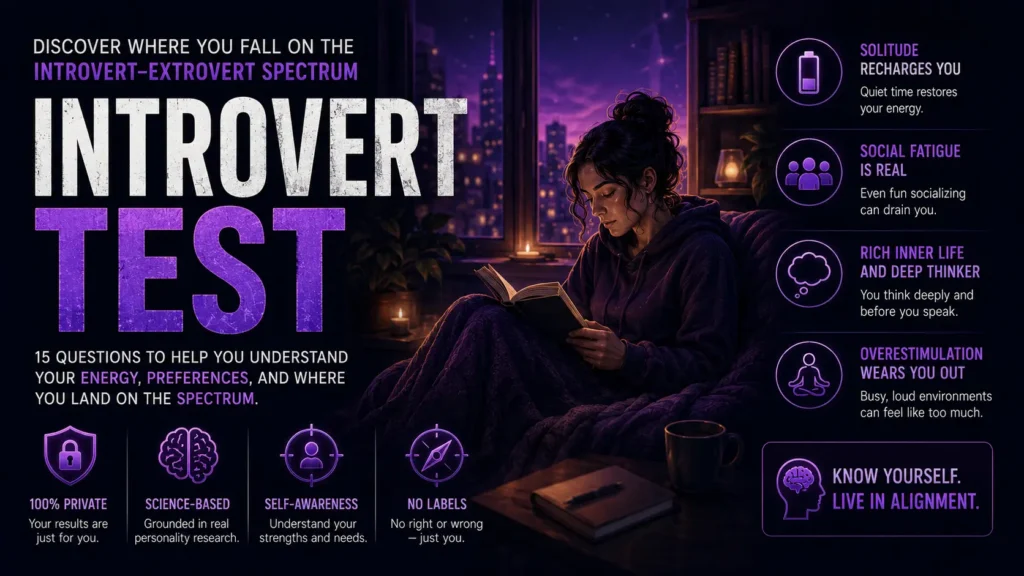
Do you feel recharged after a quiet evening alone — and quietly drained after even a fun night out with a crowd? Do you do your best thinking in your own head before you speak, and prefer one deep conversation to a room full of small talk? If so, you may lean introverted. But introversion is widely misunderstood, so before you decide, it’s worth finding out what it actually is.
This free introvert test helps you see where you fall on the introvert–extrovert spectrum — as an introvert, an extrovert, or an ambivert somewhere in between. It’s based on how personality psychologists actually understand introversion, and it’s a tool for self-understanding, not a label or a judgment. There’s no “better” end of this spectrum; there’s just knowing yourself. 15 questions, completely private.
What Is Introversion?
Introversion is a normal, healthy personality trait — one end of a spectrum that runs from introversion to extraversion, with most people landing somewhere in between. It was first described by the psychologist Carl Jung in 1921, and today it forms the core of the “Extraversion” dimension in the Big Five, the most scientifically validated model of personality. In other words, introversion isn’t a quirk or a problem; it’s one of the fundamental ways human personalities vary.
The single most important thing to understand about introversion is that it’s about energy and stimulation, not about disliking people. Introverts have a nervous system that’s more sensitive to stimulation — the brain runs at a higher baseline level of arousal — so social interaction, busy environments, and lots of external input tend to drain their energy, while quiet and solitude restore it. Extraverts are wired the opposite way: they’re less easily stimulated, so they seek out social contact and activity to feel energized. It’s a real, measurable difference in how the brain responds to the world, linked to differences in arousal and dopamine sensitivity.
This is why an introvert can genuinely love their friends and still need to leave the party early — not because they’re not having fun, but because their battery is running down while an extravert’s is charging up. Understanding this one distinction dissolves most of the confusion around introversion.
Introvert, Extrovert, or Ambivert?
Introversion and extraversion are the two ends of a single spectrum, and — importantly — most people aren’t at either extreme. The large middle zone is called ambiversion, and some researchers estimate ambiverts make up around half the population. Here’s the quick picture.
| Type | Gets Energy From | Tends To |
|---|---|---|
| Introvert | Solitude and quiet; drained by lots of socializing | Prefer deep one-on-one connection, reflect before speaking, enjoy rich inner life, need alone time to recharge |
| Ambivert | Both, depending on context | Flexibly enjoy socializing and solitude; shift between modes; often adaptable in different settings |
| Extrovert | Social interaction and activity; drained by too much solitude | Think out loud, seek stimulation and new experiences, feel energized in groups |
Being an ambivert isn’t a lack of personality — it’s an adaptive flexibility. In fact, research on salespeople famously found that ambiverts tended to outperform both strong introverts and strong extraverts, because they could read a situation and shift modes. Wherever you land, each position on the spectrum comes with its own genuine strengths.
Introversion is one of five core personality dimensions. If you want to go beyond introversion alone and get a full personality profile — including how you take in information, make decisions, approach planning, and handle stress — our Free Personality Test covers all five dimensions in 50 questions and places you within one of 16 personality types, instantly and for free.
Introversion Is Not Shyness (or Social Anxiety)
This is the confusion worth clearing up most of all, because it leads a lot of people to think something is wrong with them when nothing is. Introversion, shyness, and social anxiety are three different things:
Introversion is a preference for lower stimulation — a matter of where you get your energy. An introvert might be perfectly confident and socially skilled; they simply find socializing tiring and solitude restorative. Introversion is not fear-based at all.
Shyness is a fear of social judgment — feeling nervous, self-conscious, or anxious in social situations, especially with new people. Shyness is about discomfort and avoidance, not about energy. Research has found that only around 40% of introverts are actually shy — which means most introverts aren’t shy, and plenty of shy people are actually extraverts (the “shy extravert” who craves connection but fears it).
Social anxiety is a clinical condition — an intense, persistent fear of social situations that interferes with daily life. It’s more severe than shyness and can affect introverts and extraverts alike. If social situations cause you real distress or you avoid them out of fear, that’s worth exploring separately; our Social Anxiety Test looks at that specifically.
And one more myth to retire: introversion is not the same as being antisocial, cold, rude, or misanthropic. Introverts can be warm, funny, deeply caring, and socially fluent — they just prefer their socializing in smaller, closer, less draining doses. Preferring solitude isn’t the same as disliking people.
Signs You Might Be an Introvert
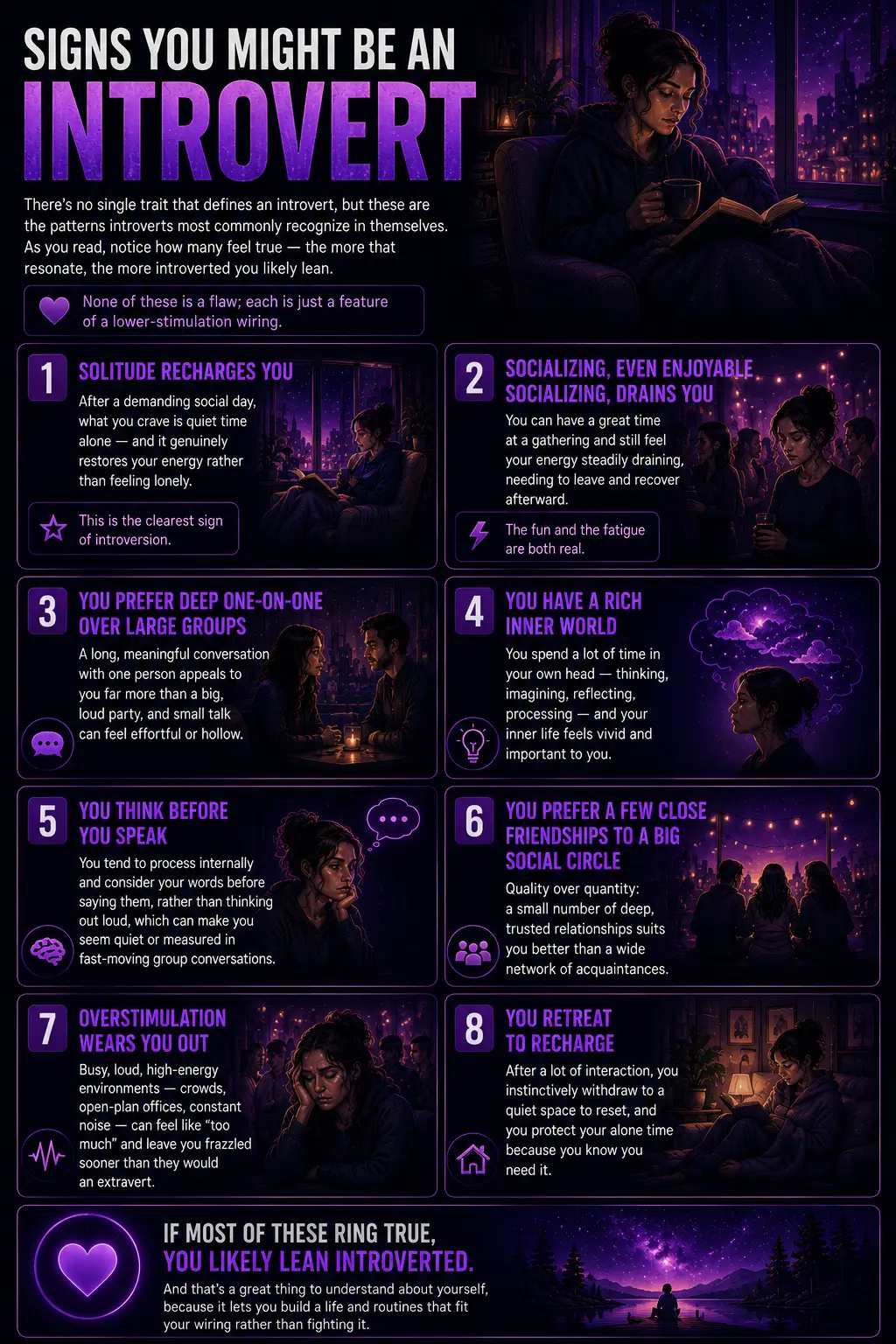
There’s no single trait that defines an introvert, but these are the patterns introverts most commonly recognize in themselves. As you read, notice how many feel true — the more that resonate, the more introverted you likely lean. None of these is a flaw; each is just a feature of a lower-stimulation wiring.
Solitude recharges you
After a demanding social day, what you crave is quiet time alone — and it genuinely restores your energy rather than feeling lonely. This is the clearest sign of introversion.
Socializing, even enjoyable socializing, drains you
You can have a great time at a gathering and still feel your energy steadily draining, needing to leave and recover afterward. The fun and the fatigue are both real.
You prefer deep one-on-one over large groups
A long, meaningful conversation with one person appeals to you far more than a big, loud party, and small talk can feel effortful or hollow.
You have a rich inner world
You spend a lot of time in your own head — thinking, imagining, reflecting, processing — and your inner life feels vivid and important to you.
You think before you speak
You tend to process internally and consider your words before saying them, rather than thinking out loud, which can make you seem quiet or measured in fast-moving group conversations.
You prefer a few close friendships to a big social circle
Quality over quantity: a small number of deep, trusted relationships suits you better than a wide network of acquaintances.
Overstimulation wears you out
Busy, loud, high-energy environments — crowds, open-plan offices, constant noise — can feel like “too much” and leave you frazzled sooner than they would an extravert.
You retreat to recharge
After a lot of interaction, you instinctively withdraw to a quiet space to reset, and you protect your alone time because you know you need it.
If most of these ring true, you likely lean introverted — and that’s a great thing to understand about yourself, because it lets you build a life and routines that fit your wiring rather than fighting it.
How This Introvert Test Works
This test has 15 statements about how you experience energy, socializing, and stimulation. For each, choose how much you agree, thinking about how you generally are rather than one specific day:
Strongly Disagree = 0 | Disagree = 1 | Neutral = 2 | Agree = 3 | Strongly Agree = 4
Your answers add up to a score from 0 to 60, placing you on the introvert–extrovert spectrum. A higher score means you lean more introverted; a lower score, more extraverted; and the middle range means you’re an ambivert who draws on both. Remember, there’s no “right” result here — every point on the spectrum has real strengths. Answer honestly and privately; no one sees your results but you.
Understanding Your Result
| Score | Where You Land | What It Means |
|---|---|---|
| 46 – 60 | Strong Introvert | You clearly lean introverted — solitude recharges you and lots of stimulation drains you. |
| 31 – 45 | Introvert-Leaning | You lean introverted, with some flexibility — you value solitude but can enjoy socializing too. |
| 16 – 30 | Ambivert | You’re near the middle, drawing energy from both socializing and solitude depending on context. |
| 0 – 15 | Extravert-Leaning | You lean extraverted — social interaction and activity tend to energize you. |
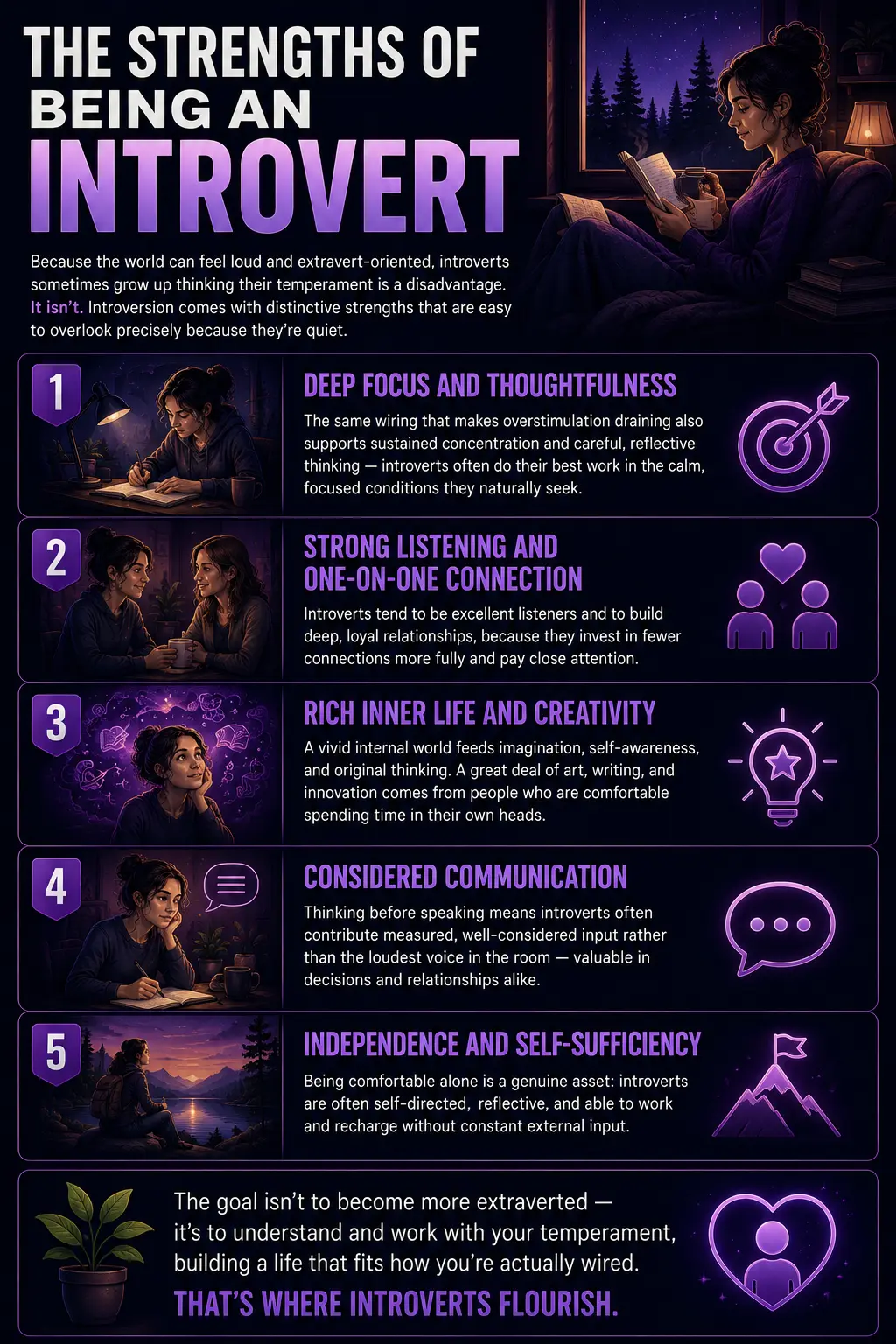
The Strengths of Being an Introvert
Because the world can feel loud and extravert-oriented, introverts sometimes grow up thinking their temperament is a disadvantage. It isn’t. Introversion comes with distinctive strengths that are easy to overlook precisely because they’re quiet.
Deep focus and thoughtfulness
The same wiring that makes overstimulation draining also supports sustained concentration and careful, reflective thinking — introverts often do their best work in the calm, focused conditions they naturally seek.
Strong listening and one-on-one connection
Introverts tend to be excellent listeners and to build deep, loyal relationships, because they invest in fewer connections more fully and pay close attention.
Rich inner life and creativity
A vivid internal world feeds imagination, self-awareness, and original thinking. A great deal of art, writing, and innovation comes from people who are comfortable spending time in their own heads.
Considered communication
Thinking before speaking means introverts often contribute measured, well-considered input rather than the loudest voice in the room — valuable in decisions and relationships alike.
Independence and self-sufficiency
Being comfortable alone is a genuine asset: introverts are often self-directed, reflective, and able to work and recharge without constant external input.
The goal isn’t to become more extraverted — it’s to understand and work with your temperament, building a life that fits how you’re actually wired. That’s where introverts flourish.
Frequently Asked Questions
What’s the difference between being an introvert and being shy?
They’re often confused but genuinely different. Introversion is about energy and stimulation: introverts find socializing draining and solitude restorative, but they aren’t necessarily afraid of social situations — an introvert can be confident and socially skilled and simply prefer quieter, less frequent interaction. Shyness, by contrast, is a fear of social judgment — feeling anxious, self-conscious, or nervous around people, especially new people. Shyness is about discomfort and fear; introversion is about preference and energy. Research has found that only about 40% of introverts are actually shy, which means the two often don’t overlap. You can be a shy extravert (craving connection but fearing it) or a confident introvert (socially at ease but needing to recharge alone) — and everything in between.
Can you be both an introvert and an extrovert?
In a sense, yes — that’s what an ambivert is. Introversion and extraversion are two ends of a single spectrum, and most people don’t sit at either extreme; they fall somewhere in the middle, drawing energy from both socializing and solitude depending on the situation. Ambiverts can enjoy a lively social event and then happily retreat to recharge, shifting between modes fairly fluidly. Some researchers estimate ambiverts make up around half the population, so if you didn’t feel like a “pure” introvert or extravert, that’s completely normal — you’re likely an ambivert, which is arguably the most flexible place on the spectrum to be.
Is introversion something I need to fix or change?
No, absolutely not. Introversion is a normal, healthy personality trait — one of the fundamental ways human personalities vary — not a flaw, a disorder, or a problem to overcome. The idea that introverts should try to become more extraverted comes from a cultural bias toward outgoing behavior, not from anything actually wrong with introversion.
Introverts have tremendous strengths, and the healthiest path is to understand and work with your temperament rather than against it: protecting your alone time, choosing environments that suit you, and socializing in the ways and amounts that feel right. You can certainly develop social skills and stretch your comfort zone when you want to — everyone benefits from that — but the goal is growth, not becoming a different kind of person.
Are introverts antisocial or do they dislike people?
No — this is one of the most persistent and unfair myths about introverts. Introversion has nothing to do with disliking people or being antisocial. Introverts can be warm, caring, funny, and socially skilled; they often have deep, meaningful relationships and genuinely enjoy connecting with others. The difference is simply that socializing costs them energy rather than generating it, so they need it in smaller, more manageable doses and require solitude to recharge afterward. Preferring a quiet night in or a small gathering over a big party isn’t a sign of disliking people — it’s a sign of a nervous system that gets its energy differently. Wanting alone time is about recharging, not rejecting others.
Do introverts and extroverts have different brains?
Research suggests there are real, measurable differences in how introverts’ and extraverts’ brains respond to stimulation. Introverts appear to have a higher baseline level of cortical arousal — meaning their brains are naturally more “switched on” and sensitive to external input — so additional stimulation from busy, social, or noisy environments can more easily tip into feeling overwhelming. Extraverts have a lower baseline, so they seek out stimulation to reach a comfortable level of arousal. There are also differences in sensitivity to dopamine, the neurotransmitter linked to reward-seeking, with extraverts tending to be more responsive to those external rewards. This is why the introvert–extravert difference isn’t just behavior or preference — it reflects genuine differences in how the nervous system is wired.
Can your introversion or extroversion change over time?
To some degree, yes. While your basic temperament tends to be fairly stable across life, personality isn’t completely fixed — people can shift somewhat along the introvert–extravert spectrum as they age, gain experience, or move through different life circumstances. Many people also learn to “act” more extraverted or introverted when a situation calls for it, even if their underlying preference stays the same (an introvert can be sociable and engaging at work, then go home to recharge). Some research suggests people can drift modestly in extraversion over the lifespan. So while you probably won’t transform from a strong introvert into a strong extravert, your position on the spectrum can flex, and you can absolutely develop skills across the whole range.
Further reading
Introversion is a personality trait, not a skill — and it says nothing about how emotionally intelligent someone is. EQ is a separate, learnable skill set, which the emotional intelligence test measures across five components.
Related Tests
- Social Anxiety Test — if social situations cause real fear or distress (different from introversion), this looks at that
- Personality Complex Test — a broader look at how you see yourself in relation to others
- Sensory Processing Sensitivity Test — high sensitivity is the trait most often confused with introversion; the two overlap but are measured separately
- Self-Esteem Test — how you feel about yourself, distinct from where you fall on the introversion spectrum
- Emotional Availability Test — how open and present you are in close relationships
- Attachment Style Test — your blueprint for closeness and connection in relationships
- Alexithymia Test — how easily you identify and describe your own emotions
References
- Jung, C.G. (1921). Psychological Types. [Origin of the introversion–extraversion concept] simplypsychology.org
- McCrae, R.R., & Costa, P.T. (1987). Validation of the five-factor model of personality. Journal of Personality and Social Psychology, 52(1), 81–90. [Extraversion as a Big Five dimension] pubmed.ncbi.nlm.nih.gov
- Eysenck, H.J. (1967). The Biological Basis of Personality. [Cortical arousal theory of introversion–extraversion] simplypsychology.org
- Cheek, J.M., & Buss, A.H. (1981). Shyness and sociability. Journal of Personality and Social Psychology, 41(2), 330–339. [Shyness and introversion are distinct] pubmed.ncbi.nlm.nih.gov
- Grant, A.M. (2013). Rethinking the extraverted sales ideal: The ambivert advantage. Psychological Science, 24(6), 1024–1030. [Ambiverts’ performance advantage] pubmed.ncbi.nlm.nih.gov
Related Tests
See All Quiz →

You may also like
See All Quiz →
Dissociation and Psychosis
Free Depersonalization Disorder Test (DPDR) – Do I Have Depersonalization-Derealization Disorder?
→