
Sadism Test: How Sadistic Are You?
A 15-item self-reflection scale measuring everyday (subclinical) sadism - the tendency to find reward in others' suffering across its vicarious, verbal and direct forms, and the fourth trait of the Dark Tetrad. This measures a personality trait, not sexual sadism, and is not a diagnosis.
Published Updated
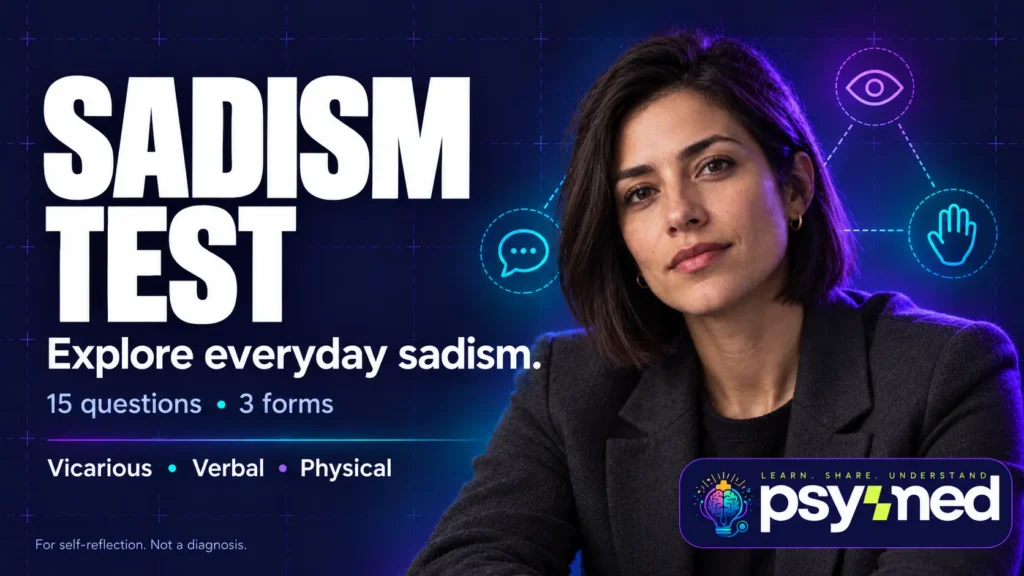
This free Sadism Test measures “everyday sadism” — the tendency to take pleasure in others’ discomfort, suffering, or humiliation, studied as an ordinary personality trait rather than a crime or a clinical disorder. In 15 questions, it gives you a private, instant read on where your sadistic tendencies fall, from very low to high, across the forms sadism actually takes in everyday life.
Two honest notes before you begin. First, this test is about subclinical, everyday sadism as a personality trait — it is not about sexual sadism, which is a separate clinical matter, and it can’t diagnose anything. Second, sadistic tendencies exist on a spectrum that lots of ordinary people sit somewhere on — enjoying a brutal action movie is a mild, common form — so a higher score doesn’t make you a monster. It’s simply self-awareness about a real and well-studied part of human personality.
What Is Everyday Sadism?
Everyday sadism is the tendency of otherwise normal people to derive enjoyment, satisfaction, or a sense of power from others’ pain, fear, or humiliation. Unlike the extreme, criminal, or sexual sadism that dominates headlines, “everyday” or subclinical sadism describes a trait found in the general population, in varying degrees, among people who function perfectly normally in daily life. It was brought into mainstream personality research by Erin Buckels, Daniel Jones, and Delroy Paulhus, whose influential 2013 study in Psychological Science demonstrated it in ordinary volunteers.
In that research — now widely known as the “bug-crunching” study — participants who scored higher on sadism were more likely to choose to harm bugs when given the option, and in a follow-up, to blast an innocent opponent with loud noise even when that person had never provoked them. Strikingly, the researchers found that sadists reported lower baseline positive emotion overall, suggesting that cruelty may be a way of generating feeling for people who otherwise feel little. This is what makes everyday sadism distinct from the other dark traits: the suffering of others isn’t just a means to an end, it’s the reward itself.
The Three Types of Everyday Sadism
Researchers have found that everyday sadism shows up in three main forms, measured by instruments like the Comprehensive Assessment of Sadistic Tendencies (CAST). Most people who have sadistic tendencies lean toward one or two of these rather than all three.
- Vicarious sadism — enjoying cruelty, violence, or suffering at a distance, through movies, video games, news, sports, or online content. This is by far the most common and most socially acceptable form; enjoying a violent film is a mild example.
- Verbal sadism — taking pleasure in mocking, humiliating, belittling, or cutting others down with words, and enjoying the discomfort it causes.
- Physical (direct) sadism — deriving enjoyment from directly causing physical pain or harm to others. This is the rarest and most serious form.
Signs of a Sadistic Personality
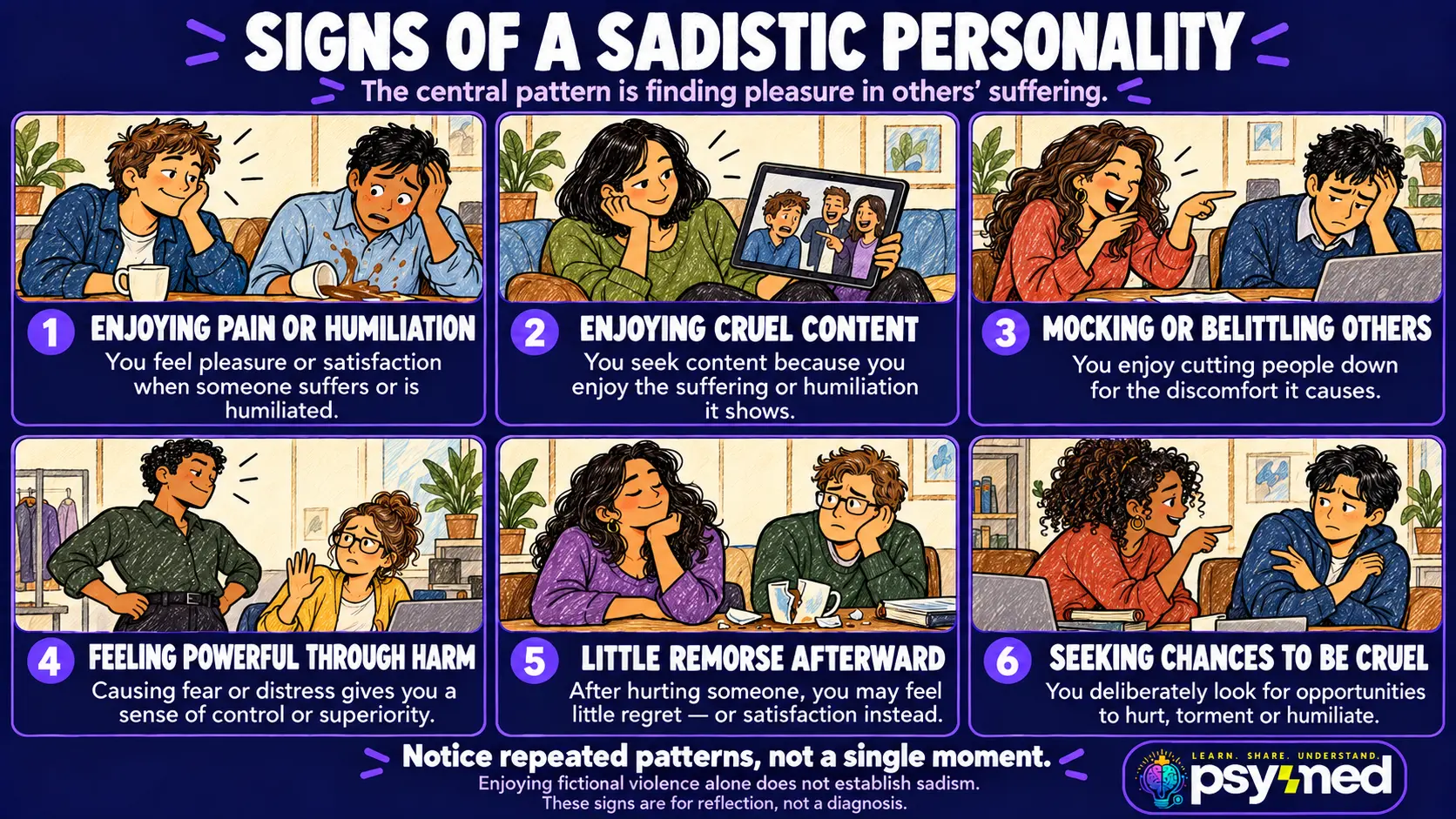
Everyday sadism shows up as a recognizable cluster of signs, all centered on finding reward in others’ suffering. You don’t need all of them, and the milder, more common ones (like enjoying violent entertainment) carry far less weight than the direct ones. Read these as the “signs you have it.”
You find others’ pain or humiliation enjoyable
The core sign of sadism is experiencing genuine pleasure, satisfaction, or excitement — rather than discomfort — when someone else suffers, fails, or is humiliated. Where most people flinch, you feel a flicker of enjoyment.
You’re drawn to violent or cruel content
A pull toward media that depicts real suffering, brutality, humiliation, or cruelty — and genuinely enjoying it rather than finding it disturbing — is the vicarious form of sadism. On its own and in moderation this is very common; it becomes more telling in combination with the other signs.
You enjoy mocking, belittling, or dominating people
Taking pleasure in cutting others down, making them squirm, or asserting power over them — especially when they haven’t wronged you — reflects verbal and interpersonal sadism. The enjoyment comes from their discomfort, not from any goal it serves.
You feel powerful when you cause pain or fear
Sadism is often tied to a sense of power and control. If causing someone pain, fear, or distress gives you a feeling of strength or superiority, that link between others’ suffering and your own sense of power is a central marker.
You feel little remorse — or even satisfaction — afterward
Unlike people who feel guilt after hurting someone, those high in sadism tend to feel little remorse, and sometimes satisfaction instead. The absence of the usual emotional brake is part of what defines the trait.
You seek out cruelty rather than just stumbling into it
Perhaps the most significant sign is being willing to go out of your way for the chance to hurt or torment — seeking out situations where you can dominate others, as the research found sadists would even endure boredom for the opportunity. This intentional pursuit separates sadism from a momentary cruel impulse.
Everyday Sadism vs Sexual Sadism
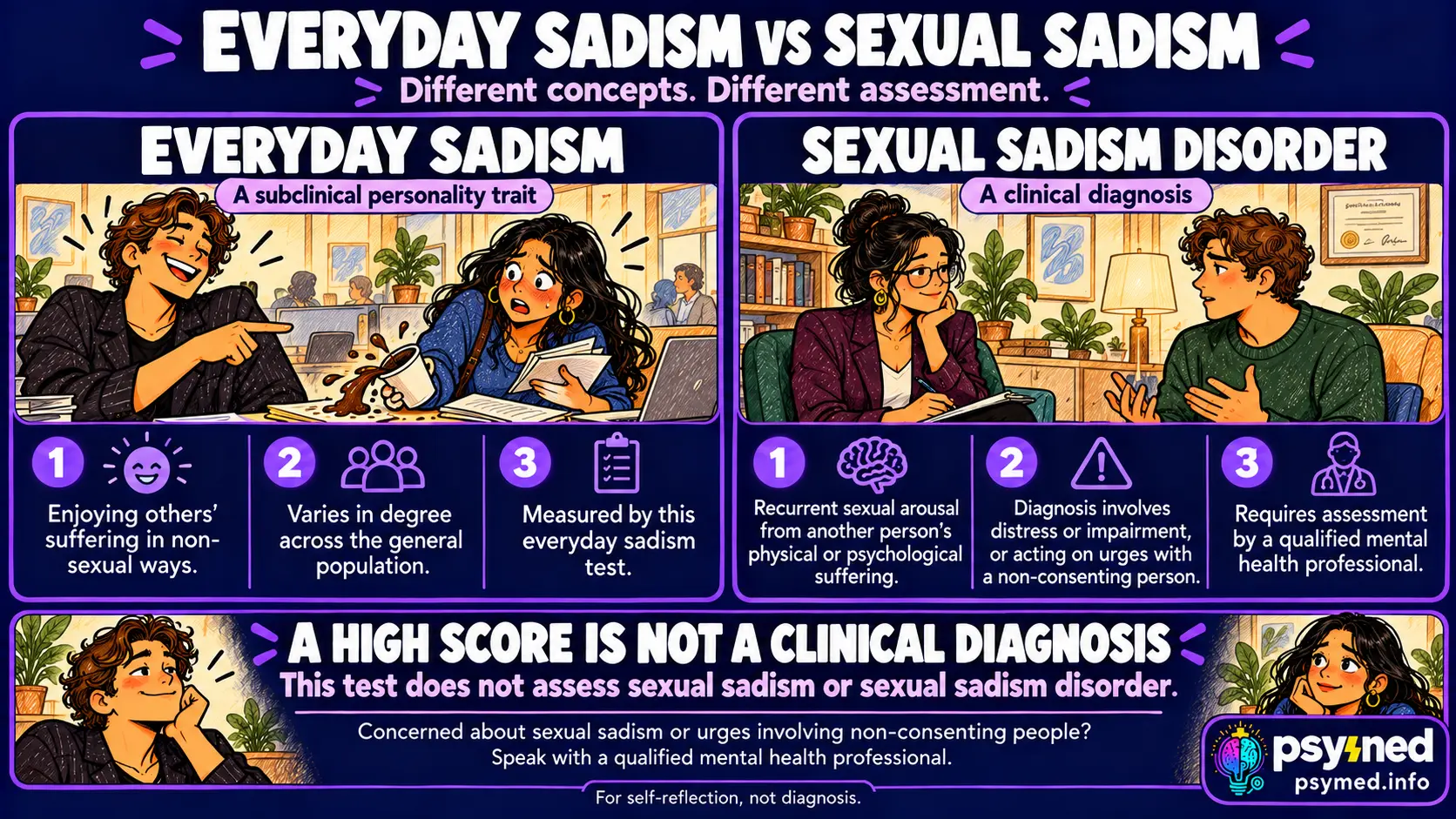
It’s important not to confuse the two, because they’re genuinely different things. Everyday (subclinical) sadism, which this test measures, is a normal-range personality trait: the tendency to enjoy others’ suffering in non-sexual ways, found across the general population in varying degrees. Sexual sadism disorder is something else entirely — a clinical diagnosis in the DSM-5 (the main psychiatric manual), involving recurrent sexual arousal from the physical or psychological suffering of another person, that causes significant distress or impairment or involves non-consenting people.
This test does not assess sexual sadism and should not be used for that purpose; a high score here reflects an everyday personality trait, not a paraphilic disorder. If concerns about sexual sadism or urges toward non-consensual behavior are relevant to you, that warrants a conversation with a qualified mental health professional.
Sadism and the Dark Tetrad
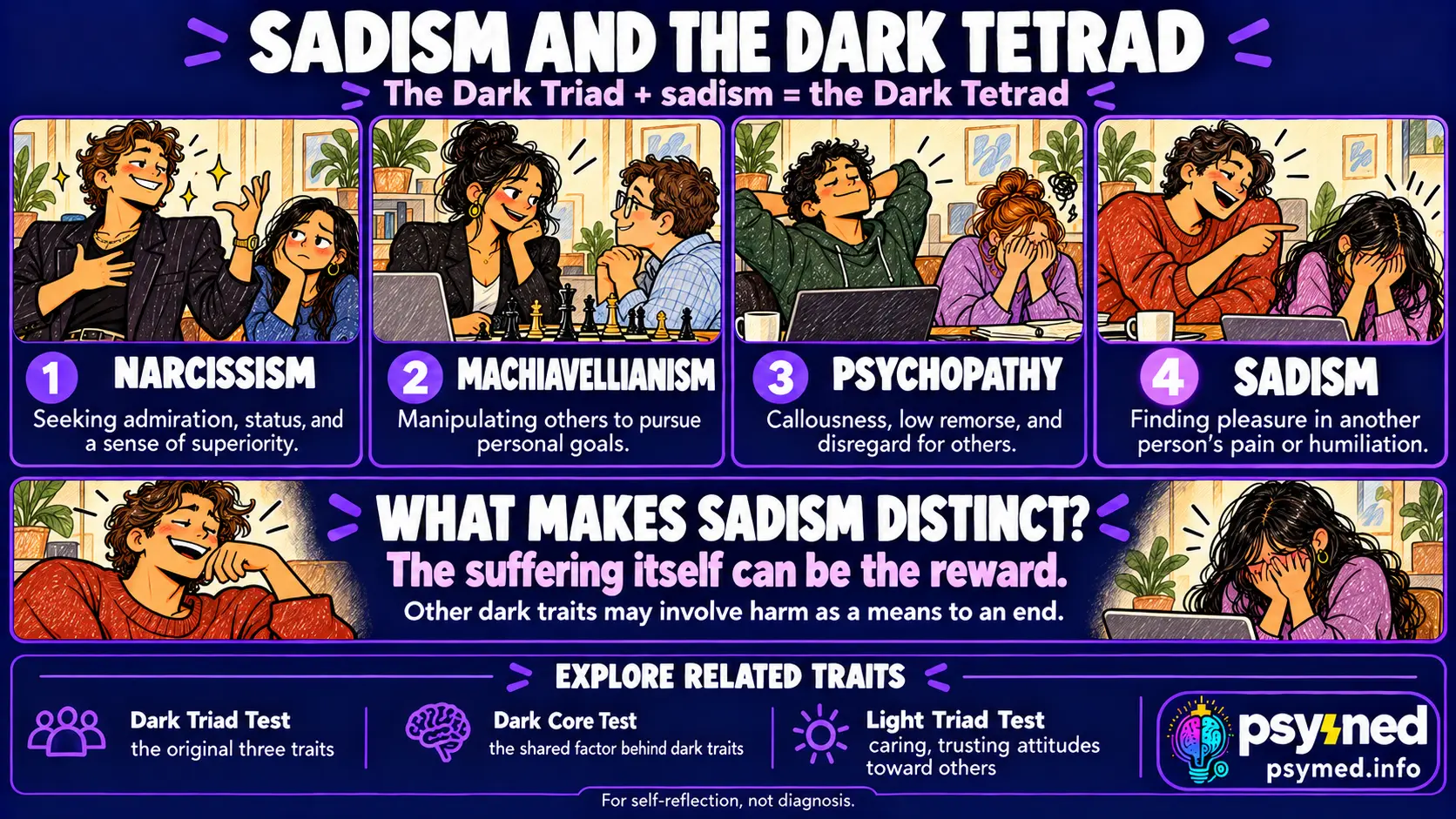
Sadism is best understood as the “fourth” dark trait. For years, researchers studied the “Dark Triad” — narcissism, Machiavellianism, and psychopathy — as the core malevolent personality traits. But Buckels and colleagues showed that sadism predicts aggressive, harmful behavior over and above those three, which led to the proposal of the Dark Tetrad: the Dark Triad plus sadism. What makes sadism a distinct addition is its signature feature — while the other dark traits involve harming others in pursuit of some goal (status, gain, dominance), sadism involves harming others because the harm itself is enjoyable.
If you want to understand how sadism fits with the other dark traits, our Dark Triad Test measures the original three, and our Dark Core (D-Factor) Test measures the single common factor — including sadism — that underlies all dark traits. For the opposite end of the spectrum, the Light Triad Test measures the prosocial, benevolent side of personality.
How This Sadism Test Works
This test contains 15 statements covering the three forms of everyday sadism — vicarious, verbal, and physical/direct — along with the core experience of finding reward in others’ suffering. For each, choose how much you agree, thinking about how you generally are:
- Strongly Disagree = 0
- Disagree = 1
- Neutral = 2
- Agree = 3
- Strongly Agree = 4
Your answers add up to a single sadism score from 0 to 60, placing you in one of four ranges from very low to high. Answer honestly — this takes a willingness to look at an uncomfortable part of your personality, and your results are completely private. There are no right answers.
Understanding Your Sadism Test Results
Your score places you in one of four ranges. Read it as a dimensional snapshot, not a label or a diagnosis — and remember that the milder, vicarious forms of sadism are common and carry much less weight than the direct ones.
| Score | Level | What It Suggests |
|---|---|---|
| 0 – 15 | Very Low | You find others’ suffering genuinely unpleasant — a strongly empathic, non-sadistic profile. |
| 16 – 30 | Low–Moderate | Some common, mostly mild tendencies — such as enjoying violent media or occasional schadenfreude. |
| 31 – 45 | Elevated | Notable sadistic tendencies that may extend beyond the vicarious into how you treat people. |
| 46 – 60 | High | Strong sadistic tendencies — a consistent pattern of finding reward in others’ suffering. |
Methodology & Sources
This test is based on the research concept of everyday (subclinical) sadism established by Erin Buckels, Daniel Jones, and Delroy Paulhus. Its 15 items are original statements written to reflect the three recognized forms of sadism — vicarious, verbal, and physical/direct — and the core experience of finding reward in others’ suffering, as captured by validated measures such as the Short Sadistic Impulse Scale (SSIS) and the Comprehensive Assessment of Sadistic Tendencies (CAST). It is an educational self-reflection tool, not a reproduction of those scales, and not a diagnostic instrument. It assesses an everyday personality trait and does not diagnose sexual sadism disorder or any other condition.
References
- Buckels, E.E., Jones, D.N., & Paulhus, D.L. (2013). Behavioral confirmation of everyday sadism. Psychological Science, 24(11), 2201–2209. doi.org/10.1177/0956797613490749
- Paulhus, D.L. (2014). Toward a taxonomy of dark personalities. Current Directions in Psychological Science, 23(6), 421–426. doi.org/10.1177/0963721414547737 [The Dark Tetrad]
- Buckels, E.E., & Paulhus, D.L. (2014). Comprehensive Assessment of Sadistic Tendencies (CAST). Unpublished measure, University of British Columbia. [Measures physical, verbal, and vicarious sadism]
Frequently Asked Questions
What is everyday sadism?
Everyday sadism is a personality trait describing the tendency of ordinary people to take pleasure in others’ suffering, humiliation, or discomfort — in non-sexual, everyday ways. It exists on a spectrum in the general population, from mild forms (like enjoying violent entertainment) to more serious ones (like deliberately tormenting others). It was established in mainstream research by Erin Buckels, Daniel Jones, and Delroy Paulhus, whose 2013 studies showed that people higher in sadism would choose to hurt innocent targets even without provocation. What distinguishes sadism from other dark traits is that the suffering itself is the reward, not a means to some other goal.
Is enjoying violent movies a sign of sadism?
Mildly, and very commonly — but on its own it means little. Enjoying violent or intense media is called “vicarious sadism,” the most common and most socially acceptable form, and vast numbers of people who are not meaningfully sadistic enjoy action films, true crime, or combat sports. It becomes more telling only in combination with the other signs, particularly taking pleasure in the real suffering of actual people around you. So enjoying a brutal movie by itself is not something to worry about; it’s the pattern across the different forms of sadism that matters.
What is the difference between sadism and sexual sadism?
They are different things. The everyday sadism this test measures is a non-sexual personality trait — enjoying others’ suffering in general, found across the normal population. Sexual sadism disorder is a separate clinical diagnosis in the DSM-5, involving recurrent sexual arousal from another person’s physical or psychological suffering that causes significant distress or impairment, or that involves non-consenting people. A high score on this test reflects an everyday personality trait, not a sexual disorder. If concerns about sexual sadism or non-consensual urges apply to you, that’s important to discuss with a qualified mental health professional.
Can a sadistic personality change?
Personality traits are relatively stable but not fixed, and the behaviors that express sadism are choices that can change. Because everyday sadism is often linked to a low baseline of positive emotion — with cruelty serving as a way to feel something — therapy that addresses the underlying emotional life can make a real difference, as can building healthier sources of stimulation, connection, and meaning. Change is harder the more entrenched the pattern, and it usually requires genuine motivation, but it is possible. Recognizing the tendency honestly, as this test invites, is the necessary first step.
Related Tests
- Dark Triad Test — narcissism, Machiavellianism, and psychopathy (sadism makes it the Dark Tetrad)
- Dark Core (D-Factor) Test — the single factor behind all dark traits, including sadism
- Psychopath Test — callousness and lack of remorse, the dark trait closest to sadism
- Dark Empath Test — dark traits combined with empathy
- Light Triad Test — the compassionate, prosocial opposite
This test measures an everyday personality trait for educational purposes and is not a diagnosis. If you are experiencing urges to harm other people or animals, or thoughts of violence, please reach out to a mental health professional. In the US, you can call or text 988 (Suicide & Crisis Lifeline), available 24/7 for any crisis, including thoughts of harming yourself or others. Outside the US, find international helplines at findahelpline.com.
Related Tests
See All Quiz →

You may also like
See All Quiz →