
Free Kinsey Scale Test — Where Do You Fall on the Sexual Spectrum?
Take this free Kinsey Scale Test to find where you fall on the sexual spectrum — from exclusively heterosexual to homosexual & everything in between
Published Updated
In 1948, Alfred Kinsey published a finding that shook the field of human sexuality: most people are not exclusively straight or exclusively gay. They exist somewhere in between — and that “somewhere in between” is far more populated than anyone had publicly acknowledged.
His solution was a seven-point heterosexual-homosexual rating scale. Not a box. Not a binary. A spectrum running from 0 to 6, with a separate category for people who experience little or no sexual attraction at all. It was imperfect, controversial, and decades ahead of its time — and it remains the most widely referenced framework for thinking about sexual orientation in the world.
This free Kinsey Scale Test is designed to help you explore where your patterns of attraction place you on that spectrum. It covers attraction, fantasy, emotional connection, and behavior — the same dimensions Kinsey’s original research into human sexual behavior examined. Results are instant and completely private.
One thing to know before you start: as the Kinsey Institute has clarified, there is no official Kinsey test. Kinsey’s team assigned numbers through in-depth interviews about an individual’s full sexual history — not a quiz. What you’ll find here is an adaptation that draws on the scale’s framework. It’s a self-reflection tool, not a clinical instrument.
What Is the Kinsey Scale?
The Kinsey Scale was introduced in Alfred Kinsey’s landmark 1948 publication Sexual Behavior in the Human Male, and expanded in the 1953 follow-up on female sexuality. Kinsey was a biologist at Indiana University who, alongside colleagues including Wardell Pomeroy, had spent years interviewing thousands of men and women about their sexual histories — a project almost unheard of in its scope and frankness at the time.
What he and Pomeroy found consistently contradicted the prevailing assumption that people were simply heterosexual or homosexual. The data on human sexual behavior showed a continuous distribution of attraction across men and women, with many people clustering in the middle ranges of the heterosexual-homosexual rating scale rather than at the extremes.
The scale runs from 0 to 6, with an additional category Kinsey labeled X:
| Rating | Description |
|---|---|
| 0 | Exclusively heterosexual — attraction, fantasy, and behavior directed exclusively toward the opposite sex |
| 1 | Predominantly heterosexual, only incidentally homosexual — occasional same-sex attraction, overwhelmingly heterosexual overall |
| 2 | Predominantly heterosexual, more than incidentally homosexual — meaningful same-sex attraction alongside a primary heterosexual orientation |
| 3 | Equally heterosexual and homosexual — comparable attraction to both sexes; the bisexual midpoint |
| 4 | Predominantly homosexual, more than incidentally heterosexual — meaningful opposite-sex attraction alongside a primary homosexual orientation |
| 5 | Predominantly homosexual, only incidentally heterosexual — occasional opposite-sex attraction, overwhelmingly homosexual overall |
| 6 | Exclusively homosexual — attraction, fantasy, and behavior directed exclusively toward the same sex |
| X | No socio-sexual contacts or reactions — little to no sexual attraction to either sex; corresponds to the modern asexual spectrum |
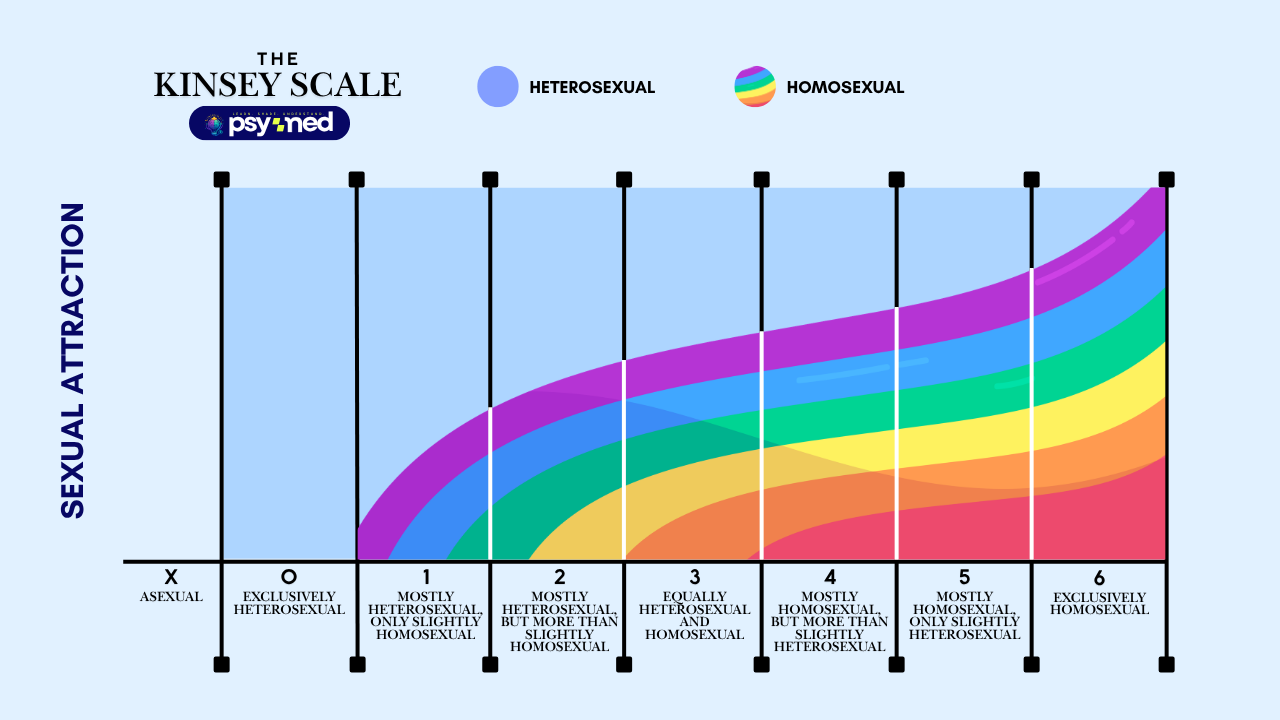
Importantly, the Kinsey Scale only measures sexual attraction — it doesn’t account for gender identity, romantic orientation, or identities such as asexuality. If gender identity is the piece you want to explore, the Am I Trans? Quiz covers that axis directly. If you want a broader picture that covers all of these dimensions together, our LGBTQ+ Test goes beyond attraction alone and addresses the full spectrum of orientation and gender experience.
What Kinsey Actually Measured — And Why It Still Matters
Kinsey’s research team didn’t just ask people whether they were gay or straight. They conducted detailed interviews covering sexual contacts, attraction, fantasy, and the balance of same-sex versus opposite-sex experience across a person’s full history. The number assigned reflected the totality of that history — not any single data point.
Kinsey was explicit that the numbers were not fixed identity labels. People could occupy different points on the scale at different times in their lives. The scale described a pattern of experience up to a given point in time, not a permanent classification.
His findings were disruptive precisely because of what the data actually showed. In his sample of white American males, 37% reported at least one same-sex experience to orgasm between adolescence and old age, and 10% were more or less exclusively homosexual for at least three years. These numbers demolished the public assumption that same-sex attraction was rare — and helped lay the groundwork for decades of LGBTQ+ advocacy that followed.
His methodology had real limitations: samples were not representative of the general population, he relied heavily on prison populations and volunteers, and many racial and socioeconomic groups were excluded. These criticisms are legitimate. But the core insight — that sexual orientation is continuous rather than categorical — has held up consistently across subsequent research.
What the Kinsey Scale Doesn’t Capture
Understanding the scale’s limitations matters as much as understanding what it measures.
It doesn’t separate sexual from romantic attraction. Some people are sexually attracted to one gender and romantically attracted to another. Others experience romantic attraction without much sexual attraction. The Kinsey Scale collapses these into a single number, which misses that distinction entirely. This is part of why the modern split attraction model exists.
It was built on a male/female binary. The original scale has no framework for attraction to non-binary or genderqueer people, or for people whose own gender is non-binary. A pansexual person — attracted to people regardless of gender — doesn’t map cleanly onto any point.
It treats behavior and attraction as equivalent. Someone may have exclusively heterosexual behavior due to social circumstances while experiencing predominantly same-sex attraction. Kinsey’s team tried to account for this through interviews; a self-report quiz cannot fully replicate that.
It’s a snapshot, not a permanent state. Sexual orientation is stable across a lifetime for many people — and genuinely fluid for others. The result you get today reflects where you are now, not a fixed classification going forward.
It doesn’t capture asexuality well. The X category is a rough approximation of what is now understood as a rich spectrum of asexual identities. If asexuality resonates with you, our Asexuality Spectrum Test explores this in far more depth.
How This Kinsey Scale Test Works
This test covers the core dimensions Kinsey’s research assessed: patterns of attraction, fantasy, emotional connection, and experience. Answer based on your genuine patterns over time — not a single situation, not how you think you should feel, but how you actually are.
There are no right or wrong answers. The test isn’t sorting you into a category — it’s reflecting back what you’ve told it about your experience.
Understanding Your Result
Kinsey 0 — Exclusively Heterosexual
Your responses point to attraction and experience directed exclusively toward the opposite sex. This is the most commonly reported position on the scale, though Kinsey’s data showed that even many people who identify as exclusively heterosexual have experienced at least some degree of same-sex attraction or curiosity at some point in their lives.
Kinsey 1 — Predominantly Heterosexual, Only Incidentally Homosexual
Your responses suggest a predominantly heterosexual orientation with occasional, incidental same-sex attraction. This is one of the most common positions on the scale — and one of the most quietly held, because it doesn’t fit neatly into either heterosexual or bisexual identity as most people define them. Many people here simply identify as straight.
Kinsey 2 — Predominantly Heterosexual, More Than Incidentally Homosexual
Your responses suggest a primary heterosexual orientation alongside meaningful same-sex attraction that goes beyond occasional. Sometimes described as “mostly straight,” this position doesn’t map cleanly onto any single modern identity label. Some people here identify as bisexual; others as straight; others prefer no label at all.
Kinsey 3 — Equally Heterosexual and Homosexual
Your responses suggest roughly equivalent attraction to both sexes — the bisexual midpoint on the scale. Worth noting: bisexuality doesn’t require precisely equal attraction to be valid. Most bisexual people experience varying degrees of attraction to different genders at different times. Our Bisexual Quiz explores this identity in more depth if it resonates.
Kinsey 4 — Predominantly Homosexual, More Than Incidentally Heterosexual
Your responses suggest a primary same-sex orientation alongside meaningful opposite-sex attraction. This is the mirror of position 2 — a “mostly gay” or “mostly lesbian” position that doesn’t fit neatly into either gay/lesbian or bisexual identity as commonly understood. Some people here identify as gay or lesbian; others as bisexual; others prefer queer as a broader, less prescriptive term.
Kinsey 5 — Predominantly Homosexual, Only Incidentally Heterosexual
Your responses suggest a predominantly same-sex orientation with only occasional, incidental opposite-sex attraction. Many people in this position identify as gay or lesbian. The incidental opposite-sex attraction is real but not a defining feature of how they experience or understand their orientation.
Kinsey 6 — Exclusively Homosexual
Your responses indicate attraction and experience directed exclusively toward the same sex. Many people here identify as gay or lesbian. Our Gay Test and Lesbian Test explore same-sex orientation in more depth if they feel relevant to your experience.
Kinsey X — Asexual / No Strong Sexual Attraction
Your responses suggest little or no sexual attraction to either sex — corresponding to the asexual spectrum. Asexuality is a valid sexual orientation, not an absence of one. It exists on its own continuum from fully asexual to graysexual and demisexual. The Asexuality Spectrum Test is the best next step from here.
The Kinsey Scale and Modern Sexual Identity
One of the most important things to understand about the Kinsey Scale is what it was never designed to do: tell you what to call yourself.
Kinsey explicitly resisted using his scale as an identity framework. He was interested in behavior and attraction as phenomena, not in the social categories people organized themselves into. The numbers were descriptive, not prescriptive. A 2 is not a type of person — it’s a point on a continuum describing a pattern of experience.
Modern sexual identity — gay, lesbian, bisexual, queer, pansexual, asexual, and many others — carries social, cultural, and sometimes political meaning that the Kinsey Scale doesn’t attempt to address. Many people find that their Kinsey number aligns with an identity they already use. Others find no label fits their number. Both are completely normal.
If your result feels accurate, that’s useful. If it doesn’t — if your experience is more fluid, more complex, or structured differently than any single point on a 0–6 scale can capture — that’s also useful information. The scale is a starting point, not a final answer.
Frequently Asked Questions
Is there an official Kinsey Scale test?
No. The Kinsey Institute has been explicit about this: there is no official Kinsey Test. Kinsey’s original team assigned numbers through in-depth interviews covering a person’s complete sexual history — a process that can’t be replicated in a quiz. Every Kinsey Scale test available online is an adaptation drawing on the scale’s framework. They can be useful for self-reflection; they are not the same as Kinsey’s original methodology.
Can your Kinsey number change over time?
Yes — and Kinsey himself expected this. He never described the scale as measuring a fixed trait. For many people, sexual orientation is stable across a lifetime. For others, Dr. Lisa Diamond’s longitudinal research on sexual fluidity — particularly in women — has shown that attraction patterns can shift meaningfully over time. Getting a different result at different points in your life isn’t confusion. It may simply be how your sexuality moves.
What does Kinsey 3 actually mean?
It represents equal heterosexual and homosexual attraction — the exact midpoint of the scale. In modern identity terms, it maps most closely to bisexuality, though bisexuality doesn’t require precisely equal attraction. Many bisexual people experience different ratios of same-sex and opposite-sex attraction at different times and still identify as bisexual. Kinsey 3 is notable partly because his data suggested it was actually less common than positions 1, 2, 4, or 5 — most people cluster toward either end of the scale rather than at the exact middle.
What’s the difference between the Kinsey Scale and pansexuality?
The Kinsey Scale measures the ratio of same-sex to opposite-sex attraction — it operates on a male/female binary. Pansexuality describes attraction to people regardless of gender, including non-binary and genderqueer people, which falls outside what the binary Kinsey framework can represent. A pansexual person might score anywhere from 1 to 6 on this test, depending on how they answer questions framed around male/female attraction — but that score doesn’t capture the nature of their attraction accurately.
I identify as straight, but got a Kinsey 1 or 2. Does that mean I’m bisexual?
Not necessarily. A Kinsey 1 or 2 doesn’t require you to change how you identify. Identity is about how you understand and present yourself, not about meeting a numerical threshold. Kinsey’s data showed that many people who live entirely heterosexual lives and identify as straight have experienced some degree of same-sex attraction or curiosity. How you label yourself is your decision, and that decision doesn’t have to track precisely against any scale.
How does asexuality fit on the Kinsey Scale?
Imperfectly. The X category was intended for people with no socio-sexual contacts or reactions, which overlaps with asexuality but isn’t quite the same thing. The Kinsey Scale was designed around the same-sex versus opposite-sex dimension of attraction, which is orthogonal to the question of whether sexual attraction exists at all. If you think you might be asexual, the Asexuality Spectrum Test is a better tool for exploring that than this one.
Explore More
Sexual orientation is broader than any single scale can capture. For a deeper look at specific aspects of your identity, explore our full Sexual Orientation & Gender Identity test collection — including tests covering bisexuality, asexuality, lesbian and gay identity, pansexuality, gender dysphoria, and coming out readiness.
References
- Kinsey, A. C., Pomeroy, W. B., & Martin, C. E. (1948). Sexual Behavior in the Human Male. Philadelphia: W.B. Saunders.
- Kinsey, A. C., Pomeroy, W. B., Martin, C. E., & Gebhard, P. H. (1953). Sexual Behavior in the Human Female. Philadelphia: W.B. Saunders.
- The Kinsey Institute, Indiana University. The Kinsey Scale. kinseyinstitute.org
- Diamond, L. M. (2008). Sexual Fluidity: Understanding Women’s Love and Desire. Cambridge, MA: Harvard University Press.
Further reading
The Kinsey scale describes who you are drawn to, not how you prefer relationships to be structured. The polyamory quiz looks at that second question.
Related Tests
See All Quiz →
Sexual Orientation & Gender Identity
What Type of Lesbian Am I Quiz – Discover Your Lesbian Identity
→

You may also like
See All Quiz →