
Sexual Orientation & Gender Identity
Free Asexuality Spectrum Test — Where Do You Fall?
Most people assume that sexual attraction is universal — that everyone experiences it, in roughly the same way, toward some gender or another. That assumption is so deeply embedded in mainstream culture that people who don’t share it often spend years wondering what is wrong with them, before discovering that nothing is wrong at all. They’re simply on a different part of the spectrum.
The asexual spectrum — often called the ace spectrum — describes people who experience little or no sexual attraction to others. This is not celibacy, which is a behavioral choice. It is not low libido, which is a medical condition. It is not fear of intimacy, which is a psychological pattern. Asexuality is a sexual orientation: a consistent, enduring way of experiencing (or not experiencing) sexual attraction that is as valid and as varied as any other.
This free Asexuality Spectrum Test explores your experience of sexual attraction across the ace spectrum — from fully asexual to demisexual to graysexual and beyond. 15 questions. Honest answers only. Instant, private results.
What Is Asexuality? The Research-Based Definition
Asexuality is most commonly defined as experiencing little or no sexual attraction to others, regardless of sex or gender (Bogaert, 2015; Copulsky & Hammack, 2023). This definition has evolved from earlier, more limiting formulations to acknowledge a broader asexual umbrella that includes people who experience low levels of sexual attraction, or only experience sexual attraction in specific contexts (Copulsky & Hammack, 2023).
The most influential early research on asexuality prevalence was conducted by Dr. Anthony Bogaert (2004) at Brock University, who analyzed data from a national probability sample of over 18,000 British residents. In that study, approximately 1% of the sample indicated they were asexual — defined as having no sexual attraction to a partner of either sex (Bogaert, 2004, Journal of Sex Research, 41(3), 279–287). Conservative estimates based on subsequent studies have consistently placed asexuality prevalence at around 1% of the general population (Bogaert, 2004; Rothblum et al., 2020; Antonsen et al., 2020).
These estimates likely represent a floor rather than a ceiling: research consistently finds that asexual individuals are often reluctant to disclose their orientation, that many are unaware the term applies to them, and that prevalence varies across populations, age cohorts, and measurement methods (Carroll, 2024).
The Asexuality Visibility and Education Network (AVEN), founded in 2001, defines asexuality as a sexual orientation in which a person does not experience sexual attraction. AVEN has been the primary community-building, education, and research resource for the ace community globally, and its annual community censuses have produced the most detailed demographic data available on ace-spectrum identification.
Critical distinction: asexuality is not the same as celibacy, low libido, or sexual dysfunction. Celibacy is a behavioral choice, often motivated by religious or personal beliefs, made by people who may experience sexual attraction. Low libido (hypoactive sexual desire disorder) is a clinical condition characterized by distress about reduced desire. Asexuality is an orientation — the absence of sexual attraction — and is not inherently distressing. The DSM-5-TR specifically excludes asexuality as a diagnosis: a lack of sexual attraction is only diagnosable as a disorder if it causes significant personal distress, which is not part of the asexual experience for many people.
Signs You Might Be on the Asexual Spectrum
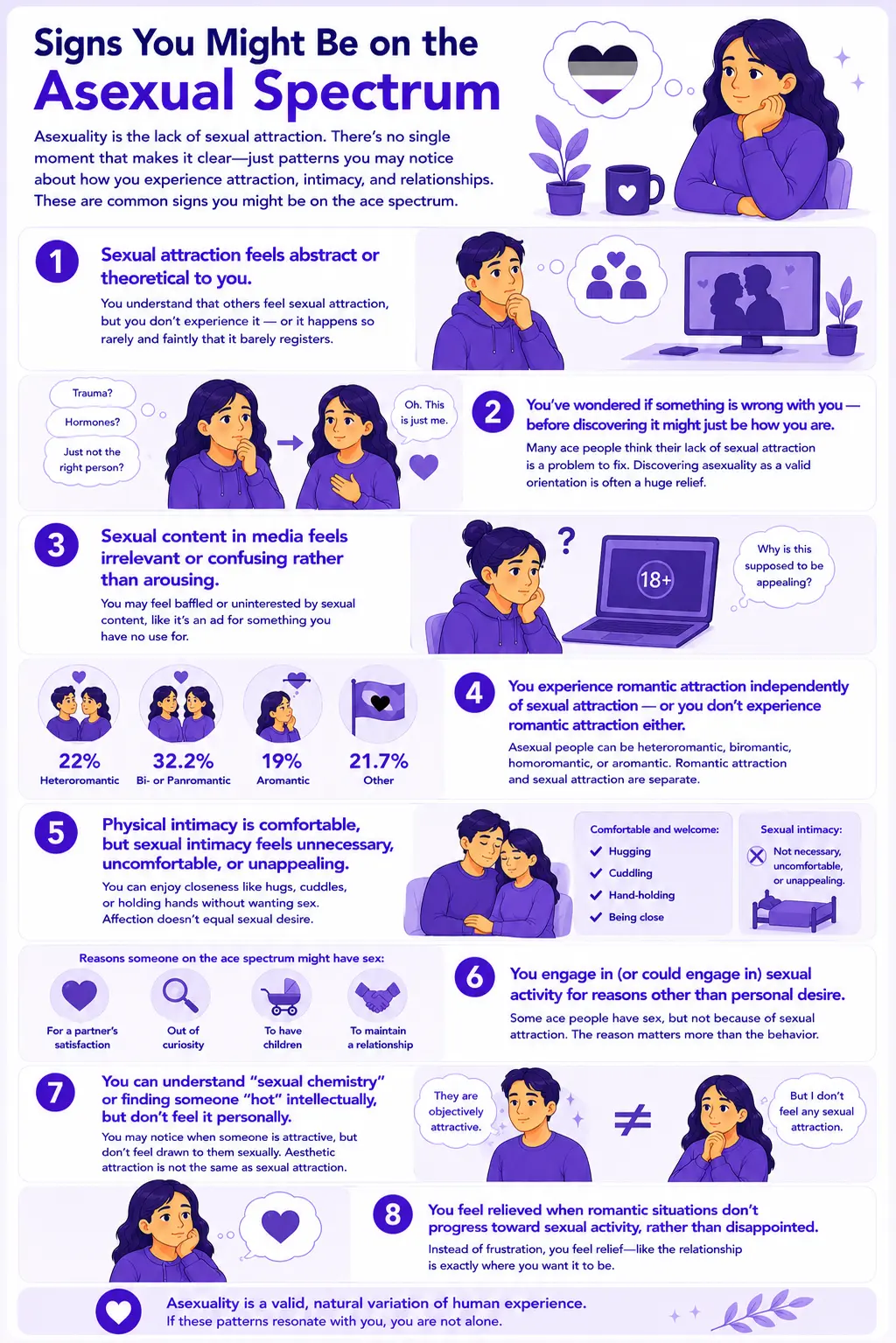
Because asexuality is defined by the absence of something that most people assume is universal, it is often invisible to the person experiencing it — there is no dramatic event, no moment of crisis, just a quiet persistent sense that something most people describe as a major part of their lives simply doesn’t register in the same way for you. These are the patterns that most consistently indicate someone may be on the ace spectrum:
Sexual attraction feels abstract or theoretical to you. You understand that people find others sexually attractive — you can observe it, read about it, follow it in film and television — but the experience of looking at someone and feeling sexual desire doesn’t happen for you, or happens so rarely and faintly that it barely registers. It feels like being told about a color you’ve never seen. You understand the concept. You just don’t have the experience.
You’ve wondered if something is wrong with you — before discovering it might just be how you are. Most people on the ace spectrum spend some time assuming that their absence of sexual attraction is a problem to be fixed — a result of trauma, hormones, introversion, or simply not having met the right person yet. Many spend years waiting for sexual attraction to “kick in,” which never does. The discovery that asexuality is a recognized, named orientation is frequently described as a moment of significant relief.
Sexual content in media feels irrelevant or confusing rather than arousing. Where other people respond to sexual content with desire, you may find yourself baffled, uninterested, or genuinely unclear about why this is supposed to be appealing. This is distinct from finding sexual content offensive or distressing — it’s more like watching an advertisement for a product you have no use for.
You experience romantic attraction independently of sexual attraction — or you don’t experience romantic attraction either. This is one of the most important and frequently misunderstood features of the ace spectrum. Asexual people can and do experience romantic attraction — a desire for emotional closeness, partnership, and intimacy — without experiencing sexual attraction. Some asexual people are homoromantic, heteroromantic, or biromantic. Others experience no romantic attraction either (aromantic asexuals, or aroaces). According to AVEN’s 2014 community census of asexual-identifying individuals, 22% identified as heteroromantic, 32.2% as bi- or panromantic, 19% as aromantic, and 21.7% selected other options (Ginoza et al., 2014). The split-attraction model — distinguishing sexual orientation from romantic orientation — was developed largely within and for the ace community to capture this reality.
Physical intimacy is comfortable, but sexual intimacy feels unnecessary, uncomfortable, or simply unappealing. Asexual people frequently report enjoying physical closeness — hugging, cuddling, hand-holding — without this producing or requiring sexual desire. The absence of sexual attraction doesn’t preclude warmth, affection, or deep physical connection; it just means that sexual activity isn’t a natural next step from those things.
You find that you engage in (or could engage in) sexual activity for reasons other than personal desire. Some asexual people do have sex — for a partner’s satisfaction, out of curiosity, to have children, or simply to maintain a relationship. What distinguishes this from allosexual (non-asexual) experience is not behavior but internal experience: for an asexual person, the sexual activity is not driven by personal sexual attraction or desire. This distinction matters because it means that sexual activity alone cannot rule out asexuality.
The concept of “sexual chemistry” or finding someone “hot” is something you can intellectually understand, but don’t personally experience. You may notice that someone is conventionally attractive — well-proportioned, aesthetically appealing — without this producing any pull toward sexual activity with them. Aesthetic attraction (finding someone beautiful) and sexual attraction (wanting to have sex with them) are distinct, and asexual people often experience the former without the latter.
You feel relieved when romantic situations don’t progress toward sexual activity, rather than disappointed. Where an allosexual person might feel frustrated when a romantic situation doesn’t include sexual intimacy, asexual people often describe the opposite: a quiet relief, a sense that the relationship is landing in the right place. This pattern of relief rather than disappointment is one of the most reliably reported experiential markers of asexuality.
The Asexual Spectrum — Types, Definitions, and Differences
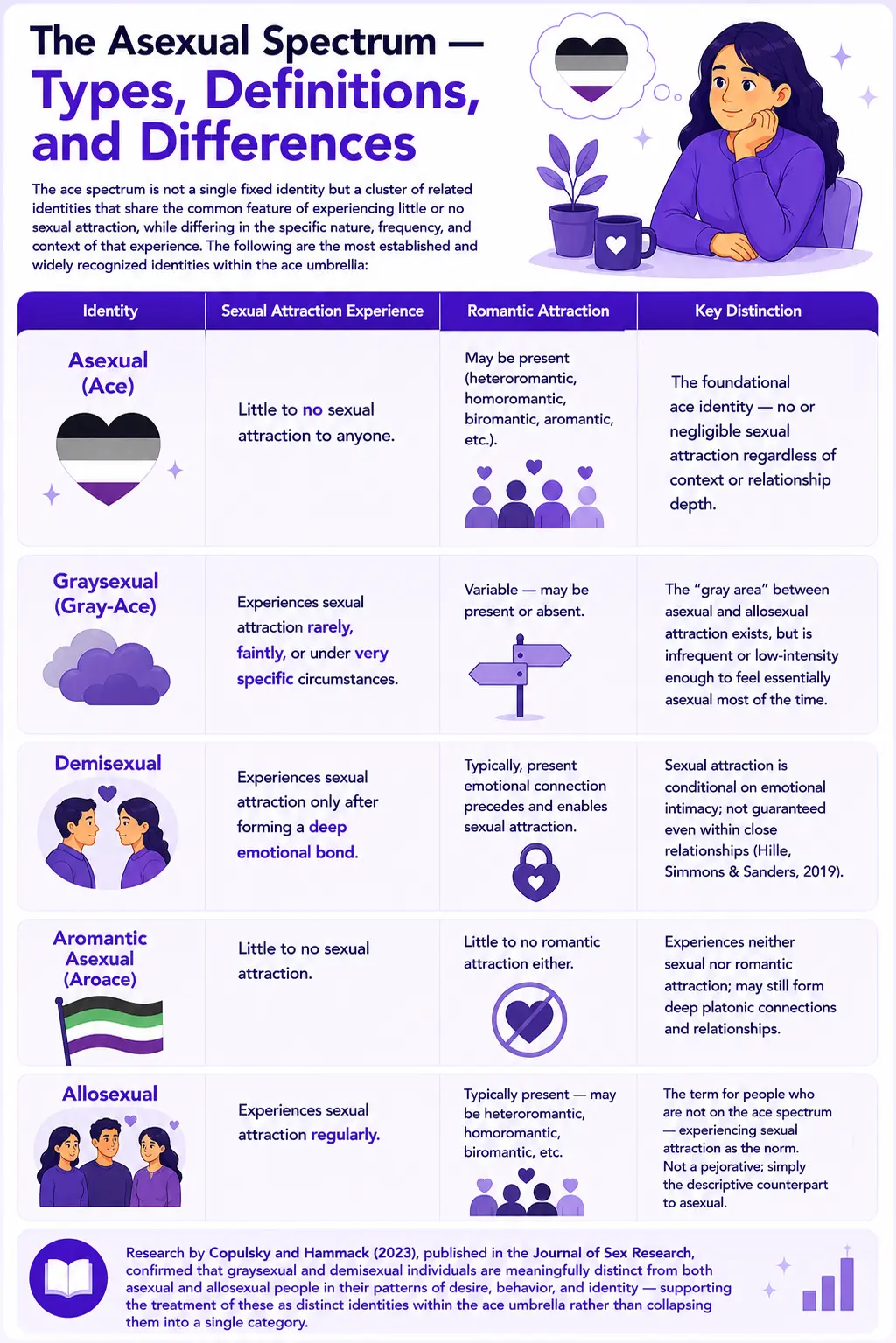
The ace spectrum is not a single fixed identity but a cluster of related identities that share the common feature of experiencing little or no sexual attraction, while differing in the specific nature, frequency, and context of that experience. The following are the most established and widely recognized identities within the ace umbrella:
| Identity | Sexual Attraction Experience | Romantic Attraction | Key Distinction |
|---|---|---|---|
| Asexual (Ace) | Little to no sexual attraction to anyone | May be present (heteroromantic, homoromantic, biromantic, aromantic, etc.) | The foundational ace identity — no or negligible sexual attraction regardless of context or relationship depth |
| Graysexual (Gray-Ace) | Experiences sexual attraction rarely, faintly, or under very specific circumstances | Variable — may be present or absent | The “gray area” between asexual and allosexual attraction exists, but is infrequent or low-intensity enough to feel essentially asexual most of the time |
| Demisexual | Experiences sexual attraction only after forming a deep emotional bond | Typically, present emotional connection precedes and enables sexual attraction | Sexual attraction is conditional on emotional intimacy; not guaranteed even within close relationships (Hille, Simmons & Sanders, 2019) |
| Aromantic Asexual (Aroace) | Little to no sexual attraction | Little to no romantic attraction either | Experiences neither sexual nor romantic attraction; may still form deep platonic connections and relationships |
| Allosexual | Experiences sexual attraction regularly | Typically present — may be heteroromantic, homoromantic, biromantic, etc. | The term for people who are not on the ace spectrum — experiencing sexual attraction as the norm. Not a pejorative; simply the descriptive counterpart to asexual. |
Research by Copulsky and Hammack (2023), published in the Journal of Sex Research, confirmed that graysexual and demisexual individuals are meaningfully distinct from both asexual and allosexual people in their patterns of desire, behavior, and identity — supporting the treatment of these as distinct identities within the ace umbrella rather than collapsing them into a single category.
Sexual Attraction vs Romantic Attraction — The Split-Attraction Model
One of the most important conceptual contributions from the ace community is the split-attraction model — the recognition that sexual and romantic attraction are distinct phenomena that can exist independently of each other. This model was developed largely within and for the ace community because asexual people, who frequently experience romantic attraction without sexual attraction, needed language to describe a reality that conventional models of sexual orientation couldn’t capture.
Under the split-attraction model, a person has both a sexual orientation (who they experience sexual attraction toward, if anyone) and a romantic orientation (who they experience romantic attraction toward, if anyone). For most allosexual people, these two orientations align — they want both sexual and romantic relationships with the same gender(s). For asexual people, the two frequently diverge: a person can be asexual and heteroromantic (no sexual attraction, but romantic attraction toward a different gender), or asexual and biromantic, or aromantic and allosexual.
According to Diamond’s (2003) theory of romantic attraction, romantic bond formation operates through a separate motivational system from sexual desire — a finding that aligns with the lived experience of asexual people who describe robust romantic attraction alongside absent sexual attraction (Brotto & Milani, 2022).
About This Asexuality Spectrum Test
This Asexuality Spectrum Test uses 15 questions to explore your experience of sexual attraction across the major domains that research and community knowledge have identified as most relevant to ace-spectrum identification: the presence or absence of sexual attraction, the contexts in which attraction might occur, the relationship between sexual and romantic attraction, your experience of sexual content and situations, and your sense of alignment with ace-spectrum identities.
Answer each question based on your honest, consistent experience — not your best day or worst day, and not how you think you “should” feel. The test is not a clinical diagnostic instrument and sexual orientation cannot be “diagnosed.” What it can do is provide a framework for understanding your own experience and language for what you may have been noticing for a long time.
Understanding Your Asexuality Spectrum Test Results
| Result | Identity | What It Suggests |
|---|---|---|
| Result A | Asexual (Ace) | Responses suggest little to no sexual attraction toward others. Your experience aligns with the core asexual identity on the ace spectrum. |
| Result B | Graysexual (Gray-Ace) | Responses suggest you experience sexual attraction rarely, infrequently, or under very specific conditions. You sit in the gray area between asexual and allosexual. |
| Result C | Demisexual | Responses suggest you experience sexual attraction only after forming a deep emotional connection. Emotional intimacy is a prerequisite for sexual desire. |
| Result D | Allosexual | Responses suggest you experience sexual attraction with regularity. Your orientation does not appear to fall on the ace spectrum based on your answers. |
What Causes Asexuality? What the Research Shows
Asexuality is not caused by trauma, medical conditions, medication side effects, or psychological patterns — at least not in most cases. The available research consistently supports asexuality as a genuine sexual orientation rather than a symptom or consequence of something else, although this distinction requires careful clinical assessment in individual cases.
Asexuality as a stable orientation. Research by Bogaert (2006) found that asexuality is distinguished from low sexual desire by its stability and ego-syntonic nature — asexual people generally do not experience their lack of attraction as a problem or a loss in the way that people with hypoactive sexual desire disorder typically do. This stability across time and context is one of the key features that distinguishes asexuality as an orientation from other presentations.
Biological factors. Some research has identified correlates of asexuality including hormonal differences, birth order effects, and physical health markers (Bogaert, 2004), though no single biological cause has been established. Bogaert’s (2004) national probability sample found that asexuality was associated with several factors including gender (more women than men), religiosity, and health variables — though these are correlates, not causes, and the relationship between biology and orientation remains an active area of research across all orientations.
What asexuality is not. The DSM-5-TR (APA, 2022) specifies that a diagnosis of Female Sexual Interest/Arousal Disorder or Male Hypoactive Sexual Desire Disorder is not made if the presentation is better explained by asexuality as a self-identified sexual orientation. This is a clinical acknowledgment that asexuality is a valid orientation, not a disorder. The key clinical distinction: a disorder involves personal distress about the condition; asexuality as an orientation typically does not produce distress about the orientation itself, though social stigma and invalidation can produce secondary distress.
Asexuality and neurodivergence. Research has documented higher rates of asexuality among autistic individuals compared to the general population (van der Miesen et al., 2018). This does not mean asexuality is caused by autism, or that asexual people are autistic — the majority of asexual people are not autistic, and the majority of autistic people are not asexual. It means there is a statistical association that is worth noting for individuals who may be exploring both identities. Both are valid, and both deserve to be understood on their own terms.
Asexuality, Mental Health, and Well-being
Asexuality itself is not a mental health condition and does not require treatment. However, people on the ace spectrum face specific challenges related to social stigma, identity invalidation, and navigating relationships in a predominantly allosexual world — and these challenges can have genuine mental health impacts.
Minority stress. The minority stress model, well-documented across LGBTQ+ populations, applies to ace-spectrum people as well. Experiencing your orientation as unrecognized, dismissed (“you just haven’t met the right person”), pathologized, or invisible produces a chronic low-level stress that accumulates over time and can contribute to anxiety, depression, and reduced wellbeing. The impact is not from the orientation itself but from the social context in which it is experienced.
Relationship navigation. Mixed-orientation relationships — where one partner is asexual, and the other is allosexual — require explicit communication and negotiation around sexual intimacy that allosexual couples may not need to address as directly. This is manageable, but it requires both partners to have the language and willingness to navigate it honestly. The AVEN community has extensive resources specifically for mixed-orientation relationship navigation.
Seeking support. If you are struggling with questions about your orientation — whether from internal confusion, relationship difficulty, or external pressure to be something you’re not — speaking with a therapist who is knowledgeable about asexuality and the ace spectrum is genuinely useful. Not all therapists are familiar with asexuality; explicitly asking about their experience with LGBTQ+ and ace-spectrum clients before beginning therapy is appropriate and recommended by AVEN.
Frequently Asked Questions
What is the difference between asexual and aromantic?
Asexuality refers to experiencing little or no sexual attraction. Aromanticism refers to experiencing little or no romantic attraction — the desire for romantic partnership, emotional intimacy in a specifically romantic context, and the experience of “falling in love.” These two dimensions are distinct and independent. A person can be asexual and still experience strong romantic attraction (an asexual heteroromantic person, for example, desires romantic partnership with people of a different gender but does not experience sexual attraction). A person can be aromantic and allosexual — experiencing sexual attraction regularly but not wanting romantic relationships. Aroace (aromantic asexual) describes people who experience neither. The split-attraction model, developed largely within the ace community, was designed to capture this independence.
Can asexual people still have sex or romantic relationships?
Yes. Asexuality describes the experience of sexual attraction (or its absence), not sexual behavior or relationship structure. Some asexual people do have sex — for a partner’s pleasure, out of curiosity, to conceive children, or to maintain a relationship — while others do not. Many asexual people form deeply meaningful romantic partnerships. Sexual behavior and orientation are distinct, and asexuality does not determine or preclude any particular relationship structure. What it does mean is that the motivation for sexual activity, when it occurs, is not driven by personal sexual attraction.
Is asexuality the same as having a low sex drive?
No — and this distinction is clinically important. A low sex drive (low libido) typically refers to reduced frequency or intensity of sexual desire and is often experienced as a change from a previous baseline, and frequently as distressing. Hypoactive Sexual Desire Disorder (HSDD) is a diagnosable condition specifically characterized by distress about low desire. Asexuality, by contrast, is an orientation — an enduring, stable absence of sexual attraction that is typically ego-syntonic (not experienced as a problem by the person). The DSM-5-TR explicitly excludes asexuality from the diagnostic criteria for sexual dysfunction disorders, recognizing that a person who identifies as asexual and is not distressed about their lack of sexual attraction does not have a disorder.
How do I know if I’m asexual or just haven’t met the right person?
This is one of the most common questions asked by people exploring ace-spectrum identity, and it doesn’t have a simple answer. A few considerations: if the absence of sexual attraction has been consistent across many relationships, many contexts, and many “right people” — if it’s not specific to circumstances but general — that pattern suggests orientation rather than situational circumstance. If you notice that the prospect of meeting someone “right” doesn’t change your expectation of experiencing sexual attraction, that’s also informative. Demisexuality is worth exploring if you do experience sexual attraction, but only after forming deep emotional bonds — in which case “the right person” isn’t about physical appearance or initial chemistry but about depth of connection. Ultimately, orientation is self-determined; the question isn’t whether you’ve found the right person but whether sexual attraction to anyone is part of your experience.
Is asexuality a recognized sexual orientation?
Yes. Asexuality is increasingly recognized by researchers, clinicians, and LGBTQ+ organizations as a valid sexual orientation. The DSM-5-TR (APA, 2022) acknowledges asexuality in its discussion of sexual dysfunction disorders by explicitly excluding self-identified asexual individuals from those diagnoses. Major research publications in sexology, including the Journal of Sex Research and Archives of Sexual Behavior, have published peer-reviewed research on asexuality for over two decades. Conservative research-based prevalence estimates place asexuality at approximately 1% of the general population (Bogaert, 2004; Rothblum et al., 2020), making it comparably prevalent to other sexual minority orientations.
What does “ace” mean?
“Ace” is a colloquial shorthand for “asexual” — derived from the phonetic pronunciation of the letter “A” in “asexual.” It’s used both as an identity label (“I’m ace”) and as an umbrella term for the whole ace spectrum, including graysexual, demisexual, aroace, and other related identities. The ace community, primarily organized through AVEN (Asexuality Visibility and Education Network) and related online spaces, uses “ace” broadly to describe membership in the asexual spectrum regardless of which specific identity within it a person holds.
Can asexuality change over time?
Sexual orientation in general, including asexuality, can have a fluid dimension — some people’s experience of attraction shifts over time, while others’ remains stable throughout their life. Research on sexual fluidity (Diamond, 2008) found that this fluidity is more commonly reported by women than men across orientations, and it applies to ace-spectrum orientations as well. Importantly, fluidity is not the same as “growing out of it” — the idea that asexual people simply haven’t met the right person yet, or will eventually develop sexual attraction, is not supported by research and can be invalidating. Some people do identify as asexual at one point and later experience sexual attraction; others remain asexual throughout their lives. Both patterns are valid.
Related Tests
If you’re exploring your orientation and identity, these are the most relevant companion assessments:
- Kinsey Scale Test — the foundational sexual orientation spectrum test; useful for understanding where you fall between heterosexual and homosexual, including the rarely-discussed implications for asexual people
- LGBTQ+ Test — broad sexual orientation and gender identity exploration covering the full spectrum of LGBTQ+ identities
- What Type of Lesbian Am I? — relevant if you experience romantic attraction toward women alongside asexual or graysexual orientation
- Gay Test — for men exploring orientation alongside ace-spectrum identity
- Gender Dysphoria Test — research documents elevated rates of gender-diverse identities among ace-spectrum people; worth exploring if gender identity questions are also present
- Am I Straight Quiz — for those questioning whether their orientation is more complex than assumed
- Anxiety Test — minority stress and identity invalidation can contribute to anxiety; worth assessing if you’ve experienced distress related to your orientation
- Clinical Depression Test — similarly, depression related to social stigma and invalidation is worth screening for separately from orientation questions
For more sexual orientation and gender identity tests, visit our Sexual Orientation & Gender Identity collection.
References
- Bogaert, A.F. (2004). Asexuality: Prevalence and associated factors in a national probability sample. Journal of Sex Research, 41(3), 279–287. doi.org/10.1080/00224490409552235
- Bogaert, A.F. (2006). Toward a conceptual understanding of asexuality. Review of General Psychology, 10(3), 241–250. doi.org/10.1037/1089-2680.10.3.241
- Copulsky, D., & Hammack, P.L. (2023). Asexuality, graysexuality, and demisexuality: Distinctions in desire, behavior, and identity. Journal of Sex Research, 60(2), 221–230. doi.org/10.1080/00224499.2021.2012113
- Ginoza, M., & Miller, T. (2014). The 2014 AVEN Community Census: Preliminary Findings. AVEN. asexualcensus.files.wordpress.com
- Hille, J.J., Simmons, M.K., & Sanders, S.A. (2019). “Sex” and the ace spectrum: Definitions of sex, behavioral histories, and future interest for individuals who identify as asexual, graysexual, or demisexual. Journal of Sex Research, 57(7), 813–823. doi.org/10.1080/00224499.2019.1689378
- Brotto, L.A., & Milani, M. (2022). Asexuality: When sexual attraction is lacking. In L.A. Brotto (Ed.), Better Sex Through Mindfulness. University of British Columbia. med-fom-brotto.sites.olt.ubc.ca
- Diamond, L.M. (2003). What does sexual orientation orient? A biobehavioral model distinguishing romantic love and sexual desire. Psychological Review, 110(1), 173–192. doi.org/10.1037/0033-295X.110.1.173
- Rothblum, E., Krueger, E.A., Kittle, K.R., & Meyer, I.H. (2020). Asexual and non-asexual respondents from a U.S. population-based study of sexual minorities. Archives of Sexual Behavior, 49(2), 757–767. doi.org/10.1007/s10508-019-01485-0
- Asexuality Visibility and Education Network (AVEN). (2023). About Asexuality. asexuality.org
- American Psychiatric Association. (2022). Diagnostic and Statistical Manual of Mental Disorders, Fifth Edition, Text Revision (DSM-5-TR). APA. psychiatry.org
- Wikipedia. (2025). Asexuality. en.wikipedia.org
Related Tests
See All Quiz →
Sexual Orientation & Gender Identity
Am I Straight? Take This 15-Item Quiz and Explore Your Identity
→

You may also like
See All Quiz →
Emotional and Trait Assessments · Personality
Introvert Test: Are You an Introvert, Extrovert, or Ambivert?
→